
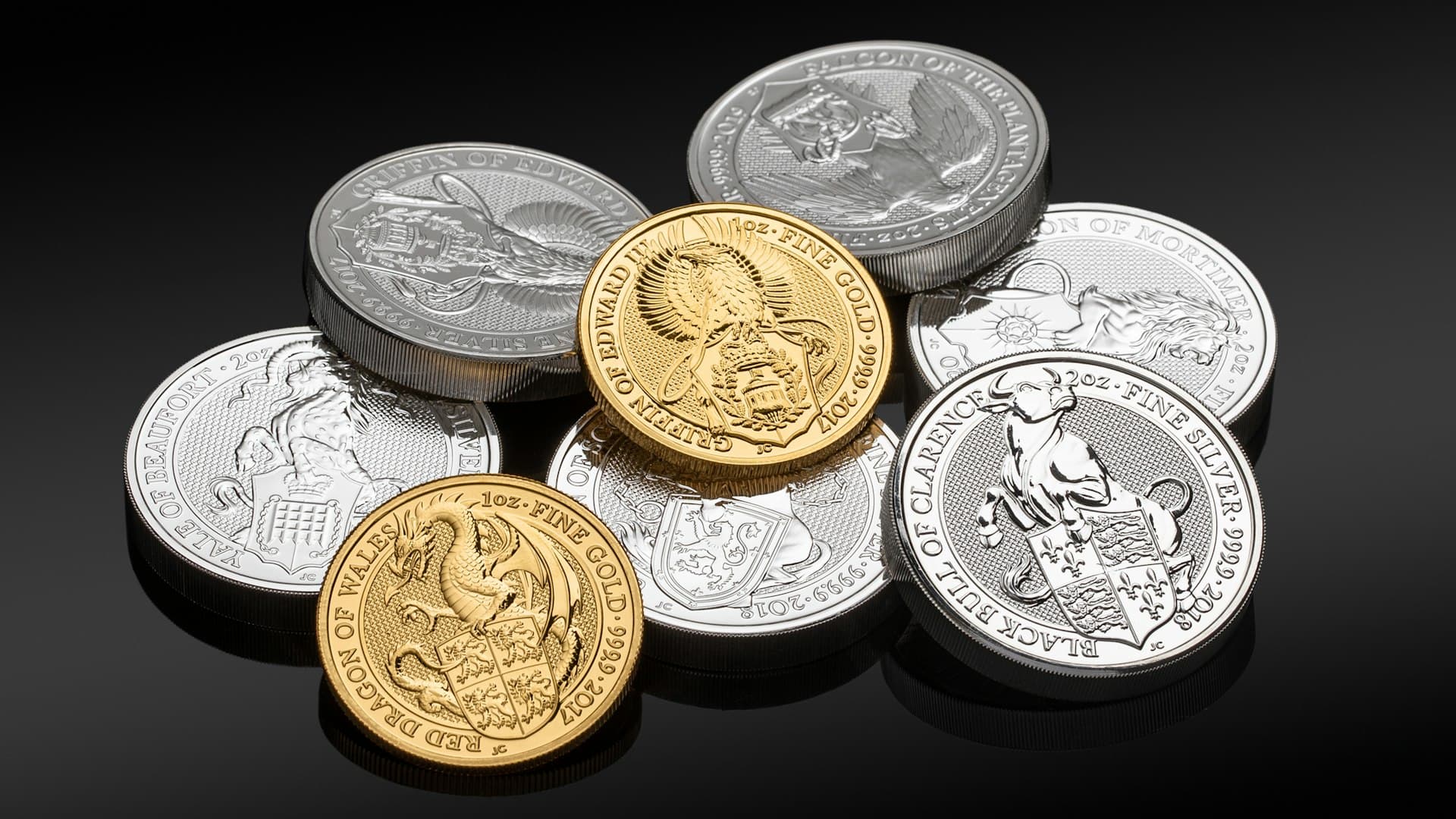
Two metals, chosen independently by societies that had no contact with each other, across thousands of years. Not shells everywhere, not cattle everywhere, but gold and silver arriving repeatedly at the top of the hierarchy in Mesopotamia, in China, in the Mediterranean, in the Americas.
That convergence is the interesting thing. It suggests the choice was not arbitrary or cultural but driven by constraints, and that different people solving the same problem kept finding the same answer.
The usual explanations, that gold is pretty or rare, do not survive much scrutiny. Plenty of things are pretty. Plenty of things are rare, including things nobody ever used as money. The real answer is a set of unglamorous practical tests, and gold and silver happened to be almost the only substances available to pre-industrial people that passed all of them simultaneously.
What problem was money invented to solve?
The standard account starts with barter and its central difficulty: the double coincidence of wants.
To trade directly, you need someone who has what you want and wants what you have, at the same time, in quantities that match. A baker who needs shoes must find a shoemaker who happens to want bread, today, in roughly the amount of bread that a pair of shoes is worth. Each additional condition makes the transaction less likely, and the conditions multiply.
Money breaks the problem into two halves. Sell bread to anyone who wants bread, receive money, buy shoes from anyone selling shoes. Neither party needs to want what the other produces. The market stops being a search problem and becomes two independent transactions.
It is worth noting that anthropologists, notably David Graeber, have argued that pure barter economies of the textbook kind were rare, and that credit and obligation systems often preceded coinage. That critique has real force and is worth knowing. But it does not change the analysis of what makes a good medium of exchange once one is being used, which is the question here.
Money does not need to be valuable in itself. It needs to be the thing everyone is confident everyone else will accept.
The five tests a money has to pass
Anything serving as money has to survive practical use, and five properties determine whether it can.
Durability. It must survive storage and handling. Anything that rots, rusts or breaks cannot store value across time, and storing value across time is half the job.
Divisibility. It must split into smaller units without losing proportional value. Half a cow is not worth half a cow in any useful sense, which rules cattle out for anything but large transactions.
Portability. Meaningful value must be movable by one person. If settling a debt requires a cart, the money is limiting trade rather than enabling it.
Uniformity. One unit must be interchangeable with another. If every unit needs individual assessment, every transaction includes a negotiation about the money itself.
Scarcity. Supply must be limited and hard to expand quickly. Anything easily produced gets produced until it is worthless, and the people producing it capture the value everyone else loses.
| Candidate | Durable | Divisible | Portable | Uniform | Scarce |
|---|---|---|---|---|---|
| Cattle | No | No | No | No | Yes |
| Grain | No | Yes | Poor | Roughly | Seasonal |
| Salt | Fair | Yes | Poor | Yes | Locally |
| Shells | Yes | No | Yes | Roughly | Until found in bulk |
| Iron | No, rusts | Yes | Poor | Yes | No |
| Silver | Yes | Yes | Yes | Yes | Yes |
| Gold | Yes | Yes | Very | Yes | Very |
The pattern in that table is the whole story. Nearly everything fails at least one test badly, and failing one test badly is enough to disqualify a money, because the failure shows up in every single transaction.
Why did gold and silver pass when nothing else did?
Gold's durability is close to absolute. It does not rust, tarnish or corrode in air or water. Gold recovered from ancient shipwrecks emerges essentially unchanged. For a substance whose job includes storing value across generations, this is not a minor advantage. Most metals available to pre-industrial societies degraded, which quietly ruled them out.
Both metals divide cleanly. They can be melted, split and recombined without loss, so a large amount can become many small amounts and back again. Value is proportional to weight, which means arithmetic works.
Both carry high value in small mass, which solves portability. A quantity of gold worth a year's income fits in a hand. This is what made long-distance trade possible before modern transport, because the money could travel with the merchant.
Both are chemically simple elements, so a unit of pure gold is identical to any other. Purity can be tested, which is what assaying and hallmarking exist to do, and once tested, uniformity is genuine rather than approximate.
And both are genuinely hard to obtain. Not impossible, but requiring real effort at real cost. Supply grew slowly because mining was difficult, which meant no one could inflate the money supply by deciding to.
One underrated factor: gold's uselessness for anything else. Iron makes tools and weapons, so iron used as money is iron not used for ploughs. Gold is too soft for tools. Its lack of industrial application meant using it as money cost the society nothing in foregone production, which is a strange kind of advantage but a real one.
How this is taught inside Astra Trainer
This is the opening course of the Money Systems direction in the Business & Finance world, taught in five steps: why gold and silver rose to money, metal money and credit, from money to asset, gold as an asset, and a closing challenge.
It sits first for a reason. Everything later in the twenty-course direction, how banks create money from credit, how the Federal Reserve operates, makes far more sense once you have seen what money had to do before institutions existed to do it. Lessons take about five minutes and a guide walks you through anything strange.
Why two metals rather than one?
Because one metal could not cover the whole range of transactions.
Gold's high value per unit weight, so useful for large payments, makes it impractical for small ones. A gold coin small enough to buy a loaf of bread would be too small to handle or to see. Silver, worth considerably less per unit weight, produced coins of a sensible size for everyday trade.
So many societies ran both: gold for large transactions, stored wealth and international settlement, silver for daily commerce. Copper often sat below silver for the smallest payments, giving a three-tier system in which each metal handled the range of values it suited.
This created a persistent difficulty known as bimetallism. If a currency is defined in terms of both metals at a fixed ratio, and the market ratio between them moves, the metal that becomes undervalued at the official rate disappears from circulation. People spend the overvalued metal and hoard the undervalued one, which is the mechanism behind Gresham's law, usually summarised as bad money driving out good.
Managing this was a recurring headache for monetary authorities for centuries, and it is one of the reasons systems eventually converged on a single standard.
How did credit change the game?
This is the pivot, and it is where the story stops being about metal.
Carrying gold is safe in a strongbox and dangerous on a road. So institutions emerged that would hold metal on deposit and issue a receipt, a paper claim promising the bearer a stated quantity of metal.
Then something decisive happened. The receipts started circulating instead of the metal. If a receipt is reliably redeemable, and everyone believes it is, paying with the receipt is easier than retrieving and transporting the metal. The claim became the money, and the metal sat still.
Once that was true, the people holding the metal noticed that redemptions were a small fraction of deposits on any given day. Most receipts simply circulated. Which meant more receipts could be issued than there was metal to back them, and as long as confidence held, nobody would discover it.
This is the origin of fractional reserve banking, and it is where the modern system begins. The money supply became a function of credit issuance rather than of metal stocks. The link to metal persisted as a promise and a constraint, but the actual circulating money was already claims rather than substance.
The vulnerability this created. A system in which claims exceed the metal behind them works while confidence holds and fails immediately when it does not. If enough holders demand redemption simultaneously, the promises cannot all be kept, regardless of whether the institution is otherwise sound. Bank runs are not a malfunction of this arrangement. They are the arrangement's structural weak point, and every subsequent piece of banking regulation is in some sense a response to it.
Why did the link to gold eventually break?
Because the property that made gold excellent money, its fixed and slowly growing supply, became a constraint on economies that needed money supply to respond to conditions.
Under a strict gold standard, money supply is tied to gold stocks. An economy growing faster than its gold supply faces downward pressure on prices, which sounds pleasant and is not, because falling prices raise the real burden of existing debts and encourage people to postpone spending. Meanwhile, a central bank facing a crisis cannot expand liquidity beyond what its gold reserves allow, precisely when expansion is what a crisis calls for.
These pressures came to a head repeatedly. Countries suspended convertibility during wars, when spending needs exceeded gold. The interwar attempt to restore the gold standard is widely argued to have deepened the Great Depression by preventing monetary response. The Bretton Woods system after 1944 kept an indirect link, with the dollar convertible to gold and other currencies pegged to the dollar, until the United States ended convertibility in 1971.
Since then the major currencies have been fiat, meaning they are money because of law and confidence rather than because of metal backing. The trade is explicit: flexibility to respond to conditions, in exchange for relying on institutional discipline rather than a physical constraint. Whether that trade was worth making is a genuine and continuing argument among economists, and anyone claiming it is obviously settled in either direction is overstating.
Locking in a long chain of reasoning
Five properties, two metals, a shift from substance to claims, and a century of arguments about whether breaking the link was wise. That is a lot of structure to keep straight from one read.
The Business & Finance world drills it rather than presenting it once. Quizzes follow each topic and each course closes with a ten-question final exam. The daily Connections round and the 10x10 crossword are generated from that world's own lessons, so terms like supply, demand, liquidity and ledger return as practice with a fresh round every day. There is a Gold & Silver Challenge at the end of this particular course, and a Circle if you would rather work through it with a small group holding a shared weekly goal.
Do precious metals still do anything?
They no longer serve as money in any major economy. Nobody prices goods in gold or settles ordinary transactions with silver, and the properties that mattered for a medium of exchange are irrelevant when payment is electronic.
What gold retained is a role as an asset, which is a different job. Central banks still hold substantial reserves of it. It is traded as a store of value, particularly during periods of currency instability or inflation concern, and it has some industrial and jewellery demand underneath.
The case for holding it rests on the same scarcity that once made it good money: supply cannot be expanded by decision, so it cannot be inflated away by policy. The case against is that it produces no income, costs money to store and insure, and has been volatile enough over meaningful periods that its reputation as a safe store of value is more complicated than the reputation suggests.
This article is not investment advice and takes no position on whether anyone should own any. The point worth carrying is structural: gold moved from being money to being an asset, and those are genuinely different functions with different logic. Confusing them produces a lot of bad argument in both directions.
What to take from this
Money is a technology for avoiding the search problem in barter, and like any technology it has performance requirements.
Five properties decide what can do the job. Gold and silver passed all five simultaneously, which is why unconnected societies kept arriving at the same answer independently.
Credit changed everything. Once claims circulated more conveniently than metal, the metal became backing rather than money, and the money supply became a function of credit rather than of mining.
And the final break was a trade, not an accident. Fixed supply is a virtue when you want restraint and a defect when you need response, and the modern system chose response while accepting dependence on institutional discipline.
No finance background is needed for any of this, and none of it is investment advice. It is the history that explains why the money in your account is a number rather than a metal, and why that number can change in ways a mine never could.
Why not just use something more common than gold?
Because scarcity is one of the five requirements. Anything easily produced gets produced until its value collapses, and whoever produces it captures value from everyone holding it. Abundance disqualifies a money regardless of how well it performs on the other tests.
Was money really invented to replace barter?
The barter story is the standard economic account and it is useful for explaining what a medium of exchange does. Anthropologists including David Graeber have argued that credit and obligation systems often came first and that pure barter economies were rarer than the textbook implies. Both can be true: the critique is about history, the framework is about function.
Is fiat money backed by nothing?
It is not backed by a commodity. It is supported by legal tender status, by the state's requirement that taxes be paid in it, and by confidence in the issuing institutions. Whether that is sufficient is exactly the argument between advocates of hard money and of flexible money, and it remains live.
Could gold ever return as money?
Technically possible, practically very difficult. Existing gold stocks are small relative to the size of modern economies, so a return would require either extreme deflation or revaluing gold enormously, and it would remove the ability to respond to crises with liquidity. Most economists regard the costs as prohibitive, though the position is not unanimous.
Where can I learn this properly?
The Money Systems direction inside the Business & Finance world of Astra Trainer opens with this exact course and runs to twenty courses covering credit, banking and central bank operations. Lessons take about five minutes and the first needs no card. You can see what is inside the world here.