
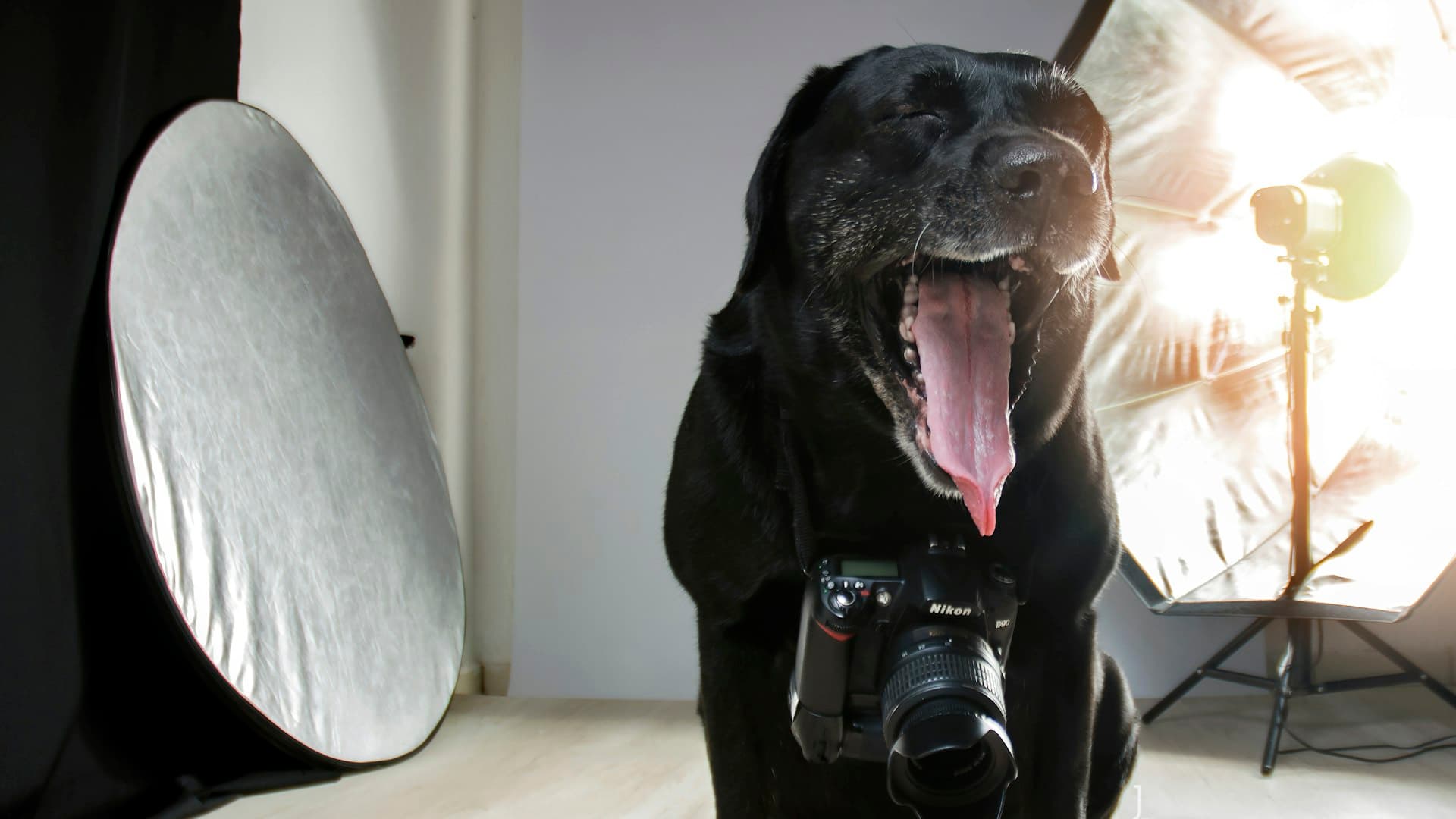
Your dog does something funny, you post it, and it does considerably better than anything else on your account. Someone comments that you should start a page for him.
So the question arrives: is there actually money in this, and how does it work.
There is, the mechanics are more varied than they look from outside, and there is one thing that has to be settled before any of it.
The thing that has to come first
The animal does not get a say in this, which means the responsibility sits entirely with you.
A few things follow from that, and they are not caveats to be skimmed past.
A dog that does not enjoy being filmed should not be filmed. The signals are readable: turning away, lip licking, yawning out of context, moving off, refusing to engage. A dog doing those while you hold a camera is telling you something.
Costumes, props and staged situations are not automatically fine. Some dogs genuinely do not mind. Many tolerate rather than enjoy, and tolerance is not consent.
Do not manufacture distress for content. Reaction videos that rely on startling, frustrating or confusing an animal perform well and are a straightforward welfare problem.
Do not let a schedule drive it. The point at which you need a video today and the dog is not interested is the point where this starts going wrong.
If the account requires the dog to do things the dog does not want to do, the account is the problem rather than the dog.
The commercially useful version of this is also the ethically right one: accounts built around a dog genuinely enjoying itself last longer, because the content stays easy to make.
Why follower count is the wrong target
The assumption is that income scales with followers and that you need a large number before anything happens. Both are roughly wrong.
What brands actually assess: engagement rate, meaning the proportion of your audience that interacts rather than the total; niche relevance, meaning whether your audience is actually dog owners; content quality, meaning whether they can use what you produce; and reliability, meaning whether you deliver on time and follow the brief.
A ten thousand follower account with eight percent engagement and an audience of genuine dog owners is more useful to a pet brand than a hundred thousand follower account with one percent engagement and a general audience, and is frequently paid comparably.
This is the part the Petfluencer direction's own description points at: turning the account into a business without a huge following. Not by pretending size does not help, but because size is not the gate people assume.
The five income streams, and which arrives first
| Stream | What it is | Typically starts at |
|---|---|---|
| UGC | Making content brands use on their own channels | Very small followings, sometimes none |
| Affiliate | Commission on sales through your links | Any size, scales slowly |
| Brand partnerships | Paid posts on your account | Usually 5,000 upward, varies widely |
| Platform payouts | Revenue share from the platform | Threshold-dependent, unreliable |
| Own products | Merchandise, digital products, services | Needs a genuinely engaged audience |
Brand partnerships are the visible one, which is why everyone assumes they are the entry point. They are usually not, because they require a brand to want access to your specific audience.
Affiliate income is slow and compounds. It works best when recommendations are genuine and specific, because generic affiliate spam converts poorly and damages trust.
Platform payouts are the least reliable. Programmes change, thresholds move, rates fall. Worth taking and not worth building on.
Own products require an audience that trusts you, which takes time, and they carry actual business overheads.
And then the one most people have never considered.
UGC: the one most people have never heard of
User-generated content work means being paid to produce content that the brand posts on their own channels. Your account is not where it runs. You are being hired as a small production service.
Why this matters for anyone starting out: the brand is buying content, not audience. Which means follower count is close to irrelevant. What matters is whether you can produce good footage of a dog, reliably, to a brief.
This is genuinely accessible. People do UGC work with a few hundred followers, and some do it with essentially no public account at all, because the deliverable is footage rather than reach.
What it requires: decent lighting and stable footage, a dog that is comfortable being filmed, the ability to follow a brief, and delivering when you said you would. The last one is more of a differentiator than people expect.
It is also lower risk for your own audience, since you are not repeatedly posting sponsored content to people who followed you for a dog.
How this is taught inside Astra Trainer
This is the whole subject of the Petfluencer direction in the Dogs world: make your pet the main character, film moments platforms reward, and turn the account into a business through UGC, brand deals and income streams, without a huge following.
It is the newest and smallest direction in this world at four courses, and it is the only one that is commercial rather than about the animal itself. Worth noting that it sits alongside Dog language, which is where the welfare side lives, and the two are genuinely connected: reading your dog accurately is what tells you whether the filming is working for them. Lessons take about five minutes and a guide walks you through anything strange.
A worked example: two accounts, same size
Two accounts, both around twelve thousand followers, both a year old.
Account one chases reach. Posts whatever is trending, uses popular audio, makes the dog do the current format. Follower count grew quickly. Engagement rate sits around one and a half percent, because the audience arrived for trends rather than for this dog.
She pitches brands and hears very little back. The two deals she lands are gifted products rather than paid, which means free food in exchange for posts. She concludes the market is saturated.
Meanwhile the dog is doing a lot of things he does not obviously enjoy, because the formats demand it.
Account two builds a specific audience. Posts about one thing: life with a reactive dog, honestly, including the difficult parts. Growth was much slower. Engagement sits around seven percent, and the comments are conversations rather than emojis.
Her first income was UGC, at around four thousand followers, filming product footage for a harness company that found her through a hashtag. That paid a few hundred for a day's work and repeated three times.
By month ten she has two affiliate relationships with products she genuinely uses, which produce a small but steady monthly amount, and one paid partnership with a calming-supplement brand who approached her specifically because her audience is people with anxious dogs.
Same follower count. Quite different position, and the difference is that her audience is defined by a shared situation rather than by a format.
The dog, incidentally, is filmed doing ordinary things, because the content is about the situation rather than about tricks.
Gifted is not paid. A great many early approaches offer free product in exchange for posts. That is a reasonable trade occasionally, for something you would have bought anyway. It is not income, and brands that only ever offer gifting are frequently testing whether you will work for free indefinitely. It is fine to reply asking whether there is a paid budget. The worst outcome is that they say no.
What the numbers realistically look like
Being straight about this, because the visible examples are the outliers.
The accounts you have heard of are the extreme tail of the distribution, in the way that visible successes always are. Most pet accounts earning anything are earning supplementary income rather than a living: a few hundred a month, irregular, alongside other work.
Rates vary enormously by market, platform and niche, which is why specific figures in an article are usually unreliable by the time you read them. What is more stable is the shape: UGC is typically paid per deliverable and can be reasonable for the time involved; brand partnerships scale with engagement and audience fit rather than followers alone; affiliate income is small per sale and depends entirely on genuine recommendation.
Timeline is similarly worth being honest about. Most accounts that reach any income take a year or more to get there, and a majority never do. That is not a discouragement, it is the base rate, and knowing it prevents the sense of failure at month four that causes most people to stop.
Treat it as something that might become supplementary income over a year or two, and the whole thing becomes considerably more pleasant.
The rules you are legally required to follow
This is not optional and it is frequently ignored by people who do not realise it applies to them.
Paid partnerships must be disclosed clearly. In most markets, including the UK and the US, advertising regulators require that content you were paid or gifted for is identifiable as advertising. The disclosure must be visible without clicking more, and near the start rather than buried in hashtags.
Gifted products count. Receiving a free item in exchange for a post is a commercial relationship and generally requires disclosure, even without money changing hands.
Affiliate links require disclosure too. If you earn commission, say so.
Do not make claims you cannot support. Health and behaviour claims about products are the risky area. Saying a supplement cured a condition is a claim, and in some jurisdictions an actionable one.
The specifics vary by country and change, so check your own market's regulator rather than relying on an article. The general principle is stable: if you were paid or given something, say so plainly.
Why the dog-reading skills matter here too
The most useful thing you can bring to this is the ability to tell whether your dog is actually enjoying the process, which is not a media skill.
The Dogs world puts Petfluencer alongside Dog language for that reason. Twelve courses on reading posture and stress cues, and the daily Connections round drills that vocabulary, yawning, licking, turning, sniffing, alongside the nutrition and training sets. Quizzes follow each topic and each course ends with a ten-question final exam. Daily quests, points and a streak keep five-minute lessons running, with a streak shield for the day that goes wrong.
A Circle gives you a small group with a shared weekly goal and live sessions, which for this material is useful in an unglamorous way: other people will tell you when a video looks like the dog is not enjoying it, which is very hard to see in your own footage.
What actually makes an account work
One specific thing. Not a general dog account. A particular dog in a particular situation: a reactive dog, a senior dog, a working breed in a flat, a rescue's first year. Specificity is what gives people a reason to follow rather than to watch once.
Consistency over volume. A sustainable rhythm you can hold for a year beats an intense month. This is the same finding as everywhere else.
Content that is genuinely easy to make. If each post requires elaborate setup, you will stop, and the dog will bear the cost of the effort in the meantime. Accounts built on ordinary moments outlast accounts built on productions.
Actual engagement. Replying to comments, being a person. This is what produces the engagement rate that brands assess.
Honesty. Accounts that show the difficult parts tend to build more committed audiences than accounts that show only charm, and they are also far easier to sustain, because you are not maintaining a fiction.
What to take from this
The animal comes first. If the content requires the dog to do things it does not want to do, stop.
Follower count is the wrong target. Engagement rate, niche relevance and reliability are what brands assess.
UGC usually arrives before brand deals and is accessible at very small followings, because you are selling content rather than audience.
Disclose paid and gifted content clearly. It is a legal requirement in most markets and it is routinely ignored by people who do not know it applies.
And hold realistic expectations. Supplementary income over a year or two is the normal good outcome, and treating it that way makes the whole thing sustainable rather than disappointing.
How many followers do I need before brands will work with me?
For UGC, potentially none, because the brand is buying content rather than reach. For partnerships on your own account, it varies widely and engagement rate and audience fit matter more than a threshold number.
Is it exploitative to make money from my dog?
It depends entirely on whether the dog is being asked to do things it does not want to do. A dog filmed doing ordinary things it enjoys is not being exploited. A dog repeatedly put in costumes or staged situations it visibly dislikes is a different matter, and the signals are readable.
Do I have to say a post is an ad?
Yes, in most markets, including for gifted products with no money involved. The disclosure needs to be clear and visible without clicking through. Check your own country's advertising regulator, since the specifics vary.
How long before an account earns anything?
Typically a year or more for accounts that earn at all, and a majority never do. Knowing that base rate is useful, because month four is where most people conclude it is not working when in fact nothing unusual is happening.
Where can I learn this systematically?
The Petfluencer direction inside the Dogs world of Astra Trainer runs to four courses on filming moments platforms reward and turning an account into a business through UGC and brand deals. Lessons take about five minutes and the first needs no card. You can see what is inside the world here.