
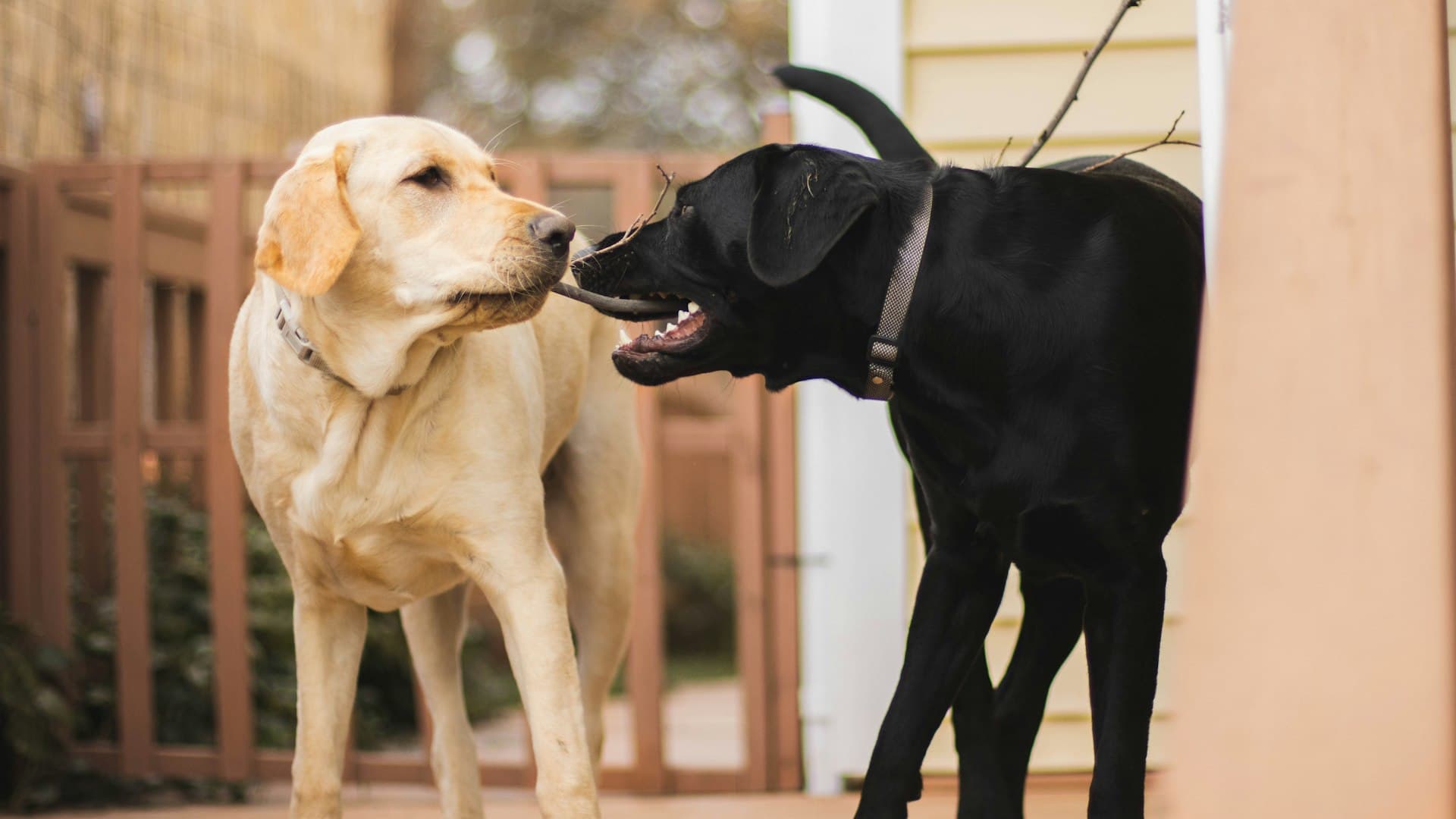
Two owners meet on a path. The dogs pull toward each other. The leads go tight and tangle. The owners say something apologetic while the dogs are nose to nose and the leads are crossed.
Ten seconds later something has gone slightly wrong, and nobody is quite sure what.
This is the most common social situation dogs encounter, it is the one we manage worst, and almost all of the problem is on the human end of the lead.
What a good greeting looks like
Brief, curved, and over quickly.
Two dogs meeting well approach at an angle rather than head-on. They sniff, usually rear ends rather than faces, for a few seconds. Bodies stay loose. Then both disengage and move on, or the interaction converts into play, which is a different thing with its own signals.
The whole exchange frequently takes under five seconds.
A good greeting is short and ends with both dogs walking away. A long greeting is not a friendly one, it is one that has not resolved.
What it does not look like: a prolonged nose-to-nose standoff, one dog looming over the other, stiff bodies, or one dog persistently following a dog that is trying to move away.
Why dogs approach in curves
Left to themselves, dogs rarely walk directly at each other. They arc.
The curved approach appears to serve a social function: a direct frontal approach is confrontational in dog terms, and curving signals non-threatening intent. Turid Rugaas included curving in her description of calming signals, and whether or not it is deliberate communication, the pattern is easy to observe in dogs meeting off-lead in open space.
Two practical consequences follow.
We force head-on approaches constantly. Two people on a path walk directly toward each other, which means the dogs do too. That is the socially rudest possible configuration and we set it up by default.
Narrow spaces remove the option. Corridors, doorways, narrow paths and car parks all prevent curving. A high proportion of greeting problems happen in exactly those places.
The fix is simple and looks slightly odd: arc outward as you approach another dog, giving your dog the space to curve. Most people find this makes a noticeable difference within a week.
The three second rule
A useful default: allow about three seconds of greeting, then move on.
The reasoning is that most of what dogs need from a greeting happens fast. Beyond a few seconds, arousal builds, one dog frequently becomes uncomfortable, and the interaction has to resolve somehow.
Practically: let them approach, count three, then cheerfully move away with your dog. If both dogs are loose and clearly want more, you can allow more. The default is short.
This also sidesteps the most common problem, which is that owners stand still and chat while the dogs are left to manage an open-ended social situation on tight leads with no way to leave.
How this is taught inside Astra Trainer
Reading dog-to-dog signals in real moments sits at the centre of the Dog language direction in the Dogs world, twelve courses on posture, stress cues and telling ordinary calm from something escalating.
Greetings are where most owners encounter this material for the first time, because it is the situation that happens several times a walk and where the consequences of misreading show up immediately. The vocabulary the direction drills, including the yawning, licking, turning and sniffing set that appears in this world's daily Connections round, is exactly what you need to read a greeting accurately. Lessons take about five minutes and a guide walks you through anything strange.
Why leads make greetings worse
This is the mechanism behind most on-lead greeting problems, and it is worth understanding properly.
Dogs regulate social interactions primarily through movement: approaching, retreating, circling, turning away, increasing distance. A lead removes most of that.
Three specific effects.
Retreat is unavailable. A dog that becomes uncomfortable cannot back off. Its main de-escalation option has been removed, which leaves fewer and worse choices.
Curving is prevented. On a short lead beside a person, a dog cannot arc. It is held in the frontal approach.
Tension travels down the lead. A tight lead changes the dog's posture, pulling the head up and the body forward, which is a configuration that reads as confrontational to the other dog. It also communicates the handler's anxiety directly.
This is the explanation for a phenomenon most owners have noticed: dogs who are fine off-lead and difficult on-lead. Frequently the lead is causing the difference rather than revealing something about the dog.
It does not mean letting dogs off-lead to greet, which is not appropriate in most public situations. It means keeping the lead loose during greetings, keeping them short, and not walking dogs directly into each other.
A worked example: the same two dogs, twice
Two dogs, neither with any behaviour problem, meeting on the same path a week apart.
First meeting. Both owners spot each other and continue walking directly toward one another on a narrow pavement. Both leads are short. The dogs reach each other head-on and go straight to nose-to-nose contact.
The owners stop and begin talking. Twenty seconds pass. The leads cross as the dogs move around each other.
One dog turns his head away and licks his lips. His owner, unaware, keeps chatting. The lead prevents him moving back. The other dog, still engaged, moves closer and puts his head over the first dog's shoulders.
The first dog snaps. Nothing connects, both owners pull the dogs apart, and both leave believing one of the dogs is reactive.
Second meeting, same dogs. One owner spots the other and steps off to the side, arcing outward. The other, seeing this, does the same. The dogs approach at an angle on loose leads.
They sniff, briefly, rear ends rather than faces. Three seconds. Then one owner says "let's go" cheerfully and walks on. The other does the same.
Both dogs walk away loose. Nothing happened, which is the correct outcome.
The difference between the two is entirely human behaviour: approach angle, lead tension, duration, and whether the owners stopped to talk. The dogs were the same dogs.
The snap was not the start. In the first meeting, the dog gave a head turn and a lip lick, which is a request for space, several seconds before anything happened. Because he could not retreat and nobody noticed the signal, the next available option was a louder one. Most on-lead greeting incidents follow this shape, and the useful conclusion is not that the dog is reactive but that his early signals were unavailable to him and invisible to everyone else.
What the humans are doing wrong
Five things, all common and all fixable.
Walking straight at each other. Covered above and the easiest to fix.
Tight leads. Frequently tightened precisely because the owner is anxious about the greeting, which makes the greeting worse, which confirms the anxiety.
Stopping to talk. The single biggest contributor. An open-ended greeting with no exit while two humans have a conversation is a situation the dogs have to resolve themselves.
Forcing it. Insisting dogs greet, or dragging a reluctant dog forward because it would be rude not to. Dogs do not owe each other greetings.
Missing the early signals. The head turn, the lip lick, the attempt to move behind you. These arrive well before anything else and are routinely overlooked.
Greetings that should not happen at all
Worth saying plainly: most dogs do not need to greet most dogs, and a great deal of stress is created by the assumption that they do.
Situations where the answer is simply to pass by:
Either dog is on a lead in a narrow space with no room to curve. Either dog is showing tension before contact. Either dog is eating, carrying something valued, or resting. One dog is much larger and the smaller one seems uncertain. Either owner is uncomfortable. Either dog is wearing something indicating they need space, which in many countries includes yellow leads or harnesses marked accordingly.
And one worth knowing: if the other owner says their dog needs space, take it seriously immediately and move away without discussion. That person is managing something and the polite response is distance rather than reassurance about how friendly your dog is.
Passing another dog calmly without interaction is a completely successful outcome, and for many dogs it is a better one than greeting.
Why this becomes automatic with practice
Everything here is simple to understand and takes repetition to do without thinking, because greetings happen quickly and usually while you are mid-conversation or mid-thought.
The Dogs world is structured around that. Quizzes follow each topic and each course ends with a ten-question final exam, and the daily Connections round and 10x10 crossword are generated from this world's own lessons, so the signal vocabulary stays available rather than becoming something you read once. Daily quests, points and a streak keep five-minute lessons going, with a streak shield for the day that goes wrong.
A Circle gives you a small group with a shared weekly goal and live sessions. For this material the group has an obvious practical use, since most people have plenty of walk situations to compare notes on.
How to manage a pass on a narrow path
The specific situation that causes the most trouble, and it has a straightforward handling.
Spot early. The earlier you see another dog, the more options you have. This is mostly a matter of looking up.
Create distance sideways. Step off the path, move behind a car, use a driveway. Even two extra metres changes the interaction substantially.
Keep moving. Movement past each other is far easier for both dogs than standing still opposite each other.
Keep the lead loose and get between if needed. Position yourself on the side nearer the other dog, which puts your body in the line and takes the pressure off.
Use food or a cue if your dog finds passes difficult. Something to do other than stare at the approaching dog is genuinely helpful, and there is no shame in it.
And the general principle: you are allowed to avoid. Crossing the road, turning around, or waiting behind a hedge are all legitimate, and doing them routinely is how dogs who find other dogs difficult stay under threshold rather than rehearsing bad experiences.
If passing other dogs is consistently difficult, that is worth working on with a qualified behaviourist rather than managing indefinitely, and a vet check first is sensible if the difficulty is new, since pain frequently reduces tolerance.
What to take from this
A good greeting is brief, curved and ends with both dogs moving on. Long greetings are not friendlier ones.
Dogs approach in arcs, and we force head-on approaches constantly by walking directly at each other on paths.
Three seconds is a sensible default, and stopping to chat while dogs greet on tight leads is the single biggest contributor to things going wrong.
Leads remove the movement dogs use to regulate interactions, which is why dogs who are fine off-lead are frequently difficult on it.
And most dogs do not need to greet most dogs. Passing calmly is a successful walk, not a missed opportunity.
Should dogs sniff each other's faces or rear ends?
Rear-end sniffing is the normal dog greeting and face-to-face is more confrontational. Prolonged nose-to-nose contact, which we tend to encourage by approaching head-on, is not the relaxed version.
My dog is friendly, why does he need to be on a lead?
Because the other dog may not be, and your dog approaching a dog who needs space creates a problem for someone managing a real difficulty. Friendly is about your dog and greetings involve two.
Is it bad if my dog does not want to greet other dogs?
Not at all, and it is common in adult dogs. Many dogs are perfectly social and simply uninterested in meeting strangers, which is a preference rather than a problem.
What does a yellow lead or bandana mean?
In many places it signals that the dog needs space, for any of a range of reasons including illness, recovery, training or nervousness. The correct response is to give distance without asking why.
Where can I learn this systematically?
The Dog language direction inside the Dogs world of Astra Trainer runs to twelve courses on reading posture, stress cues and dog-to-dog signals in real moments. Lessons take about five minutes and the first needs no card. You can see what is inside the world here.