
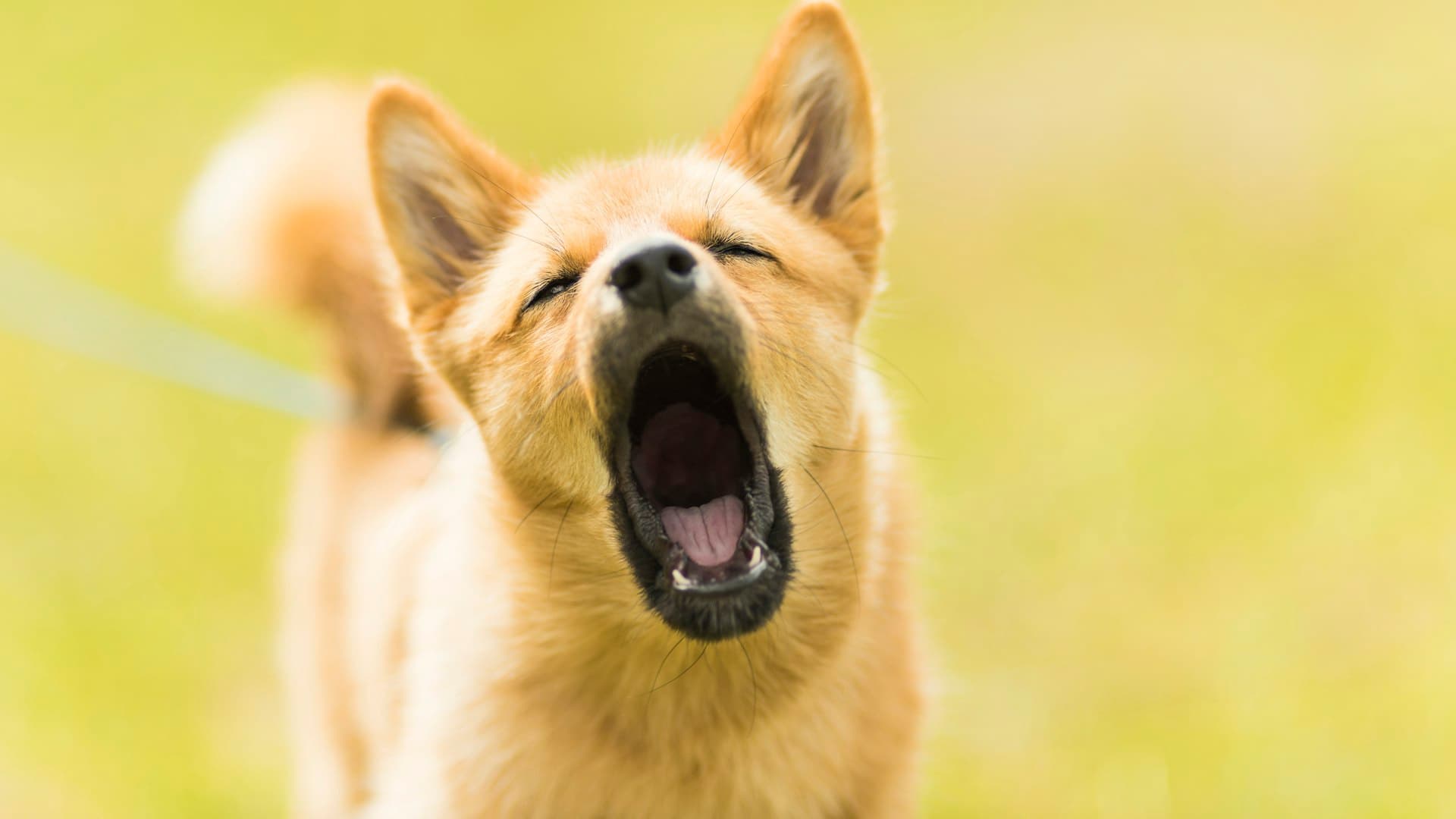
Your dog yawns while a stranger leans over to stroke him. You read it as tiredness.
He licks his lips when a child hugs him. You read it as anticipation of food.
He turns his head away and sniffs the ground intently when another dog approaches. You read it as distraction, and you tug the lead to get his attention back.
In each case something was being communicated and the message went past you, which is entirely normal and is also the most fixable gap in most people's relationship with their dog.
The signals you have been reading as nothing
Dogs communicate continuously and most of it is quiet. The dramatic signals, growling, barking, baring teeth, are the end of a sequence rather than the start of one, and they get all the attention because they are impossible to miss.
What comes earlier is small: a head turn, a yawn, a tongue flicking over the nose, a sudden interest in a patch of grass. These are easy to miss and easy to misread, because each has an obvious innocent explanation that is sometimes correct.
The loud signals are the end of the conversation. The quiet ones are the dog telling you something while there is still time to do something about it.
Where the idea comes from, and how solid it is
The term calming signals comes from the Norwegian dog trainer Turid Rugaas, whose book on the subject has been enormously influential in modern dog training. Her observation was that dogs use a repertoire of behaviours to defuse tension, both their own and other dogs', and that humans routinely misread them.
Being straight about the evidence: Rugaas's work is observational and came from watching dogs rather than from controlled study, and the specific claim that these behaviours are intentional communication aimed at calming another party is not established in the way it is often presented. Researchers in animal behaviour generally describe these as stress or appeasement signals, which is a slightly more cautious framing about what the dog is doing and why.
What is well supported is the part that matters practically. These behaviours occur more often in situations dogs find uncomfortable, they occur reliably before more serious signals, and people who learn to notice them handle their dogs better. Whether a yawn is a deliberate message or an automatic stress response, it tells you the same thing about how the dog is feeling.
So use the vocabulary, hold the theory lightly, and pay attention to the pattern rather than to the interpretation.
The four in the vocabulary, and what each looks like
Yawning. A yawn out of context, meaning not on waking and not during a genuinely restful moment, frequently indicates mild stress. Common when someone leans over the dog, during a tense wait at the vet, when voices are raised in the house, or when a dog is being held still.
Lip licking. A quick flick of the tongue over the nose or lips, with no food present. One of the most frequent and most missed signals. Very common in photographs of dogs being hugged by children, which is worth knowing.
Turning away. Head turn, body turn, or simply looking away from something. Often read as the dog ignoring you or being stubborn. It is usually the opposite: an attempt to reduce pressure in a situation that has become uncomfortable.
Sudden sniffing. An abrupt and intense interest in the ground at a moment when something else is happening. Frequently read as distraction and corrected. It is often a displacement behaviour, which is to say something the dog does instead of responding to a tension it would rather not engage with.
| Signal | Commonly read as | Frequently means |
|---|---|---|
| Yawning | Tired | Mild stress, particularly under social pressure |
| Lip licking | Hungry | Discomfort, very often during handling |
| Turning away | Ignoring you, stubborn | Reducing pressure, asking for space |
| Sniffing suddenly | Distracted | Displacement, avoiding a tense interaction |
How this is taught inside Astra Trainer
These four terms, yawning, licking, turning and sniffing, appear as a set in the daily Connections round of the Dogs world, grouped together alongside a set of nutrition components and a set of training rewards.
They sit inside the Dog language direction, at twelve courses the largest in this world, which covers reading posture, stress cues and dog-to-dog signals in real moments. Real moments is the operative phrase, because the difficulty is never identifying a signal in a diagram, it is noticing one in a busy park while holding a lead. Lessons take about five minutes, a guide walks you through anything strange, and there is a discussion thread under every lesson.
Why context decides the meaning
Every one of these behaviours has a perfectly ordinary non-communicative explanation. Dogs do yawn when tired. They do lick their lips around food. They do sniff because something smells interesting.
Which means a single behaviour tells you very little. What tells you something is the combination of three things.
What else is happening. A yawn on the sofa at eleven at night is a yawn. The same yawn as a stranger reaches toward his collar is not.
What else the dog is doing. Signals cluster. A lip lick alone means little. A lip lick plus a head turn plus a lowered tail plus weight shifted backwards is a clear picture.
What this dog is normally like. Baselines vary enormously between individuals. Some dogs sniff constantly and it means nothing. For a dog that rarely does, a sudden sniff mid-interaction is informative.
This is the same discipline as reading a room with people: clusters and changes from baseline, never a dictionary of single gestures.
A worked example: the same greeting, two readings
You are at a friend's house. Your dog is lying near the door. A visitor arrives, likes dogs, and crouches down to say hello, leaning forward with a hand out toward his head.
Reading one, the common one. The dog yawns, licks his lips, and turns his head to the side. The visitor reads this as the dog being sleepy and relaxed, and continues reaching, moving to stroke the top of his head. The dog holds still. The visitor says he is so calm and good natured.
Ten seconds later the dog gets up and moves to the other side of the room. The visitor is slightly disappointed. Nobody thinks anything happened.
Reading two. The same three behaviours, in the same ten seconds, with a fourth thing visible if you are watching: the dog's weight has shifted slightly backwards and his ears have moved back.
That cluster, arriving exactly as someone leaned over him, says the dog is uncomfortable. Not frightened, not about to do anything, just uncomfortable and communicating it in the only register available.
Holding still was not consent. It was a dog with no other option, since the exit was behind the person approaching him.
What changes with the second reading is small and immediate: you say "give him a second, he will come to you" and the visitor sits back. Nine times out of ten the dog then approaches on his own within a minute, and the interaction happens on terms he chose.
Nothing bad was going to happen in either version. The point is that one version teaches the dog that being approached leads to pressure he cannot avoid, and the other teaches him that his signals work. Over hundreds of repetitions, those produce quite different dogs.
The photograph problem. An enormous number of shared photos of dogs with children show a dog performing several of these signals at once: head turned away, whale eye with the white showing, lips licking, ears back. The caption is usually about how much the dog loves the child. If you learn these signals, you will start seeing this constantly, and it is worth knowing that most of those dogs are tolerating rather than enjoying the interaction.
What to do when you see them
The response is almost always the same and it is simple: reduce the pressure.
Create space. Step back, ask the other person to step back, or let the dog move away. Most discomfort resolves immediately when the dog is given the option to increase distance.
Let the dog choose. Instead of bringing a person to the dog, let the dog approach if it wants to. The difference in the dog's experience is substantial and it costs nothing.
Do not correct the signal. This is the important one. Telling a dog off for turning away, or tugging the lead when it sniffs, punishes communication. Dogs whose quiet signals are repeatedly ignored or corrected learn that those signals do not work, and some of them stop using them, which removes the early warning entirely.
Notice what triggered it. Over a few weeks, patterns become visible. Many dogs have specific situations that reliably produce these signals: being hugged, being approached head-on, men in hats, the vet's car park. Knowing which lets you manage them in advance.
Why this matters more than obedience
Most dog training effort goes into the dog understanding you: sit, stay, come, leave it. All useful.
Comparatively little goes into you understanding the dog, and that direction does more work in practice.
A dog who reliably sits on command but whose discomfort is never noticed is still going to end up in situations that build up. A dog whose owner reads him well is in fewer of those situations in the first place, which is a better outcome than being able to interrupt them.
There is also a trust effect worth naming, though it is easy to overstate. A dog whose small signals produce a response, who finds that turning away results in space rather than in more pressure, generally becomes easier to handle in new situations. That is not sentiment, it is the ordinary result of a signal reliably working.
Why this takes practice rather than reading
Recognising a calming signal in a photograph takes about a second once you know what to look for. Noticing one in a real moment, while you are holding a lead and talking to someone and the dog is slightly behind you, is a different skill entirely.
The Dogs world is built around closing that gap. Quizzes follow each topic and each course ends with a ten-question final exam, and the daily Connections round and 10x10 crossword are generated from this world's own lessons, so the vocabulary stays available rather than fading. Daily quests, points and a streak keep five-minute lessons running, with a streak shield for the day that goes wrong.
Dog language runs twelve courses, the largest direction here, and a Circle gives you a small group with a shared weekly goal, which for this material is useful because other people spot things in your dog that you have stopped seeing.
When to stop reading and act
This article is about ordinary mild discomfort in everyday situations. Some situations are not that, and reading signals is the wrong activity.
If a dog is growling, showing teeth, stiffening and staring, or has stopped moving entirely with weight forward, the conversation has moved past the quiet register. The response is to calmly increase distance immediately rather than to continue observing or to attempt to reassure at close range.
Never punish a growl. A growl is information, and a dog that has been punished for growling may skip that step next time, which removes the last clear warning before a bite.
And if your dog is showing these signals frequently in ordinary situations, if there has been any bite or attempted bite, or if behaviour has changed noticeably, that is a reason to involve a professional. A qualified behaviourist, ideally one working on veterinary referral, is the right resource. Sudden behavioural change in particular warrants a vet visit first, because pain is a common and frequently missed cause.
What to take from this
Yawning, lip licking, turning away and sudden sniffing are frequently communication about discomfort rather than the innocent explanations they resemble.
Hold the theory lightly and the observation tightly. Whether these are deliberate messages or automatic stress responses, they tell you the same thing about how the dog is feeling.
Context decides. Clusters, timing, and a change from this dog's normal behaviour, never a single gesture read from a list.
The response is almost always to reduce pressure and let the dog choose. And never correct the signal, because a dog whose quiet communication stops working may stop using it.
When the signals escalate past this register, stop reading and increase distance. And take any growl seriously as information rather than as something to discipline.
Is my dog stressed if he yawns?
Not necessarily, and dogs yawn for ordinary reasons too. What makes a yawn informative is the context: out of nowhere, during a social interaction, alongside other signals, and different from how this dog usually behaves in that situation.
Does my dog not like being hugged?
Many dogs tolerate hugging rather than enjoying it, and the signals in this article are commonly visible in photographs of dogs being hugged. Some individuals genuinely do enjoy close contact, so watch your own dog rather than assuming either way.
Should I tell my dog off for ignoring me?
If the ignoring is a head turn or sudden sniffing in a tense moment, that is not defiance and correcting it punishes communication. Dogs whose signals are repeatedly overridden sometimes stop producing them, which removes your early warning.
Is the calming signals theory scientifically proven?
It comes from observational work by Turid Rugaas rather than from controlled study, and the specific claim of intentional calming communication is not established. That these behaviours occur more in uncomfortable situations and precede more serious signals is well supported, which is the part that matters practically.
Where can I learn this systematically?
The Dog language direction inside the Dogs world of Astra Trainer runs to twelve courses on reading posture, stress cues and dog-to-dog signals in real moments. Lessons take about five minutes and the first needs no card. You can see what is inside the world here.