
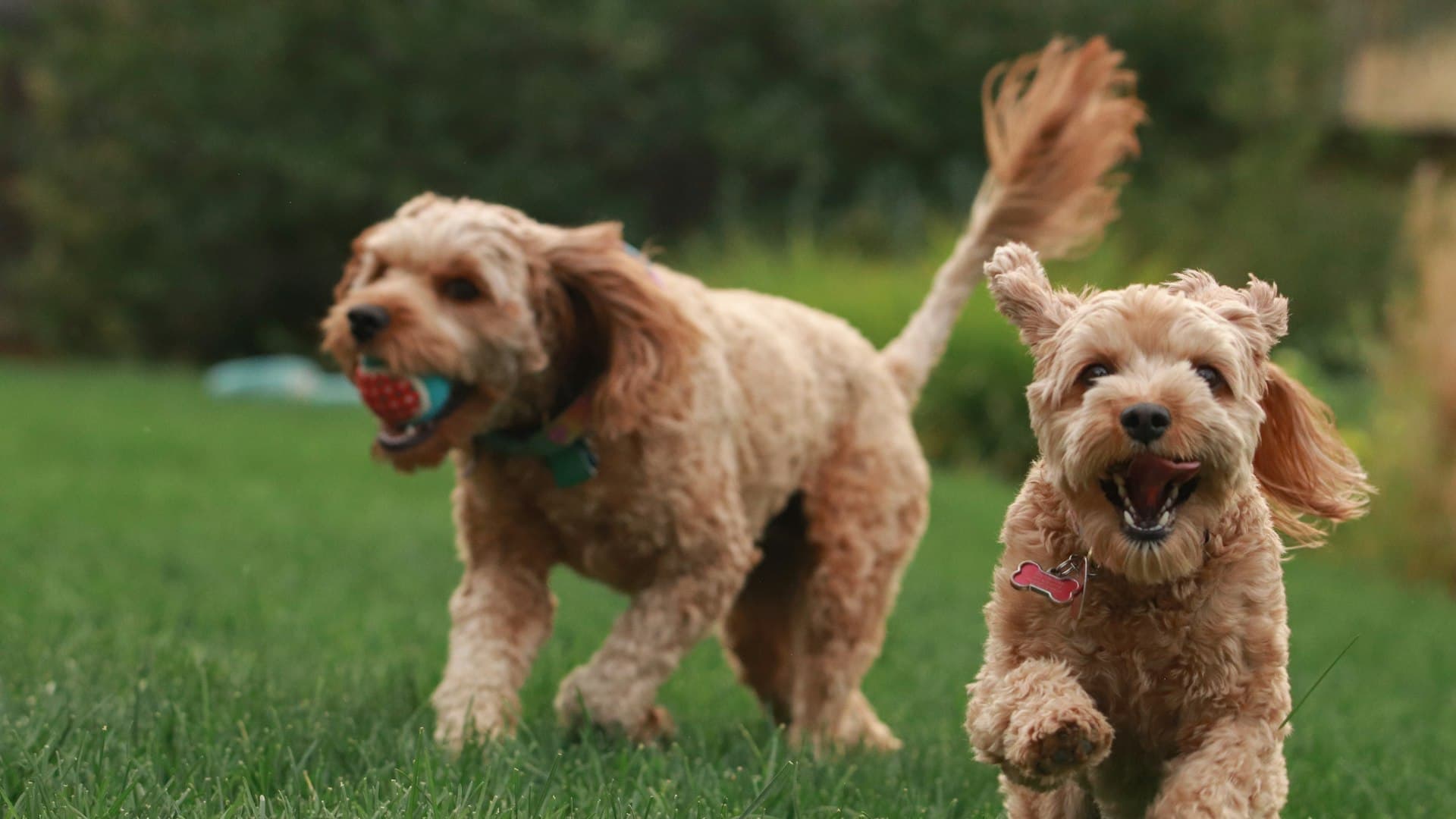
Two dogs are making a noise that would empty a room. There is growling, a great deal of teeth, one has the other by the neck, and they have just slammed into a bench.
Everyone at the park has stopped talking. You are trying to work out, quickly, whether to intervene.
The honest answer is that this is probably fine, and that the reason you cannot tell is that good play is deliberately designed to look like fighting.
Why good play looks so alarming
Play in dogs is largely made of fight and chase behaviours performed without the intent behind them. Stalking, chasing, grabbing, pinning, mouthing at the neck. That is what play is, which is why it triggers alarm in people watching.
The sounds are similarly misleading. Play growling is common and normal, and it is frequently louder and more theatrical than a serious growl, which tends to be lower and shorter.
So you cannot judge by the elements. Teeth, growling, pinning and crashing about all appear in perfectly good play.
Play is made of fighting behaviours with the seriousness removed. Judging by the moves will always mislead you. Judge by the structure around them.
The five signals that separate them
Role reversal. The most reliable single indicator. In play, dogs take turns: the chaser becomes the chased, the one on top ends up underneath. In a fight, roles are fixed. If the same dog is always on top and always pursuing, that is worth watching.
Self-handicapping. A larger or stronger dog making itself less effective: lying down to be at a smaller dog's level, using less force than it obviously could, letting itself be caught. This is a dog managing the interaction to keep it going, which only happens in play.
Bouncy, exaggerated movement. Play has a distinctive quality: loose, springy, inefficient. The play bow, front end down, rear up, is the clearest example and it is a genuine invitation signal. Serious conflict is economical and direct.
Pauses. Good play breaks. Dogs stop, shake off, sniff something, then restart. These micro-breaks are how play regulates itself. Play that becomes continuous with no pauses is the earliest sign it is escalating.
Loose bodies. Wiggly, curved, relaxed. Tension is the tell in the other direction: stiff bodies, still bodies, hard stares, weight pitched forward.
| Signal | Play | Trouble |
|---|---|---|
| Roles | Swap back and forth | Fixed, one dog always on top |
| Force | Deliberately reduced by the stronger dog | Full force, no handicapping |
| Movement | Bouncy, loose, exaggerated | Direct, efficient, economical |
| Rhythm | Frequent pauses and restarts | Continuous, no breaks |
| Body | Curved, loose, wiggly | Stiff, still, weight forward |
The consent test, which settles it in three seconds
The single most useful thing in this article, and it takes almost no time.
Gently hold or lead away the dog that appears to be doing more of the chasing or pinning. Then watch the other dog.
If the second dog immediately comes back, bounces, play bows, or otherwise asks for more, both dogs are enjoying it. Let them continue.
If the second dog moves away, shakes off and stays away, goes behind you, or looks visibly relieved, then it was not enjoying it and the interaction was one-sided.
That is the whole test. It works because it asks the dog who would be having the worse time, and it does so in a way that requires no interpretation.
Worth doing periodically during any energetic play session between dogs that do not know each other well, rather than only when something looks wrong.
How this is taught inside Astra Trainer
Reading dog-to-dog signals in real moments is one of the stated aims of the Dog language direction in the Dogs world, which at twelve courses is the largest direction here.
The direction's framing is about reading posture and stress cues in real situations and telling ordinary calm from the point where something is escalating. Real situations is the difficult part with play specifically, because it is fast, loud and usually happening several metres away while you are holding a lead. Lessons take about five minutes, a guide walks you through anything strange, and the discussion thread under each lesson is frequently where people post a video and ask what they are looking at.
A worked example: the same noise, two situations
Two pairs of dogs at the same park, both producing roughly the same volume.
Pair one. A large labrador and a small terrier. The labrador is lying down for much of it, letting the terrier climb on him. Periodically he gets up, the terrier runs, he chases, then he flops again and the terrier comes back and jumps on his head. There is a great deal of growling.
Every few seconds they stop, both shake, one sniffs the grass, then it starts again.
Check the signals: roles swapping constantly, obvious self-handicapping by the larger dog, loose bouncy movement, frequent pauses, curved relaxed bodies. Five out of five. This is good play and the noise is irrelevant.
Pair two. Two dogs of similar size. One is repeatedly chasing the other and putting his mouth on the back of the neck. The second dog keeps trying to move away and the first follows. There are no pauses, and it has been going for perhaps forty seconds without a break.
The second dog's tail is tucked, his body is low, and his ears are back. The first dog's body is stiff and forward.
Same volume, same apparent moves. But roles are fixed, there is no handicapping, movement is direct rather than bouncy, there are no pauses, and one dog's body language is asking to leave.
The consent test would settle it in three seconds and would almost certainly show the second dog moving away and staying away. This needs interrupting, and it did about thirty seconds ago.
The most common misjudgement. People intervene in pair one because it is loud, and do not intervene in pair two because it is quieter and looks less dramatic. Volume is the least informative signal available. The second situation is the one where a dog is being repeatedly pursued while trying to disengage, which is how bad experiences and future reactivity get built.
When play tips over, and what that looks like
Good play can escalate, particularly when dogs get over-aroused, and the transition has recognisable markers.
Pauses stop. The earliest and most reliable sign. Continuous play without breaks is play that has lost its regulation.
Movement becomes efficient. The bounciness goes. Movement becomes direct and purposeful.
One dog stops reciprocating. Roles become fixed. The dog underneath stops trying to get up and start again.
Bodies stiffen. Loose becomes rigid. Sometimes a brief complete stillness, which is worth taking seriously.
The pitch changes. Play growling is usually higher and more theatrical. A shift to something lower and shorter is a change worth acting on.
A third dog joins. Groups escalate faster than pairs, and a dog joining an existing energetic interaction is a common trigger for things tipping over.
The useful habit is to interrupt at the pause point rather than at the stiffening point. Calling both dogs away for a few seconds when play has been going a while, then letting them resume, keeps arousal manageable and costs nothing.
Why size and style mismatches matter
Two dogs can both be playing in good faith and still be a poor match.
Size. A large dog playing appropriately can still injure a small one by accident. Self-handicapping helps and does not eliminate the risk, particularly with very small dogs and heavy ones.
Style. Dogs have play preferences that vary by individual and somewhat by breed type. Some are chasers, some are wrestlers, some prefer to body-slam. A wrestler and a dog who only wants to chase frequently frustrate each other without either doing anything wrong.
Arousal level. A dog that plays in short bursts and a dog that plays relentlessly will not match well, and the mismatch usually shows as the first dog trying repeatedly to take a break.
None of this is a behaviour problem. It is compatibility, and the practical response is to notice which dogs your dog actually enjoys and to be relaxed about the ones it does not.
Why this is hard to learn from articles alone
Play happens fast. By the time you have recalled a five-item list, the interaction has moved on twice. This has to become recognition rather than checking.
The Dogs world is built for that kind of repetition. Quizzes follow each topic and each course ends with a ten-question final exam. The daily Connections round and 10x10 crossword are generated from this world's own lessons, so the vocabulary of stress and play signals comes back as practice with a fresh round each day. Daily quests, points and a streak keep five-minute lessons running, with a streak shield for the day that goes wrong.
A Circle gives you a small group with a shared weekly goal and live sessions, which helps here because comparing readings of the same situation is how calibration happens, and dog owners tend to have plenty of footage.
How to interrupt safely
If you do need to stop something, the method matters.
Call the dogs away. A cheerful recall, moving away yourself so they follow. This works better than it sounds because moving away triggers following in most dogs.
Use your body as a barrier. Step in and block the line between them, standing sideways. This interrupts without contact.
Use a noise interrupter. A clap, a loud cheerful noise. Enough to break focus.
If you must physically separate, grab back legs or the base of the tail, not collars. Reaching for a collar or between two aroused dogs is how people get bitten, frequently by their own dog, and frequently by accident. This is the single most important safety point here.
Move both dogs away and let them settle. Do not immediately let them resume.
What not to do
Do not shout or panic. Rising human tension raises the dogs' arousal, and shouting frequently makes escalation more likely rather than less.
Do not punish growling. Play growling is normal communication, and punishing growling generally teaches a dog to skip that signal, which removes information you need.
Do not force interactions. If your dog does not want to play with a particular dog, that is a preference rather than a problem. Dragging a reluctant dog into a group is how bad associations form.
Do not assume the smaller or quieter dog is the victim. Small dogs instigate plenty, and the consent test is more reliable than assumptions about who is doing what to whom.
And a note on when this goes beyond reading signals: if there has been an actual fight, any injury, or a dog that is repeatedly unable to settle around other dogs, that is a reason to work with a qualified behaviourist rather than to keep managing it at the park. Sudden changes in tolerance in a previously sociable dog also warrant a vet check, since pain is a common and frequently missed cause.
What to take from this
Play is made of fighting behaviours with the intent removed, which is why it looks and sounds alarming and why judging by the moves fails.
Five signals do the work: role reversal, self-handicapping, bouncy movement, pauses, and loose bodies.
The consent test settles it in three seconds. Hold one dog briefly and see whether the other comes back.
Loss of pauses is the earliest reliable sign of escalation, which is why interrupting periodically during long sessions is worth doing before anything looks wrong.
And if you separate dogs physically, back legs rather than collars. That one detail prevents most of the bites that happen to people breaking up dogs.
Is growling during play normal?
Yes, and it is frequently louder and more dramatic than serious growling, which tends to be lower and shorter. Growling on its own tells you very little, and punishing it removes useful communication.
My dog is always on the bottom. Is that bad?
Not necessarily, as long as roles swap at least sometimes and the dog keeps coming back for more. The consent test is the check: if you pause the play and that dog re-engages, it is choosing this.
Should big and small dogs play together?
They can, and it requires more supervision, because a large dog playing appropriately can still injure a small one accidentally. Watch for genuine self-handicapping and be readier to interrupt than you would with a size-matched pair.
How often should I interrupt play?
Periodically during long or energetic sessions, before anything looks wrong. Calling both dogs away for a few seconds and then releasing them keeps arousal manageable, and the pause itself is what good play does naturally.
Where can I learn this systematically?
The Dog language direction inside the Dogs world of Astra Trainer runs to twelve courses on reading posture, stress cues and dog-to-dog signals in real moments. Lessons take about five minutes and the first needs no card. You can see what is inside the world here.