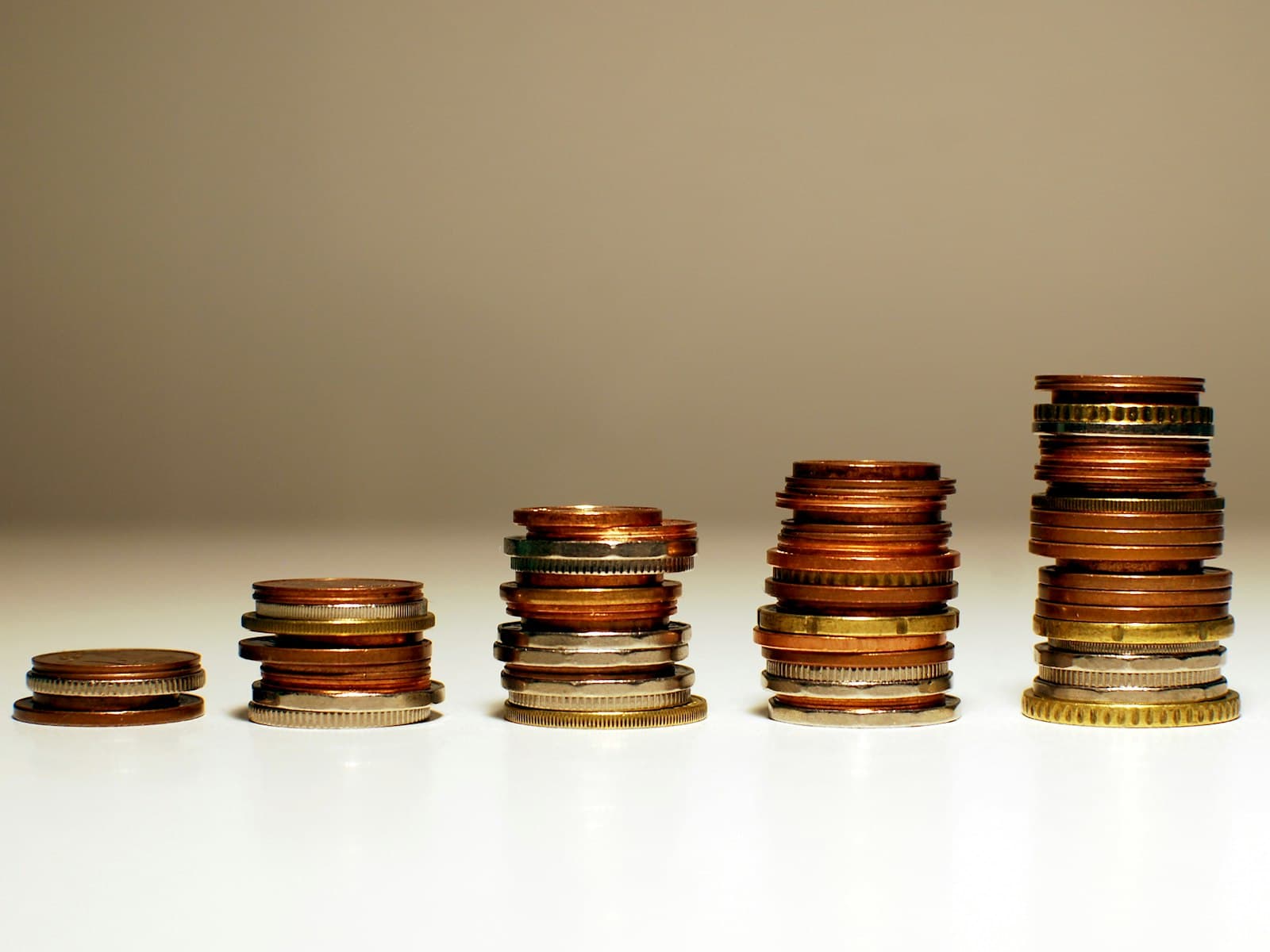
How does compound interest work? In one sentence: interest is added to the amount you have, and the next round of interest is calculated on that larger amount. Interest starts earning interest. The idea is simple, the arithmetic is simple, and the effect over long periods is larger than most people expect, in both directions, because the same mechanism that grows savings also grows debt.
This article explains the mechanism, the formula, the rule of 72, why compounding frequency matters, and why it applies just as strongly to what you owe as to what you hold.
How does compound interest work?
Start with simple interest, which is the easier idea. If you deposit $1,000 at 5 percent simple interest, you receive $50 a year, every year, calculated only on the original $1,000. After ten years you have $1,500.
Compound interest adds each year's interest to the balance before calculating the next year's. Year one: 5 percent of $1,000 is $50, so the balance becomes $1,050. Year two: 5 percent of $1,050 is $52.50, so the balance becomes $1,102.50. Each year the interest is slightly larger, because the base it is calculated on has grown.
At first the difference is tiny, a couple of dollars. But it keeps widening, because the gap itself is earning interest.
Compounding is slow at the start and fast at the end. Most of the effect arrives in the years people are least patient to wait for.
The difference over time
The table shows $1,000 at 5 percent a year, compounded annually, against the same amount at 5 percent simple interest.
| Years | Simple interest | Compound interest | Difference |
|---|---|---|---|
| 10 | $1,500 | $1,629 | $129 |
| 20 | $2,000 | $2,653 | $653 |
| 30 | $2,500 | $4,322 | $1,822 |
Over thirty years, the compounded amount has more than quadrupled while simple interest has only added one and a half times the original. Nearly half of the final compound balance comes from interest earned on earlier interest.
This is why time matters more than almost anything else in compounding. The rate matters, and the starting amount matters, but the number of periods is what turns a modest difference into a large one.
The formula, plainly
The standard formula is:
Final amount = P × (1 + r / n) ^ (n × t)
- P is the starting amount, the principal.
- r is the annual interest rate, as a decimal, so 5 percent is 0.05.
- n is how many times a year interest is added.
- t is the number of years.
For $1,000 at 5 percent, compounded once a year for ten years: 1,000 × 1.05 to the power of 10, which is $1,628.89. The formula looks technical, but it is only the year-by-year calculation above written in one line.
Check yourselfTwo savings accounts both quote 5 percent a year, but one adds interest once a year and the other every month. Before you read on: which figure in their terms shows what each one actually pays, and why can the quoted 5 percent not show it?Show the answerHide the answer
The effective rate, called APY in the US and AER in the UK. The quoted 5 percent is the nominal rate, often called APR in the US, which states the annual rate before compounding, so it reads the same on both accounts. The monthly account does pay more, about $1,647 against $1,629 on $1,000 over ten years, because each month's interest starts earning interest sooner, and only the effective rate includes that.
Why compounding frequency matters
Interest can be added yearly, monthly, daily or at other intervals. The more often it is added, the sooner each piece of interest starts earning interest of its own.
The same $1,000 at 5 percent compounded monthly for ten years becomes about $1,647, rather than $1,629 with yearly compounding. The difference is small at modest rates and grows with higher rates and longer periods.
This is why lenders and banks quote two different figures. A nominal rate, often called APR in the United States, states the annual rate before compounding. An effective rate, called APY in the US and AER in the UK, includes the effect of compounding within the year. When comparing products, the effective rate is the one that tells you what actually happens to the balance.
How this is taught inside Astra Trainer
The Money Systems direction in the Business & Finance world runs to twenty courses covering money creation, credit and central bank operations, starting from courses such as Money, Currency, and Credit.
Compounding sits underneath much of that material, because interest is the price of credit, and credit is how most money is created. Understanding the mechanism makes the rest of the system easier to follow. Lessons take about five minutes and a guide walks you through anything strange.
The rule of 72
A quick way to estimate how long it takes an amount to double under compounding is to divide 72 by the annual percentage rate.
At 6 percent, 72 divided by 6 is 12, so an amount roughly doubles in 12 years. The exact figure is about 11.9. At 8 percent, 72 divided by 8 is 9 years, which is almost exactly right. The rule works best for rates between about 6 and 10 percent and becomes less accurate far outside that range.
The shortcut is old. The Italian mathematician Luca Pacioli described it in 1494, in his Summa de arithmetica, the same book that set out double-entry bookkeeping. It works in reverse too: at 3 percent inflation, prices roughly double in 24 years, which means money held as cash loses about half its purchasing power over the same period. The article on what causes inflation covers that side.
Compounding works on debt too
Everything above applies with equal force to money you owe. Interest on unpaid debt is added to the balance, and the next period's interest is charged on the larger total.
Take a credit card balance of $2,000 at a rate of 2 percent a month, roughly 24 percent a year, with no repayments. After twelve months, compounding monthly, the balance is about $2,536. The effective annual rate is close to 27 percent, not 24, because of the monthly compounding.
This is also why minimum payments on high-interest debt can take so long to clear it. If a payment barely exceeds the interest being added, very little of it reduces the balance itself, and the compounding continues on almost the full amount.
The article on how banks create money explains why interest-bearing credit is so central to the whole system.
Try it now, on your own accounts
Ticked: 0 of 4
Each of these is printed in an account's terms or on a statement, so a gap here is a figure to look up rather than a verdict on how you handle money.
Franklin's two-hundred-year experiment
The most famous real-world test of compound interest was set up by Benjamin Franklin. In a codicil to his will, shortly before his death in 1790, he left £1,000 each to Boston and Philadelphia. The money was to be lent to young tradesmen at interest for a hundred years, after which part could be spent on public works, and the rest compounded for another century.
Franklin calculated that after two hundred years each fund could reach over £4 million. It did not. When the trusts were wound up around 1990, Boston's fund was worth about $4.5 million and Philadelphia's about $2 million, far below his projection.
The gap is the lesson. Compounding is powerful, but the result depends entirely on the rate being sustained. Loans that were not repaid, periods of low returns and money withdrawn along the way all cut the rate, and over two hundred years a small cut in the rate compounds into an enormous difference in the result.
General information, not financial advice. This article explains how a mechanism works. It does not recommend any product, account or course of action, and interest rates, fees and rules vary by lender and country. For decisions about your own money, check the terms directly with the provider and consider speaking to a qualified, regulated adviser.
What compound interest does not do
Compounding describes what happens to an amount at a given rate. It does not guarantee that the rate will hold. A savings account's rate can change. An investment's return varies from year to year and can be negative, in which case compounding works against the balance, not for it.
Compounding also works on nominal amounts. If prices are rising at the same rate as the interest, the number in the account grows while what it can buy stays roughly the same.
Why understanding the mechanism is a habit
Compound interest is one of those ideas most people have heard of and few apply when it matters: reading an effective rate, spotting how a debt balance is growing, or noticing the difference a few percentage points make over a decade.
Astra Trainer is built to make ideas like this stick. Quizzes follow each topic and each course ends with a ten-question final exam, while daily quests, points and a streak keep five-minute lessons going. A Circle gives you a small group with a shared weekly goal and live sessions, which helps when the subject is one people rarely discuss openly.
What to take from this
Compound interest is interest calculated on the principal plus the interest already added, so each period's interest is larger than the last.
The effect is small at first and large over long periods. Time is the biggest factor, followed by the rate and the frequency of compounding.
The rule of 72 gives a quick estimate of doubling time, and the effective rate, APY or AER, shows the real effect of compounding within a year.
Which is why the most useful answer to how does compound interest work is that it works the same way on everything, and applies as strongly to a credit card balance as to a savings account.
Test yourself
Question 1 of 3
A card balance carries a high rate, and each month's payment only just exceeds the interest being added. What happens to the debt?
How does compound interest work in simple terms?
Interest is added to your balance, and the next round of interest is calculated on the new, larger balance. Over time, interest earns interest, so the amount grows faster than with simple interest, which is only ever calculated on the original sum.
What is the difference between simple and compound interest?
Simple interest is calculated only on the original amount. Compound interest is calculated on the original amount plus interest already added. For $1,000 at 5 percent over thirty years, simple interest gives $2,500 and annual compounding gives about $4,322.
What is the rule of 72?
A shortcut for estimating how long an amount takes to double under compound interest: divide 72 by the annual percentage rate. At 6 percent, that gives about 12 years. It was described by Luca Pacioli in 1494.
Does compound interest apply to debt?
Yes. Unpaid interest on loans and credit cards is added to the balance and then charged interest itself. A balance at 2 percent a month grows by about 27 percent over a year if nothing is repaid.
Where can I learn how money and credit work in short lessons?
The Money Systems direction inside the Business & Finance world of Astra Trainer runs to twenty courses covering money creation, credit and central bank operations, in five-minute lessons with quizzes. The first lesson needs no card.
Where this leads. How to Get Better With Money: The Order to Learn It places compounding in sequence with the other money concepts, and explains which to learn first.