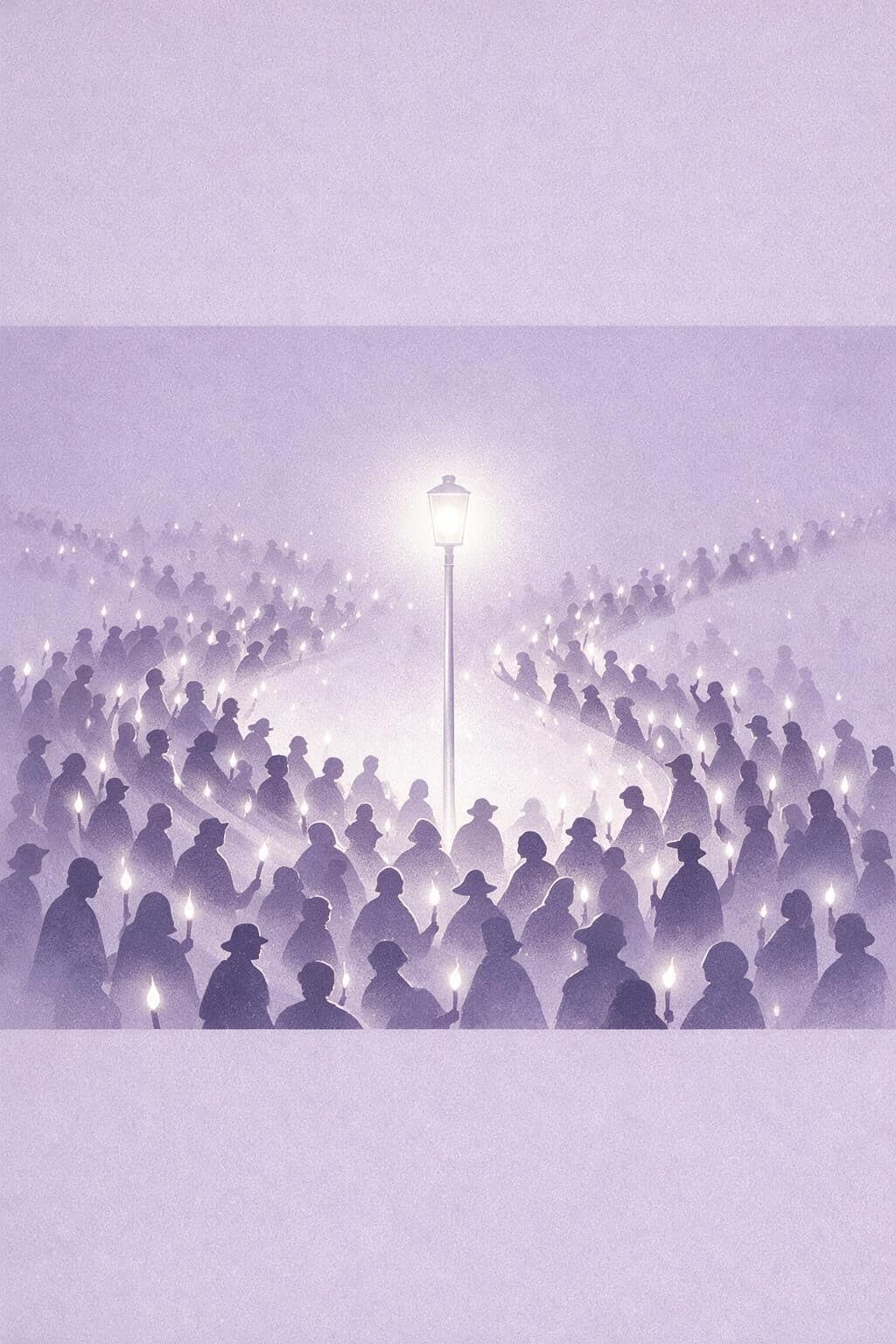
The bandwagon effect is the tendency to do something, buy something or believe something because many other people already have. It is one of the main engines of trends: a product becomes popular partly because it is popular, a phrase spreads because everyone seems to be using it, and a restaurant gets a queue because it already has one. Following the crowd is not irrational. When you do not know enough to judge for yourself, what other people have chosen is useful information. But the same instinct can make popularity snowball far beyond what quality alone would explain, and it can make whole crowds confidently wrong.
This article explains where the term comes from, what the classic experiments show, how the bandwagon effect shapes trends and markets, and how to tell a crowd worth following from one that is simply following itself.
Where the bandwagon effect gets its name
A bandwagon was originally a wagon that carried a band in a circus parade. In 19th-century American politics, candidates used bandwagons at rallies, and the phrase "jumping on the bandwagon" came to mean backing a campaign because it looked like a winner. Politicians who switched sides late were said to climb aboard.
Economists later borrowed the term. In 1950, Harvey Leibenstein described a bandwagon effect in demand: people want a product more when they see others buying it. He set it alongside the snob effect, wanting something less because others have it, and the Veblen effect, wanting something more because it is expensive.
The bandwagon effect is not stupidity. It is using other people as information, and forgetting that they may be doing the same.
The classic experiments
Asch's line experiments. In the early 1950s, the psychologist Solomon Asch asked people to judge which of three lines matched the length of a reference line. The answer was obvious. But each real participant sat among actors who had been told to give the same wrong answer. About three quarters of participants went along with the group's wrong answer at least once, even though most answered correctly most of the time.
MusicLab. In 2006, the sociologists Matthew Salganik, Peter Dodds and Duncan Watts published an experiment in Science in which more than 14,000 people listened to and downloaded songs by unknown bands. Some participants could see how many times each song had been downloaded; others could not. Showing download counts made the most popular songs far more popular and made success much less predictable. The best songs rarely failed completely and the worst rarely did well, but almost anything in between could become a hit, depending on early luck.
Check yourselfChoosing the busy restaurant in a town you do not know, and adopting a style so you fit in with a group, both look like following the crowd. Are they driven by the same thing? Decide before reading on.Show the answerHide the answer
No. The restaurant choice treats other people's choices as information: the locals may know something you do not, which is often sensible. Adopting a style to fit in is about belonging, which concerns social standing rather than truth. The two reasons are different, but they push in the same direction, and that is a large part of why the bandwagon effect is so strong.
Why people follow the crowd
There are two main reasons, and they are quite different.
| Reason | What is happening | Example |
|---|---|---|
| Information | Others' choices are treated as evidence of what is good or true | Choosing the busy restaurant in an unfamiliar town |
| Belonging | Going along avoids standing out or being left out | Adopting a style or opinion to fit in with a group |
The first is often sensible: a crowd can know things you do not. The second is about social standing, not truth. Both push in the same direction, which is why the bandwagon effect is so strong. It is closely related to social proof, explained in social proof marketing.
How the bandwagon effect drives trends
Trends spread partly on their merits and partly on their momentum. Once enough people adopt something, its visibility becomes a reason for others to adopt it too. That is why many trends seem to take off suddenly after a long quiet start, a pattern described in the diffusion of innovations.
The same momentum explains why trends can end abruptly. When a bandwagon is carried by visibility rather than lasting value, it can reverse as soon as the crowd moves on. That is one of the clearest differences between a trend and a fad, set out in trend vs fad.
How this is taught inside Astra Trainer
The Trends & culture direction in the Marketing, Sales & Attention world covers what a trend is, why people follow trends and how ideas spread, with courses such as Why Humans Follow Trends and The Lifecycle of a Trend.
Why Humans Follow Trends is about exactly this: the social forces that make people join in. Lessons take about five minutes and a guide walks you through anything strange.
Bandwagons in markets and politics
Markets. Investment manias are bandwagons with prices attached: rising prices attract buyers, whose buying raises prices further, until the story breaks. The history of such episodes, from tulips to railway shares, is told in Charles Mackay's 1841 book on popular delusions.
Politics. Researchers have long debated whether publishing polls creates a bandwagon, with undecided voters drifting towards whoever appears to be winning. The evidence is mixed, and some studies find the opposite, an underdog effect, but the concern is old enough to have given the phrase its name.
Products and platforms. For some products, popularity genuinely adds value: a messaging app is more useful when your friends use it. In those cases following the crowd is rational, because the crowd itself is part of the product.
When to trust the crowd, and when not to
The bandwagon effect is not something to avoid entirely. A few questions help decide when it is working for you.
- Is the crowd independent? Many people reaching the same conclusion separately is strong evidence. Many people copying each other is not.
- Does the crowd know more than you? Local diners choosing a restaurant know more than you do. Strangers following a viral claim may not.
- Would you choose it without the numbers? Imagine the product, idea or trend without its popularity. Does it still appeal?
- What is driving it? Lasting need or momentum? A trend built on a real need tends to last; one built on visibility tends to fade.
For anyone launching something, the lesson from MusicLab is sobering and useful: early visibility matters enormously, and success is partly luck. Getting real early adopters, rather than faking popularity, is what makes a bandwagon worth joining.
Why reading crowds is a skill
Knowing that you are influenced by crowds does not stop it happening, but it does make it easier to pause and ask whether the crowd knows something or is simply moving.
Astra Trainer is built to make that pause habitual. Quizzes follow each topic and each course ends with a ten-question final exam, while daily quests, points and a streak keep five-minute lessons going. A Circle gives you a small group with a shared weekly goal and live sessions, useful for comparing how different people read the same trend.
Think of something you chose recently because it was popular
Ticked: 0 of 4
Following the crowd is often reasonable. Several ticks suggest this crowd is carrying real information; few ticks suggest it may simply be following itself, which is worth a second look.
What to take from this
The bandwagon effect is the tendency to adopt something because others have. The term comes from 19th-century political rallies and was brought into economics by Harvey Leibenstein in 1950.
Asch's experiments showed people sometimes go along with an obviously wrong group, and MusicLab showed that visible popularity makes hits bigger and harder to predict.
People follow crowds for information and for belonging. The bandwagon effect drives trends, market manias and some political swings.
Which is why the most useful way to think about the bandwagon effect is as a question to ask, not a bias to fear: does this crowd know something I do not, or is it simply following itself?
Test yourself
Question 1 of 3
A buyer goes off a designer handbag once it starts appearing on every commuter around her. Which of the effects Leibenstein described fits best?
What is the bandwagon effect?
The bandwagon effect is the tendency to adopt a belief, product or behaviour because many other people already have. It helps explain why popular things become more popular and why trends can take off suddenly.
Where does the term bandwagon come from?
A bandwagon carried a band in 19th-century parades and political rallies. Jumping on the bandwagon came to mean backing a campaign that looked like a winner. Economist Harvey Leibenstein used the term for consumer demand in 1950.
What is an example of the bandwagon effect?
Choosing a busy restaurant over an empty one, buying a product because it is a bestseller, or adopting a style because everyone around you has. In the 2006 MusicLab experiment, showing download counts made popular songs much more popular.
Is the bandwagon effect always bad?
No. Other people's choices can be useful information, especially when they know more than you and have decided independently. It becomes a problem when popularity is mistaken for quality or when a crowd is simply copying itself.
Where can I learn how trends spread in short lessons?
The Trends & culture direction inside the Marketing, Sales & Attention world of Astra Trainer covers Why Humans Follow Trends and The Lifecycle of a Trend, in five-minute lessons with quizzes. The first lesson needs no card.
Where this leads. How to Grow an Audience From Zero, in Order shows how early momentum is built honestly, before any bandwagon exists.