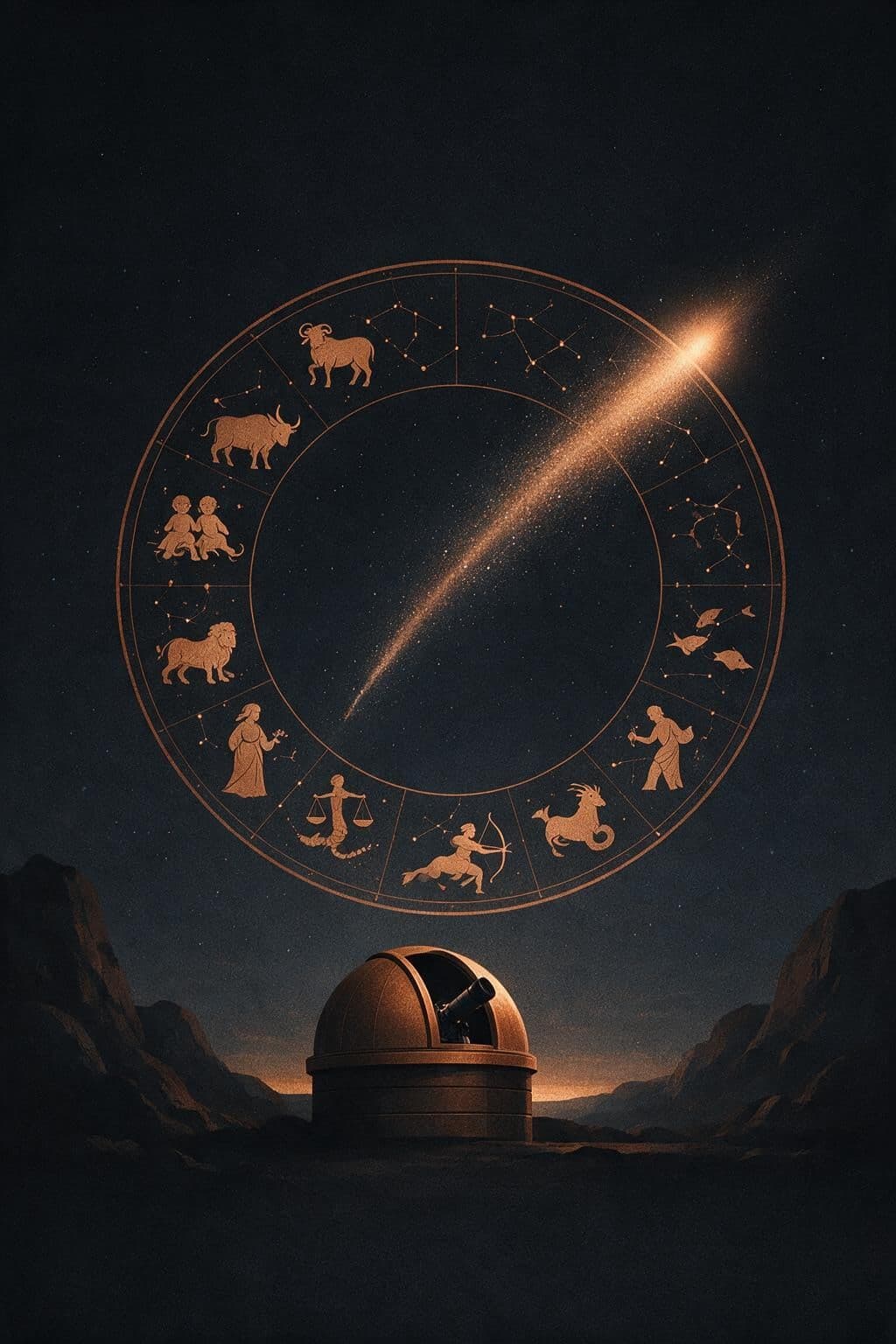


Your zodiac sign usually means your Sun sign: the sign occupied by the Sun when you were born. The zodiac dates below follow Western tropical astrology, the system used by most familiar birthday horoscopes. Find your birthday in the table first. If it falls near a changeover, check your birth chart before settling on a sign.
Zodiac sign dates at a glance
These are common reference ranges, not exact Sun-entry times for every year. A birthday close to either end of a range needs an individual calculation.
| Zodiac sign | Approximate dates | Symbol | Element |
|---|---|---|---|
| Aries | March 21–April 19 | Ram | Fire |
| Taurus | April 20–May 20 | Bull | Earth |
| Gemini | May 21–June 20 | Twins | Air |
| Cancer | June 21–July 22 | Crab | Water |
| Leo | July 23–August 22 | Lion | Fire |
| Virgo | August 23–September 22 | Maiden | Earth |
| Libra | September 23–October 22 | Scales | Air |
| Scorpio | October 23–November 21 | Scorpion | Water |
| Sagittarius | November 22–December 21 | Archer | Fire |
| Capricorn | December 22–January 19 | Sea-goat | Earth |
| Aquarius | January 20–February 18 | Water-bearer | Air |
| Pisces | February 19–March 20 | Two fish | Water |
How to find your zodiac sign by birthday
For a birthday comfortably inside a range, the table is a useful starting point. August 8 falls well inside the usual Leo period; November 5 falls inside Scorpio. You do not need a personality quiz to choose between them.
For a birthday near a boundary, use your full birth date, recorded birth time, and birthplace in a chart calculator set to the tropical zodiac. Read the sign next to the Sun symbol, ☉. Do not mistake the Moon or Ascendant for your Sun sign.
The birthplace lets the software interpret your local birth time correctly, including historical time-zone rules. Once the birth moment has been converted correctly, standard geocentric Sun-sign calculations refer to that same moment worldwide. Your sign does not change because you move countries.
If the resulting wheel looks unfamiliar, our guide to what a natal chart shows explains how to identify its main parts.
Check yourselfOne reference begins Cancer on June 21 and another begins it on June 22. Before you read on: is one of them simply wrong — and if not, what has to be true about the Sun for both lists to stand?Show the answerHide the answer
Neither. The Sun enters a tropical sign at a particular instant, not at midnight on a fixed calendar date, and leap years and time zones move that instant across the calendar from year to year and place to place. A generic list compresses a timed astronomical event into a convenient birthday range; only your own year, time and time zone settle a boundary birthday.
Why do zodiac dates change between websites?
The Sun enters a new tropical sign at a particular instant, rather than at midnight on a fixed calendar date. Calendar years, leap-year adjustments, and local time zones mean that this instant can fall on different dates in different years or places.
That is why one reference might begin Cancer on June 21 while another uses June 22. A generic date list is compressing a timed astronomical event into a convenient birthday range. It is not a personalised calculation.
When two tools disagree, check these settings before deciding one must be wrong:
- Birth year and date format: 04/05 can mean April 5 or May 4.
- Birth time: verify AM/PM and whether the recorded time was local time.
- Time zone: follow the calculator's daylight-saving instructions; do not apply the adjustment twice.
- Zodiac system: tropical and sidereal settings can return different signs.
These checks are especially useful for dates such as April 20, June 21, July 23, and September 23. No single cutoff list can settle every boundary birthday.
Born on the cusp: can you have two zodiac signs?
In a standard birth chart, the Sun occupies one sign at the recorded birth moment. Being born close to a changeover does not create a half-and-half Sun sign. If the birth time is uncertain, the result may be uncertain; that is different from having two Sun signs.
Suppose a calculator places the Sun at 29°59′ Cancer. That is still Cancer. At 0°00′ Leo, the Sun has entered Leo, provided the display is not merely rounding up from the preceding sign. This example illustrates the boundary; it is not a calculation for a particular birthday.

If you do not know your birth time, a calculator can compare the Sun's position across your possible birth window. If it stays in one sign, the Sun sign is clear; if it crosses the boundary, keep both possibilities open. Cafe Astrology's calculation notes explain unknown-time entries and why rounded boundary positions need care.
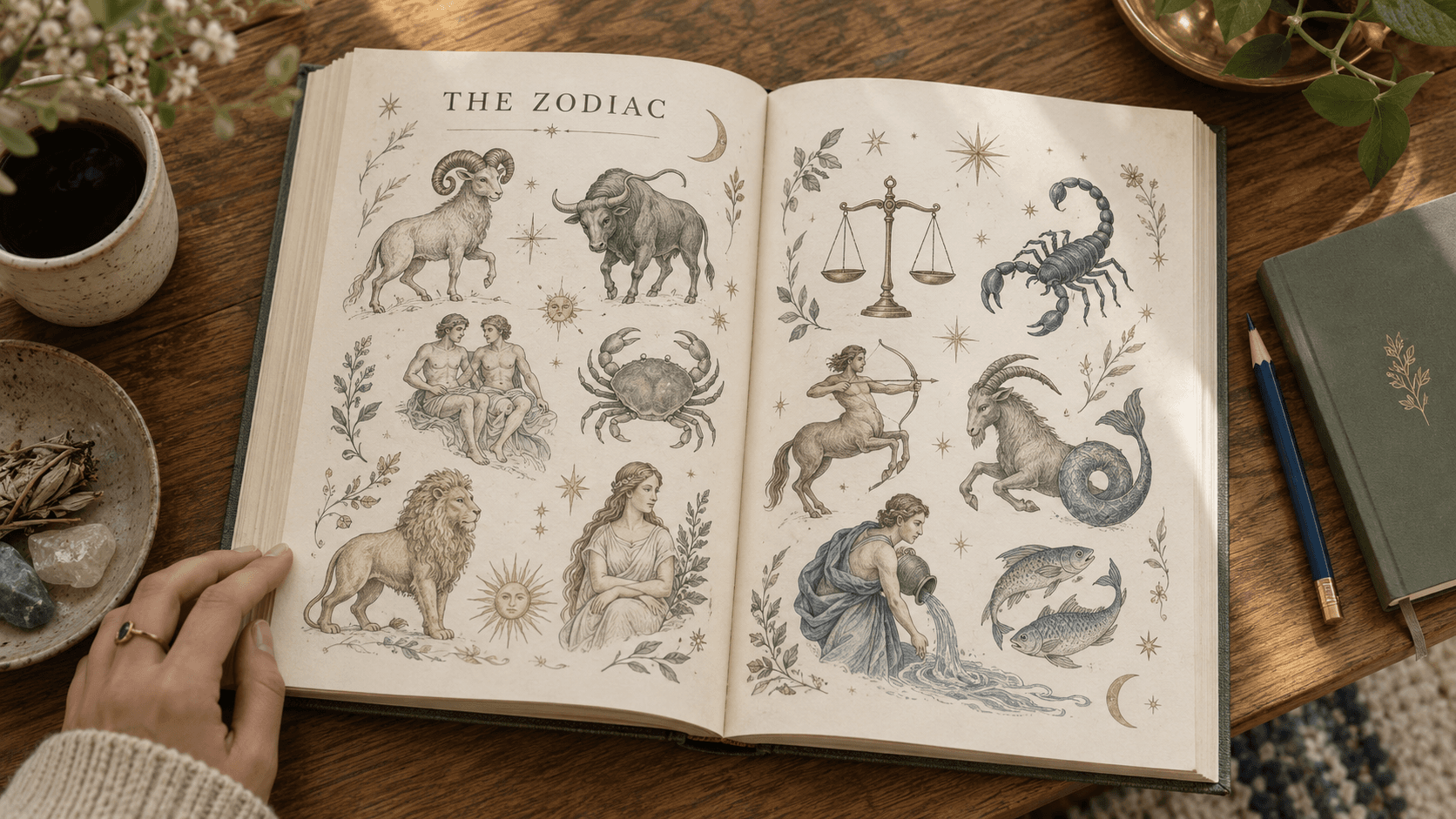
The 12 zodiac signs in order
Astrological meanings are traditional interpretations, not scientifically established personality categories. Read the descriptions below as a vocabulary for exploring the system, rather than a verdict about everyone born during a particular month.
The order begins with Aries, at the March equinox, and ends with Pisces. Each sign combines an element with a modality: a traditional description of whether it initiates, sustains, or adapts.
Aries: March 21–April 19
Fire · Cardinal · Ruled by Mars. Aries introduces themes of initiative, courage, and direct action. In an interpretation, it can suggest the willingness to begin before every detail is settled. Its associated challenge is acting so quickly that patience or cooperation gets overlooked. See our Aries zodiac sign guide for a fuller explanation.
Taurus: April 20–May 20
Earth · Fixed · Ruled by Venus. Taurus is associated with consistency, physical comfort, and building something that lasts. Its symbolism asks what is worth maintaining and what makes life feel secure. The same steadiness can become resistance when circumstances call for change. Taurus is represented by the bull, but its meaning extends beyond the familiar stubbornness stereotype.
Gemini: May 21–June 20
Air · Mutable · Ruled by Mercury. Gemini centres on language, curiosity, and exchanging information. The twins symbol invites more than one viewpoint; it does not establish that Gemini people are dishonest or “two-faced.” A useful interpretive question is whether collecting more information is helping understanding or postponing a decision. Explore the Gemini dates and meanings guide.
Cancer: June 21–July 22
Water · Cardinal · Ruled by the Moon. Cancer is linked with belonging, memory, care, and protecting what matters. The crab's shell offers a simple way to remember the theme of emotional boundaries. In a reading, nurturing can be considered alongside overprotection, without assuming that sensitivity equals weakness. Our Cancer zodiac guide develops these themes.
Leo: July 23–August 22
Fire · Fixed · Ruled by the Sun. Leo represents creative expression, warmth, and the wish to contribute something recognisably your own. Visibility is one theme, but so are generosity and taking pride in a craft. Its shadow is making approval the measure of every effort. Read the Leo dates and traits guide for more context.
Virgo: August 23–September 22
Earth · Mutable · Ruled by Mercury. Virgo is associated with observation, practical skill, and improving how something works. Think of editing a paragraph, learning a technique, or noticing a missing step. The challenge is letting useful discernment turn into endless fault-finding. Its traditional symbol is the maiden, often pictured with a sheaf of grain.
Libra: September 23–October 22
Air · Cardinal · Ruled by Venus. Libra explores proportion, fairness, and relationships between people. The scales are a reminder to weigh competing considerations. That can support negotiation, but the desire to keep everything balanced may also make a choice harder. Libra symbolism concerns how we relate; it does not mean every Libra person avoids conflict.
Scorpio: October 23–November 21
Water · Fixed · Traditionally ruled by Mars; modern association with Pluto. Scorpio is linked with intensity, privacy, trust, and change that reaches below the surface. Its themes can prompt questions about vulnerability or control. They are not a reason to label someone dangerous, manipulative, or destined for difficult relationships simply because of a birthday.
Sagittarius: November 22–December 21
Fire · Mutable · Ruled by Jupiter. Sagittarius is represented by the archer and associated with exploration, meaning, and broadening a perspective. Learning, travel, and philosophy fit this vocabulary. The corresponding tension is between seeing a larger possibility and attending to inconvenient details. Optimism is useful; certainty about having the only answer can close the conversation.
Capricorn: December 22–January 19
Earth · Cardinal · Ruled by Saturn. Capricorn concerns responsibility, structure, and sustained effort toward a goal. Its sea-goat symbol is more unusual than the everyday goat often used as shorthand. The interpretive challenge is building something worthwhile without reducing every part of life to productivity, status, or an obligation that must be fulfilled.
Aquarius: January 20–February 18
Air · Fixed · Traditionally ruled by Saturn; modern association with Uranus. Aquarius is associated with ideas, groups, independence, and social systems. Despite the water-bearer symbol, it is an air sign, not a water sign. Its themes include questioning a shared assumption, while its tension can be becoming rigid about the alternative it proposes.
Pisces: February 19–March 20
Water · Mutable · Traditionally ruled by Jupiter; modern association with Neptune. Pisces closes the cycle with themes of imagination, empathy, and permeability. The two fish offer a memorable image for movement between perspectives. Its associated challenge is keeping workable boundaries while remaining receptive. Compassion is a theme of the sign, not a trait a birth date can guarantee.
Zodiac elements and modalities: an easier way to remember the signs
You do not have to memorise twelve unrelated personality lists. The four elements organise recurring themes:
- Fire — Aries, Leo, Sagittarius: action, enthusiasm, expression.
- Earth — Taurus, Virgo, Capricorn: resources, consistency, practical work.
- Air — Gemini, Libra, Aquarius: ideas, communication, perspective.
- Water — Cancer, Scorpio, Pisces: feeling, connection, receptivity.
The three modalities add a second distinction:
- Cardinal — Aries, Cancer, Libra, Capricorn: initiating.
- Fixed — Taurus, Leo, Scorpio, Aquarius: sustaining.
- Mutable — Gemini, Virgo, Sagittarius, Pisces: adapting.
Try comparing two signs that share an element. Aries and Leo are both fire signs, but Aries is cardinal and Leo is fixed. Within the tradition, that suggests a contrast between starting an expression and sustaining it. This combination gives each sign a place in the system without turning its keywords into rigid rules about people.
Tropical vs. sidereal zodiac dates
The table in this guide uses the tropical zodiac, whose starting point is the March equinox. The sidereal zodiac, used in many Vedic traditions and some Western practices, uses a different reference tied to the stellar background. Both commonly divide the zodiac into twelve equal 30-degree signs.
Sidereal calculations use an offset called an *ayanamsha*, and conventions differ. Consequently, two systems can assign different signs to the same birth moment. Neither result should be compared without checking the settings. Sidereal signs also should not be confused with the unequal astronomical constellations. Astrodienst explains this distinction between signs and constellations.
What about Ophiuchus and the “13th zodiac sign”?
Ophiuchus is a real constellation on the Sun's apparent path. That does not add a thirteenth sign to the twelve-part tropical system used here. Claims that everyone's birthday sign has suddenly changed usually mix a constellation map with an astrological coordinate system. Choose the system first, then use a calculation intended for it.
Settle your own sign once, instead of looking it up again
Ticked: 0 of 5
The first three decide whether your sign is actually settled; the last two are what make it usable. A boundary birthday with no recorded time stays open, and leaving it open is a better answer than choosing the sign you like more.
Your Sun sign is only the starting point
Finding your Sun sign answers one question about a birth chart. It does not identify your Moon sign, rising sign, or the houses occupied by planets.

In astrological interpretation, the Sun commonly concerns identity and direction; the Moon concerns emotional habits; the rising sign describes the sign on the eastern horizon at birth and contributes to how practitioners read the chart. Our Sun sign and rising sign comparison explains that distinction. For the next layer, explore the twelve astrological houses.
Start with one practical exercise: find your Sun sign, name its element and modality, and explain those two words in your own language. Then choose one other chart placement to understand. This gives you something more useful than collecting increasingly long lists of traits.
Test yourself
Question 1 of 3
A chart calculator places your Sun at 29 degrees and 59 minutes of Cancer. What is your Sun sign?
What are the 12 zodiac signs in order?
Aries, Taurus, Gemini, Cancer, Leo, Virgo, Libra, Scorpio, Sagittarius, Capricorn, Aquarius, and Pisces. The tropical zodiac begins with Aries at the March equinox, rather than beginning with January.
What zodiac sign is June 21?
June 21 is commonly listed as the start of Cancer, but it is a boundary birthday. Use your birth year, time, and the correct time zone to determine whether your Sun was in Gemini or Cancer.
Is July 23 Cancer or Leo?
Most reference tables list July 23 as Leo. Because it is close to the changeover, the exact result requires a birth-year calculation. A generic calendar cannot resolve every July 23 birthday.
Can I find my Sun sign without a birth time?
Usually, if your birthday falls comfortably inside a sign's date range. Near a boundary, you may need the time to distinguish between two possibilities. An unknown time should remain unknown rather than be treated as a verified noon birth.
Are zodiac sign dates different in the Southern Hemisphere?
The tropical signs are not reversed in the Southern Hemisphere. Aries still begins at the March equinox, although it is autumn there. Local time zones can affect the calendar date of a sign change.
Learn what comes after your zodiac sign
Your birthday gives you an entry point. Understanding the signs, houses, planets, and their relationships lets you read the chart with more context.
Explore astrology in Astra Trainer: learn the system through short lessons and practise what its symbols mean, one concept at a time.