
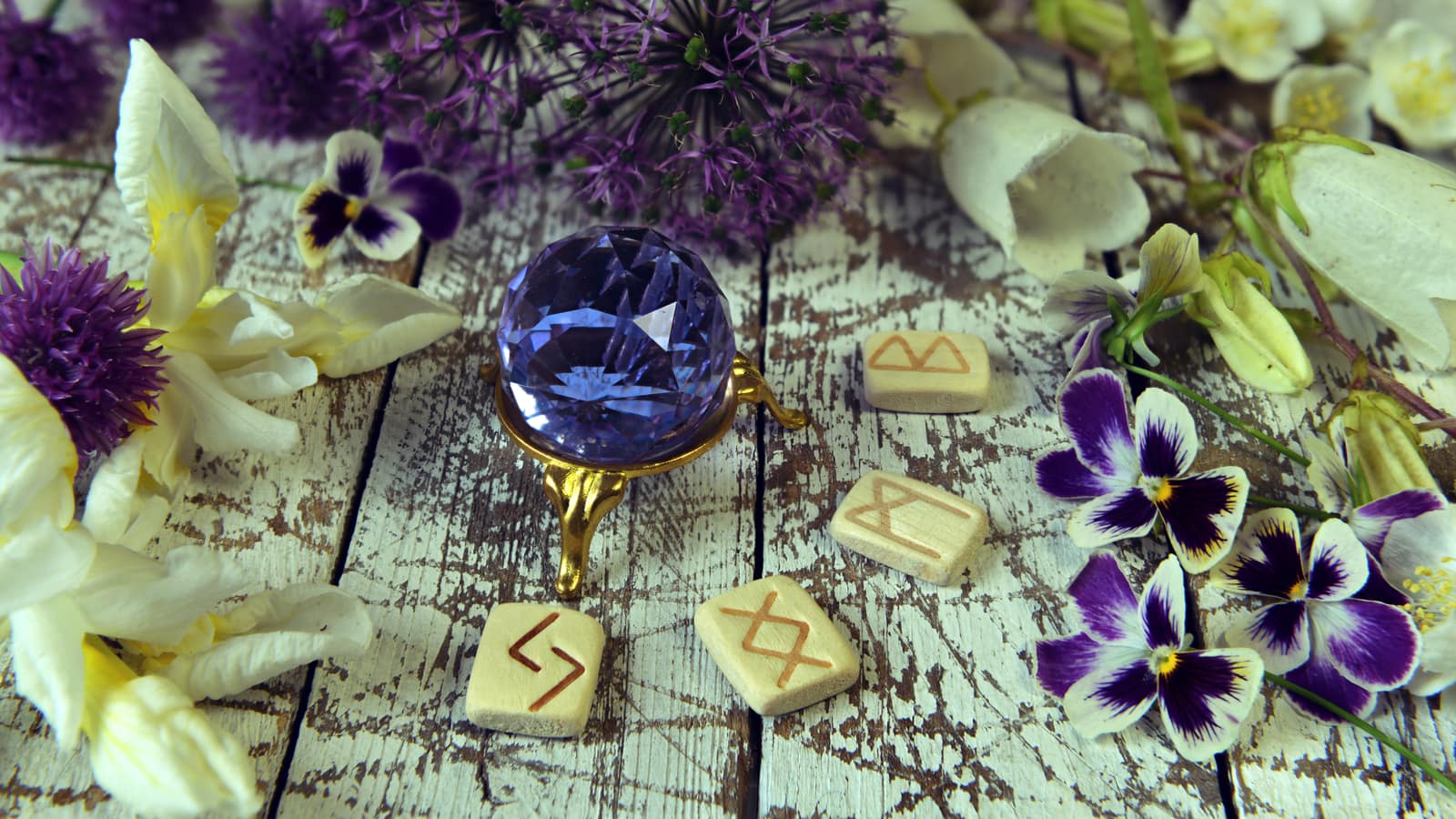
You bought a set. Twenty-four small tiles and a bag, plus a booklet telling you these symbols had been used by Norse seers for thousands of years to divine the will of the gods. You drew one, looked it up, read three sentences about "the unknowable" — and something didn't sit right. The booklet was extremely confident and gave no sources for anything.
The usual response is to buy a better book, or to assume the vagueness is the point. Neither helps. The popular literature on runes routinely presents material invented in the last forty years as if it were Iron Age tradition, and once you can't tell which parts are which, you can't tell what you're actually learning.
Here's the useful thing: the honest version is more interesting, not less. The runes are real. There are inscriptions in museums in Denmark and Sweden and Norway carved by people whose names we know because they carved them. What's uncertain is a narrower question — how, exactly, these letters were used to answer questions — and being clear-eyed about that uncertainty is what separates a competent beginner from someone reciting a paperback. Astra Trainer's runes course is built around this distinction, with short lessons and a quiz after each, but the underlying principles are worth having on their own.
What is rune casting, actually?
Rune casting is the practice of drawing or scattering marked tokens and interpreting the symbols that come up — a form of what anthropologists call sortilege, or divination by lots.
Mechanically it's simple. You have 24 tokens, each bearing one character of the Elder Futhark. You draw one, or three, or scatter a handful and read the ones that land face up. Then you interpret — and the interpretive layer is where all the variation lives. Two books will give you two different readings of the same rune, sometimes barely overlapping.
What rune casting is not is a decoding procedure. There's no key that converts a symbol into a fact about your life. What practitioners describe doing — and what's honest to say about it — is using a fixed set of symbols as prompts for structured reflection: the rune supplies a theme, you supply the situation, and the interaction is where anything useful happens. That framing matters practically, not just ethically. Treat the runes as a lookup table and the practice collapses the first time the lookup returns something that doesn't fit.
The runes don't tell you anything. They give you twenty-four fixed places to stand while you look at a problem — which is a genuinely different thing, and a more defensible one.
Check yourselfA set is sold to you as the Viking runes. Before you read on: predict whether that description is accurate, and what it would tell you about the book it came with.Show the answerHide the answer
It is not accurate. The Viking Age begins around 793 CE, and by then Scandinavia had largely moved to the reduced 16-rune Younger Futhark — the Elder Futhark ran from roughly 150 to 800 CE and is pre-Viking. An author who gets this wrong is reliably working from other popular books rather than from sources, which makes it one of the cheapest reliability tests you can run on a rune guide.
What were the runes originally for?
Writing. The Elder Futhark was an alphabet, and the overwhelming majority of surviving inscriptions are ordinary text.
The script has 24 characters and was in use across Germanic-speaking Europe from roughly 150 to 800 CE. It's called the futhark after its first six letters — f, u, th, a, r, k — the same way "alphabet" comes from alpha and beta. "Elder" distinguishes it from the later Younger Futhark, a reduced 16-rune system used in Scandinavia during the Viking Age proper, and from the Anglo-Saxon futhorc, which expanded in the other direction.
The oldest undisputed runic inscription is on a comb from Vimose in Denmark, around 160 CE. It reads harja — probably a personal name. What survives from the Elder Futhark period is a few hundred inscriptions, and they are mostly names: who made this, who owns this, who is buried here.
A minority are harder to read and may be formulaic — words like alu and laukaz recur in contexts that suggest something other than plain labelling, and runologists take those seriously. But "some inscriptions may have had ritual force" is a long way from "the runes were an oracle," and the gap between those two statements is where most beginner guides quietly cheat.
A tell worth knowing. If a source calls the Elder Futhark "the Viking runes," be careful with the rest of it. The Viking Age begins around 793 CE, by which point Scandinavia had largely moved to the Younger Futhark — the Elder Futhark is pre-Viking. Getting this wrong reliably signals an author working from other popular books rather than from sources.
How much do we actually know about historical rune divination?
Less than almost any popular book admits — and the single most-cited piece of evidence doesn't mention runes.
That evidence is Tacitus, Germania, chapter 10, written around 98 CE. A branch is cut from a fruit-bearing tree and divided into small pieces, which are marked with distinguishing signs and scattered on a white cloth. A priest — or, for a family matter, the head of the household — prays, looks upward, and picks up three pieces one at a time, reading them by the marks cut into them.
It's a vivid passage and clearly describes lot-casting with marked wooden tokens. Two problems. First, Tacitus writes notae, "signs" or "marks," not runes; he never uses a word for the script. Second, he's writing decades before the earliest runic object we can actually date. The marks may have been early runes. They may equally have been tally marks or tribal signs. The passage is consistent with runic divination without being evidence for it.
Beyond Tacitus the picture is fragmentary. Later Norse literature refers to runes in magical contexts, but it was written down in Christian Iceland centuries after the Elder Futhark fell out of use, and it describes carving far more often than drawing lots. No ancient manual survives — nobody wrote down a rune-by-rune divinatory system, because as far as the record shows, nobody had one to write down.
| What's solid | What's plausible | What's modern |
|---|---|---|
| The Elder Futhark existed, 24 characters, c. 150–800 CE | Some inscriptions had ritual or protective intent | The 24 runes as a fixed oracle deck with set meanings |
| Hundreds of inscriptions survive; most are names and ownership marks | Germanic peoples cast marked lots, per Tacitus | Reversed or "merkstave" rune meanings |
| The Kylver Stone (Gotland, c. 400 CE) lists all 24 in order | The lots Tacitus describes may have borne runes | The blank rune |
| Runes remained in use for centuries as everyday writing | Rune names carried meaning beyond their sound | Three-rune past/present/future spreads |
Where do modern rune meanings come from?
Two sources, one medieval and partial, one from 1982 and enormously influential.
The rune poems. Three medieval mnemonic poems give a stanza to each rune of their respective alphabets: the Old English rune poem, composed perhaps in the 8th or 9th century, the Norwegian from around the 13th, the Icelandic from around the 15th. These are the closest thing we have to period commentary on what the rune names meant. They are also, crucially, not about the Elder Futhark — the Old English poem covers the Anglo-Saxon futhorc, the Norse poems the 16-rune Younger Futhark. The reconstructed Proto-Germanic names on any modern rune set are back-formations, built by comparing those later poems with Gothic letter names and with what historical linguistics predicts. They are careful reconstructions, not attested contemporary names, and nobody serious claims otherwise. The Old English poem's own survival shows how thin the record is: its manuscript, Cotton Otho B.x, burned in the Cotton library fire of 1731, and every modern edition depends on George Hickes's 1705 printing.
Ralph Blum. The Book of Runes was published in 1982, packaged with a bag of tiles, and sold in the high hundreds of thousands. More than any other single source, it is why rune divination looks the way it does in English-language bookshops. Blum reordered the futhark into a sequence of his own, introduced a blank twenty-fifth rune representing the unknowable — a piece with no historical precedent whatsoever — and, by his own account, arrived at several interpretations by consulting the I Ching and folding those hexagrams into the runes.
None of that is dishonest on Blum's part; he was candid about his method. The trouble is downstream — forty years of books, apps and websites have copied his meanings while dropping his caveats, so a system assembled in the early 1980s now circulates as ancient Norse wisdom. If your rune set came with a blank tile, you are holding Blum's system, whatever the packaging says.
How should a beginner actually start?
Learn the runes as letters before you learn them as symbols, because the letter layer is the documented part and everything else attaches to it.
Four things are worth holding for each rune, in this order:
- The sound value. ᚠ is /f/. ᚢ is /u/. The rune's actual, verifiable function, and an afternoon's work to get roughly right.
- The name. Fehu, Uruz, Thurisaz. Reconstructed, but consistently used and worth knowing as the standard handle.
- The literal meaning. Cattle. Aurochs. Giant or thorn. Concrete nouns from the world the script came out of.
- The interpretive layer. What the name suggests once extended — cattle as movable wealth, the aurochs as raw untamed force. This is where books diverge, and knowing it's the divergent layer beats picking a favourite version.
Then, once the alphabet is in place:
- Write something. Transliterate your name, or a sentence. Nothing embeds a script faster than using it as one, and it immediately shows where the Elder Futhark doesn't map onto English.
- Start with one rune, not three. A single draw plus a written note about what you made of it builds range. Three-rune spreads early on mostly produce fluent-sounding nonsense.
- Keep a log. Rune, date, situation, what you took from it. Reread it monthly. This is the practice that most reliably improves people's readings, and it costs nothing.
- Read one scholarly source. A book by an actual runologist alongside your practical guide. You'll hear the difference in register immediately, and never quite unhear it.
A useful check: can you say what sound a rune makes, without reaching for its oracle meaning? If not, you've learned a keyword list attached to a picture, not an alphabet — and the keyword list is the part with the least evidence behind it.
Try this on the rune set you already own
Ticked: 0 of 6
The first three are the documented layer and take about an afternoon between them. The last three are the practice. A low count is not a verdict on your reading — most rune books sell the interpretive layer and skip everything on this list.
What are the most common beginner mistakes?
Treating invented tradition as ancient fact — everything else follows from that one.
The specific failures are predictable. Beginners memorize a single book's meanings as if they were canonical, then feel lost when a second book contradicts the first. They learn reversed meanings as 24 extra entries, doubling the workload for a practice the rune poems give no basis for. They start with elaborate nine-rune layouts before they can reliably identify a rune on sight. And they conflate the three futharks, mixing Younger Futhark names into an Elder Futhark set without noticing.
There's also a quieter mistake: reading about the runes instead of being tested on them. It's the same trap that sends people looking for tarot flashcards — the available material is almost entirely prose to absorb, with nothing to recall against. Recognition feels like knowledge right up to the moment you need to produce something and can't. The tarot card meanings reference is built the other way: read it, close it, then answer before checking.
How long does it take to learn the Elder Futhark?
The alphabet itself is a week or two of short daily sessions. Interpretive fluency is open-ended, and anyone quoting you a number for that is guessing.
Twenty-four characters is a small set — smaller than the English alphabet, far smaller than a tarot deck's 78. Spread over short sessions across a fortnight, with recall practice rather than rereading, most people can name every rune and give its sound and literal meaning. That's the whole documented layer, and it goes quickly. What takes longer isn't memorization at all: it's developing a consistent interpretive practice and being able to say where each part of it came from. That has no completion date, and it can't be shortcut by buying a longer book.
If you're thinking about eventually working with clients, what that actually involves is worth understanding early — not least because the ethics of a practice with this much invented history deserve deciding before you charge for it, not after.
What to take from this
The runes have a real history, and it's better than the marketed one. A working alphabet carried across Europe for six centuries, carved on combs and spears and grave slabs, most of it saying nothing more mystical than a name.
The divinatory system layered on top is young. Some comes from careful reading of medieval poems that describe different alphabets; a great deal comes from one paperback published in 1982 and everything that copied it. The honest description is "a modern symbolic practice built on an ancient script," not "an ancient oracle."
Learn the script first. Keep the layers labelled. When you don't know something — and with Perthro, nobody does — say so. That habit will make you a better reader than any amount of confident prose.
Test yourself
Question 1 of 3
Someone cites Tacitus as proof that Germanic peoples were reading runes in 98 CE. What is the precise problem with that?
Did the Vikings read runes for divination?
There's no clear evidence they used the Elder Futhark as a fixed 24-symbol oracle. Runes were primarily a writing system, and by the Viking Age Scandinavia was mostly using the later 16-rune Younger Futhark anyway.
Does Tacitus describe rune casting?
He describes Germanic lot-casting with marked wooden strips in Germania (98 CE), but he calls the marks notae — signs — and never mentions runes. He's also writing before the earliest datable runic inscription.
Why do rune books disagree with each other?
Because there's no historical source that assigns divinatory meanings rune by rune. Modern systems are reconstructions, and the most widely copied one comes from Ralph Blum's 1982 book rather than from period evidence.
Should I use a rune set with a blank rune?
You can, but know what it is. The blank rune was introduced by Blum in 1982 and has no precedent in any historical futhark. Plenty of practitioners simply leave it in the box.
Do reversed runes have separate meanings?
That's a modern convention. The rune poems don't give inverted stanzas, and several runes are symmetrical enough that "reversed" isn't well defined. Many practitioners read upright only.