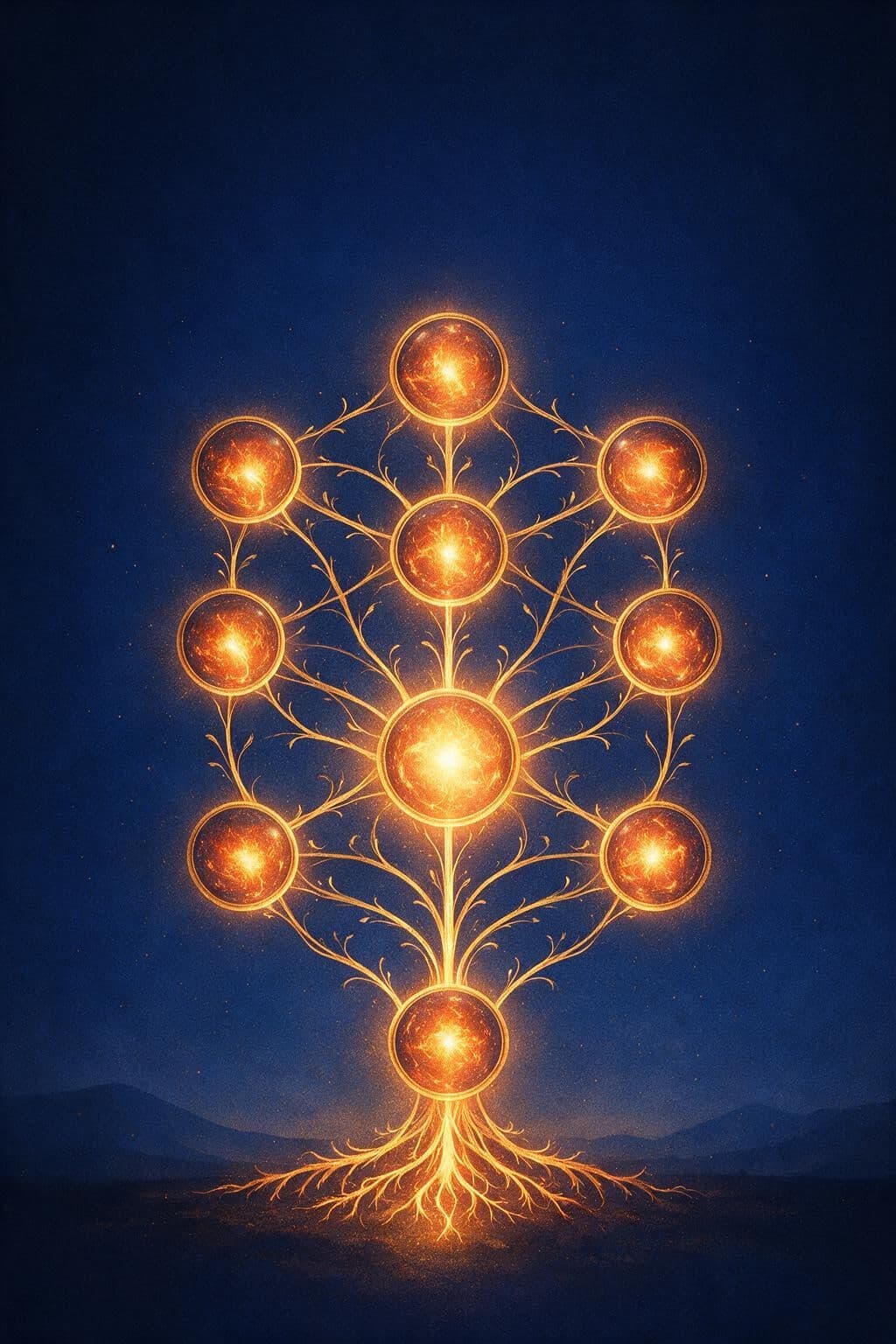

You have seen the diagram. Ten circles in a pattern that is almost symmetrical, joined by twenty-two lines, reproduced everywhere as though its meaning were self-evident. So you look at it. You count the circles. Nothing happens.
Then you compare two versions and find they don't agree. One labels the spheres in Hebrew. One puts a planet in each. One hangs a tarot card on every line and calls the whole thing ancient. The usual response is to assume you need a better diagram, or to memorise the positions and wait for comprehension to arrive. It won't. Memorising the picture is like memorising the shape of a sentence in a language you don't read.
The Tree isn't a symbol with a hidden meaning. It's a diagram of a structure, and the structure is an argument — about how something infinite could give rise to something finite. Get the argument and the positions no longer need memorising, because they follow. Astra Trainer's Kabbalah course is built around that order of operations, with five-minute lessons and a quiz after each, but the structure is worth having on its own.
What is the Tree of Life in Kabbalah?
The Tree of Life, Etz Chaim (עץ חיים), is the diagram that maps the ten sephirot — the emanations through which Kabbalistic thought describes the infinite God becoming related to creation.
The problem it answers is genuinely hard. Kabbalah begins from Ein Sof (אין סוף, "without end"): God as infinite, without attribute, without limit, and therefore with no property you could name and no point of contact with a finite world. Nothing can be said about Ein Sof, including that it is good, or one, or present. And yet the world exists, and Jewish tradition speaks of a God who acts, judges and shows mercy.
The sephirot (ספירות, singular sephirah, ספירה) are the answer: ten emanations through which the infinite becomes progressively expressible and, finally, relatable. Not ten gods, and not ten parts of God — the texts are emphatic on both counts. Closer to ten aspects under which an unknowable unity can be approached.
The name has a double life. Etz Chaim comes from Proverbs 3:18 — wisdom is "a tree of life to those who grasp her" — and is also the title of Chaim Vital's 1573 compilation of Isaac Luria's teachings. When a source says "Etz Chaim," check which it means.
The sephirot are also arrayed across four olamot, worlds: Atzilut (emanation), Beriah (creation), Yetzirah (formation) and Asiyah (action), descending from the purely divine to the physical.
The Tree isn't a map of the universe. It's a map of how an unknowable God becomes something a person can stand in relation to — a different and much more specific question.
What are the ten sephirot, in order?
They descend from Keter to Malkhut, from the least differentiated to the most concrete, and each name is an ordinary Hebrew word doing extraordinary work.
| Sephirah | Hebrew | Translation | What it holds |
|---|---|---|---|
| 1. Keter | כתר | Crown | The first stirring toward existence; closest to Ein Sof, least sayable |
| 2. Chokhmah | חכמה | Wisdom | Insight as a flash — undivided, before it has been unfolded |
| 3. Binah | בינה | Understanding | The unfolding; wisdom developed into something with parts |
| 4. Chesed | חסד | Loving-kindness | Unbounded giving, expansion, grace without limit. Also Gedulah (greatness) |
| 5. Gevurah | גבורה | Severity, strength | Restraint, judgement, the drawing of boundaries. Also Din (judgement) |
| 6. Tiferet | תפארת | Beauty | The reconciliation of Chesed and Gevurah; harmony, compassion |
| 7. Netzach | נצח | Victory, endurance | Persistence, the drive that carries something through |
| 8. Hod | הוד | Splendour, majesty | Yielding, receptivity, the counterweight to Netzach's push |
| 9. Yesod | יסוד | Foundation | The channel gathering everything above and transmitting it downward |
| 10. Malkhut | מלכות | Kingdom | Receiving, manifestation, divine presence in the world. The Shekhinah |
Two groupings do most of the work of holding these in mind.
- The upper three — Keter, Chokhmah, Binah — are often treated as a distinct order, the intellectual or supernal triad. In Hasidic thought, especially Chabad, the triad of Chokhmah, Binah and Da'at gives the movement its name: ChaBaD.
- The lower seven — Chesed through Malkhut — are the middot, the emotive attributes, associated with the seven days of creation. They also structure a live practice: during Sefirat ha-Omer, the seven weeks counted between Passover and Shavuot, each of the forty-nine days takes a pairing, so a given day is "Gevurah within Chesed."
Most beginner explanations omit that last detail, and it changes the character of the diagram. The Tree isn't only contemplated. It's counted, on a calendar, by people not thinking about symbolism.
What are the three pillars, and why do they matter?
Three vertical columns organise the ten, and the entire ethical logic of the Tree lives in the tension between the outer two.
- The pillar headed by Chokhmah — through Chesed and Netzach — is expansion, giving, outward force. Conventionally the Pillar of Mercy.
- The pillar headed by Binah — through Gevurah and Hod — is limitation, form, restraint. Conventionally the Pillar of Severity.
- The central pillar — Keter, Tiferet, Yesod, Malkhut, with Da'at sometimes marked below Keter — is balance, and the only column running the full height from crown to kingdom.
The point is that neither outer pillar is good alone. Chesed without Gevurah is boundless giving with no form to hold it — the tradition treats unrestrained mercy as a kind of dissolution, kindness that collapses every distinction and so accomplishes nothing. Gevurah without Chesed is judgement with no compassion in it: severity turned to cruelty. Tiferet is what each becomes when the other tempers it.
This is why the Tree is drawn rather than listed. The relationships are the content. Ten attributes in three columns with a balancing axis tells you the tradition's account of divine action, and of a well-ordered life, is about the calibration of opposites.
Left and right are genuinely ambiguous, and sources contradict each other. Some depictions orient the Tree from the viewer's perspective, some from the Tree's own, which flips Chesed and Gevurah across the page. Learn the pillars by the sephirah heading each and no mirrored diagram will trip you.
Check yourselfMany diagrams mark a further circle on the central pillar, Da'at, and no traditional count includes it. Before you read on: what do you think it names, and why can it not simply be added to the ten?Show the answerHide the answer
Because the count is fixed. Sefer Yetzirah states the constraint directly — ten, and not nine; ten, and not eleven — so nothing may be added to it. Da'at names the point at which Chokhmah and Binah, insight and its unfolding, become knowledge that can be acted on; in Hasidic thought it carries intellect down into the emotive attributes. Less a place on the Tree than a hinge within it.
What is Da'at, and why isn't it one of the ten?
Da'at (דעת, "knowledge") is a point on the central pillar that many diagrams mark and no traditional count includes — not an eleventh sephirah, and the sources are blunt about it. Sefer Yetzirah, the oldest surviving text of the tradition, states the constraint directly: ten, and not nine; ten, and not eleven. Whatever Da'at is, it can't be an addition to the count.
What it names is the point where Chokhmah and Binah — insight and its unfolding — become knowledge that can be acted on. In Hasidic thought, particularly Chabad, Da'at carries intellect down into the emotive attributes; without it, understanding never reaches conduct. Less a place than a hinge.
You will also see Da'at described as sitting in "the Abyss," a region of the Tree to be crossed. That framing is largely a Hermetic Qabalah elaboration from the Golden Dawn material onward, and it carries connotations — initiatory crisis, a gap to be leapt — the Jewish sources don't supply. Both usages circulate. They aren't the same idea.
What are the 22 paths, and why the Hebrew alphabet?
The twenty-two paths correspond to the twenty-two letters of the Hebrew alphabet, and the pairing comes from Sefer Yetzirah's opening claim that God created through "thirty-two paths of wisdom" — ten sephirot plus twenty-two letters. Ten and twenty-two make thirty-two. That arithmetic is the seed of everything built afterwards.
Sefer Yetzirah then divides the letters into three groups, and this division is the origin of correspondences most people meet centuries downstream without knowing where they came from:
- Three mother letters — Aleph (א), Mem (מ), Shin (ש). Air, water and fire, with Aleph as the balance point between the other two.
- Seven double letters — Bet, Gimel, Dalet, Kaf, Pe, Resh, Tav. "Double" because each carries a hard and a soft pronunciation. Associated with the seven days and, in the text's own scheme, with planets.
- Twelve simple letters — He, Vav, Zayin, Chet, Tet, Yod, Lamed, Nun, Samekh, Ayin, Tzadi, Qof. Single-sound letters, associated with the twelve months.
Three, seven and twelve. Elements, planets, zodiac signs. Every later system of astrological attribution on the Tree elaborates a division already present in a text possibly written before the 7th century.
What Sefer Yetzirah does not do is say which letter connects which pair of sephirot. The specific wiring diagram — Aleph joins these two spheres, Bet joins those — is a much later construction, and it's where versions diverge most.
Where do the tarot correspondences come from?
From Éliphas Lévi in the 1850s and the Hermetic Order of the Golden Dawn after 1888 — not from Jewish Kabbalah at any point in its history.
Lévi, a French occultist born Alphonse-Louis Constant, noticed the arithmetic everyone notices: the Major Arcana number twenty-two, and so do the Hebrew letters, and so do the paths. He matched them, and mapped the four suits onto the four letters of the Tetragrammaton. The Golden Dawn — founded in London by William Wynn Westcott, Samuel Liddell MacGregor Mathers and William Robert Woodman — turned the scheme into a curriculum and revised it, moving the Fool to the front as card zero and attributing it to Aleph, which shifted every subsequent card by one letter. That revised system sits underneath the Rider–Waite–Smith deck, Crowley's Thoth, and nearly every tarot book written since.
None of it appears in the Zohar, in Etz Chaim, or anywhere in the Jewish corpus. Tarot begins as a card game in 15th-century northern Italy; the traditions ran separately for around four hundred years before Lévi introduced them.
Worth stating precisely rather than dismissively. Hermetic Qabalah is internally consistent and the Tree is a powerful organising structure for tarot's 78 cards. Just hold the dates: a Victorian synthesis laid over a medieval Jewish structure.
This is the most common error in "Tree of Life explained" content. Pages routinely show a Tree with tarot cards on the paths and describe it as ancient Kabbalah. Six centuries separate the two components — and noticing that is the difference between knowing what you're looking at and reciting someone else's diagram.
Why does every version of the diagram look slightly different?
Because there is no single canonical arrangement, and the version most familiar in the West descends from a specific 17th-century engraving rather than from a Jewish source.
Traditional ilanot — the Hebrew scrolls and diagrams depicting the sephirot — vary considerably, and arrangements associated with Cordovero and with the Lurianic school differ from one another. The first printed depiction appeared in Portae Lucis (Augsburg, 1516), Paolo Riccio's Latin abridgement of Joseph Gikatilla's Sha'arei Orah — so the first Tree diagram in print reached Europe through the Christian Cabala of the Renaissance.
The Tree reproduced in almost every Western esoteric book, meanwhile, follows the engraving in Athanasius Kircher's Oedipus Aegyptiacus (1652). Its configuration became the standard variant in Hermetic Qabalah, and passed from there into the Golden Dawn material and general circulation. When you see "the" Tree of Life, you are usually seeing Kircher's.
So "which diagram is right" is a malformed question. Ask instead which tradition an arrangement belongs to, and what it was drawn to demonstrate.
How do you actually learn the Tree of Life?
By learning the ten Hebrew words and the logic of the pillars first, and leaving the paths until the spheres are stable — the opposite of how most guides sequence it.
- 1The ten names, in Hebrew, with translations. Ten words, an afternoon. Don't proceed until you can produce all ten in descending order — everything else attaches here.
- 2The two triads. Upper three as intellect, lower seven as middot. Ten items become two groups, and each sphere gains a neighbourhood.
- 3The three pillars, learned as a tension. Expansion, restraint, balance. Once you can explain why Chesed unchecked is a problem, the geometry stops being arbitrary.
- 4Da'at, and why it isn't counted. Short, and it inoculates you against a common confusion.
- 5The 22 letters and the _Sefer Yetzirah_ division. Three mothers, seven doubles, twelve simples — learn this first and correspondence tables become derivable rather than memorisable.
- 6Correspondences last, with their dates attached. Planetary attributions or tarot path assignments, learned as the later overlays they are.
Most people stall because they start at step six. Correspondence tables are the most visible part of the subject and the least informative, and memorising one you have no framework for produces exactly the experience of staring at a diagram and feeling nothing.
A useful check: cover the diagram and describe the tension between Chesed and Gevurah, and what Tiferet does about it, in your own words. If you can, you have the structure. If you can only point at where the circles go, you have a picture.
Check the structure with the diagram covered
Ticked: 0 of 5
The third line is the article's own test, and it is what separates holding the structure from holding a picture. If the last line is the only blank one, you are in the ordinary place: correspondences are the most visible part of this subject and the least informative.
What to take from this
The Tree of Life looks like a symbol and functions like a schematic. It holds an argument about how an infinite God becomes a God one can relate to, and it holds it in its geometry — which is why the relationships between the spheres carry more meaning than the spheres taken singly.
Ten names in Hebrew, three columns in tension, twenty-two letters bridging them. That's the whole frame, and it's small enough to hold in a week. Everything else — planetary attributions, tarot paths, the four worlds, the variant arrangements — hangs off it.
And the dates matter. A medieval Jewish structure, a Renaissance Latin transmission, a 17th-century engraving, a Victorian occult overlay. Keeping those layers distinct doesn't diminish any of them. It's the only way to see what each contributed.
Test yourself
Question 1 of 3
A diagram you find online puts Gevurah on the left of the page and the one in your book puts it on the right. What follows?
What is the Tree of Life in Kabbalah?
It's Etz Chaim, the diagram mapping the ten sephirot — the emanations through which Kabbalistic thought describes an infinite God (Ein Sof) becoming related to a finite world. A theological structure, not a symbol with a hidden meaning.
What are the ten sephirot in order?
Keter (crown), Chokhmah (wisdom), Binah (understanding), Chesed (loving-kindness), Gevurah (severity), Tiferet (beauty), Netzach (victory), Hod (splendour), Yesod (foundation) and Malkhut (kingdom).
What are the three pillars of the Tree of Life?
The pillar headed by Chokhmah (expansion, mercy), the pillar headed by Binah (restraint, severity), and the central pillar of balance from Keter to Malkhut. Learn them by which sephirah heads each, since diagrams mirror left and right inconsistently.
Is Da'at the eleventh sephirah?
No. Sefer Yetzirah is explicit that there are ten and not eleven. Da'at names the point where Chokhmah and Binah integrate into applied knowledge — significant in Hasidic thought, but never counted among the ten.
Why are there 22 paths on the Tree of Life?
Because Sefer Yetzirah describes creation through thirty-two paths of wisdom: ten sephirot plus the twenty-two Hebrew letters. Those letters divide into three mothers, seven doubles and twelve simples — the source of later elemental, planetary and zodiacal attributions.
Are the tarot cards on the paths part of traditional Kabbalah?
No. Lévi matched the 22 Major Arcana to the 22 Hebrew letters in the 1850s, and the Golden Dawn revised the scheme after 1888. A coherent Hermetic Qabalah system, roughly six centuries younger than the Jewish material it's laid over.