

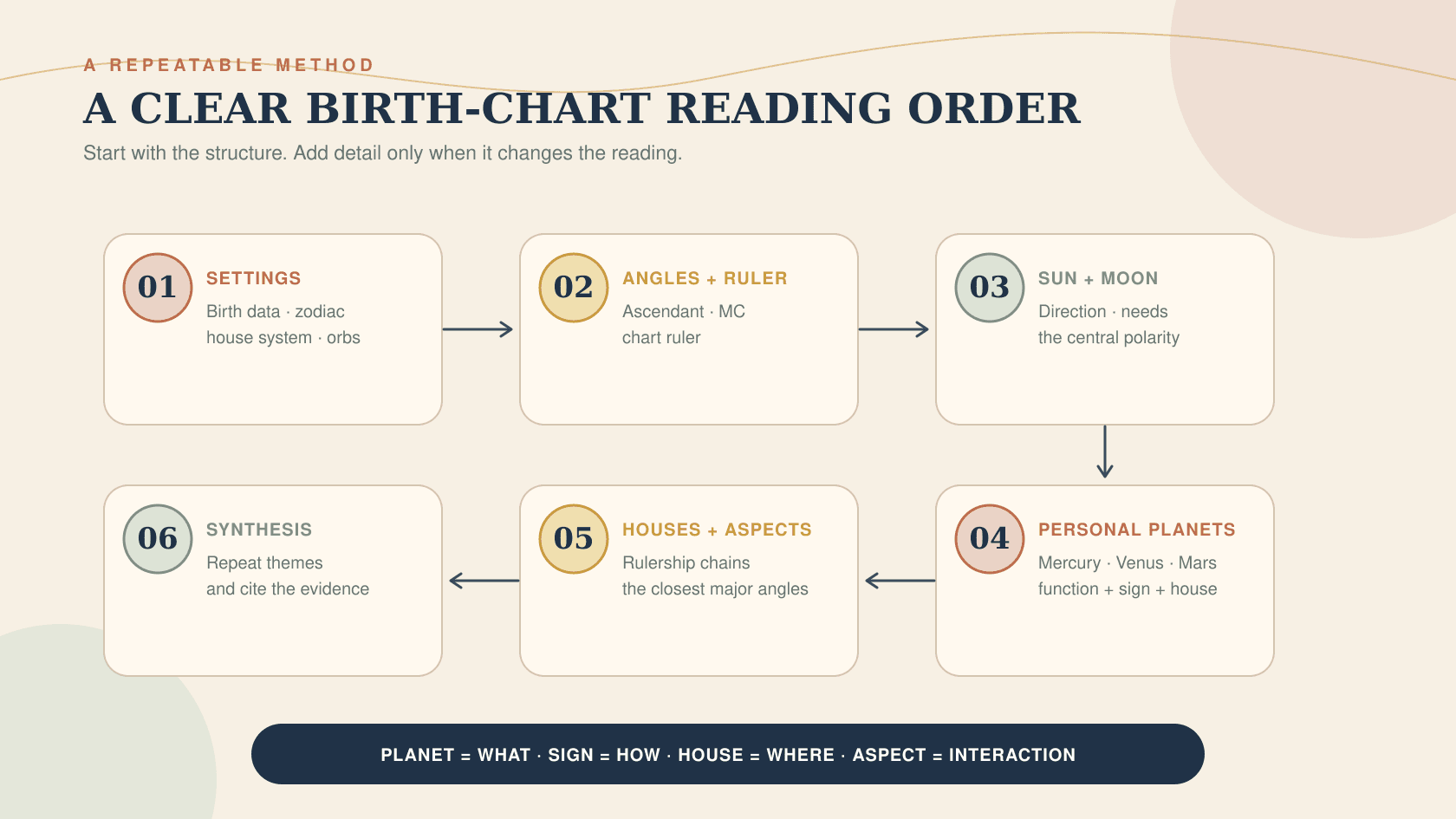
To read a birth chart, do not begin with every symbol at once. Confirm the chart settings, find the Ascendant and its ruling planet, read the Sun and Moon, add the personal planets by sign and house, then examine a few close major aspects. Only after that should you combine repeated themes into a short interpretation.
This guide shows that sequence on one fictional teaching chart. The placements were chosen to make the method easy to see; they do not belong to a real person and should not be used as a factual personality profile. If you first need to understand what the wheel measures, start with what a natal chart actually shows.
The goal is not to produce twenty disconnected labels. It is to build an evidence trail: planet = what, sign = how, house = where, and aspect = how two parts interact. A useful reading can point back to the chart feature behind every sentence.
What do you need before reading a birth chart?
You need a chart calculated from a birth date, an accurate local birth time, and a birthplace. The date locates the planets along the zodiac. The time and place establish the local horizon, the Ascendant, and the houses. If the time is unknown, the Sun and slower planets can still be read by sign, but the Ascendant and houses should remain unconfirmed.
Before interpreting anything, record the calculator settings. This example uses Western tropical positions, traditional planetary rulers, and Whole Sign houses. Another reader may choose Placidus houses or include modern rulers. Either can be used consistently, but quietly switching systems halfway through changes the evidence.
| Check | Why it matters | What to record |
|---|---|---|
| Birth data | Time and location determine the angles and houses | Date, local time, city, time-zone handling |
| Zodiac | Tropical and sidereal systems use different zero points | Tropical for this example |
| House system | A planet may change houses between systems | Whole Sign for this example |
| Rulership | Traditional and modern rulership schemes differ | Traditional rulers used for house analysis |
| Aspect orbs | Software may display different aspect lists | Major aspects within the stated orb |
Do not enter noon merely because the birth time is missing and then interpret the resulting Ascendant and houses as verified. A noon chart is a hypothetical time, not recovered birth data.
The sample birth chart used in this guide
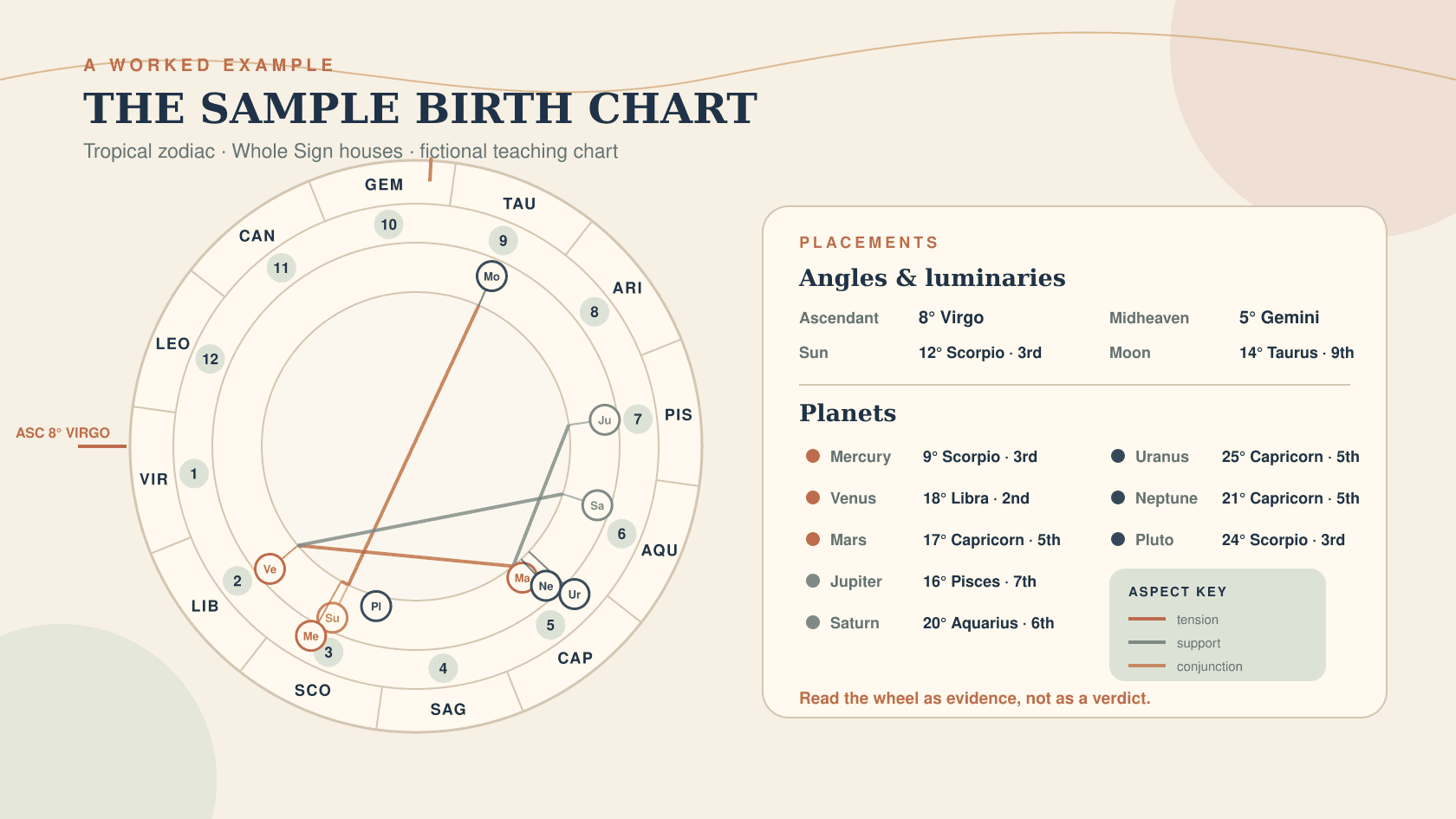
Our fictional example has Virgo rising at 8° and a Gemini Midheaven at 5°. Under Whole Sign houses, Virgo becomes the entire 1st house, Libra the 2nd, Scorpio the 3rd, and so on. The exact Midheaven can float inside a Whole Sign house; here it falls in Gemini, the 10th sign from Virgo.
| Point | Position | Whole Sign house |
|---|---|---|
| Ascendant | 8° Virgo | 1st |
| Midheaven | 5° Gemini | 10th |
| Sun | 12° Scorpio | 3rd |
| Moon | 14° Taurus | 9th |
| Mercury | 9° Scorpio | 3rd |
| Venus | 18° Libra | 2nd |
| Mars | 17° Capricorn | 5th |
| Jupiter | 16° Pisces | 7th |
| Saturn | 20° Aquarius | 6th |
| Uranus | 25° Capricorn | 5th |
| Neptune | 21° Capricorn | 5th |
| Pluto | 24° Scorpio | 3rd |
A worked chart is easier to learn from than a dictionary because every technique has to compete for priority. The question is not only “What does this mean?” but “What deserves to be said first?”
Step 1: Start with the Ascendant and chart ruler
The Ascendant is the zodiac degree rising on the eastern horizon. In many traditions it sets the chart's orientation and identifies the chart ruler. Virgo rises in this example, so Mercury — Virgo's traditional ruler — becomes the chart ruler.
Next, locate Mercury. It is at 9° Scorpio in the 3rd house and within 3° of the Sun. That gives the first interpretive chain: the planet organising the chart is placed in a house associated with communication, learning, siblings, and the immediate environment, while Scorpio supplies a concentrated, investigative style in conventional symbolism.
Do not turn that into a diagnosis such as “secretive communicator.” Keep the statement tied to function: Mercury rules the Virgo Ascendant and sits in Scorpio in the 3rd, so communication and inquiry become an early organising theme of the chart. The Sun conjunction will strengthen that theme later.
Step 2: Read the Big Three as three different jobs
The Sun, Moon, and Rising signs are a starting structure, not three competing personality labels. The Sun is conventionally associated with conscious direction and vitality, the Moon with habitual needs and responses, and the Ascendant with immediate approach and the chart's local framework.
Virgo rising
Virgo rising gives Mercury responsibility for the chart. A beginner may describe the outward approach as observant, selective, or improvement-oriented, but the more useful move is to follow Mercury into Scorpio and the 3rd house. The ruler tells us where the Ascendant's approach is directed.
Sun in Scorpio in the 3rd house
The Sun's traditional identity and direction themes are expressed through Scorpio and located in the 3rd house. Rather than stacking keywords, form a sentence: purpose is sought through sustained inquiry, difficult conversations, close observation, or learning that goes beneath the obvious. This is a symbolic reading, not a measured trait.
Moon in Taurus in the 9th house
The Moon is traditionally exalted in Taurus, a condition many astrologers read as steadier access to comfort, continuity, and embodied routines. In the 9th house, those needs are placed in study, philosophy, travel, religion, law, or encounters with unfamiliar frameworks. Because the Moon opposes the Sun, stability and inquiry will not remain separate themes.

Step 3: Add Mercury, Venus, and Mars
The personal planets add specific functions. Mercury is associated with perception and communication, Venus with attraction, agreement, taste, and relating, and Mars with action, assertion, separation, and conflict. Read each through both sign and house before checking aspects.
Mercury in Scorpio in the 3rd repeats the communication-and-investigation pattern already identified through the chart ruler. Its conjunction with the Sun joins thinking and expression to the chart's central direction. This repetition matters more than finding a new adjective for Mercury.
Venus at 18° Libra in the 2nd is in a sign it rules. Astrologers may read Venusian themes as comparatively direct here: balance, reciprocity, and aesthetic judgement applied to money, possessions, personal resources, or values. A placement in the 2nd does not promise wealth; it identifies the domain in which the symbolism is read.
Mars at 17° Capricorn in the 5th is traditionally exalted. Action is placed in creative work, play, romance, performance, children, or chosen risks and expressed through Capricorn's structured, strategic symbolism. The close square to Venus adds friction between preserving balance and pursuing a demanding objective.
Check yourselfIn the sample chart the 10th house is Gemini, and it holds no planets at all. Before you read on: is there anything a traditional reader can say about career from an empty 10th house, and if so, what would they follow?Show the answerHide the answer
Yes — they follow the ruler. Mercury rules Gemini and sits at 9 degrees Scorpio in the 3rd, so the chain runs 10th house, Mercury, 3rd house: public direction connected with writing, teaching, analysis, commerce, the movement of information. Occupancy is only the first layer, and an empty house is read through the placement of the planet that rules it.
Step 4: Follow house rulers to connect life areas
The twelve houses identify life areas, but occupancy is only the first layer. In traditional chart reading, the ruler of the sign on a house leads to another planet and house. That creates a connection between topics even when a house is empty.
For Virgo rising with Whole Sign houses, Gemini is the 10th house. Mercury rules Gemini, and Mercury sits in the 3rd. The interpretive chain is therefore 10th-house topics → Mercury → 3rd house. A reader might explore public work or reputation connected with writing, teaching, analysis, media, commerce, or the movement of information.
Pisces is the 7th house and Jupiter is its traditional ruler. Jupiter is also placed in Pisces in the 7th, giving partnership themes a direct, repeated emphasis within this framework. Again, this does not guarantee marriage quality or describe a partner as fact; it tells the reader that 7th-house questions carry unusual structural weight.
| House topic | Cusp sign | Traditional ruler | Ruler's placement | Connection to examine |
|---|---|---|---|---|
| Identity and approach (1st) | Virgo | Mercury | Scorpio, 3rd | Self-expression through inquiry and communication |
| Money and values (2nd) | Libra | Venus | Libra, 2nd | Resources tied directly to Venusian priorities |
| Partnership (7th) | Pisces | Jupiter | Pisces, 7th | Partnership becomes a repeated structural theme |
| Career and reputation (10th) | Gemini | Mercury | Scorpio, 3rd | Public direction linked with information and analysis |
Step 5: Read only the strongest major aspects first
Aspects are measured angles between planets. A conjunction combines two functions, an opposition places them across an axis, a square creates friction, a trine indicates an easier flow, and a sextile suggests a workable opportunity. Interpretations and allowable orbs vary by school, so begin with the closest major aspects rather than every line the software displays.
| Aspect | Orb | Traditional reading task | How it modifies this chart |
|---|---|---|---|
| Sun conjunct Mercury | 3° | Combine identity/direction with thought and speech | Reinforces the Scorpio 3rd-house inquiry theme |
| Sun opposite Moon | 2° | Hold conscious direction and habitual needs across an axis | Links 3rd-house inquiry with 9th-house beliefs and perspective |
| Venus square Mars | 1° | Work with tension between agreement and assertion | Complicates the balance between resources and creative ambition |
| Mars sextile Jupiter | 1° | Find a channel between action and expansion | Connects 5th-house initiative with 7th-house cooperation |
| Venus trine Saturn | 2° | Notice an easier link between relating and structure | Adds restraint and durability to Venusian choices |
The Sun–Moon opposition is more important than a wide aspect between two outer planets because it involves both luminaries and is close. It also connects houses already central to the chart: the 3rd house of immediate learning and exchange with the 9th house of broader frameworks and meaning.
Step 6: Look for repetition before writing conclusions
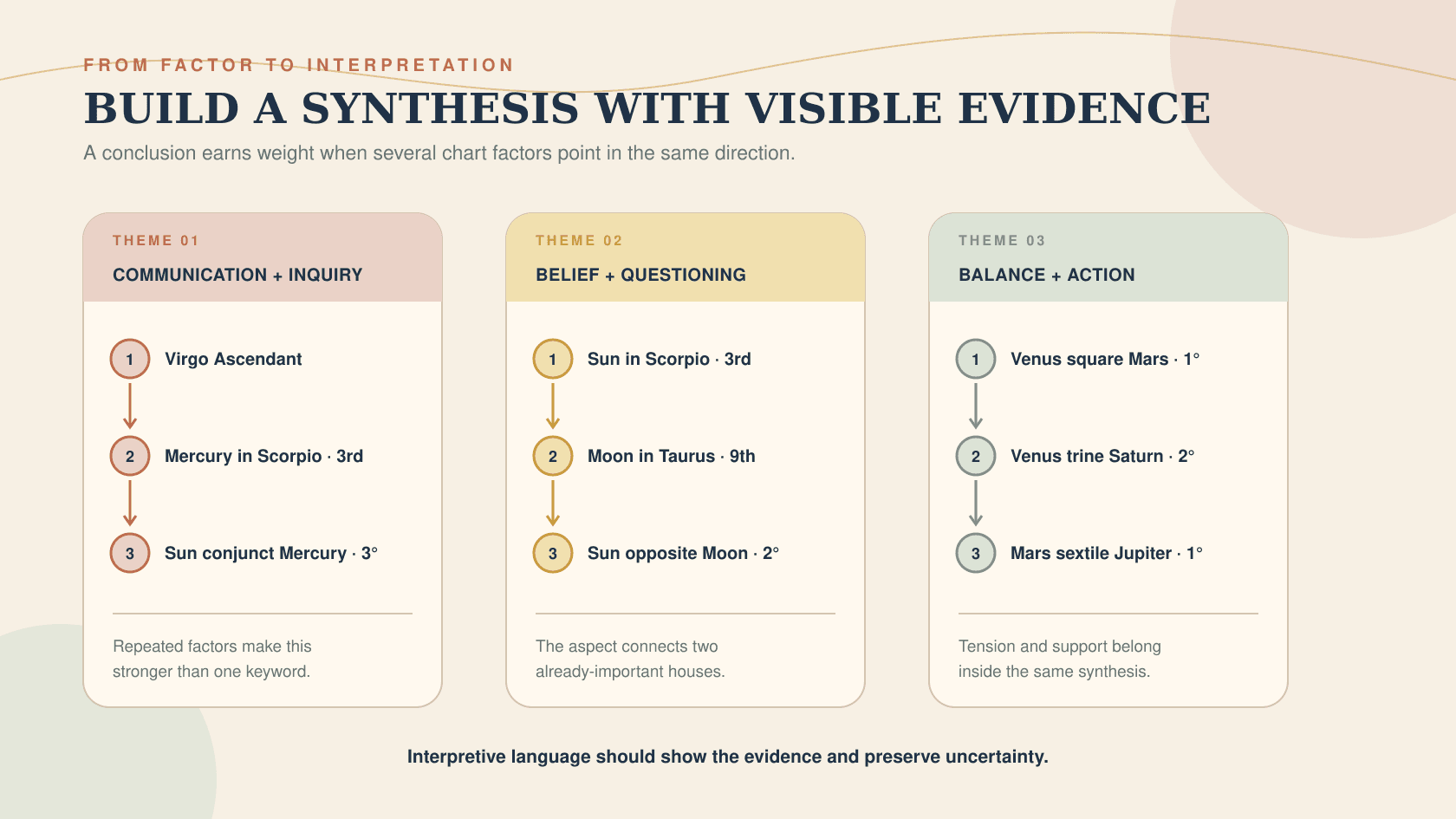
A chart becomes coherent through repetition. In this example, Mercury rules the Ascendant and 10th house, occupies the 3rd, conjoins the Sun, and shares Scorpio with the Sun and Pluto. Several independent factors point toward communication, analysis, research, and the handling of complex information.
A second pattern links the 2nd, 5th, 6th, and 7th houses through Venus, Mars, Saturn, and Jupiter. The tight Venus–Mars square is not isolated: Venus also trines Saturn, while Mars sextiles Jupiter. A reader can therefore discuss the negotiation between stability, disciplined effort, creative initiative, and cooperation without pretending the chart supplies one inevitable outcome.
Use a simple weighting rule: begin with angles and their rulers, luminaries, planets in angular houses, exact major aspects, and repeated rulership chains. Leave asteroids, minor aspects, and isolated symbolic details until the core reading already makes sense.
How to turn the chart into a short reading
A beginner often writes one paragraph per planet. That creates a catalogue, not a reading. Instead, choose two or three themes supported by multiple factors, state the evidence, and describe the tension or resource the pattern symbolically represents.
For this teaching chart, a concise opening could be: The chart repeatedly directs attention toward close observation, communication, and the organisation of complex information. Virgo rises, its ruler Mercury is in Scorpio in the 3rd house, and Mercury conjoins the Sun. The same Mercury also rules the Gemini 10th, linking public direction with 3rd-house skills.
A second paragraph could say: The Taurus Moon in the 9th opposes the Scorpio Sun in the 3rd. Within astrological symbolism, this can be read as an ongoing negotiation between trusted frameworks and the need to question, investigate, or revise them. Notice the wording: it describes a possible pattern and names its evidence.
A third could add: Venus in Libra squares exalted Mars in Capricorn, while Venus trines Saturn and Mars sextiles Jupiter. Relating, resources, creative ambition, discipline, and cooperation are connected rather than separate. The chart does not dictate which side wins; it supplies a structure for examining how those functions are balanced.
Run the same order once on your own chart
Ticked: 0 of 5
The five items are the reading order itself, done once. Most people stop after the second, which is also where most beginner material stops: the chain that runs from the ruler onwards is the part that turns a list of placements into a chart.
Common birth chart reading mistakes
- Reading every symbol equally. Angles, luminaries, rulers, and close major aspects usually deserve attention before minor points.
- Treating signs and houses as synonyms. A sign describes style within the tradition; a house locates the life area.
- Ignoring the chart ruler. The Ascendant's ruler often connects the opening impression to the rest of the chart.
- Using an empty house as “nothing happens here.” Its ruler still links that house to another part of the chart.
- Changing house systems to get a preferred answer. Compare systems openly, but do not mix them without saying so.
- Turning symbolism into certainty. A chart cannot diagnose health, prove compatibility, identify danger, guarantee money, or replace medical, legal, or financial expertise.
What if the birth time is unknown?
Work only with what the data supports. The Sun, Mercury, Venus, Mars, and slower planets can usually be located by sign from the date, although a planet changing signs that day may still require a time. The Moon moves quickly enough that its sign can also be uncertain on an ingress day.
Without a reliable time, omit the Ascendant, Midheaven, houses, and house rulership chains. You can compare a few hypothetical times to see what changes, but that produces a range of possibilities, not a recovered chart. Birth-time rectification is itself an interpretive practice and is not a verified way to reconstruct a missing record.
Label uncertainty directly: “Moon may be late Aries or early Taurus; houses unknown.” An incomplete chart with honest limits is more useful than a precise-looking chart built on invented data.
People may still study astrology as a historical symbolic system, shared language, or structured prompt for reflection. The responsible distinction is to identify which part is calculation and which part is interpretation, and not use a symbolic reading as evidence for high-stakes decisions.
What to take from this
The shortest reliable reading order is: settings, Ascendant and chart ruler, Sun and Moon, personal planets, house rulers, close major aspects, then repeated themes. That sequence turns a crowded wheel into a small set of connected statements.
The discipline is not memorising more keywords. It is showing why one factor matters, what modifies it, and how several factors support the same theme. When you can trace each sentence back to the chart, you are reading a system rather than assembling a horoscope.
Test yourself
Question 1 of 3
You have a birth date but no time, so you enter noon and the calculator returns a Libra Ascendant. What can honestly be done with that chart?
How do you read a birth chart for beginners?
Confirm the birth data and settings, find the Ascendant and its ruler, read the Sun and Moon, add Mercury, Venus, and Mars by sign and house, then examine the closest major aspects. Finish by combining only themes supported by several chart factors.
What should I look at first in a birth chart?
Start with the Ascendant, chart ruler, Sun, and Moon. They establish the chart's local framework, central direction, and habitual needs within astrological tradition.
What do planet, sign, and house mean in a birth chart?
A common beginner formula is planet = what function is described, sign = how it operates, and house = where in life it is expressed. Aspects then show how two planetary functions relate.
What is the chart ruler?
The chart ruler is the traditional or modern ruler of the Ascendant sign, depending on the system used. For Virgo rising, Mercury is the ruler.
Can I read a birth chart without an exact birth time?
You can usually read many planets by sign, with caution on changeover days. You cannot confirm the Ascendant, Midheaven, houses, or house rulers without a reliable time and birthplace.
Which house system should a beginner use?
There is no empirically proven best system. Whole Sign is visually straightforward and historically established; Placidus is a common modern Western default. Choose one, name it, and use it consistently.
How many aspects should I read?
Begin with close conjunctions, oppositions, squares, trines, and sextiles involving the Sun, Moon, chart ruler, personal planets, or angles.
Does an empty house mean nothing will happen there?
No. Empty houses are normal. Astrologers read an empty house through the sign on its cusp and the placement of that sign's ruler.