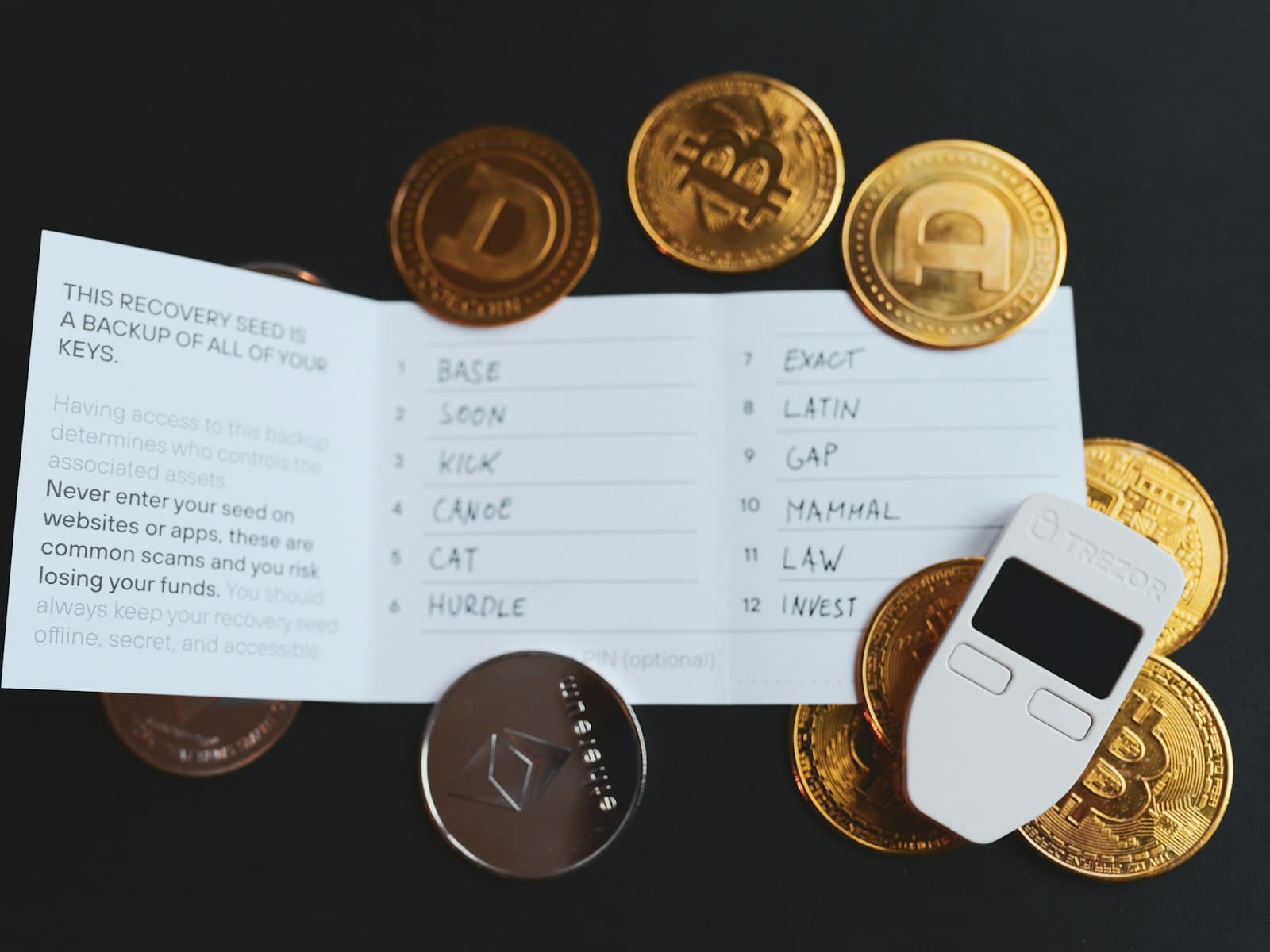
What is a crypto wallet? The name suggests a purse that holds coins, and that picture causes most of the confusion. Crypto coins are never stored in a wallet. They exist as entries on a shared public record, the blockchain. What a wallet stores is the secret that proves you are allowed to move those entries: your private key. Lose the key and the coins are still on the blockchain, but nobody can ever move them again. Hand the key to someone else and they can move them as easily as you can.
This article explains what a wallet actually holds, how keys and addresses relate, what a recovery phrase is, the difference between custodial and self-custody wallets, and hot versus cold storage. It explains the mechanism and is not financial advice.
What is a crypto wallet, really?
A blockchain is a record of which addresses control which amounts, as explained in how blockchain works. To move an amount from an address, you have to sign a transaction with the private key that belongs to it. The network checks the signature, and if it is valid, the transfer is recorded.
A wallet is the software, or device, that keeps that private key and uses it to sign transactions for you. It also reads the blockchain to show you a balance. That balance is not inside the wallet. It is the wallet's view of what the public record says your addresses control.
This is why the same funds can appear in two different wallet apps at once, if both hold the same key. And it is why deleting a wallet app does not delete any coins, as long as the key has been backed up somewhere else.
A crypto wallet is really a keyring. The coins stay on the blockchain; the wallet holds the right to move them.
Check yourselfYour wallet address is derived from your private key. Before reading on, why might it still be safe to publish that address for anyone to see?Show the answerHide the answer
The mathematics runs in one direction only. Going from a private key to a public key and then to an address is easy; going back from an address to the key is practically impossible. So an address can be shared like an account number, while the private key, which signs transactions, must stay secret.
Private keys, public keys and addresses
Every wallet is built on a pair of related numbers, created using public-key cryptography.
| Item | What it is | Safe to share? |
|---|---|---|
| Private key | A very large secret number that signs transactions | Never |
| Public key | Derived from the private key; lets others verify your signatures | Yes |
| Address | A shorter code derived from the public key, used to receive funds | Yes |
| Recovery phrase | A list of words that can regenerate all of the wallet's private keys | Never |
The mathematics runs in one direction only. It is easy to go from a private key to a public key and an address, and practically impossible to go back. That is why an address can be published openly, like an account number, while the private key must stay secret.
The consequence is stark. There is no bank to call and no password reset. A transaction signed with your key is final, whoever signed it.
What is a recovery phrase?
Writing down a private key, a string of dozens of random characters, is error prone. Most modern wallets instead show a recovery phrase, also called a seed phrase: usually 12 or 24 ordinary words in a fixed order. The format was proposed in 2013 as Bitcoin Improvement Proposal 39, or BIP-39, and uses a standard list of 2,048 words.
The phrase is a human-readable backup of the master secret from which all of the wallet's keys are generated. Anyone who has it can recreate the wallet on any compatible app or device, anywhere in the world. That makes it the single most important thing a self-custody wallet owner has to protect.
- Write it down offline. A photo, a cloud note or an email copy exposes it to anyone who gets into that account.
- Store it where it survives. Fire, water and forgetting where you put it destroy more phrases than hackers do.
- Never type it into a website or give it to anyone. No genuine support team will ever ask for it. A request for your recovery phrase is the signature of a scam.
Custodial vs self-custody wallets
The most important choice in crypto storage is who holds the keys.
Custodial wallets. When you buy crypto on an exchange and leave it there, the exchange holds the keys. Your account shows a balance, but legally and technically you are relying on the company, much as a depositor relies on a bank, though usually without the deposit protection banks offer. It is convenient: forgotten passwords can be reset and support can help.
The risk is the custodian itself. In February 2014, Mt. Gox, then the largest bitcoin exchange, filed for bankruptcy in Tokyo, saying around 850,000 bitcoins held for customers and itself were missing. In November 2022, the exchange FTX collapsed into bankruptcy, and customers found they could not withdraw. The phrase "not your keys, not your coins" became popular for this reason.
Self-custody wallets. Here you hold the keys yourself, in an app or device. No company can freeze, lose or misuse your funds. But no company can rescue you either. If the recovery phrase is lost, the funds are gone permanently. Studies of the bitcoin blockchain have estimated that millions of coins are probably lost for good, much of it through lost keys.
How this is taught inside Astra Trainer
The Crypto direction in the Business & Finance world runs to eleven courses, and one of them, The Wallet Illusion, is devoted to exactly this: where crypto actually lives, what a wallet controls, and the mistakes that cannot be undone. It sits alongside courses such as Basics of Blockchain, Decentralization and Coins vs Tokens.
Understanding keys before handling any money is the point. Lessons take about five minutes and a guide walks you through anything strange.
Hot wallets vs cold wallets
A second distinction is whether the keys are kept on a device connected to the internet.
| Feature | Hot wallet | Cold wallet |
|---|---|---|
| Examples | Phone apps, browser extensions, desktop apps | Hardware devices, paper backups kept offline |
| Keys stored | On an internet-connected device | Offline |
| Convenience | High; quick to send and use with apps | Lower; the device must be connected to sign |
| Exposure to online attack | Higher | Much lower |
| Typical use | Small amounts for everyday use | Longer-term storage of larger amounts |
A hardware wallet is a small device that keeps the private key inside it and signs transactions without ever revealing the key to the computer it is plugged into. Hardware wallets first reached the market in 2014. Many people use a hot wallet for small, frequent transactions and a cold wallet for everything else, the way someone might carry some cash while keeping savings elsewhere.
Common wallet mistakes
Most losses in crypto do not come from breaking the cryptography. They come from people.
Phishing and fake apps. Look-alike websites, fake wallet apps and messages from impersonated support staff are designed to get you to enter your recovery phrase. Once entered, the funds can be emptied within minutes.
Sending to the wrong address or network. Transactions cannot be reversed. Sending a token to an address on a different blockchain from the one intended can make it unrecoverable. Test with a small amount first.
Signing what you do not understand. Connecting a wallet to an app and approving a transaction can give that app permission to move your tokens. Reading what you are approving matters as much as protecting your phrase.
No backup, or a single backup. A phrase stored in one drawer is one accident away from being lost.
General information, not financial advice. This article explains how a technology works. It does not recommend any coin, token, wallet, exchange or platform. Crypto-assets can lose most or all of their value, rules differ by country and change quickly, and losses from lost keys, hacks or scams are usually irreversible. For decisions about your own money, consider speaking to a qualified, regulated adviser.
Why wallets make sense once the mechanism is clear
Wallet advice often sounds like a list of rules. Once it is clear that the key is the money, the rules stop being arbitrary: every one of them is about protecting the key or making sure you can recover it.
Astra Trainer is built around that kind of understanding. Quizzes follow each topic and each course ends with a ten-question final exam, while daily quests, points and a streak keep five-minute lessons going. A Circle gives you a small group with a shared weekly goal and live sessions, useful for a subject where most questions are ones people are embarrassed to ask.
If you hold crypto yourself, check how you protect the keys
Ticked: 0 of 5
Every item protects the key or your ability to recover it. An unticked one is not a disaster in itself, but in self-custody there is nobody who can reverse the loss it could lead to, so it is worth fixing calmly, one at a time.
What to take from this
A crypto wallet does not store coins. The coins are entries on a blockchain; the wallet stores the private keys that allow them to be moved.
A recovery phrase of 12 or 24 words backs up those keys. Anyone with the phrase controls the funds, and a lost phrase usually means lost funds.
Custodial wallets trade control for convenience; self-custody trades convenience for control and full responsibility. Hot wallets are convenient, cold wallets are safer.
Which is why the clearest answer to what is a crypto wallet is this: it is a tool for holding keys, and everything about using one well comes down to who holds those keys and how they are protected.
Test yourself
Question 1 of 3
Tom deletes the wallet app from his phone, but his recovery phrase is written down at home. What happens to his coins?
What is a crypto wallet?
A crypto wallet is software or a device that stores the private keys used to sign transactions on a blockchain. It does not store coins; the coins exist as entries on the blockchain, and the wallet holds the right to move them.
What is a seed phrase?
A seed phrase, or recovery phrase, is a list of usually 12 or 24 words, in a format standardised as BIP-39 in 2013, that backs up all of a wallet's private keys. Anyone who has it can recreate the wallet, so it should never be shared or stored online.
What is the difference between a custodial and non-custodial wallet?
In a custodial wallet, such as an exchange account, a company holds the private keys on your behalf. In a non-custodial or self-custody wallet, you hold the keys yourself, which gives full control but also full responsibility for keeping them safe.
What is the difference between a hot and cold wallet?
A hot wallet keeps keys on an internet-connected device such as a phone or browser, which is convenient but more exposed. A cold wallet, such as a hardware device, keeps keys offline and is much harder to attack remotely.
Where can I learn how crypto wallets work in short lessons?
The Crypto direction inside the Business & Finance world of Astra Trainer runs to eleven courses, including The Wallet Illusion on what a wallet actually controls, in five-minute lessons with quizzes. The first lesson needs no card.
Where this leads. How to Get Better With Money: The Order to Learn It places crypto among the money topics worth learning, and explains which to understand first.