

"It came out of nowhere." That's the sentence almost every owner says after a bite, and it's almost never true. What's true is that the warnings came earlier and quieter than anyone was watching for — a head turned away, a tongue flicking over a nose, a body gone still for half a second. By the time a dog growls, it has usually been asking for space for a while in a language nobody was reading.
That's genuinely good news, even if it doesn't feel like it right now. If the signals exist, they can be learned. Most bites are the last step in a sequence, not a random event, and owners who learn to spot step two rarely end up at step ten.
This is a guide to behavior, not a substitute for veterinary care. If your dog's behavior has changed suddenly — new snapping, new irritability, new sensitivity to being touched — pain is one of the most common hidden causes, and a vet visit should come before any behavior work.

Why do dogs bite?
Dogs bite because they've run out of other options for making something stop. Almost every bite traces back to one of a handful of underlying causes, and none of them is "the dog is bad."
- Fear. By far the most common driver. A dog that feels cornered, trapped, or unable to escape something frightening will eventually defend itself. Fear-based bites often happen in exactly the situations where a dog can't leave — a vet table, a hug, a child leaning over its bed.
- Pain. A dog with an ear infection, arthritis, or an undiagnosed injury may snap when touched in a specific spot. This is why sudden behavior change deserves a vet appointment first, not a training plan.
- Resource guarding. Food, a favorite toy, a stolen sock, a resting place. The dog isn't being greedy — it's protecting something it believes will be taken.
- Being startled. A sleeping dog woken abruptly, or approached from behind, may react before it's fully awake and oriented.
- Frustration. A dog restrained on a leash, unable to reach something it desperately wants to get to, can redirect that frustration onto whatever is closest.
- Play that escalated. Especially with puppies and adolescent dogs, mouthing that starts as play can tip over into something harder when arousal climbs too high.
Notice what's absent from that list: dominance. The American Veterinary Society of Animal Behavior has been direct about this for years — framing dog behavior as a struggle for social rank misreads what's actually happening and leads owners toward confrontational methods that tend to make defensive biting more likely, not less. A frightened dog that gets punished for growling doesn't become less frightened. It just learns that growling gets it in trouble.
A dog that has learned not to growl hasn't become safer. It has become quieter on its way to the same place.
Do dogs really bite without warning?
Almost never. What owners experience as "no warning" is usually a sequence of signals that were either too subtle to notice, or — more often — actively trained out of the dog by being punished for the louder ones.
The most useful framework here comes from Kendal Shepherd, a veterinary behaviorist who described what's now widely called the Ladder of Aggression. Her insight was that dogs escalate through a predictable series of increasingly obvious signals, starting with tiny appeasement gestures and ending, only if nothing else works, with a bite. The ladder isn't a personality type. It's a communication sequence, and every dog runs it.
This connects to work by Turid Rugaas, whose book on what she called calming signals documented the specific gestures dogs use to defuse tension — turning away, licking, yawning, moving slowly, sniffing the ground for no apparent reason. Rugaas's point was that these aren't random tics. They're active attempts to avoid conflict, and a dog offering them is asking for the pressure to stop.
If you want to go deeper into the full vocabulary — posture, tail position, ear set, weight distribution — our complete guide to reading dog body language covers it in detail. This article focuses specifically on the signals that sit on the path toward a bite.
That's exactly what Astra Trainer's Dog Language course is built around: learning to tell an ordinary calm from the warning that sits one step before a snap, across twelve short courses with real photos and video rather than diagrams alone.
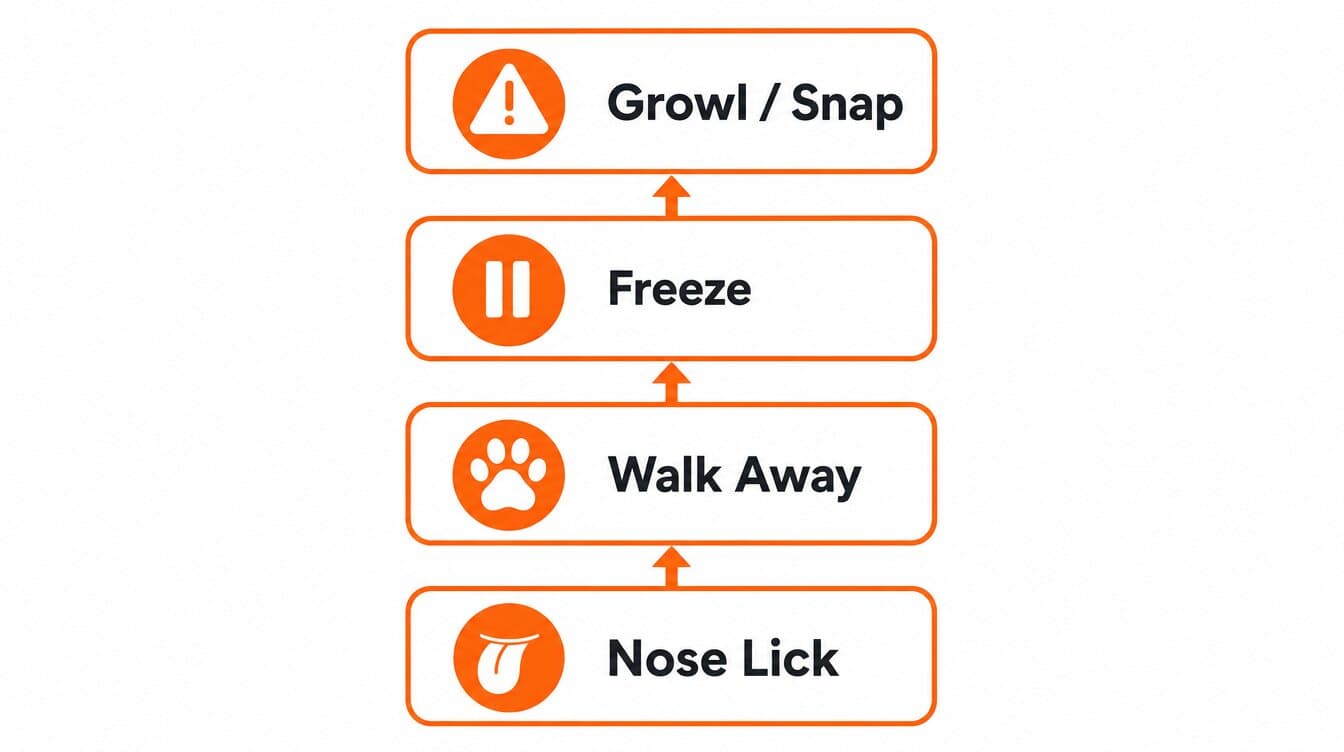
What are the warning signs before a dog bites?
The warning signs run from barely visible to unmistakable, in roughly this order. The early ones matter most, because they're where you can still change the outcome easily.
Early signals (easy to miss, easy to fix):
- Nose licking. A quick tongue flick over the nose, unrelated to food. One of the earliest and most reliable signs of discomfort.
- Yawning. Not tiredness. A yawn in a tense moment is a stress signal.
- Blinking or squinting. Rapid blinking, or a soft squint, when nothing is in the dog's eye.
- Head turn. The dog turns its head away from whatever is bothering it. This is a request, not rudeness.
- Turning the body away. A step further than the head turn — the whole body angles away, sometimes with a sit or a raised paw.
- Sniffing the ground suddenly. A displacement behavior. If a dog abruptly becomes fascinated by the floor mid-interaction, it's often looking for a way out of the moment.
Middle signals (the dog is now clearly uncomfortable):
- Walking away. The clearest possible request for space, and the one most often overridden — especially by children following a retreating dog.
- Whale eye. The dog turns its head away but keeps its eyes fixed on you, showing the white crescent at the corner. This one is worth memorizing.
- Ears back, low posture, creeping. Body lowered, movement slow and hesitant.
- Tail tucked, body crouched. Fear made visible.
- Lying down with a leg raised. A vulnerable, appeasing posture — the dog is trying hard to signal it means no harm.
Late signals (the last stops before a bite):
- Freezing. A dog that goes completely still and stiff, often while staring, is a dog on the edge. Stillness reads as calm to a human and means almost the opposite. If you learn only one signal from this article, make it this one.
- Hard stare. Direct, fixed, unblinking.
- Growling. Not a problem to be punished. A gift — the dog is telling you clearly, and it's the last easy warning you'll get.
- Showing teeth, snarling, air snap. A snap that deliberately misses is still communication, and a dog capable of missing on purpose is a dog exercising restraint.
Here's the same sequence laid out as a decision guide:
| Stage | What you might see | What it means | What to do |
|---|---|---|---|
| Early | Nose lick, yawn, blink, head turn | "I'm uncomfortable, please ease off" | Stop what you're doing, give space — problem solved here, cheaply |
| Middle | Walking away, whale eye, ears back, crouching | "I've asked politely and it isn't working" | End the interaction now; don't follow or reach |
| Late | Freezing, hard stare, growl, snarl, air snap | "I'm out of options" | Stop moving, back away calmly, don't punish the warning |
| Bite | Contact | Communication failed | Ensure safety first, then get professional help |
The whole point of the ladder is that you never need to reach the top of it. Every step below the bite is an off-ramp.
What are the red flags in dog body language?
Beyond the ladder, a few specific things are worth treating as immediate red flags — signals that the situation is closer to the edge than it looks.
Stillness. Worth repeating, because it's the single most misread signal in dog behavior. A dog that suddenly stops moving, stops wagging, and holds tension in its body is not relaxing. Late veterinary behaviorist Sophia Yin spent much of her career teaching exactly this distinction — that a dog "being good" and a dog shut down with stress can look nearly identical to an untrained eye, and the difference matters enormously.
A wagging tail that isn't friendly. Tail position and speed matter more than the wag itself. A high, stiff, fast-vibrating tail is arousal, not welcome.
A dog that can't disengage. If a dog is locked onto something and cannot be redirected by name, food, or movement, it's over threshold and no longer making choices in a normal way.
Guarding posture over an object. Body hovering low over food, a toy, or a spot, with a hard eye and slowed chewing.
Escalation over time. A single tense moment is one thing. Signals that appear more often, more easily, and with less provocation than they did a month ago mean the underlying problem is growing.
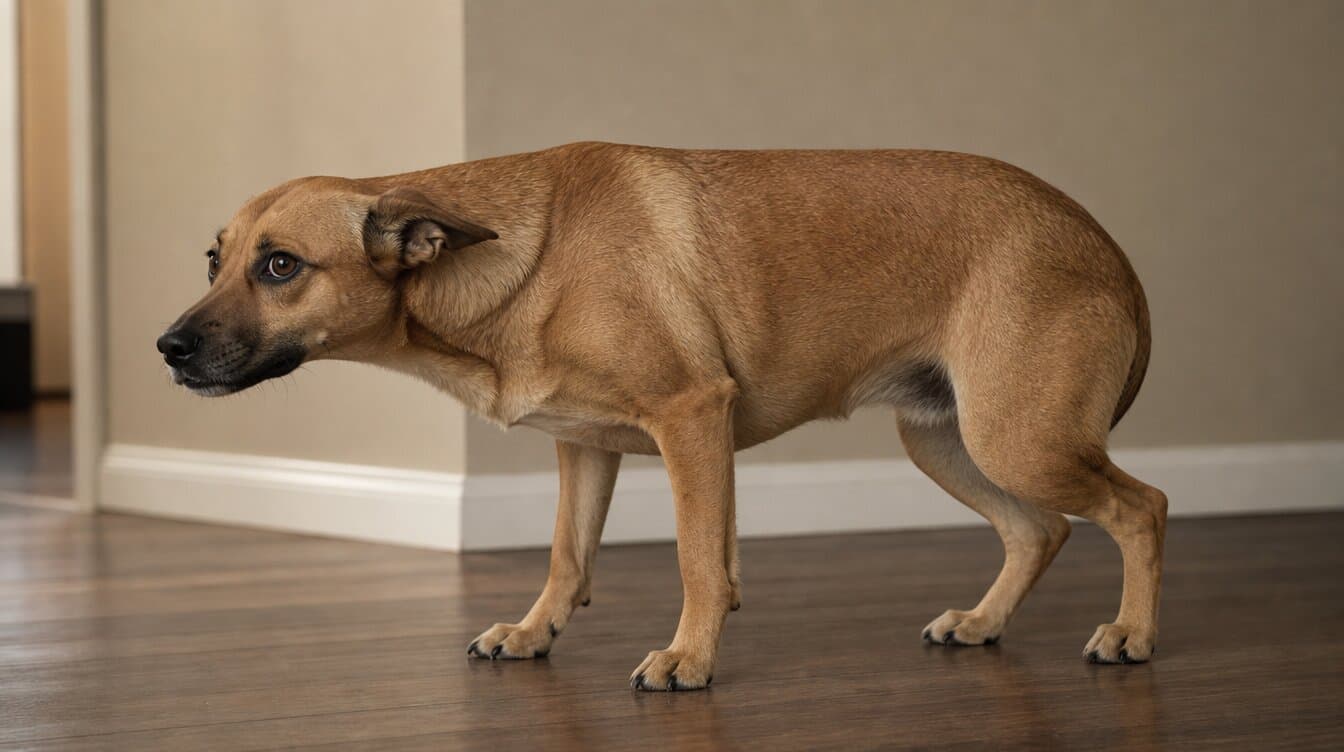
Why do dogs bite children more often?
Children are bitten more often for two reasons that have nothing to do with a dog disliking children — and both are preventable with supervision.
The first is that children don't read the early signals. A dog turns its head away, licks its nose, walks off — and a child follows, because the child's goal is affection and the dog's message is invisible to them. Every off-ramp on the ladder gets skipped, and the dog arrives at growling with a small human still in its face.
The second is proximity and height. Children interact at eye level, lean over dogs, hug around the neck, and approach dogs that are eating or sleeping — the exact contexts most likely to produce a defensive response. A hug feels affectionate to a child and restraining to most dogs.
The practical rules are simple and worth being firm about:
- Never leave a young child and a dog together unsupervised. Not for a minute, not with a dog who has always been gentle. Supervision means actively watching, not being in the same room.
- Teach children to let a dog come to them, rather than approaching a dog that is resting, eating, or moving away.
- Make the dog's bed and food area off-limits to children — a dog needs somewhere it can't be followed.
- Take the dog's side when it walks away. A dog that learns leaving works doesn't need to escalate.
The rules in your own house, as they stand today
Ticked: 0 of 5
The third and fourth lines are what keep the early warnings available to you. A dog whose growl has been punished is not a safer dog, only a quieter one on the way to the same place.
What should you do if your dog has already bitten someone?
Handle safety and medical care first, then get professional help — this is not a situation to work through alone with articles.
Immediately: separate the dog and the person calmly, without punishment or shouting, and attend to the wound. Any bite that breaks the skin needs medical attention, and depending on where you live there may be reporting requirements you're legally obliged to follow.
Then, before any behavior work: a veterinary appointment to rule out pain or an underlying medical cause, which is a common and frequently missed factor in sudden aggression.
After that, a certified professional. A bite that has broken skin is past the point where general advice is appropriate — the assessment needs to happen in person, with someone who can see the dog, the triggers, and the household. Ian Dunbar, the veterinarian who developed the widely used framework for grading bite severity, built that scale precisely because the difference between a puppy's mouthing, an air snap, and a bite that punctures deeply calls for very different responses. When to call a dog behaviorist, and what the first session actually looks like covers how to find someone qualified and what to expect.
One important distinction: if the "biting" you're dealing with is a puppy mouthing hands during play, that's a different subject with a different solution, and it isn't aggression. Puppies learn to control jaw pressure through exactly this kind of mouthing — a process Dunbar called bite inhibition — and interrupting it correctly matters more than stopping it entirely. Puppy biting and nipping has its own guide.
Check yourselfA dog snapped once, at a child who hugged him while he was asleep. Before reading on, decide what you would need to know before saying anything at all about whether he can be trusted again.Show the answerHide the answer
Four things: whether the trigger is identifiable and manageable, whether the dog showed restraint, whether there is a medical cause that can be treated, and how consistently the household can actually change the conditions that produced it. One snap in a specific, avoidable situation is a different case from an escalating pattern across several contexts, which is why this calls for someone assessing the dog in person rather than a general reassurance.
Can a dog that has bitten be trusted again?
Often, yes — but the honest answer depends on the context, the severity, and what's actually driving the behavior, which is why an in-person assessment matters more than any general reassurance.
A dog that snapped once when startled awake, in a specific and avoidable situation, is a very different case from a dog with an escalating pattern across multiple contexts. What tends to matter most: whether the trigger is identifiable and manageable, whether the dog showed restraint, whether there's a medical cause that can be treated, and how consistently the household can change the conditions that led to it.
What doesn't help is confrontational correction. Punishing the dog for the bite, or for the growl that preceded it, addresses the communication rather than the fear underneath — and a dog with fewer ways to communicate is a less predictable dog, not a safer one. Which aggression training approaches actually change behavior, and which quietly make it worse goes into that in detail.
How do you prevent a bite before it happens?
Prevention comes down to three things: reading the early signals, changing the situations that produce them, and never punishing a warning.
- Watch for the quiet signals, not the loud ones. A nose lick costs you nothing to respond to. A growl means you've already missed several chances.
- Give the dog an exit. Most defensive bites happen when a dog can't leave. A dog with a reliable escape route and a place nobody follows it into rarely needs to escalate.
- Protect the predictable flashpoints. Food, sleep, resting spots, and being handled in sensitive areas cause a disproportionate share of bites. Manage these situations rather than testing them.
- Never punish a growl. It's the clearest warning you'll ever get, and silencing it removes your last easy off-ramp.
- Treat sudden change as medical until proven otherwise. New aggression in a dog that never showed it is a veterinary question first.
Learning to read a dog isn't a personality trait you either have or don't — it's a skill, and the signals are consistent enough across dogs to be genuinely learnable. Astra Trainer's Dogs world is built for exactly that: short lessons on posture, stress cues, and the moments right before an escalation, so you catch the conversation earlier.

Test yourself
Question 1 of 3
Your seven-year-old dog has begun snapping when touched near his hindquarters. He has never done this before. Where does the article say to start?
Why do dogs bite?
Almost every bite traces back to fear, pain, resource guarding, being startled, frustration, or play that escalated — never 'the dog is bad.' Dominance is notably absent from this list; that framework has been directly contradicted by current behavior science.
Do dogs really bite without warning?
Almost never. What looks like no warning is usually a sequence of signals — from a nose lick to a freeze to a growl — that were too subtle to notice or had been punished out of the dog previously. This escalation pattern is called the Ladder of Aggression.
What are the warning signs before a dog bites?
Early: nose licking, yawning, blinking, head turns. Middle: walking away, whale eye, ears back, crouching. Late: freezing, hard staring, growling, showing teeth. Freezing is the single most misread signal — stillness is not calm.
Why do dogs bite children more often?
Children don't read the early signals and often follow a dog that's trying to walk away. They also interact at eye level and hug, which many dogs experience as restraining rather than affectionate. Both causes are preventable with active supervision.
What should you do if your dog has already bitten someone?
Separate the dog and person calmly, attend to the wound, and seek medical care for any bite that breaks skin. Then get a veterinary exam to rule out pain, followed by a certified behavior professional — this isn't a situation for self-directed articles alone.
Can a dog that has bitten be trusted again?
Often, yes, depending on context and severity. What matters most: whether the trigger is identifiable and manageable, whether the dog showed restraint, and whether a medical cause is involved. Confrontational correction doesn't help and can make the dog less predictable.