
MBA admissions looks, from the outside, like a contest of numbers: a test score, a grade point average, a list of job titles. Strong numbers matter, but they are not how the decision is made. An admissions committee is not ranking applicants from best to worst and taking the top of the list. It is building a class of people who will learn from each other for one or two years, and asking what each applicant would add to it. Understanding that shift changes how you choose schools, what you write and what you leave out.
This article explains how MBA admissions works, what the application contains, why the class matters more than the individual, what applicants can and cannot control, and what one admissions insider has written about thinking like the person who reads your file.
How MBA admissions works
The MBA is a little over a century old. Dartmouth's Tuck School, founded in 1900, was the first graduate school of business, and Harvard's, which opened in 1908, was the first to award a degree called the Master of Business Administration. Frederick Winslow Taylor, whose ideas on management shaped the early curriculum, lectured at Harvard each year from 1909.
Today most leading programmes follow a similar pattern. Applications are submitted in rounds, usually two or three a year, with the first deadlines often falling in September or October and the second in January. Each file is read, often by more than one person, and discussed. Some applicants are invited to interview. Decisions come weeks or months later, and each round is judged in the context of everyone else applying at the same time.
Competition at the most selective schools is intense. Harvard Business School reported 9,409 applications for its Class of 2027 and 943 students enrolled, roughly one enrolled student for every ten applications. Stanford Graduate School of Business received 7,259 applications for the same year, with 434 students enrolling. Most programmes are far less selective than these two, which is one reason the choice of schools matters as much as the application itself.
An admissions committee is not ranking you against everyone else. It is deciding whether the class is better with you in it.
What the application is made of
The details differ between schools, but most full-time MBA applications ask for the same components.
| Component | What it shows the committee |
|---|---|
| Test score or waiver | Readiness for the quantitative and analytical work of the programme |
| Transcript | Academic record, and how you handled demanding coursework |
| Résumé | What you have done, how fast you have grown and what you were trusted with |
| Essays | Who you are, what you want, and why this school and why now |
| Recommendations | How people who have worked with you see your impact and potential |
| Interview | How you think and communicate in person, by invitation only |
The test most associated with business school is the GMAT, first given in 1954 as the Admission Test for Graduate Study in Business. Its current version, the GMAT Focus Edition, launched in 2023, has three sections, Quantitative Reasoning, Verbal Reasoning and Data Insights, and is scored from 205 to 805. Many schools also accept the GRE, and some offer the Executive Assessment or test waivers for certain candidates. Most full-time students at leading programmes arrive with several years of work experience.
No single component decides the outcome. A strong score will not carry an unclear application, and a lower score does not end one that is otherwise compelling. Barbara Coward, whose book is discussed below, has said she hears admissions leaders regret how often strong candidates do not apply because of a single test score.
Check yourselfIn one round, an excellent management consultant is turned down while a slightly less polished applicant from a field the class lacks is admitted. Before reading on: what does the rejection say about the consultant, and why could the other applicant add more?Show the answerHide the answer
Very little about the consultant: neither decision is a verdict on the person. An MBA is taught largely through discussion, group work and case studies, so what each student brings from their work and industry becomes part of what everyone else learns. A fifth strong consultant adds less to that than someone the room lacks, which is why admitting a class is closer to casting a team than to hiring for one job.
Why admissions is about the class, not just you
The central idea of MBA admissions is that the class is the product. An MBA is taught largely through discussion, group work and case studies, so what each student brings from their work, country, industry and way of thinking becomes part of what everyone else learns. A school admitting its class is closer to casting a team than to hiring for one job.
That is why applicants with very similar profiles can receive very different decisions. If a round is full of strong candidates from one industry, the fifth excellent consultant may add less to the class than a slightly less polished applicant from a field the class lacks. Neither decision is a verdict on the person. It reflects what the class needed when the file was read.
It also changes the question worth asking. Instead of "Am I impressive enough?", the more useful question is what you would add: the experience, perspective or goal that makes the class stronger with you in it.
What applicants can and cannot control
Much of what decides a single cycle is invisible from outside. Some industries are overrepresented in a given year. Applications from one region may surge. A school's priorities can shift behind the scenes. None of this is personal, and none of it is within an applicant's reach.
What is within reach is understanding the school and presenting yourself clearly. The most reliable sources are primary ones: a school's own website, its mission statement, its admissions events, its essay questions and the way it presents itself. Forums, rankings and admissions trackers can be useful, but they are someone else's interpretation, and they often contradict each other.
The practical conclusion is to stop trying to control the outcome and put the effort into the part you can shape: a case that is clear, honest and easy for the reader to follow.
How this is taught inside Astra Trainer
The Career strategy direction in the Leadership, Career & Influence world runs to twelve courses on seeing the shape of your career and making moves on purpose, including Strengths, Interests and Direction, Personal Positioning, Career Capital and Career Transitions.
Those are the questions every MBA essay asks in some form: what you are good at, where you are heading, and why this step makes sense now. Working them out before you write makes the writing far easier. Lessons take about five minutes and a guide walks you through anything strange.
An insider's view: It's Not About You
Barbara J. Coward has spent more than twenty-five years in MBA admissions. Before founding her consultancy, MBA 360° Admissions, she worked inside business school admissions offices on two continents, recruited candidates around the world and built marketing programmes for business schools. That background, seeing applications from the school's side, is the starting point of her book.
It's Not About You: Insider Strategies for Elite MBA Applicants, published in April 2026, argues that applicants focus too much on proving how impressive they are in isolation, and too little on how schools actually build a class. It explains why candidates with similar profiles can receive different outcomes, how timing and market conditions shape decisions, what committees look for beyond grades and test scores, and how to position yourself authentically rather than as the applicant you think a school wants.
The title sounds harsh at first. Coward's point is that admissions is not really about you in the way most applicants assume. It is about how you fit into something larger. The question she puts to her own clients is "How will you enrich the cohort?"
Recommended reading
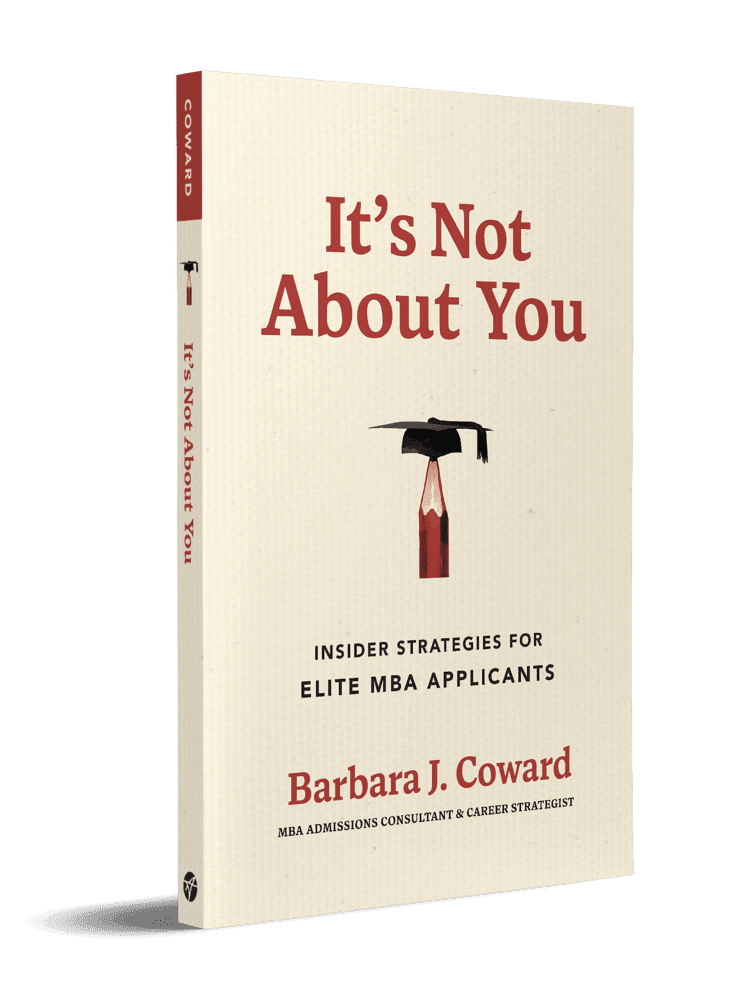
It's Not About You: Insider Strategies for Elite MBA Applicants, by Barbara J. Coward. Advantage Media Group, 2026, 212 pages.
A short, practical guide to MBA admissions from the committee's side: how a class is built, what is and is not in your control, and how to present a case the reader can support.
See It's Not About You on AmazonAffiliate link: if you buy through it, Astra Trainer may earn a commission. The price is the same for you.
Writing for the person who reads your file
The most useful habit an applicant can borrow from the book is to read their own application as the admissions reader would. That person is not only judging you. They work inside an institution and answer to deans, faculty and the class itself, and they may have well under an hour with your file.
Seen that way, several common mistakes become obvious.
- Describing the school back to itself. Committees already know what makes their programme special. Every sentence spent praising the school is a sentence not spent helping them understand you.
- Listing achievements without a thread. A string of accomplishments is hard to remember. A clear direction that connects them is not.
- Writing for an imagined ideal applicant. Essays that sound like everyone else's give the reader nothing to argue for.
- Ignoring what the essay question actually asks. Schools choose their prompts carefully, and the prompt is one of the best clues to what they value.
Coward describes the goal as giving the reader the evidence they need to advocate for you in the committee room. The aim is not to impress them. It is to make their decision easy. The same principle underlies structuring a presentation around one message: decide what you want the audience to conclude, then give them only what supports it.
Before you write, check where you stand
Ticked: 0 of 4
Each unticked line is work to do before drafting, not a verdict on your chances. These are the answers the reader needs to argue for you in the committee room.
Knowing why you want an MBA
Almost every application asks some version of the same question: why an MBA, why now, and why here. It is the hardest one to answer well, because it depends on having done the career thinking first. Applicants who can explain where they have been, where they want to go and what is missing in between write clearer essays and interview with more confidence.
It is also worth being honest about whether a full degree is the right step. An MBA offers a credential, a network and a structured change of direction. Some people mainly want the knowledge: finance, strategy, how companies are structured and led. The difference between the two is explained in what a mini MBA is and whether it is worth doing. Many applicants find that learning the core business subjects first also makes the interview easier, because they already speak the language of the classroom.
The distinction between a series of jobs and a career with a direction, set out in job versus career, is a useful place to start.
Why the story comes before the application
An MBA application is a positioning exercise. It is much easier to write once you know your strengths, your direction and what you would bring to a room of strangers from other industries and countries.
Astra Trainer is built around working that out step by step. Quizzes follow each topic and each course ends with a ten-question final exam, while daily quests, points and a streak keep five-minute lessons going. A Circle gives you a small group with a shared weekly goal and live sessions, useful for testing your story on people who do not already know you.
What to take from this
MBA admissions is the building of a class. Committees ask what each applicant would add, which is why similar profiles can receive different decisions.
The application combines a test score or waiver, a transcript, a résumé, essays, recommendations and sometimes an interview. No single part decides the result.
Much of a cycle is outside your control. How clearly you present your case, using what the school itself says it values, is within it.
Which is why the most useful way to approach MBA admissions is Barbara Coward's: read your application as the committee would, and make it easy for them to say yes.
Test yourself
Question 1 of 3
An applicant has strong essays and recommendations, but her test score sits below a school's usual range. What does the article say about her chances?
How does MBA admissions work?
Applicants submit a test score or waiver, transcript, résumé, essays and recommendations, usually in one of two or three rounds a year. Files are read and discussed, some applicants are interviewed, and decisions are made in the context of the class the school is building that year.
What do MBA admissions committees look for?
Academic readiness, a record of growth and impact at work, clear goals, and what the applicant would add to the class. Because committees build a class rather than rank individuals, fit and contribution matter alongside grades and test scores.
Is the GMAT required for an MBA?
Not always. The GMAT Focus Edition, scored from 205 to 805, is the best-known test, but many schools also accept the GRE, and some accept the Executive Assessment or offer waivers. Check each school's own requirements.
What is the book It's Not About You by Barbara Coward about?
Published in April 2026, It's Not About You: Insider Strategies for Elite MBA Applicants explains admissions from the committee's side: how schools build a class, why similar candidates get different outcomes, what applicants can control, and how to present a clear, authentic case.
Where can I learn career strategy before applying to an MBA?
The Career strategy direction inside the Leadership, Career & Influence world of Astra Trainer covers strengths, direction, personal positioning and career transitions in five-minute lessons with quizzes. The first lesson needs no card.
Where this leads. What Is a Mini MBA, and Is It Worth Doing? sets out what an MBA teaches, which parts can be learned without one, and the order to learn them in.