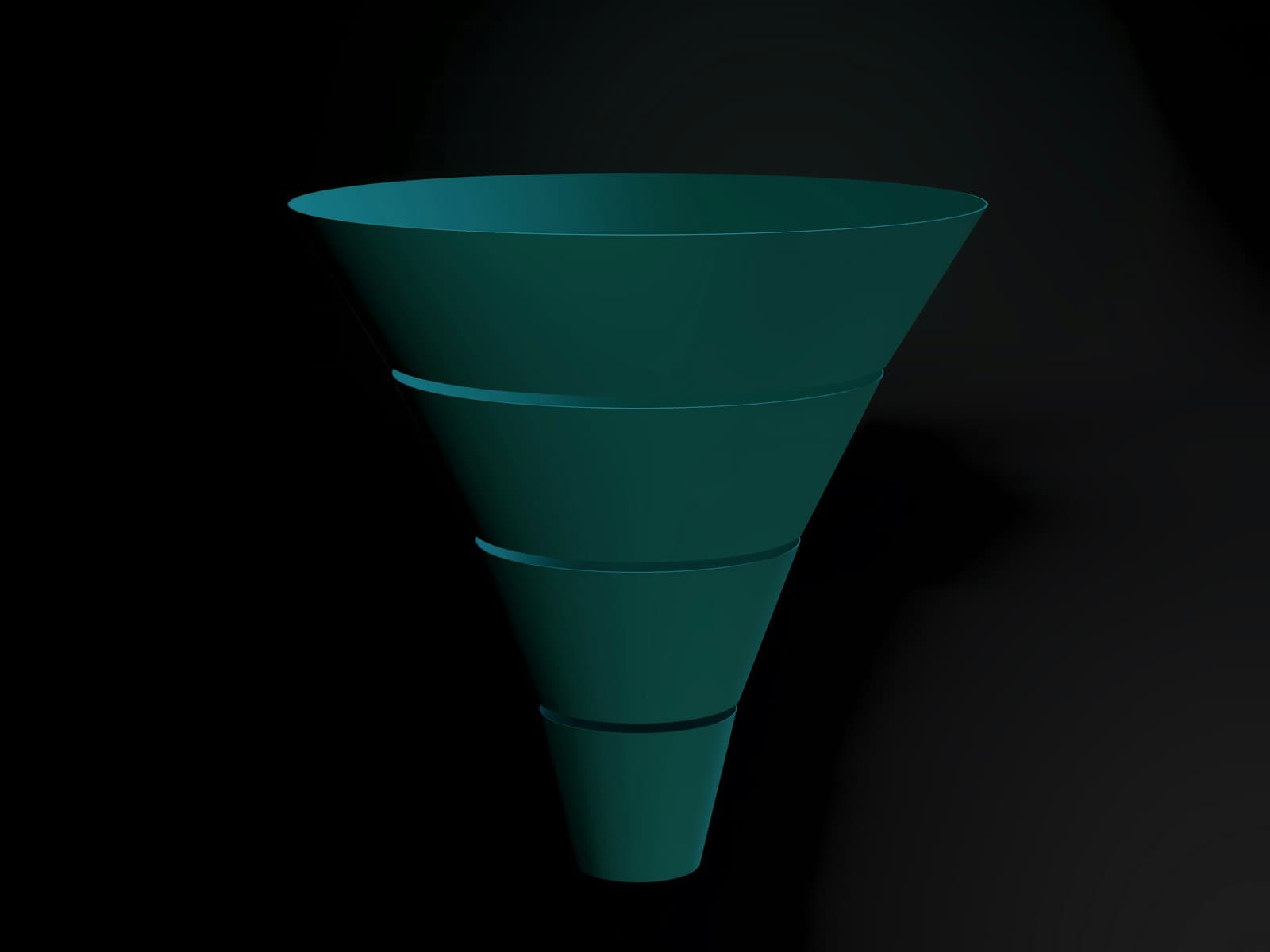
What is a sales funnel? It is a model of the path people take from first noticing an offer to buying it, drawn as a funnel because far more people enter at the top than come out at the bottom. At each stage some people move on and most do not. The model is more than a century old, it is still everywhere, and it is useful in a specific way that is often misunderstood.
This article covers where the idea came from, the stages in plain terms, how to read the numbers, and the ways the funnel picture misleads if you take it too literally.
What is a sales funnel?
A sales funnel describes the stages between strangers and buyers. The labels vary, but the shape is always the same: a wide top where many people become aware of something, a narrowing middle where some of them take an interest and consider it, and a narrow bottom where a few buy.
The funnel is not a thing you build so much as a description of something that already happens. Every business has a funnel, whether or not anyone has drawn it. What drawing it adds is visibility: it turns a vague sense that "not enough people buy" into a specific question about where people stop.
That is the funnel's real value. It is a diagnostic tool. It tells you which part of the path deserves attention.
Every business has a funnel. Drawing it simply shows you where people are leaving.
Where the funnel came from
The ideas behind the funnel are older than modern marketing. From 1898 the American advertising pioneer E. St. Elmo Lewis used a slogan for what an advertisement had to do: attract attention, maintain interest, create desire. He later added a fourth step, get action. Historians have questioned how much of the formula was Lewis's own, but by the early 1920s it was circulating in the trade press as the acronym AIDA.
The funnel shape came next. In 1924 William W. Townsend, in a book called Bond Salesmanship written for the Investment Bankers' Association of America, laid the funnel picture over those stages: many prospects at the top, fewer at each step, a handful of sales at the bottom.
The combination stuck because it was intuitive and useful for managing salespeople. A century later the words have changed, "top of funnel" and "conversion rate" instead of attention and action, but the model is recognisably Townsend's.
Check yourselfSomeone has just noticed your offer for the first time, and the first thing you show them is a full price list. Before reading on: why might that lose them, even if the prices are fair?Show the answerHide the answer
Because the message does not match the moment. At the awareness stage a buyer needs only a reason to pay attention for a few seconds; a price list answers a question from the decision stage that they have not asked yet. The same mismatch loses people in the other direction, when someone ready to decide is handed a long explanation of the category.
The stages, in plain terms
Modern versions of the funnel use different labels, but most describe the same five moments. What matters at each stage is what the buyer needs from you there, which is different every time.
| Stage | What the buyer is doing | What they need from you |
|---|---|---|
| Awareness | Noticing that you exist | A reason to pay attention for a few seconds |
| Interest | Wondering whether this is relevant to them | A clear sense of what it is and who it is for |
| Consideration | Comparing it with the alternatives | Evidence, specifics and proof from people like them |
| Decision | Deciding whether the risk is worth it | A clear offer, a fair price and a way to reduce risk |
| After purchase | Using it and judging whether it was right | A good first experience and a reason to tell others |
Each stage has its own discipline. Awareness and interest depend on positioning, consideration on proof, and the decision stage on the questions covered in how buyers actually decide.
The mistake to avoid is giving buyers what the next stage needs before they are ready for it. A price list shown to someone at the awareness stage, or a long explanation of the category shown to someone ready to decide, both lose people for the same reason: the message does not match the moment.
How this is taught inside Astra Trainer
The Marketing & attention direction in the Marketing, Sales & Attention world works through why attention turns into choice, in courses such as Why Attention Feels Exhausted, The Emotional Brain Behind the Scroll and Why People Want What Other People Want.
That is the top half of the funnel, studied from the buyer's side rather than the marketer's: what makes someone notice, what makes them care, and what makes them remember. Lessons take about five minutes and a guide walks you through anything strange.
How to read funnel numbers
The funnel becomes useful the moment you count people at each stage. Consider an invented online pottery class over one month:
| Stage | People | Moved on from the stage before |
|---|---|---|
| Visited the website | 8,000 | |
| Watched the free sample lesson | 1,200 | 15% |
| Joined the email list | 600 | 50% |
| Booked a trial class | 60 | 10% |
| Signed up for the full course | 30 | 50% |
Reading this, the obvious move is to get more website visitors. It is usually the wrong one. The weakest step here is from the email list to a trial class: only one in ten makes it. Doubling the visitors would double the result. Fixing that one step, perhaps by making the trial easier to book or clearer about what happens, could do the same for far less effort.
The general rule is to look for the stage with the steepest drop relative to what is realistic for that kind of step, and work there first. The top of the funnel is the most visible stage and rarely the most broken.
What the funnel gets wrong
The funnel picture has a flaw built into its shape: it implies people move in one direction, narrowing steadily, and that the story ends at purchase. Real buyers do neither.
In 2009 the consultancy McKinsey published "The consumer decision journey", by David Court and colleagues, based on the purchase decisions of about 20,000 consumers in the United States, Germany and Japan, across five industries. They found two things the funnel does not show.
First, the set of options buyers consider does not only shrink. During active research, buyers often add brands they had not started with, because a friend mentioned one or a review surfaced another. The middle of the funnel frequently widens.
Second, a great deal happens after purchase. A buyer's experience of the product shapes whether they buy again, whether they recommend it, and what they tell people who are just entering their own funnel. McKinsey described this as a loyalty loop. The funnel, which ends at the sale, misses it entirely.
Neither finding makes the funnel useless. It makes it a simplification: a useful map for spotting where people drop out, and a poor description of how people actually think.
Common funnel mistakes
Counting vanity numbers at the top. Followers, impressions and page views are easy to grow and easy to celebrate. They matter only if people move from them to the next stage. A smaller audience that converts beats a larger one that does not.
Optimising one stage in isolation. Pushing more people into the decision stage with aggressive offers can raise sales this month and lower them later, if the people pushed through were never a good fit and leave unhappy. The stages are connected.
Ignoring the stage after purchase. For most businesses, the cheapest new buyers come from existing ones. A funnel that stops at the sale leaves out the part that feeds the top.
Treating people as numbers only. Conversion rates describe what happened, not why. The why comes from talking to people who dropped out, which few businesses do, and which usually explains the numbers in one conversation.
Why reading a funnel is a habit
Funnels change. A channel that worked stops working, a step that was fine starts leaking. The useful skill is a regular habit of looking at the numbers and asking where people are leaving, not a single analysis done once.
Astra Trainer is built around habits like that. Quizzes follow each topic and each course ends with a ten-question final exam, while daily quests, points and a streak keep five-minute lessons going. A Circle gives you a small group with a shared weekly goal and live sessions, and describing your funnel to someone else is often the fastest way to notice where it breaks.
What to take from this
A sales funnel is a model of the stages between noticing an offer and buying it, with fewer people at each step.
Its roots are E. St. Elmo Lewis's slogan from 1898, which became AIDA, and William W. Townsend's 1924 funnel picture.
Its main use is diagnostic: the stage with the steepest drop is usually where the work should go, and it is rarely the top.
Which is why the most useful answer to what is a sales funnel is a modest one: a map for finding where people leave, drawn simply enough to be wrong in the ways McKinsey described, and still worth drawing.
Test yourself
Question 1 of 3
A course funnel: 10,000 site visitors, 2,000 watch a sample, 200 join the email list, 100 book a trial, 50 enrol. The owner plans to double traffic. What would the article have them look at first?
What are the stages of a sales funnel?
Most versions describe five: awareness, when people notice you; interest, when they wonder if it is relevant; consideration, when they compare you with alternatives; decision, when they weigh the risk and buy or not; and after purchase, when their experience shapes repeat buying and recommendations.
What is the difference between a sales funnel and a marketing funnel?
The terms overlap and are often used interchangeably. Where they are distinguished, the marketing funnel usually covers the earlier stages of awareness and interest, and the sales funnel the later stages of consideration and decision.
Who invented the sales funnel?
The stages trace back to a slogan used by E. St. Elmo Lewis from 1898, later known as AIDA. The funnel picture was first attached to those stages by William W. Townsend in his 1924 book Bond Salesmanship.
Is the sales funnel outdated?
It is a simplification rather than an error. A 2009 McKinsey study found buyers often add options mid-way and keep deciding after purchase, which the funnel does not show. It remains useful for spotting where people drop out.
Where can I learn marketing psychology in short lessons?
The Marketing & attention direction inside the Marketing, Sales & Attention world of Astra Trainer covers why attention turns into choice, in five-minute lessons with quizzes after each topic. The first lesson needs no card.
Where this leads. How to Grow an Audience From Zero works through the top of the funnel in order, from being noticed to being remembered.