Astrology certification sounds like a single thing, and it is not. There is no professional licence for astrologers, so any school, society or app can issue a certificate. One records that you watched a course to the end, another that you passed a demanding exam, a third that a senior astrologer reviewed your readings. They are not interchangeable, and the difference is what a client or an employer should care about.
This guide sets out what exists, what each kind of certificate proves, what people actually check, and how to prepare for an exam. For the wider path, from first chart to first paying client, How to Become an Astrologer covers the whole route.
Is there an official astrology certification?
Not in the sense of a licence. No country licenses astrologers the way it licenses doctors, accountants or electricians, and no government sets an exam you must pass before reading charts for other people. If you charge for readings, the ordinary rules for running a small business apply where you live, and some local authorities have rules about fortune-telling as a trade. None of that tests what you know about astrology.
What does exist is a patchwork of voluntary credentials. A few universities study astrology as an academic subject: the University of Wales Trinity Saint David, for example, has for many years offered a master's degree in cultural astronomy and astrology, which studies astrology's history and place in culture rather than training practitioners. In India, Vedic astrology, or Jyotish, is taught in some universities and in a great many private institutes, each awarding its own titles. Elsewhere, schools and astrological societies award certificates on their own terms.
So when someone describes themselves as a certified astrologer, the useful follow-up is: certified by whom, and for what? The phrase alone tells you very little. A certificate means exactly as much as the test behind it and the body that stands behind the test.
The four kinds of astrology certificate
Almost everything on offer falls into one of four kinds, and each answers a different question.
| Kind | What you do to earn it | What it shows |
|---|---|---|
| Course completion | Finish the lessons, sometimes with short quizzes | That you reached the end of that course |
| School diploma | Follow a school's syllabus and pass its exams, often over a year or more | That you met that school's standard |
| Independent body | Sit exams set by an astrological society, often in several levels, sometimes with a consulting part | That you met a standard not tied to one teacher |
| Exam only | Pass a single timed knowledge exam, however you learned | What you knew on the day, at the level tested |
Course-completion certificates are the easiest to find and the least informative: many are issued automatically when the last lesson is marked done.
School diplomas are as strong as the school. Long-established schools, for example the Faculty of Astrological Studies in London, award certificates and diplomas on the results of their own exams, and their names carry weight in the astrological community. A diploma from a school with no published syllabus and no exam carries much less.
Independent bodies set standards that do not belong to one teacher. For example, the National Council for Geocosmic Research (NCGR) certifies in graded levels, examined in stages; the International Society for Astrological Research (ISAR) combines a test of astrological knowledge with training in ethics and consulting skills; and the American Federation of Astrologers has run examinations for decades. Their exams assess what you know rather than where you studied.
Exam-only certificates separate the test from the teaching. Astra's level-1 astrology exam is one of these, described in full below.
Knowledge on paper, skill at the table
Most exams test what you know about a chart. Clients pay for something else: a reading that makes sense of their own.
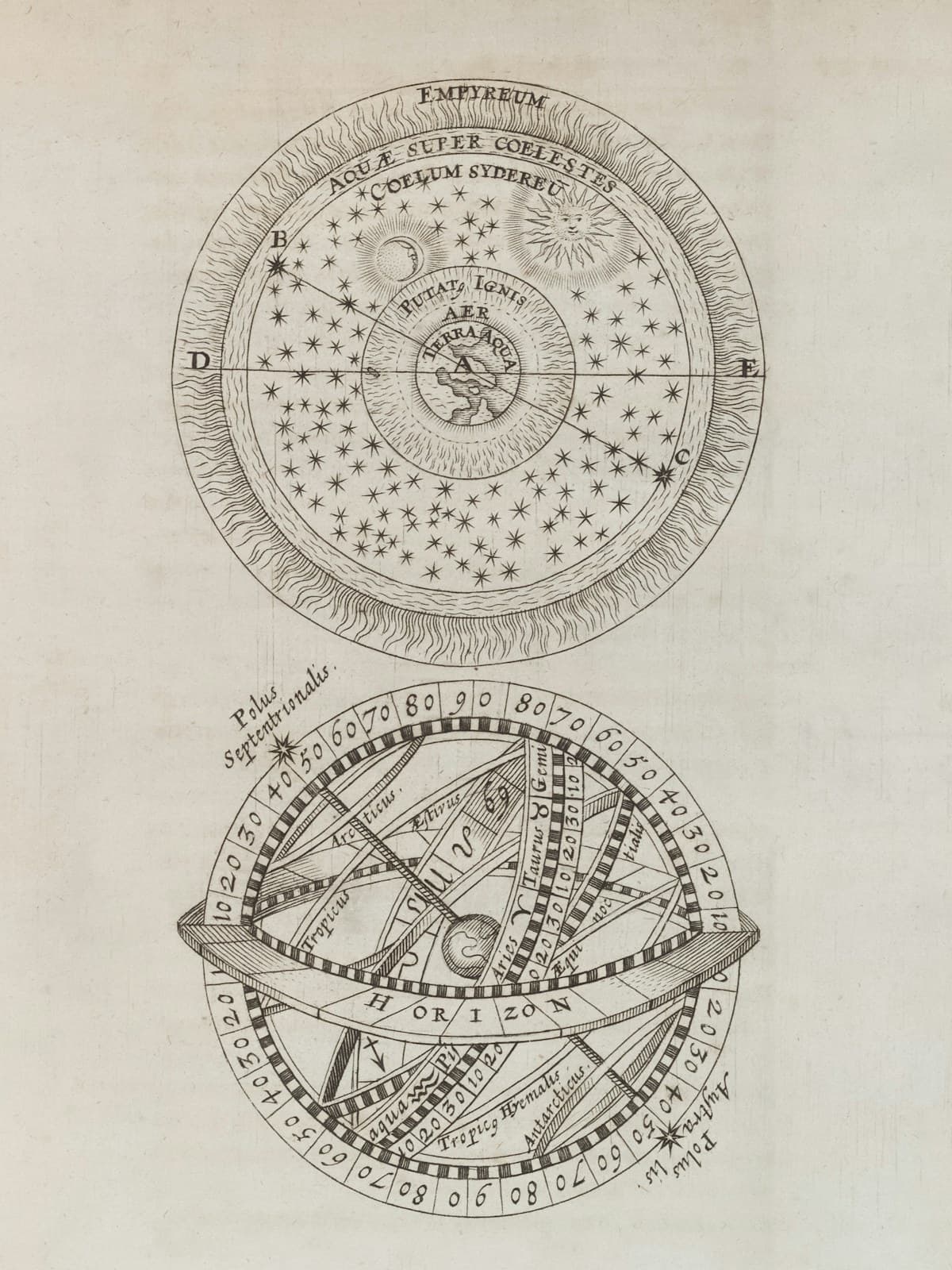
Images: The New York Public Library on Unsplash.
What a certificate proves, and what it cannot
Every certificate answers a narrow question, and reading one well means knowing which.
- A completion certificate answers: did this person reach the end? It says nothing about how much they retained.
- A knowledge exam answers: on this day, under these conditions, did this person clear this bar? The conditions matter. A supervised exam in a room and an unsupervised one at home answer the question with different confidence, and an honest issuer tells you which one you are looking at.
- A practical assessment, where an examiner reviews real chart readings or a recorded consultation, answers the question clients care about most: can this person read a chart for someone else? It is also the rarest kind, and the slowest to earn.
Three things no certificate proves. That you are good with people: a sound technician can be a poor consultant, which is why some bodies train or assess consulting separately. That you will keep to ethical lines, although a body with a code of ethics at least gives a client somewhere to complain. And that astrology works. A certificate tests your knowledge of a tradition. It does not settle whether the tradition's claims are true, and no honest issuer suggests that it does.
What clients and employers actually check
Clients choosing an astrologer rarely start with paper. What they look at instead:
- Sample work. A written reading of a public figure's chart, a recorded talk, articles that show how you think. This is the strongest evidence you can offer, because it is the thing itself.
- A clear offer. Which readings you do, how long a session takes, and what it will not cover.
- Boundaries. Whether you say plainly, before anyone asks, that a chart is not medical, legal, financial or psychological advice.
- Other people's word. Reviews and referrals, which is how many practices grow.
- Claims that can be checked. Whether a stranger can confirm the training you mention without taking your word for it.
Employers exist in this field too: astrology apps, publishers, content sites and reading platforms. They tend to test directly, with a sample chart to interpret or a piece to write to a brief. A certificate may get your application read. The sample decides it.
Where a certificate does help: it shows that you studied systematically, it gives a new practice something concrete to point to before the reviews arrive, and a certificate with a public verification page lets a sceptical client check your claim in seconds.
How to judge any astrology certificate
Before you pay for any astrology certification, get answers to six questions. A serious issuer answers all of them on its own site.
- 1Who sets the standard? A school, an independent society or a platform. Look for a published syllabus or a list of exam topics.
- 2What is assessed? Attendance, knowledge, practical reading or consulting skills. Each is a different claim.
- 3Under what conditions? Timed or untimed, supervised or unsupervised, open book or closed. None of these is wrong, but you should know which one you are buying.
- 4Can a stranger verify it? A unique number with a public page where anyone can confirm the holder, the subject and the status is worth more than any design.
- 5Does it expire? A validity period with a renewal test means the knowledge was checked recently, not once, years ago.
- 6Can you fail? Retake rules tell you a lot. If nobody ever fails, the exam is a formality.
Not a licence. No astrology certificate, Astra's included, is a licence or gives anyone a right to practise, and a certificate from a private school, society or platform is not a state qualification either. Be wary of any issuer that suggests otherwise.
The exam-only route
An exam-only certificate checks what you know, not where you learned it. It suits three kinds of people: the self-taught, who have knowledge and nothing to show for it; practising astrologers who want an independent check to put on a profile or website; and students of a course that has no assessment of its own.
Astra's level-1 astrology exam is one option of this kind. Here is exactly what it is, including its limits.
- 40 questions in 45 minutes, with up to 90 seconds for each question.
- A pass mark of 70 percent. From 90 percent the certificate says With distinction. The percentage itself is never printed.
- Unsupervised: no webcam and no proctor.
- Two attempts included, the second opening 24 hours after the first. Subscribers get level 1 included.
- A certificate with your name, the direction, Level 1 · Foundation, a number in the form AST-XXX-XXXXXX, a QR code and a public verification page. It comes as a PDF and an image, in eight languages, with an Add to LinkedIn button.
- Valid for two years, after which a short renewal test keeps it current.
If you want to see the style of the questions before deciding anything, the free practice test has 10 questions with answers and explanations, and needs no sign-up.
What it is not: a licence, an accreditation, a state or official qualification, or a right to practise. It is a checkable record that you passed a foundations exam in astrology without supervision. Level 2, which adds a practical task checked by a reviewer, is coming soon, with a waitlist.
Check yourselfBefore you read on: two well-prepared candidates answer the exam question "Which planet rules Aquarius?" One writes Saturn, the other Uranus. Can both be right, and what should the exam have done about it?Show the answerHide the answer
Both can be right. The traditional scheme, built on the seven planets visible to the naked eye, gives Aquarius to Saturn. The modern scheme gives it to Uranus, discovered in 1781. Astrology has several forks like this: rulerships, house systems, tropical or sidereal zodiac, orb sizes. A well-set exam states which conventions it expects, or accepts either answer, and a well-prepared candidate finds out before sitting it.
How to prepare for an astrology exam
Whatever exam you choose, preparation follows the same logic.
- Get the topic list. A foundations exam in astrology usually covers the signs, the planets and their rulerships, the houses and angles, the major aspects and orbs, essential dignity, and the order in which a chart is read. Higher levels add forecasting, and practical levels add real readings.
- Learn the conventions the exam uses. In places astrology has more than one defensible answer. Find out which rulership scheme, house system and zodiac an exam expects, and learn both answers where the schemes differ.
- Test yourself instead of rereading. Answering from memory and then checking is one of the most reliable findings in learning research, and it is exactly what an exam asks you to do.
- Practise at exam speed. Ninety seconds a question leaves time to think but little time to look things up, so recall has to be quick.
- Read whole charts aloud. Working through real charts in a fixed order, as set out in Reading a Chart in the Right Order, turns separate facts into something you can use, and it is what a practical assessment looks at.
If dignities or orbs are the weak spot, Essential Dignity: Why Some Placements Are Called Strong and Aspects: The Geometry Underneath the Chart cover both in depth.
Ready for a foundations exam?
Ticked: 0 of 6
Five or six ticks: take the practice test now. Fewer: the unticked lines are your study list.
What to take from this
No certificate is needed to practise astrology, and none gives official standing to do so. Every certificate is voluntary and speaks for whoever issued it, and the four kinds answer different questions: completion certificates show that you finished, exams show what you knew on the day, and practical assessments show how you read for someone else.
Clients mostly judge the work itself, so treat a certificate as a supporting document, not a substitute for sample readings and clear boundaries. If you want one, choose it by what it tests and by whether a stranger can check it.
Test yourself
Question 1 of 3
Which kind of assessment answers the question clients care about most?
Is there an official astrology certification?
Not in the sense of a licence. There is no professional licence for astrologers, and no government sets an exam you must pass before reading charts for others. Every certificate is voluntary and speaks for the school, society or platform that issued it, so the useful question is always: certified by whom, and for what?
Which astrology certification is the most respected?
There is no single standard. Long-established schools and independent bodies, for example the Faculty of Astrological Studies, NCGR and ISAR, are widely known in the astrological community. The right one depends on the tradition you practise and on what you want the certificate to show.
Can I get an astrology certification online?
Yes. Many schools now teach and examine online, and exam-only certificates such as Astra's level 1 are taken entirely online. Check whether the exam is supervised, and whether someone else can verify the certificate without asking you.
How long does it take to get certified in astrology?
It depends on the route. A completion certificate takes as long as the course, and school diplomas or multi-level certifications from independent bodies often take a year or more. An exam-only certificate takes one sitting once you know the material, which for the foundations usually means some months of study.
Is Astra's astrology certificate accredited?
No. It confirms that you passed Astra's level-1 astrology exam, which is unsupervised. It is not an accreditation, a licence, a state qualification or a right to practise. It carries a number and a public verification page, so anyone can check it.
Where this leads. How to Become an Astrologer maps the path from first chart to first client, and the ethical lines to settle before anyone asks.