
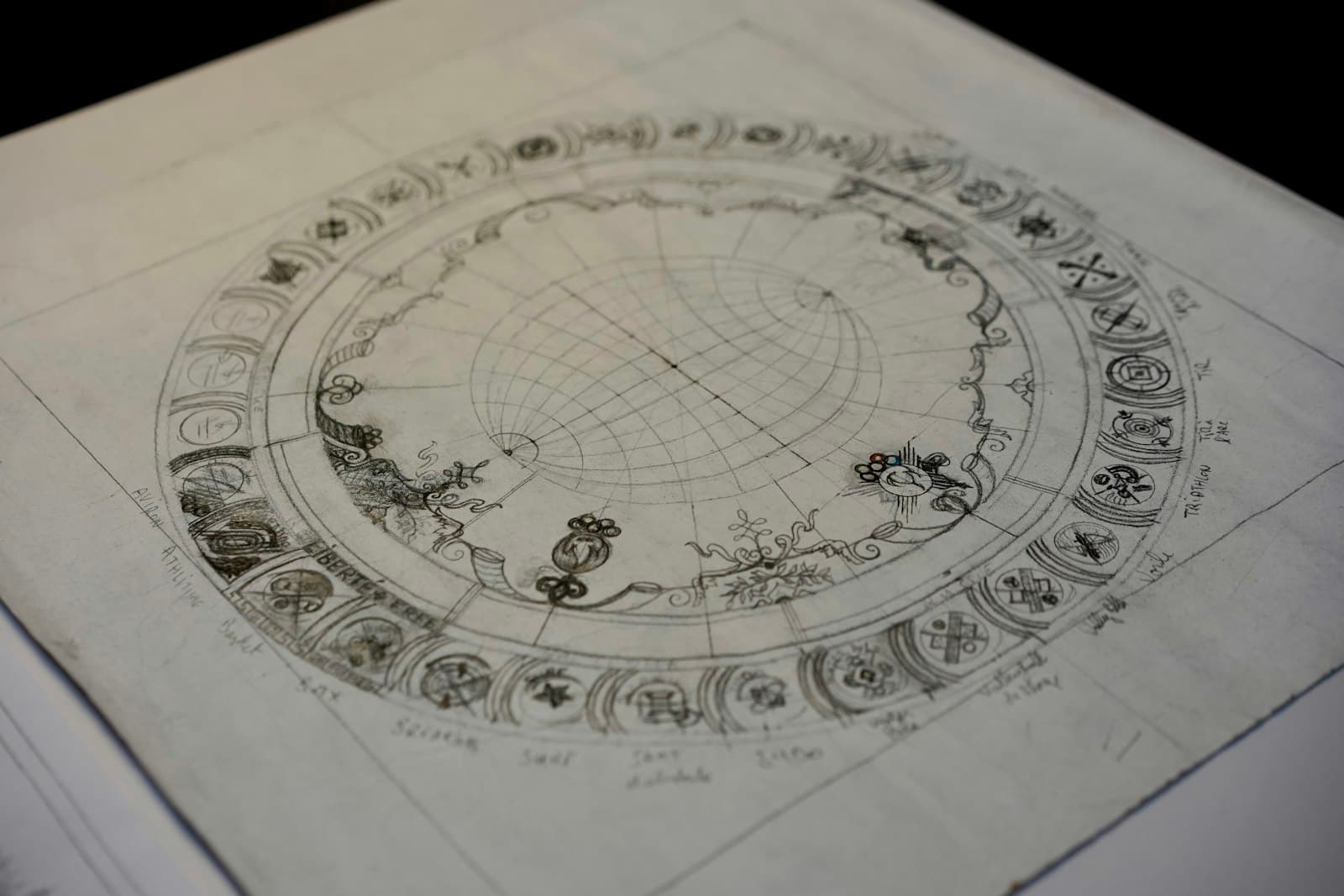
Everything in this direction so far has been a component. This is the part where the components become a reading, and order is most of it.
Why beginners produce contradictions
The usual first attempt goes like this. Look up the Sun sign. Write a sentence. Look up the Moon sign. Write a sentence. Continue through ten planets, then start on aspects.
The output is a list of twenty or thirty statements, several of which conflict, with nothing indicating which matter more.
A chart read as a list will always contradict itself, because ten bodies in twelve houses describe a person, and people contradict themselves.
The fix is not to find the true placement that overrides the others. It is to read in an order that establishes structure first and detail afterwards, so that later information modifies earlier information rather than competing with it.
Step one: the overall shape
Before any individual placement, look at the whole chart as a picture.
Where are the planets concentrated? Bunched in one area or spread around. Mostly above the horizon or below. Mostly on the eastern side or the western.
What is the elemental balance? Count planets by fire, earth, air and water. A chart with seven planets in water and none in earth is telling you something before any placement is read.
What is the modal balance? Cardinal, fixed and mutable. A heavily fixed chart and a heavily mutable one behave very differently.
Are there obvious patterns? A stellium, a T-square, a grand trine. These are structural and should be noticed before the details.
This step takes two minutes and it supplies the frame everything else hangs on. Skipping it is the main reason readings come out shapeless.
Step two: the angles and the chart ruler
The structural skeleton, established next.
The Ascendant sign. How the person meets the world, and the setting of the entire house framework.
The chart ruler. The planet ruling the Ascendant sign. Find it, note its sign, house and condition. In traditional practice this is the most significant planet in the chart, and it frequently organises the reading.
The Midheaven sign, and its ruler, for the public and vocational dimension.
Any planet conjunct an angle. These are the most prominent placements in a chart and deserve noting immediately, since they outweigh a great deal of what follows.
One caveat carried forward from the article on the angles: all of this depends on an accurate birth time. If the time is uncertain, this step is provisional and should be treated as such rather than built on.
Step three: the lights
The Sun and Moon, taken together rather than separately.
The Sun by sign and house: the core identity and the direction of the life.
The Moon by sign and house: the emotional nature, instinct and need.
Their relationship. Whether they are in aspect, and what phase the Moon was in. A person born near a new moon, with Sun and Moon conjunct, integrates identity and instinct differently from one born near a full moon with the two in opposition.
Reading the lights as a pair rather than two entries is the single biggest improvement most beginners can make, because the relationship between what a person is becoming and what they already are is one of the most useful things a chart offers.
How this is taught inside Astra Trainer
This is Natal Chart Reading, one of thirteen sub-topics in the Astrology direction of the Spiritual world, and it comes after the component sub-topics rather than before.
The direction teaches planets, signs, houses, aspects, cusps, dignity and house rulers first, then synthesis, because synthesis without components produces exactly the list of contradictions this article describes. Lessons take about five minutes, and there is a discussion thread under every one.
Step four: the rest of the planets
Now the individual placements, in a deliberate sequence.
Take Mercury, Venus and Mars first, since they are personal and fast-moving. For each: sign for manner, house for setting, and essential condition if you use dignity.
Then Jupiter and Saturn, noting that these are shared across a birth year or two, so their house placement carries more individual weight than their sign.
Then the outer three, with the same caution amplified. Everyone in a generation shares their signs, so the house is what makes them personal.
Two disciplines at this stage.
Do not write conclusions yet. Collect the placements as observations. Conclusions come after aspects, because an aspect can change what a placement means substantially.
Notice repetition as you go. If three separate placements point at the same theme, mark it. Repetition is the strongest signal in a chart and it is only visible if you are watching for it.
Step five: aspects and patterns
The connective layer, and the point where the reading starts to cohere.
Work through the aspects using the method in the article on reading an aspect between two planets: name both functions, establish whether the condition is effortless or effortful, describe the combination.
Prioritise rather than treating all aspects equally.
Tight aspects first. An aspect within a degree of exactness carries far more weight than one at the edge of orb.
Aspects to the lights and angles first. These touch the most significant points.
Patterns as units. A T-square or grand trine is read whole, not as separate pairs.
Applying before separating, if you use that distinction.
Step six: house rulers
The last technical layer, and the one that answers most of the questions people actually ask.
Trace the rulers as described in the article on house rulers: cusp sign, its ruling planet, that planet's placement. Read each as a sentence linking two areas of life.
Start with the houses relevant to the question at hand rather than doing all twelve. If someone wants to understand their work life, trace the tenth, the sixth and the second, and leave the rest.
This step is what converts the reading from a description of a person into a description of how the parts of their life connect, which is usually what was wanted.
Resolving contradictions
The skill that separates a reading from a recitation.
Charts contain opposing indications. A chart can show both caution and recklessness, both sociability and withdrawal. This is normal and the tradition does not treat it as a fault.
Four ways practitioners handle it.
Let both be true. People contain contradictions, and a chart showing them is describing rather than failing. Often the two operate in different areas, which the houses will tell you.
Weight by prominence. Angular placements, tight aspects, the chart ruler and the lights outweigh a planet in a cadent house at wide orb. Not everything counts equally.
Look for repetition. A theme arriving through three unrelated routes is the chart emphasising it. A single dramatic placement contradicted by everything else is not the headline, however striking it looks.
Check the houses. Contradictory tendencies frequently sit in different houses, which resolves the conflict into a statement about context: assertive at work, accommodating at home.
The failure mode to avoid is picking whichever indication fits what you already believe about the person. That is how astrology becomes a mirror rather than a method, and it is the most common way readings go wrong.
Not a basis for decisions. This article describes how astrologers synthesise a chart within their own tradition. Astrology is not a source of medical, psychological, financial or legal guidance, and nothing here should inform decisions in those areas. For health concerns see a qualified medical professional, and for financial or legal matters a qualified professional in that field.
What to take from this
Order is what prevents a chart reading from becoming a list of contradictions.
Work general to specific: shape, angles and chart ruler, lights, remaining planets, aspects, house rulers.
Read the Sun and Moon as a pair rather than as two entries, since their relationship is one of the most useful things in a chart.
Weight by prominence. Angular placements, tight aspects, the chart ruler and the lights are not equal to a wide-orb aspect in a cadent house.
And repetition is the strongest signal. A theme arriving three separate ways is the chart's emphasis; a single striking placement contradicted by everything else is not.
In what order should I read a birth chart?
Overall shape first, then the angles and chart ruler, then the Sun and Moon, then the remaining planets, then aspects and patterns, then house rulers. General to specific throughout.
Why does my chart seem to contradict itself?
Because ten bodies across twelve houses describe a person, and people contain contradictions. The tradition treats opposing indications as real rather than as errors, and the houses often show that they operate in different areas of life.
What matters most in a chart?
Prominence. Planets conjunct the angles, tight aspects, the chart ruler and the two lights carry more weight than a planet in a cadent house at the edge of orb.
What is the chart ruler?
The planet ruling the sign on the Ascendant. Traditional practice treats it as the most significant planet in the chart, so it is established early because it organises much of what follows.
How do I know which theme is the real one?
Repetition. A theme that appears through three unrelated routes is emphasised by the chart. A single dramatic placement contradicted by everything else is not the headline, however striking it looks.