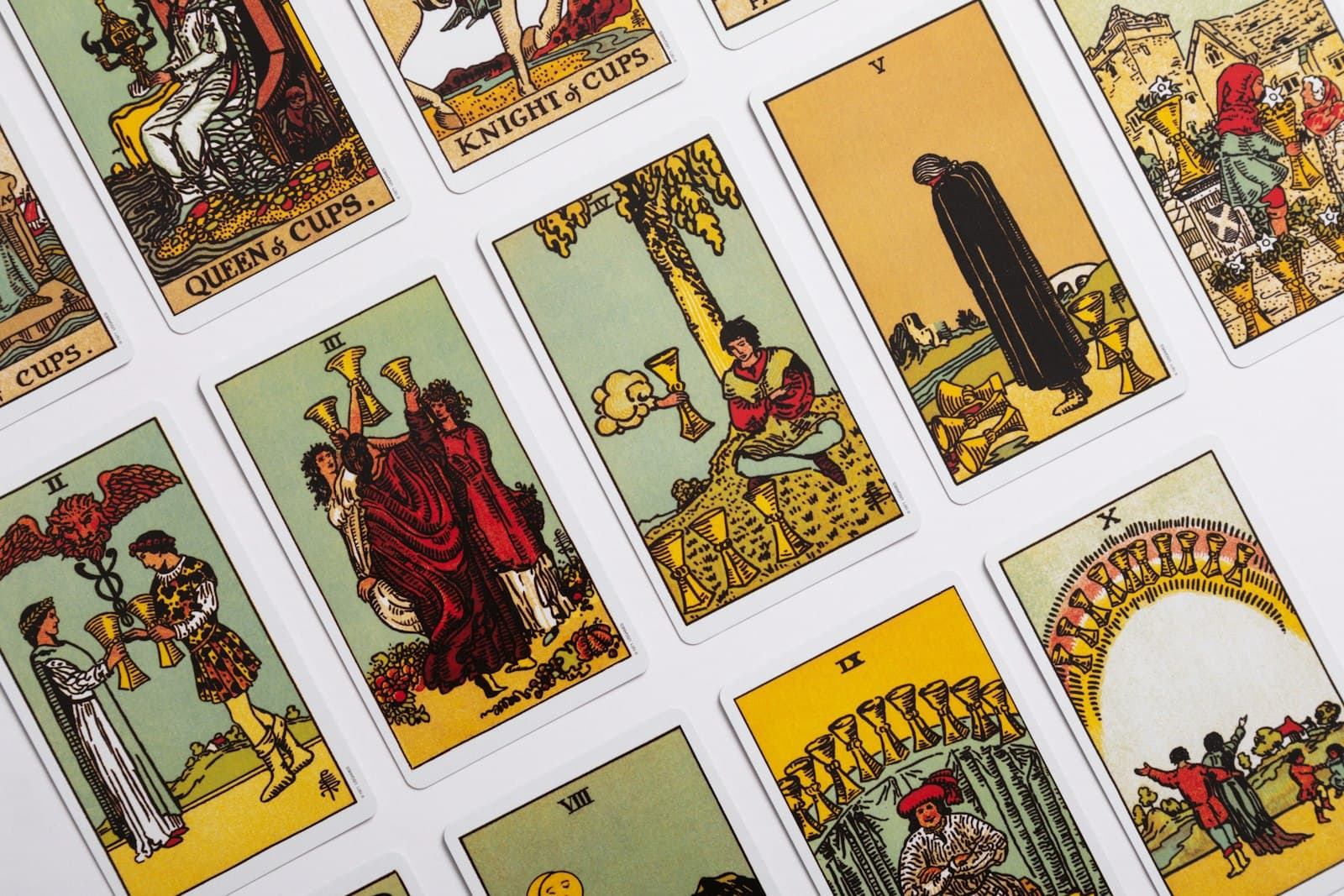
Forty numbered minor cards is an intimidating set to learn. Thirty-six of them have a structure attached, and knowing it makes them considerably less arbitrary.
Thirty-six and thirty-six
The coincidence the system is built on, and it is a genuine one.
Each zodiac sign divides into three segments of ten degrees, called decans or faces. Twelve signs times three gives thirty-six.
The minor arcana has four suits of ten numbered cards, ace through ten, giving forty. Set the four aces aside, since they are traditionally treated as the pure expression of their element rather than as a position, and forty becomes thirty-six.
Thirty-six decans, thirty-six numbered minors. The correspondence is tidy enough that once you see it, the mapping feels inevitable.
Decans are considerably older than tarot. They appear in ancient Egyptian astronomy and were carried into Hellenistic astrological practice, where each was assigned a planetary ruler. The tarot mapping is the recent part.
How the decan mapping works
The structure, and it is systematic.
Each suit is assigned an element, and each element governs three signs. Wands take fire, so Aries, Leo and Sagittarius. Cups take water, so Cancer, Scorpio and Pisces. Swords take air, so Libra, Aquarius and Gemini. Pentacles take earth, so Capricorn, Taurus and Virgo.
Within each suit, the nine numbered cards from two to ten map onto the nine decans of that element's three signs, in order.
Each decan also carries a planetary ruler, assigned in a repeating sequence through the traditional planets. So every numbered minor ends up with a planet and a sign segment.
Worked example. The Two of Wands corresponds to the first decan of Aries, ruled by Mars. Aries is cardinal fire and Mars is its ruler, so the card sits at the point of maximum initiating fire. Practitioners read the Two of Wands as the moment of surveying what has been begun and deciding where to direct it, which is consistent with that placement.
Another. The Five of Swords corresponds to a decan of Aquarius with Venus as ruler. Fives are traditionally difficult, Swords are air and conflict, and Venus in a context of conflict reads as a hollow or costly outcome. The card's usual reading, a victory that damages the relationship, follows from the components.
What it adds to a card
The practical value, and it is mostly about coherence rather than new information.
It explains meanings that look arbitrary. A reader who knows the decan can see why the Five of Swords reads the way it does, rather than memorising it.
It gives three reinforcing routes. Number, suit and decan should agree. When they do, the reading is solid. When they seem not to, you have usually misread one of them.
It connects to astrological timing. Practitioners who use both crafts sometimes relate a card's decan to where planets currently are, though that moves toward prediction and is outside what this article covers.
It makes the minors learnable. Thirty-six cards with a generative structure is a much smaller learning problem than thirty-six cards to memorise.
How this is taught inside Astra Trainer
This completes Tarot and Astrology, one of four sub-topics in the Tarot direction of the Spiritual world.
It follows the article on where the correspondences came from, and it connects to the Astrology direction, where decans appear as a dignity in their own right. Lessons take about five minutes, and there is a discussion thread under every one.
Elemental dignities
A separate technique from the same source, and it is about how cards affect each other rather than what they mean alone.
Each suit carries an element, and elements have relationships. When cards sit next to each other in a spread, those relationships strengthen or weaken what each card is saying.
The standard scheme.
Same element. Strongest reinforcement. Two Cups cards intensify each other.
Friendly elements. Fire with air, and earth with water. These support each other, and both cards are read at close to full strength.
Opposed elements. Fire with water, and air with earth. These weaken each other, and the tradition reads both cards as diminished rather than one defeating the other.
Neutral pairings. Fire with earth, and air with water. Little interaction, and the cards are read largely on their own terms.
Majors are handled variously. Some practitioners give each major its element from the correspondence table and include it in the calculation. Others treat majors as outside the scheme, on the grounds that they operate at a different level.
Applying dignities in a spread
How the technique is used, in practice.
Three-card groups are the classic application. The centre card is the subject, and the two flanking cards strengthen or weaken it according to their elements relative to it.
Two flanking cards of the same element as the centre make it emphatic.
Two opposed to it make it weak, and the reading should say so rather than delivering the card at full force.
One friendly and one opposed gives a qualified reading: the card holds, with something working against it.
The value of this is that it produces gradations. Without dignities, every card in a spread speaks at the same volume. With them, some cards are emphasised and some are muted, which is closer to how situations actually behave.
It also gives a reader a principled reason to say that a card is not doing much, which is a useful thing to be able to say and difficult without a method for it.
The honest caveats
Three things that belong alongside the technique.
The tarot mapping is nineteenth-century. Decans are ancient and the decan-to-card correspondence comes from the Golden Dawn, as covered in the companion article. The elemental dignity technique comes from the same source.
The suit attributions are disputed. Systems disagree about whether Wands take fire and Swords air or the reverse. Since dignities depend entirely on suit elements, that disagreement changes every dignity calculation, which is not a small caveat.
Many readers do not use either technique. Marseille-tradition readers generally work from number and suit structure without decans or dignities, and they read competently. These are tools within one system rather than requirements of tarot.
The reasonable position is the one this world takes throughout. The system is coherent, useful and recent, and a reader should know which of those three applies to any given claim.
Not a basis for decisions. This article describes techniques as practitioners use them within their own tradition. Tarot and astrology are not sources of medical, psychological, financial or legal guidance, and nothing here should inform decisions in those areas. For health concerns see a qualified medical professional, and for financial or legal matters a qualified professional in that field.
What to take from this
Thirty-six decans and thirty-six numbered minors, once the four aces are set aside, and the Golden Dawn mapped one onto the other.
Each numbered minor gains a planet and a zodiac segment, which explains meanings that otherwise have to be memorised.
Number, suit and decan should agree, and when they appear not to, one of them has usually been misread.
Elemental dignities let adjacent cards strengthen or weaken each other, which gives a spread gradations of volume rather than one level throughout.
And both techniques are nineteenth-century, the suit attributions they depend on are disputed, and plenty of readers work well without them.
What are decans in tarot?
Ten-degree divisions of the zodiac, thirty-six in total. The thirty-six numbered minor cards from two to ten across four suits map onto them, giving each card a planet and a zodiac segment.
Why are the aces excluded?
Because they are traditionally treated as the pure expression of their element rather than as a position within a sign, which leaves thirty-six numbered cards to match the thirty-six decans.
What are elemental dignities?
A technique where adjacent cards strengthen or weaken each other by suit element. Same element reinforces, fire with air and earth with water support, fire with water and air with earth weaken, and the remaining pairings are neutral.
Why do the suit elements matter so much?
Because dignities depend entirely on them, and systems disagree about whether Wands take fire and Swords air or the reverse. That disagreement changes every dignity calculation.
Do I need to learn decans to read tarot?
No. Marseille-tradition readers work from number and suit structure without decans or dignities. These are tools within the Golden Dawn system rather than requirements of the practice.