
A reversed tarot card is a card that lands upside down from the reader’s point of view. Many readers interpret it as the upright theme being blocked, turned inward, overexpressed, delayed, or redirected. A yes-or-no tarot reading uses a rule chosen before the draw to sort cards into yes, no, or uncertain responses. Neither practice has one universal method.
The useful part is not obtaining a one-word prediction. It is seeing what qualifies the answer. A reversed Nine of Wands might not simply mean “no”; it may show that exhaustion, defensiveness, or poor timing is shaping the question. This guide gives you a consistent way to read that difference.
What does a reversed tarot card mean?
A reversed card usually changes how the upright meaning is expressed. The reversal may describe something unavailable, private, excessive, slow, or pointed in an unhelpful direction. Start with the upright theme, because the reversed meaning should still be recognizably connected to the same card.
A. E. Waite’s 1911 *Pictorial Key to the Tarot* lists reversed meanings card by card, so reversals are not an internet invention. The book is influential, not a universal rulebook; many readers use other systems or no reversals.
| Reversal lens | What it asks | Short example |
|---|---|---|
| Blocked | What cannot move or be expressed? | The Chariot reversed: effort without clear direction |
| Internalized | Where is the theme happening privately? | Strength reversed: courage weakened by self-doubt |
| Excessive | What has gone too far? | The Emperor reversed: structure becoming control |
| Delayed or redirected | What needs different timing or another route? | Eight of Wands reversed: momentum interrupted or scattered |
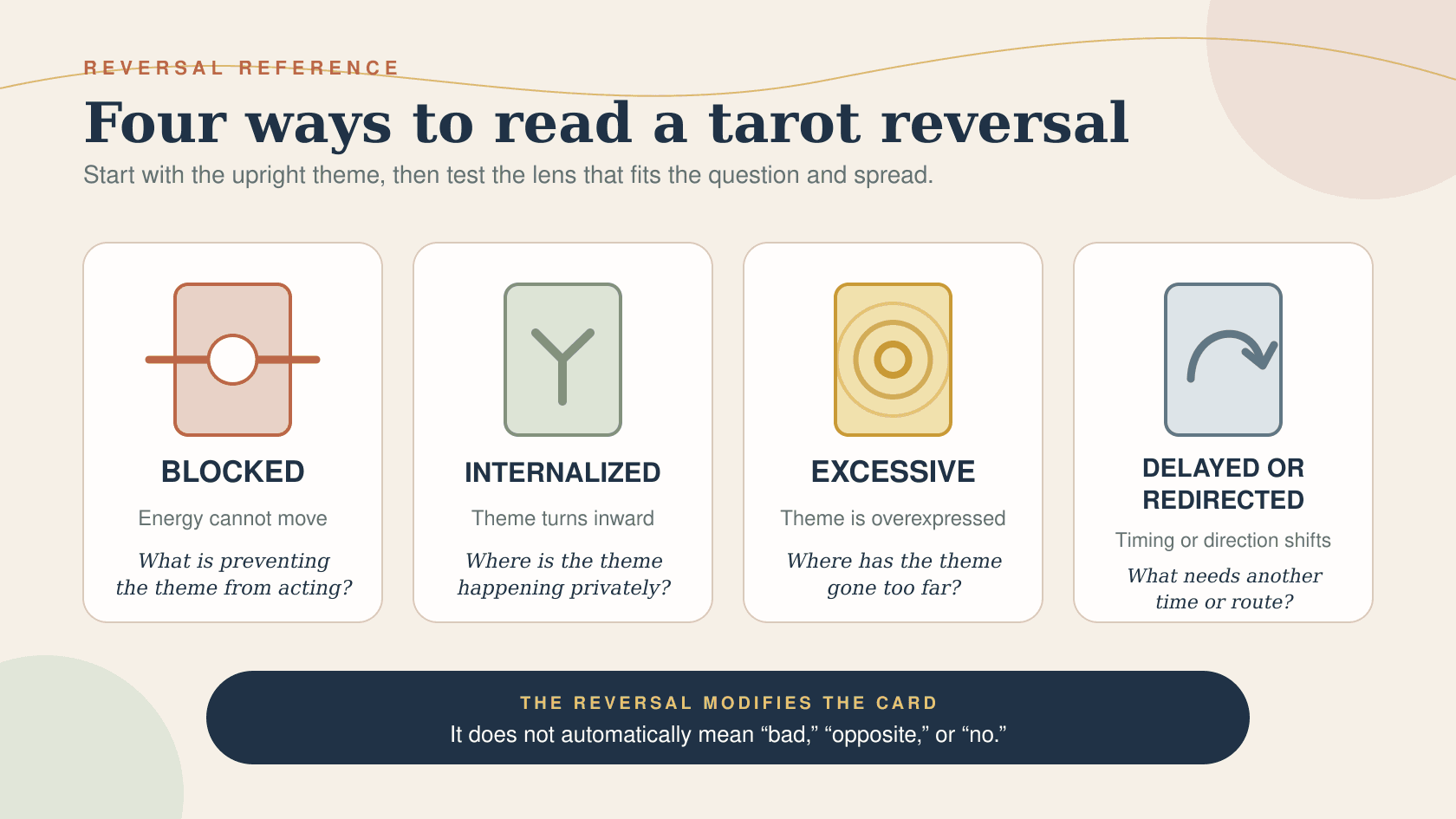
“Opposite of upright” is one possible reversal lens, but it is a poor automatic rule. The opposite of a broad symbol is often unclear, and it can disconnect the reversed meaning from the image on the card.
Do you have to read tarot reversals?
No. A complete tarot reading can be done with every card upright. Upright cards already contain tension, warning, excess, and difficult choices; reversals are an extra layer, not a requirement. If you want an upright-only deck, turn the cards to the same orientation before shuffling and avoid rotating packets.
Reversals can be helpful when they add a precise distinction you can explain. They become distracting when every upside-down card triggers a second memorized dictionary. Beginners often learn faster by becoming comfortable with the deck’s basic structure first, then adding one reversal lens at a time.

How to read a reversed tarot card in five steps
- 1. Return to the question. A reversal in advice does a different job from the same card in an obstacle position.
- 2. Name the upright theme. Use one plain sentence before changing it; otherwise a reversed definition adds noise.
- 3. Check the image. Notice direction, posture, movement, and what now appears unstable or turned away.
- 4. Test the four lenses. Ask whether the theme is blocked, internalized, excessive, or delayed. Choose the best fit.
- 5. Reconnect it to the spread. Read the surrounding cards and state one qualified sentence.
The upright Hermit can describe deliberate solitude. Reversed in an obstacle position, “internalized” adds little because solitude is already inward. “Excessive” may fit better: reflection has become isolation.
Check yourselfThe upright Four of Cups describes withdrawal, dissatisfaction and failing to engage with what is available. Before you read on: what would you expect that same card reversed to describe?Show the answerHide the answer
Re-engagement, and emotional movement after a stagnant period. The reversal here reads as more open than the upright card, not less, which is the clearest case in the article of orientation failing to sort the deck into good and bad. Note what the prediction does not do: it does not invert the symbol mechanically. It keeps the card's theme of a missed offer and asks what has changed about the reader's relation to it.
Three reversed tarot card examples
Eight of Cups reversed
The upright Eight of Cups concerns leaving something emotionally significant in search of what is more honest or fulfilling. The Eight of Cups reversed can show fear of leaving, returning to an old situation, or delaying an ending you already understand. In a yes-or-no reading about walking away, that is better read as “not yet, because attachment is unresolved” than a bare no.
Nine of Wands reversed
The upright Nine of Wands emphasizes endurance and guarded persistence. The Nine of Wands reversed may point to burnout, hypervigilance, or depleted boundaries. If the question is “Should I push through?”, the reversal invites a condition: rest and reassess capacity before treating persistence as the only form of strength.
Four of Cups reversed
The upright Four of Cups often describes withdrawal, dissatisfaction, or failing to engage with what is available. The Four of Cups reversed can suggest re-engagement and emotional movement after a stagnant period. Here a reversal may feel more open than the upright card, which is a useful reminder that reversed does not mean worse.
| Card | Upright focus | Possible reversed focus | Useful yes/no wording |
|---|---|---|---|
| Eight of Cups | Leaving what is complete | Avoiding or reconsidering departure | Not yet; clarify what keeps you there |
| Nine of Wands | Endurance with boundaries | Exhaustion or over-defensiveness | Only if the cost is sustainable |
| Four of Cups | Withdrawal or dissatisfaction | Renewed interest or re-entry | Possibly; notice the offer you missed |
How do yes-or-no tarot readings work?
A yes-or-no tarot reading converts a symbolic system into a binary result. Readers do this in different ways: card orientation, a prepared card list, elemental associations, or a multi-card tally. None is built into tarot itself. The method works only as a convention you define before seeing the cards.
| Method | Rule | Advantage | Main limit |
|---|---|---|---|
| Orientation | Upright = yes; reversed = no | Fast and easy to repeat | Ignores the identity and tone of the card |
| Prepared card list | Each card is assigned yes, no, or maybe | Uses card meaning | Lists disagree and can create false certainty |
| Suit or element | Selected suits lean yes or no | Shows the kind of energy present | Court and Major cards still need another rule |
| Three-card tally | The majority gives the direction | Preserves conditions and context | Takes more interpretation than a one-card verdict |
Do not mix systems after the draw. Switching rules because a card looks inconvenient adjusts the method to obtain the answer you wanted. Write the rule down first.
A simple three-card yes-or-no tarot method
This method keeps the clarity of a tally while leaving enough room to explain the result. It is a specialized use of a three-card tarot spread.
- Define one specific question. Include a realistic time frame when it matters, and ask only about a situation you can influence.
- Choose the rule. For a simple orientation method, upright cards count as yes and reversed cards count as no.
- Shuffle without correcting orientation. Draw three cards and place them left to right.
- Read the majority. Two or three upright cards give a qualified yes; two or three reversals give a qualified no.
- Interpret every card. The majority gives direction. The card meanings explain the condition, obstacle, resource, or reason.

Run this before your next yes-or-no draw
Ticked: 0 of 5
The second and the last do most of the work; the rest follow from them. A low count usually means the method is being settled after the cards are down, which is the one habit that removes whatever value the exercise had.
What if the tarot answer is mixed or unclear?
Treat ambiguity as part of the answer. A narrow majority may mean the direction is possible but conditional. Contradictory cards may show competing priorities. A card that does not fit may expose a vague question. Before drawing a clarifier, say exactly what remains unclear and give the extra card a defined job.
Avoid repeating the same draw until you receive a preferred result. If you still need certainty, tarot may not be the tool the question requires. Gather evidence, talk to the relevant person, or make a small reversible test.
Do not use yes-or-no tarot to diagnose illness, verify pregnancy, choose medication, decide whether a situation is safe, predict a legal result, or risk money. Use qualified professionals and verifiable information for high-stakes decisions.
Better questions than ‘Will it happen?’
Binary questions often hide the part you can act on. Rewrite them to examine choices, assumptions, or preparation instead of seeking reassurance.
| Closed question | More useful reflective question |
|---|---|
| Will I get the job? | What would strengthen my application, and what am I overlooking? |
| Will this relationship work? | What pattern is shaping this relationship, and what can I address directly? |
| Should I move? | What do I gain, risk, and need to verify before deciding? |
| Will my plan succeed? | What supports this plan, and what could stop it? |
What to take from this
Reversals are modifiers, not alarms. Yes-or-no methods are chosen conventions, not hidden rules in the deck. Start with the question, keep one method, and read the cards after counting them. The best result is not the most certain-sounding answer; it is the one that makes the condition, tradeoff, or next step clearer.
When you need a specific upright or reversed interpretation, use Astra Trainer’s complete tarot card index, then bring the meaning back to the question and position rather than treating the lookup as a verdict.
Test yourself
Question 1 of 3
The upright Hermit describes deliberate solitude. Reversed in an obstacle position, why does the internalized lens add little here?
What does it mean when a tarot card is reversed?
It is upside down from the reader’s viewpoint. It may show the upright theme as blocked, internalized, excessive, delayed, or redirected.
Does a reversed tarot card always mean no?
No. Some binary systems count a reversal as no, but ordinary reversal reading may describe hesitation, excess, difficult timing, or renewed movement.
Are reversed tarot cards always negative?
No. The Four of Cups reversed can suggest re-engagement after withdrawal, while upright cards can still be difficult. Orientation does not divide the deck into good and bad.
Do beginners have to use tarot reversals?
No. Many readers keep every card upright. Add reversals when they create a distinction you can explain, not because a complete reading requires them.
How do you shuffle tarot cards to get reversals?
Rotate part of the deck 180 degrees before recombining it. To avoid reversals, align the cards and do not rotate packets while shuffling.
How does a yes-or-no tarot spread work?
Choose a rule before drawing. With three cards, the majority gives a direction; the meanings show what supports, blocks, or qualifies it.
What does a maybe answer mean in tarot?
The question may be conditional, conflicted, poorly timed, or vague. Identify what remains uncertain before using one assigned clarifier.
Can tarot accurately predict yes or no?
Tarot cannot verify a future outcome. Use a yes-or-no spread to examine direction, obstacles, and conditions rather than as proof.
Can I ask the same yes-or-no question again?
Repeating the draw until it changes becomes a search for permission. Keep the first spread, seek evidence, or ask a genuinely different question.