
Most people arrive at tarot slightly embarrassed. Curious enough to look up what a card means, unsure enough to feel silly about it, and immediately confronted with a wall of vocabulary — arcana, querent, significator, elemental dignities — that assumes you already know what you're doing. The result is that a lot of people who'd genuinely enjoy learning tarot give up in the first ten minutes.
The system itself isn't complicated. A tarot deck is 78 cards organised into a structure you can grasp in an afternoon, and the meanings, while deep, follow patterns that make sense once someone shows you the shape of them. This article covers that shape: where tarot actually came from, what's in the deck, what each of the four suits represents, and what "reading" a card actually involves.
Astra Trainer's Tarot course walks through every suit and major arcana card with real spreads, if you'd rather learn it as short daily lessons than a single sitting — but the fundamentals below stand on their own.
What is tarot, and where did it actually come from?
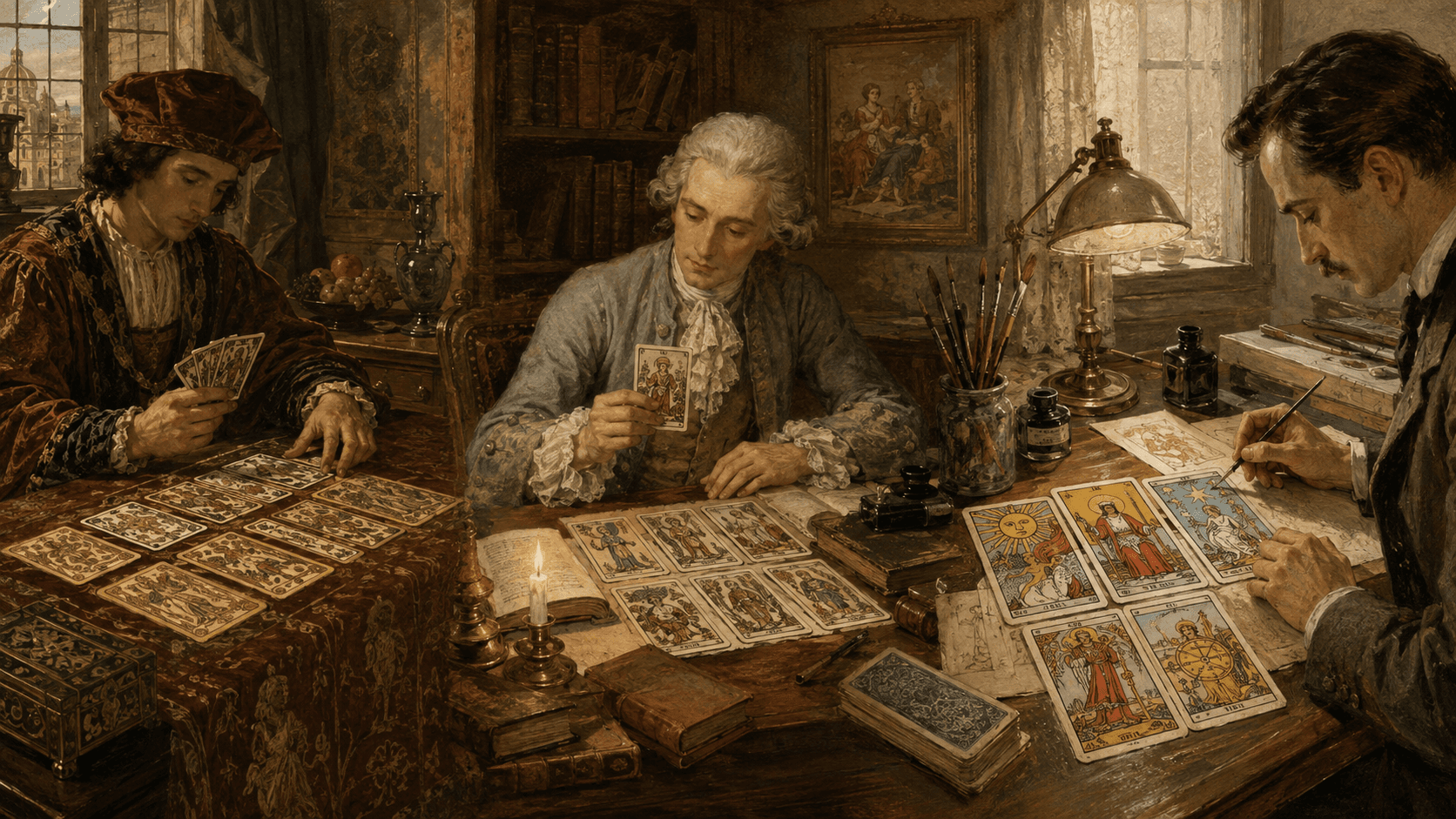
Tarot is a deck of 78 illustrated cards, used today as a system of symbolic images that people draw on for reflection — and it began, verifiably, as something considerably more ordinary: a card game.
The earliest tarot decks appeared in fifteenth-century Italy, known as *tarocchi* or *trionfi*, and they were made for playing trick-taking games, not for divination. The cards were beautiful, often commissioned by wealthy families, and functionally closer to a luxury deck of playing cards than to an occult instrument.
Divinatory use came centuries later, in eighteenth-century France. Two figures are central: Antoine Court de Gébelin, a scholar who wrote about tarot's supposed hidden significance, and Jean-Baptiste Alliette, who published under the name Etteilla and produced some of the first systematic guides to reading cards for divination.
Was tarot invented in ancient Egypt?
No — and this is worth addressing directly, because the claim is still widely repeated. Court de Gébelin proposed in the 1780s that tarot preserved the wisdom of ancient Egyptian priests, and the idea caught on enthusiastically. There's no historical evidence supporting it. The Italian playing-card origin is documented; the Egyptian origin is an eighteenth-century French invention.
Knowing tarot began as a card game doesn't diminish it. It just means the tradition is genuinely a few hundred years old rather than a few thousand — which is still a long conversation to join.
The deck almost everyone learns from
The single most influential deck is the Rider-Waite-Smith deck, published in 1909. It was conceived by A. E. Waite and illustrated by Pamela Colman Smith, an artist whose work defined the visual language of tarot for the next century — nearly every modern deck still borrows her compositions.
Smith was paid a flat fee and, for decades, received far less credit than the deck's popularity warranted; the deck was long known simply as "Rider-Waite," omitting her entirely. The increasingly common "Rider-Waite-Smith" naming is a relatively recent correction, and a deserved one.
What's inside a tarot deck?
A standard deck contains 78 cards, split into two groups: the Major Arcana (22 cards) and the Minor Arcana (56 cards). "Arcana" simply means "secrets" — it's older vocabulary for what are really just two categories of card.
The Minor Arcana is further divided into four suits of 14 cards each — ten numbered cards plus four court cards (Page, Knight, Queen, King). If that structure sounds familiar, it should: an ordinary playing-card deck is essentially the Minor Arcana with one court card removed.
The site's full card index has an individual page for every card in the deck, which is generally more useful for looking up a specific card than trying to memorise anything at this stage.
Check yourselfYou already know Swords is the suit of mind. You draw the Nine of Swords, and you have never looked that card up. Before you read on: what does the number on it add, and how far does that get you?Show the answerHide the answer
Further than you would expect. The suit gives the territory; the number says where in that territory the card sits. Aces are beginnings and raw potential, the middle numbers a situation developing or running into friction, Tens the theme in full. Nine is very late in the sequence, so the mental theme has run nearly to its extreme — which lands close to the traditional reading without your having memorised a word of it. That is the argument for learning the deck's structure before its contents.
What do the four suits mean?
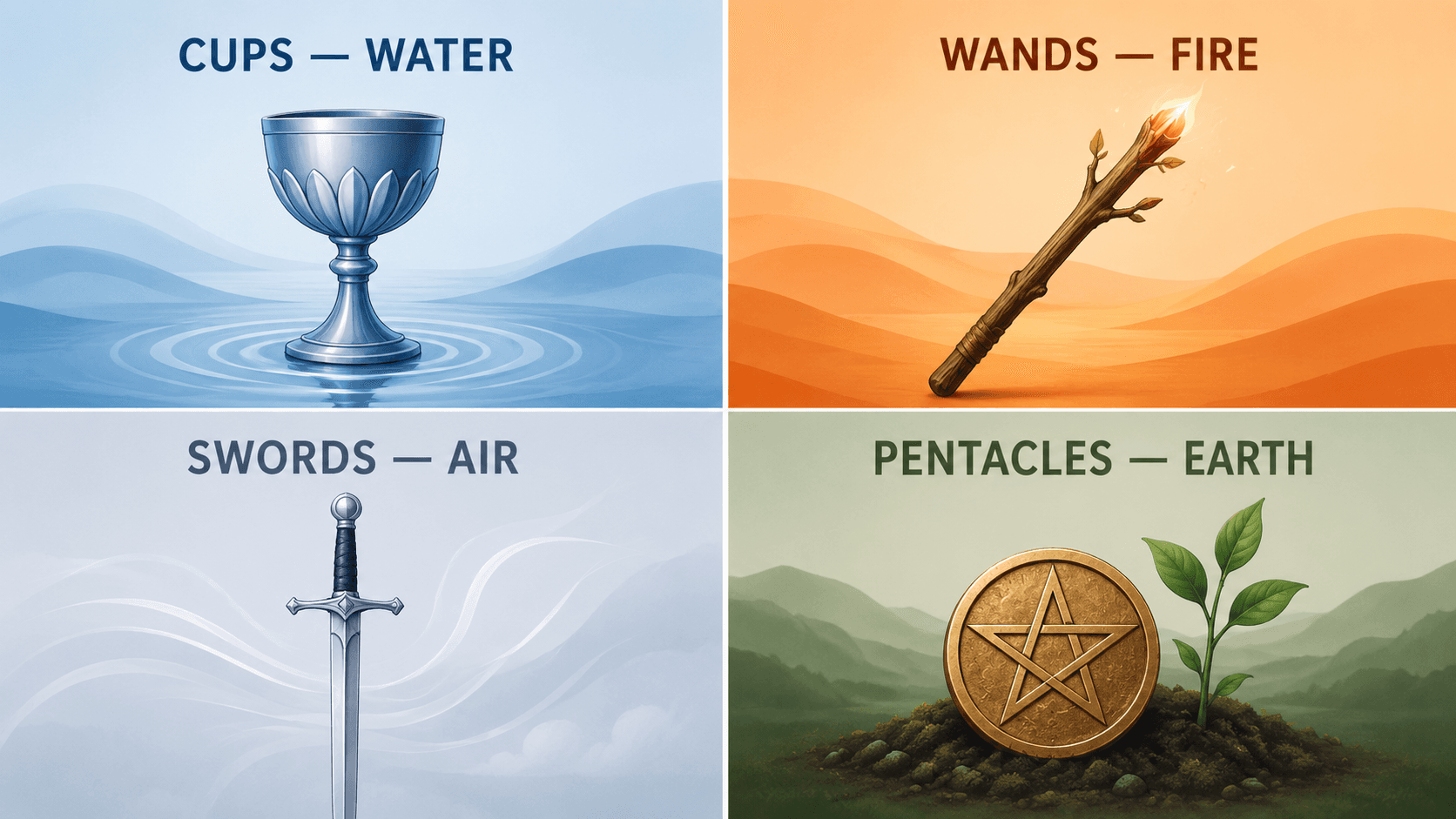
Each suit is traditionally associated with an element and a broad area of human experience. These are traditional correspondences within the Rider-Waite-Smith system — a shared vocabulary readers work with, rather than claims about how the world operates.
| Suit | Element | Life area | General tone of the cards |
|---|---|---|---|
| Cups | Water | Emotions, relationships, intuition, inner life | Feeling-led — connection, grief, love, longing, emotional honesty |
| Wands | Fire | Action, willpower, creativity, ambition | Energetic — momentum, drive, inspiration, sometimes burnout or conflict |
| Swords | Air | Thought, communication, conflict, truth | Sharp — clarity, difficult realisations, mental strain, decisions |
| Pentacles (or Coins) | Earth | Material life, work, money, health, the body | Grounded — resources, effort, security, slow practical progress |
Cups
Cups deal with emotional life — relationships, attachment, intuition, and the internal weather that isn't always visible from outside. The suit runs the full emotional range, and not all of it is pleasant.
The Eight of Cups is a useful illustration of how the suit works. Its traditional image shows a figure walking away from a row of cups, toward mountains, at night. The conventional reading involves leaving something emotionally significant behind — not because it failed dramatically, but because it's no longer enough. That's a very Cups idea: emotionally complex, not reducible to good or bad.
Wands
Wands cover action, creativity, drive, and will. Where Cups ask how you feel, Wands ask what you're doing about it. Cards in this suit tend to carry momentum, whether that means inspiration and ambition or the overextension and conflict that come from too much fire at once.
Swords
Swords are the suit of mind — thought, communication, conflict, and hard truths. They're often the cards beginners find intimidating, since the traditional imagery includes some genuinely uncomfortable scenes. In practice, the suit deals with mental states more than external disasters: overthinking, difficult conversations, painful clarity, decisions that have to be made with incomplete information.
Pentacles
Pentacles, sometimes called Coins or Discs, cover the material world — work, money, health, home, the physical body. It's the most grounded suit and often the most practical in tone: slow accumulation, tangible effort, real-world security and its absence.
How the numbers work within a suit
The suit tells you the territory; the number tells you roughly where in that territory a card sits. Traditionally, Aces suggest beginnings and raw potential, the middle numbers describe a situation developing or running into friction, and Tens represent the full expression of that suit's theme — which can be fulfilment or exhaustion depending on the suit involved.
This is genuinely useful for beginners, because it means you can make a reasonable first attempt at a card you've never seen before. A Nine of Swords is a Swords card — mental territory — sitting very late in the sequence, so the mental theme has run nearly to its extreme. Even without knowing the traditional interpretation, the structure points you somewhere close to it.
What the court cards do
The four court cards in each suit — Page, Knight, Queen, King — work differently from the numbered cards. They're traditionally read either as people involved in a situation or as modes of engaging with that suit's theme, ranging from the Page's inexperienced curiosity through the Knight's headlong action to the Queen's and King's more established mastery.
Beginners often find court cards the hardest group to interpret, largely because they're less situational and more characterological than the rest of the deck. Many readers simply hold them loosely at first — noting the suit and the rank, and letting the specific meaning fill in with experience.
What's the difference between the Major and Minor Arcana?
The rough distinction most readers work with: Minor Arcana cards tend to relate to everyday matters and specific circumstances, while Major Arcana cards are traditionally read as pointing to larger themes, turning points, or overarching patterns in a situation.
The 22 Major Arcana cards run from The Fool (numbered zero) through The World, and they're the cards most people recognise even without knowing tarot — The Lovers, Death, The Tower, The Star. Their sequence is often described as a narrative arc, sometimes called the Fool's Journey, moving from innocence through experience toward integration.
Two examples worth looking at, since they're frequently misread. Justice traditionally concerns fairness, cause and effect, and accountability — less about legal outcomes than about the honest weighing of a situation. Judgement, despite the ominous name, is conventionally about reckoning and awakening — a moment of reassessment rather than condemnation.
The Major Arcana explained card by card goes through all 22 in detail, if that's the part you want to go deeper on first.
One practical note about the Major Arcana: because these cards carry more symbolic weight, a spread containing several of them is often read as suggesting a situation with more significance or momentum than one made up mostly of Minor cards. That's a convention rather than a rule, and plenty of readers don't weight the two groups differently at all — but it's a common enough framing that it's worth knowing when you encounter it.
It's also worth being clear that the ominous-sounding names cause more anxiety than they should. Death, in traditional tarot interpretation, is almost never read as literal death — the conventional reading concerns endings and transitions, the closing of one chapter to make room for another. The Tower, similarly, deals with sudden disruption and the collapse of something built on unstable ground rather than catastrophe in any literal sense. Beginners frequently draw one of these, feel a jolt, and conclude they've done something wrong. They haven't.
How do you actually start reading tarot as a beginner?
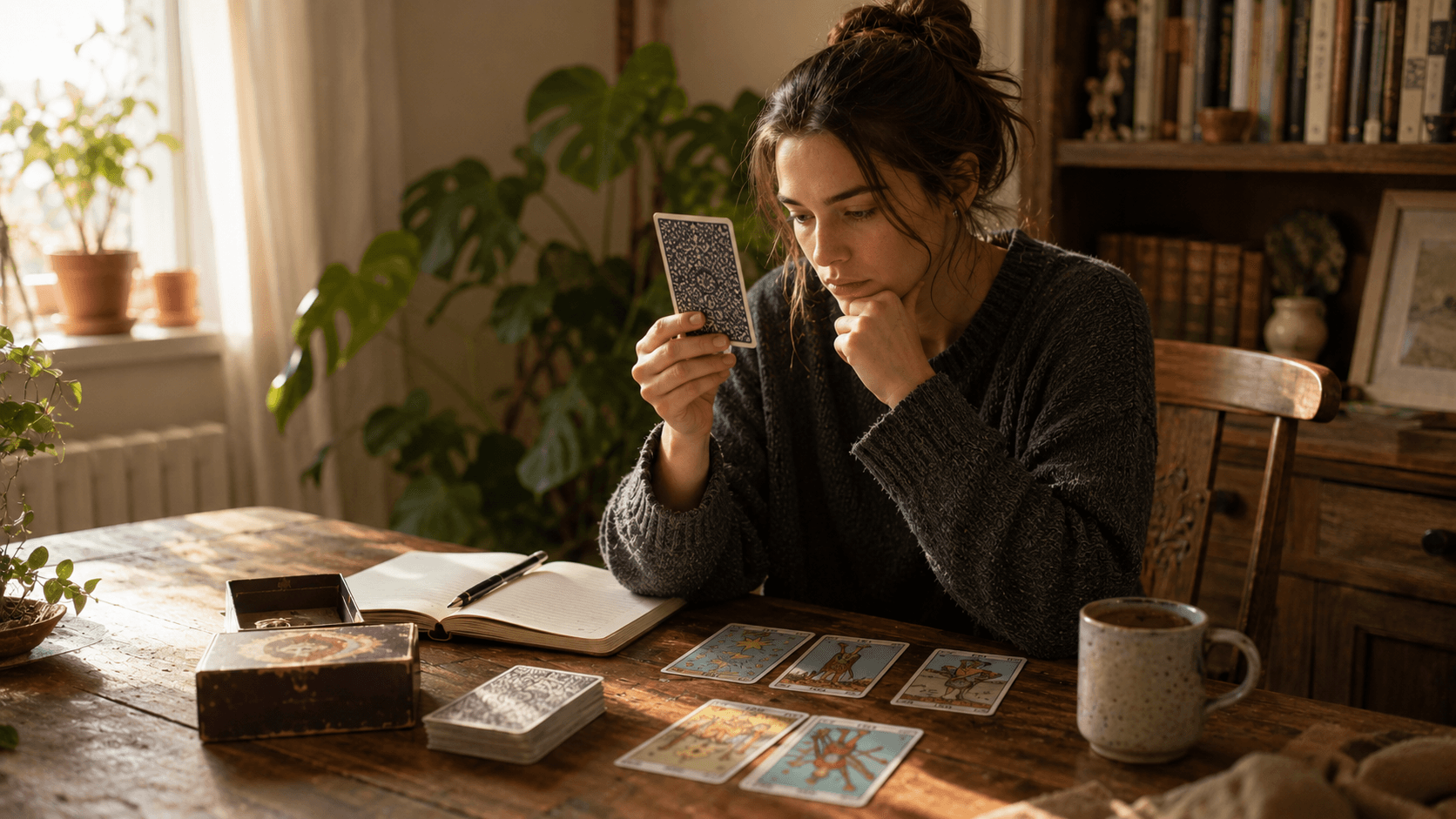
Most people start with a single card and a question, then build from there. A one-card draw is a legitimate reading, not a lesser version of one — a great deal of what makes tarot useful comes from sitting with one image rather than juggling ten.
The process, described simply: someone frames a question or situation, draws a card, looks at the image, and considers how its traditional associations might relate to what they're thinking about. That last step is where the actual work happens. The card doesn't produce an answer — it produces a prompt, and the reading is what the person makes of the prompt.
Three-card spreads are the common next step, with the three positions given meanings before the cards are drawn — past/present/future being the best-known arrangement, though situation/action/outcome is often more useful for reflection.
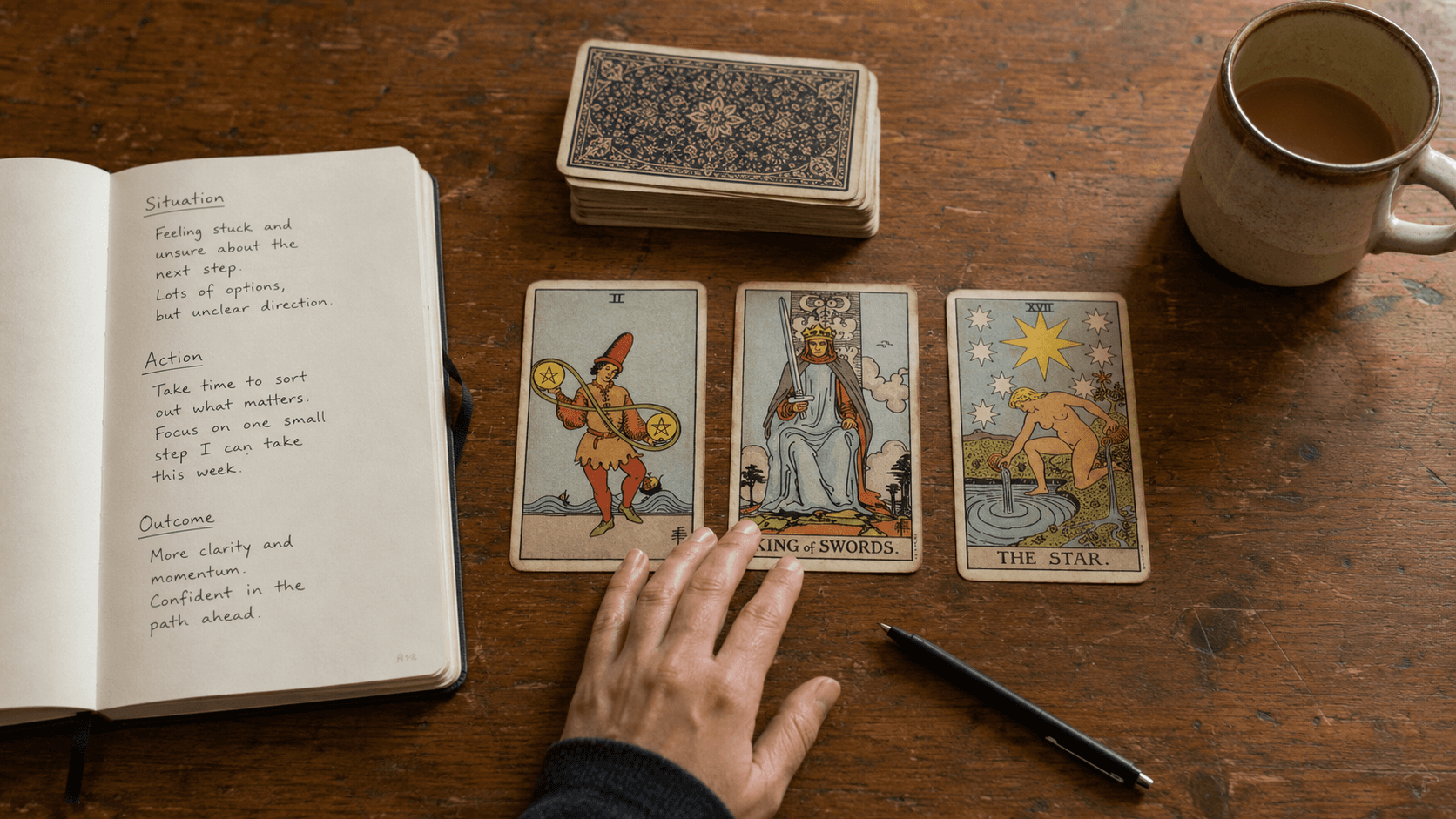
A card doesn't tell you what to do. It gives you something specific to think against, which is a different and often more useful thing.
A few habits that beginners commonly find helpful:
- Reading the image before reaching for the book. Noticing what the illustration actually shows — where the figure is looking, whether the scene feels settled or in motion, what's in the background — tends to build reading skill faster than memorising definitions, and it's why Smith's fully illustrated minor arcana mattered so much.
- Framing questions openly. "What should I understand about this situation?" gives more to work with than "will this work out?" — a distinction covered in more depth in the article on reversals and yes-or-no readings.
- Keeping a record. Many readers note what they drew and what they made of it. Over months this builds a personal reference that no published guide can replicate, since it's calibrated to your own situations and your own way of reading.
- Letting meanings stay loose early on. Traditional interpretations vary between sources, sometimes considerably. Treating them as a starting vocabulary rather than fixed definitions tends to produce better readings than trying to lock down a single correct meaning per card.
Try this on your next single-card draw
Ticked: 0 of 5
These are habits rather than knowledge, which is why every one of them can start with the next card you draw. A low count is not a sign you are reading badly — each item is a small change in how a draw is handled, and they compound over months.
Do you need a specific deck to start?
No, though there's a practical argument for beginning with a Rider-Waite-Smith deck or one closely based on it. The overwhelming majority of tarot books, courses, and reference material — including most card meanings you'll find online — assume RWS imagery, so learning on something else means constantly translating between systems.
Beyond that, deck choice is genuinely personal. There's a common piece of folklore that a tarot deck must be given as a gift rather than bought for yourself; it has no historical basis and plenty of readers ignore it entirely.
What does it mean when a card appears reversed?
A reversed card is one that appears upside down from the reader's perspective, and interpretations vary considerably between readers — which is worth knowing early, because beginners often assume there's one correct approach.
Some readers treat reversals as the opposite of the upright meaning. Others read them as the same theme in a blocked, internalised, or excessive form. And plenty of experienced readers don't use reversals at all, shuffling in a way that keeps every card upright. None of these is the wrong method; they're different conventions within the same tradition.
How reversals and yes-or-no readings actually work covers the different approaches in more depth, including the specific question of whether tarot suits binary answers at all.
Can tarot predict the future?
Tarot is best understood as a reflective practice rather than a predictive one — a structured way of thinking through a situation using a shared symbolic vocabulary, not a method for obtaining factual information about what will happen.
This distinction matters practically, not just philosophically. A reading can be genuinely useful for noticing what you're avoiding, naming an ambivalence you hadn't articulated, or considering a situation from an angle you'd been skipping. What it can't do is supply reliable information about outcomes — and treating it as though it can is where the practice stops being useful and starts being a way of outsourcing decisions.
Some decisions particularly shouldn't route through a card. Medical questions belong with a doctor, financial ones with a qualified advisor, legal ones with a lawyer. That isn't a hedge — it's the difference between a practice used for reflection and one used as a substitute for expertise it doesn't have.
What else is worth learning alongside tarot?
Tarot sits alongside two other symbolic systems people often explore together, and each is a separate vocabulary rather than a variation on the same one.
Numerology works with the significance traditionally assigned to numbers, which overlaps naturally with tarot's numbered cards. An introduction to what numerology numbers actually mean covers the basics, and your life path number is usually the first calculation people learn. Beyond that, master numbers 11, 22, and 33 are treated as a special case, and repeating or angel numbers are the version most people encounter first without necessarily knowing the framework behind them.
Astrology works with planetary and zodiacal symbolism. Zodiac signs and their date ranges is the usual starting point, though the difference between sun, rising, and moon signs tends to be the thing that makes astrology click for people who found sun signs alone unconvincing. A beginner's approach to reading a birth chart covers how the pieces fit together.
What to take from this
Tarot is more approachable than its vocabulary suggests: 78 cards, four suits with clear thematic territories, 22 major cards carrying broader themes, and a practice that amounts to looking at an image and thinking carefully about a situation. The history is genuinely interesting and genuinely documented, which is more than can be said for the Egyptian mythology built on top of it.
If you'd rather learn this as short lessons than a single long read, that's what the Spiritual world inside Astra Trainer is built for — working through the cards, the spreads, and the symbolism at a pace that actually sticks. The world's premise is about stopping the endless second-guessing that surrounds big decisions, which in practice means having a clearer way to think them through — not handing the thinking over to a deck of cards.
Test yourself
Question 1 of 3
A friend tells you that tarot preserves the wisdom of ancient Egyptian priests. What does the documented record say?
What is tarot and where did it come from?
Tarot is a deck of 78 illustrated cards used for reflection. It originated in 15th-century Italy as a card game (*tarocchi*), not an ancient Egyptian occult practice.
What are the four suits in tarot?
The four suits are Cups (Water — emotions and relationships), Wands (Fire — action and creativity), Swords (Air — thought and communication), and Pentacles (Earth — material life and work).
What is the difference between Major and Minor Arcana?
Minor Arcana cards relate to everyday matters and specific circumstances, while Major Arcana cards point to larger themes, turning points, or overarching patterns in a situation.
Can tarot predict the future?
Tarot is best understood as a reflective practice rather than a predictive one — a structured way of thinking through a situation using a shared symbolic vocabulary, not a reliable source of factual future outcomes.