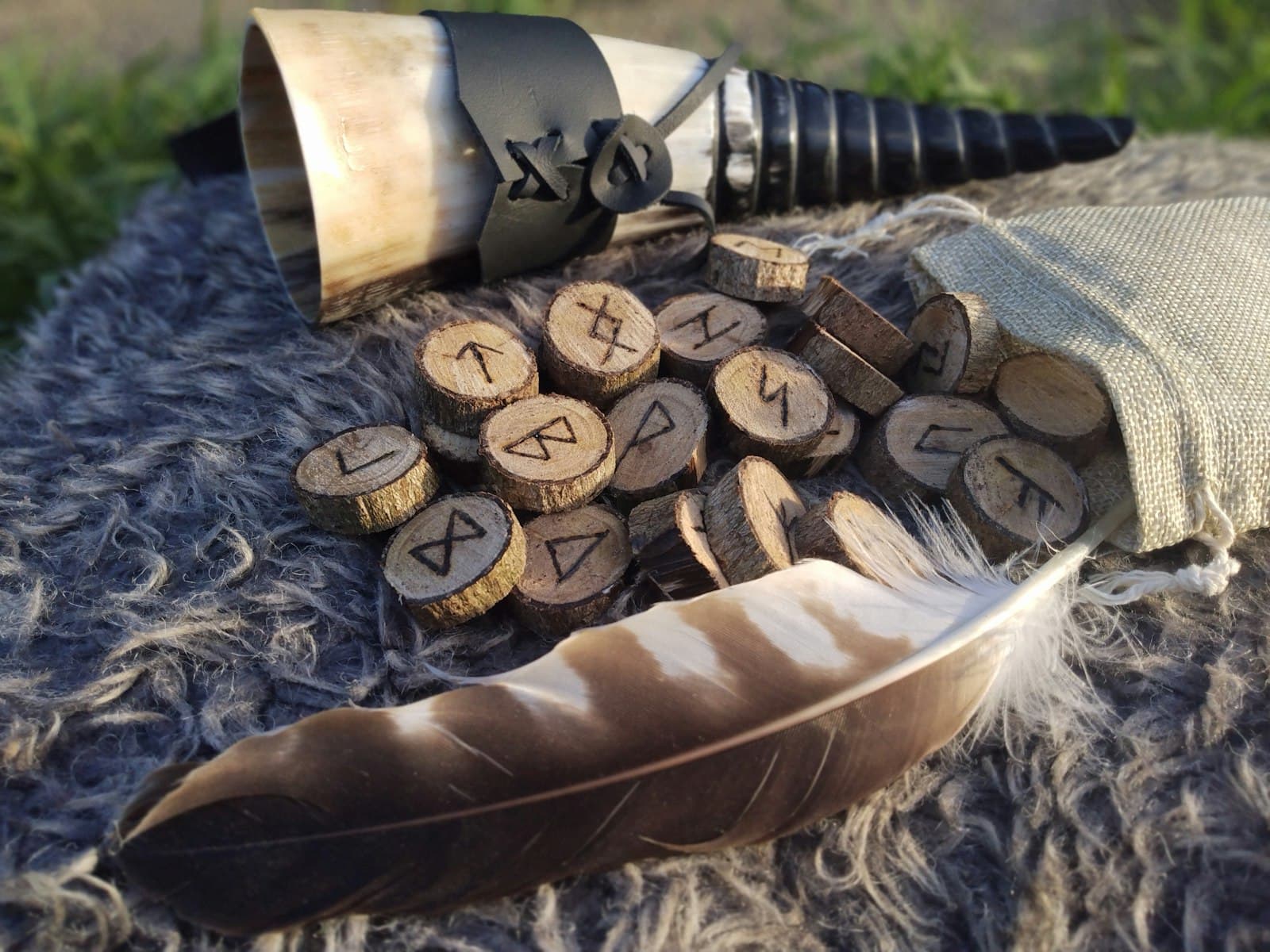
The third aett is about what people do once they are not simply surviving: law, households, horses, neighbours, inheritance.
The settled aett
The first aett covers wealth, strength and the elements of a world. The second covers what threatens it. The third covers the arrangements people make to live together.
Law, the birch, the horse, the human being, water, fertility, day, inherited land. It is the most domestic stretch of the alphabet and the least dramatic, which is presumably why modern books give it less attention.
After hail and ice and the yew, the alphabet ends with a horse, a neighbour and a piece of land that has been in the family. That is a reasonable order of priorities.
Tiwaz
Sound value t, and the only rune in the futhark named directly for a named god: Tyr, or Tiw in the Old English tradition.
The poems treat it in terms of constancy rather than of battle. The Old English poem calls it a guiding star that keeps faith well with princes, always on its course over the mists of night, never failing. The Norse poems associate it with the one-handed god and with a smith's work.
The reference to one hand is the important context. In the Norse material Tyr loses his hand to the wolf Fenrir, having placed it in the wolf's mouth as a pledge of good faith while the gods bound him. The pledge was false and Tyr knew it. He gave his hand anyway because someone had to.
So the god of this rune is associated with oath, law and the costs of keeping faith, which is a considerably more specific idea than the victory and warrior courage modern readings tend to supply.
Berkano
Sound value b, name meaning birch or the birch goddess.
The Old English poem describes the birch as bearing no fruit but producing shoots without seed, with beautiful branches, high-crowned and laden with leaves, touching the sky.
The observation about propagation without seed is literal: birch spreads readily through suckers and regenerates fast. It is also one of the first trees to recolonise cleared or burnt ground.
Modern readings give birth, growth, nurture and the feminine, which extends the source rather than contradicting it, and the connection is usually made through the birch goddess reading rather than the tree description.
Ehwaz
Sound value e, name meaning horse.
The Old English poem is one of the warmest in the collection. The horse is a joy to princes, proud on its hooves, discussed by wealthy men, and it is a comfort to the restless.
Read carefully, the verse is not really about the animal. It is about the relationship between rider and horse, and about the horse as something that carries you when you cannot stay still.
Modern readings give partnership, trust, movement and cooperation, which is one of the cases where the modern gloss is genuinely faithful to the source.
Mannaz
Sound value m, name meaning man in the sense of a human being or humankind.
The Old English poem says that each is dear to their kin, and that nonetheless all must depart, since the lord commits the body to the earth.
That is a verse about mortality and about the fact that human attachment does not prevent it. The Norse poems are sharper still, with one noting that a human is an augmentation of the dust and that the hawk's talon rules the falcon.
Placed immediately after the horse, the human rune reads as the social animal: dear to kin, embedded in relationships, and temporary. Modern readings usually give humanity, self, community and the shared human condition, which keeps the social half and drops the mortality.
How this is taught inside Astra Trainer
This is the 3rd Aett, Tyr's Aett, one of eight sub-topics in the Runes direction of the Spiritual world.
It completes the 24, after which the direction moves on to activation, formulas and scripts, bind runes and galdrastaves. Each rune is given with what the poems say alongside the modern reading, including where the two diverge. Lessons take about five minutes, and there is a discussion thread under every one.
Laguz
Sound value l, name meaning water, lake or sea.
The Old English poem is emphatically not about serenity. It describes water as seeming unending to people when they must venture out on an unsteady ship, when the sea waves terrify them and the sea-steed will not obey its bridle.
That is a verse about being at sea in bad weather in a boat that is not answering. For a seafaring culture it is the obvious association, and it is fear rather than flow.
Modern readings almost universally give intuition, the unconscious, emotion and flow, which is a complete replacement of the source's meaning rather than an extension of it. This is the widest gap between poem and gloss in the whole futhark.
Ingwaz
Sound value ng, name referring to Ing, a god associated with the Danes and connected to Freyr.
The Old English poem is unusual in being narrative. Ing was first seen among the East Danes, then departed eastwards over the waves, with his wagon running behind. That is how the warriors named the hero.
It reads as a fragment of a story that the audience knew and we do not, which is a useful reminder of how much context is missing from all of this material.
Modern readings give fertility, gestation, potential held and then released, drawing on Ing's association with Freyr and with fertility rather than on the departure narrative.
Dagaz and Othala
The final two, and the ordering is genuinely disputed. Different inscriptions place dagaz and othala in different positions, so any interpretation resting on which one closes the futhark is built on sand.
Dagaz, sound value d, name meaning day. The Old English poem calls day the lord's messenger, dear to people, a great light and a joy and comfort to rich and poor alike, useful to all. It is one of the few unreservedly positive verses in the collection, and the point that daylight is equally available to rich and poor is doing real work.
Othala, sound value o, name meaning inherited land, ancestral property, the family estate. The Old English poem describes an estate as very dear to every person if they can enjoy what is right and proper there in lasting prosperity.
Othala requires a direct note. It is among the runic symbols most adopted by contemporary far-right groups, in part because inherited land and ancestral property map easily onto ethnic nationalist claims, and it is tracked as a hate symbol. It appeared in Nazi-era insignia and remains in current extremist use.
The rune itself means a farm you inherited. That is the whole of its attested sense, and the modern political use is an appropriation with no basis in the sources. Anyone displaying it should know how it will be read by people who recognise it, because a substantial number will.
On othala in particular. Othala is among the runic symbols most used by contemporary far-right groups and is tracked as a hate symbol, alongside its use in Nazi-era insignia. Its attested meaning is inherited land. The historical runes are a writing system belonging to a genuine cultural heritage, Heathen and Norse pagan communities have consistently opposed their misuse, and Astra Trainer endorses no political use of these symbols. The full history is in the article on rune sources.
What to take from this
The third aett is about settled life: law, household, horse, neighbour, water, fertility, day and land.
Tiwaz is the only rune named for a named god, and the tradition frames Tyr through oath-keeping and its costs rather than through war.
Laguz is the biggest gap between source and modern gloss in the entire futhark. The poem is about fear at sea in a boat that will not answer, not about intuition and flow.
The final ordering of dagaz and othala varies between inscriptions, so nothing that depends on which comes last is secure.
And othala means an inherited farm. Everything it has been made to mean since is a modern political overlay, and it is the rune that most requires knowing that.
Which runes are in the third aett?
Tiwaz, berkano, ehwaz, mannaz, laguz, ingwaz, dagaz and othala. Its subject is settled social life: law, household, horse, human, water, fertility, day and inherited land.
What does tiwaz mean?
It is named for the god Tyr, and the poems treat him through reliability rather than war. The Old English verse describes a star that never fails its course, and the Norse material recalls Tyr losing his hand as a pledge he knew to be false.
Why does laguz mean intuition in modern books?
It does not, in the sources. The Old English poem describes terror at sea in a ship that will not obey. Intuition, emotion and flow are a modern replacement, and it is the widest gap between poem and gloss in the futhark.
Which rune comes last?
It varies. Dagaz and othala swap positions between inscriptions, so any interpretation that depends on the final rune is not secure.
Why is othala controversial?
Because inherited land and ancestral property map easily onto ethnic nationalist claims, it appeared in Nazi-era insignia and remains among the runic symbols most used by contemporary far-right groups. Its attested meaning is simply a farm you inherited.