

You've probably seen your life path number mentioned somewhere — a quiz result, a friend's caption, an app notification — before you ever learned what a life path number actually is or where the whole system comes from. That's the usual order people encounter numerology in: the conclusion first, the framework much later, if at all.
The framework itself is worth understanding on its own terms. Numerology is a system for assigning traditional meaning to numbers derived from your birth date and name, and while the specific numbers you'll encounter can feel oddly personal, the method behind them is learnable and, honestly, fairly straightforward once someone walks you through it.
It sits alongside tarot as one of the more commonly encountered reflective systems, working with numbers rather than images, but built on a similar underlying premise: a structured set of traditional meanings that gives you something specific to think against, rather than a source of verified fact.
What is numerology, and where does it actually come from?
Numerology is the practice of deriving numbers from personal information — most often a birth date and a full name — and interpreting those numbers according to traditional meanings assigned to each digit. It functions today primarily as a reflective framework, a way of thinking about personality and life patterns through a numerical lens, rather than as a source of verified fact about a person.
The honest history involves two separate chapters, often blurred together in ways that overstate how continuous the tradition actually is.
Is numerology really connected to Pythagoras?
Loosely, and it's worth being precise about what that connection is and isn't. Pythagoras and his followers, in ancient Greece around the sixth century BCE, held that numbers were fundamental to the structure of reality — the phrase "all is number" is closely associated with Pythagorean philosophy, and the school genuinely treated numerical relationships as carrying deep significance, including in music, geometry, and cosmology.
That's real, documented ancient philosophy. What it isn't is the same system as the modern practice of reducing a birth date to a single-digit life path number. The specific calculation methods and personality frameworks used in numerology today are largely a product of the late nineteenth and early twentieth centuries, developed during a period of intense Western interest in esoteric and occult systems — the era of the Theosophical Society and related movements, which popularized a wide range of symbolic practices across Europe and North America.
Modern numerology borrows Pythagoras's reputation more than his specific system. The direct link is philosophical inspiration, not an unbroken chain of practice.
One figure worth naming specifically: Mrs. L. Dow Balliett (born Sarah Joanna Dennis), writing in the early twentieth century, was among the people most responsible for codifying numerology into something close to the birth-date-and-name calculation system practiced today. The gap between Pythagoras and Balliett is well over two thousand years — worth keeping in mind whenever a source implies an unbroken ancient lineage.
This distinction matters for the same reason it mattered with tarot's invented Egyptian origin story: a genuinely interesting, traceable history doesn't need to borrow weight from a much older, only loosely related tradition. Pythagorean number philosophy and Balliett-era numerology are both real. They're just not the same continuous thing, and treating them as one unbroken system obscures a genuinely interesting period of early-twentieth-century esoteric history.
Check yourselfA name uses twenty-six letters, and the chart numerology converts it with runs only from 1 to 9. Before you read the method: how do you expect the letters to be assigned, and what does that force to be true about A, J and S?Show the answerHide the answer
The assignment simply cycles through the alphabet in nines, so A, J and S all carry 1, B, K and T all carry 2, and so on. Two quite different letters are therefore indistinguishable once the name is converted. A second choice sits on top of it: which letters you count at all — vowels only, consonants only, or the full name — depends on which of the core numbers you are after, so the same name yields several different sums by design.
How do numerologists actually calculate your numbers?
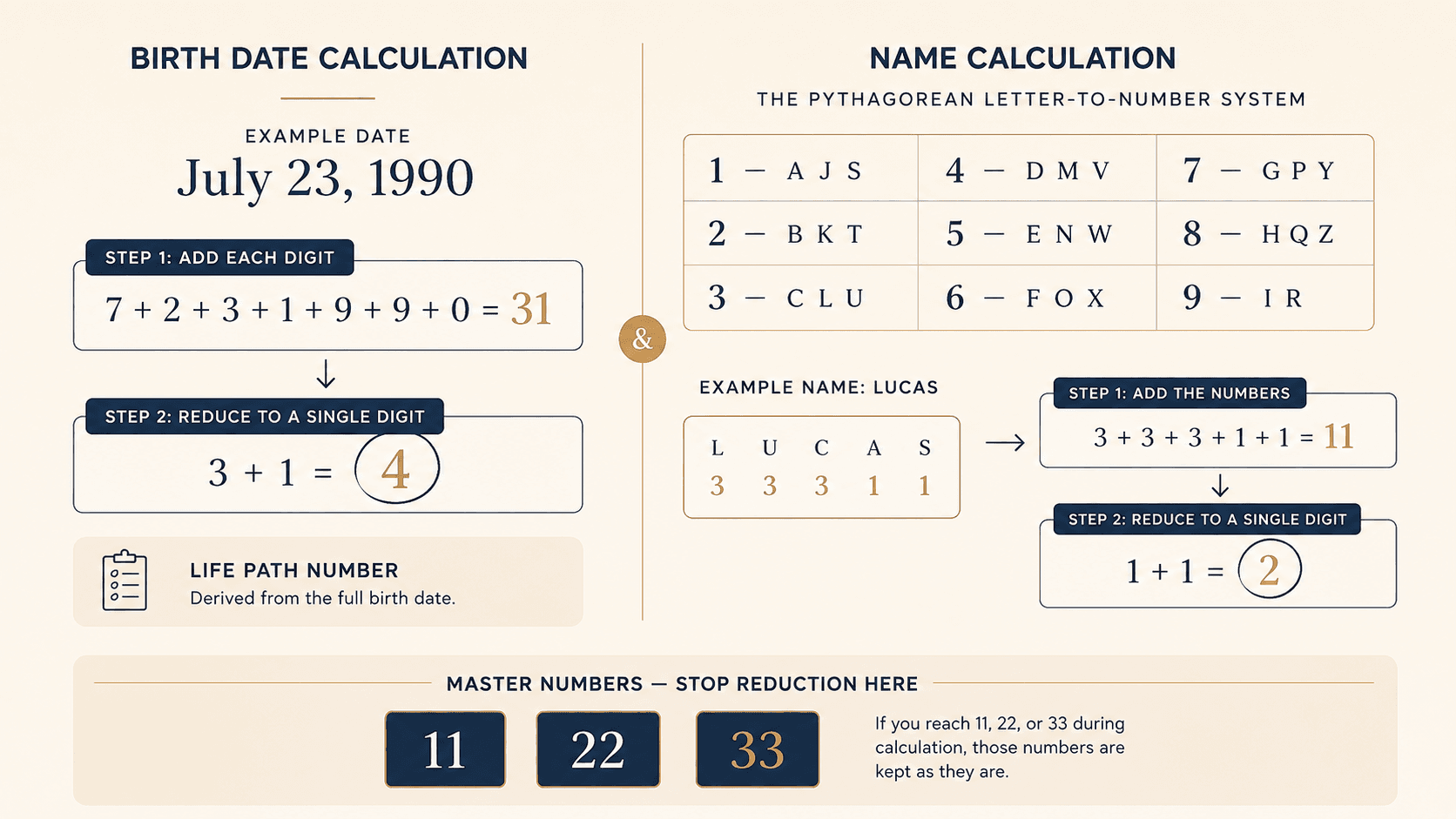
Through a straightforward arithmetic process: numbers derived from a birth date or name get reduced by repeatedly adding their digits together until a single digit remains — with one standard exception.
Take a birth date like July 23, 1990, written as 7-23-1990. Adding every digit — 7+2+3+1+9+9+0 — gives 31, and reducing further, 3+1, gives 4. That final single digit is the traditional life path number for that date.
Names get reduced through a related process, using a standard letter-to-number correspondence chart where each letter of the alphabet is assigned a digit from 1 to 9 — A and J and S, for instance, are traditionally assigned 1, since the assignment cycles through the alphabet. The letters in a name are converted to their corresponding numbers and then added together and reduced the same way a birth date is, though which letters get included — vowels only, consonants only, or the full name — depends on which of the core numbers is being calculated.
The exception: master numbers. If a calculation lands on 11, 22, or 33 at any point before the final reduction, most numerologists stop there rather than reducing further to 2, 4, or 6. These three numbers are traditionally treated as carrying amplified significance in their own right.
This calculation method is simply arithmetic — digit reduction is a mathematical procedure anyone can verify with a calculator. What's interpretive is the meaning traditionally assigned to the resulting number, not the math that produces it. Two people can follow the identical calculation steps and arrive at the identical number; where numerology becomes a matter of interpretation is entirely in what that number is then said to represent.
What are the core numbers in a numerology reading?
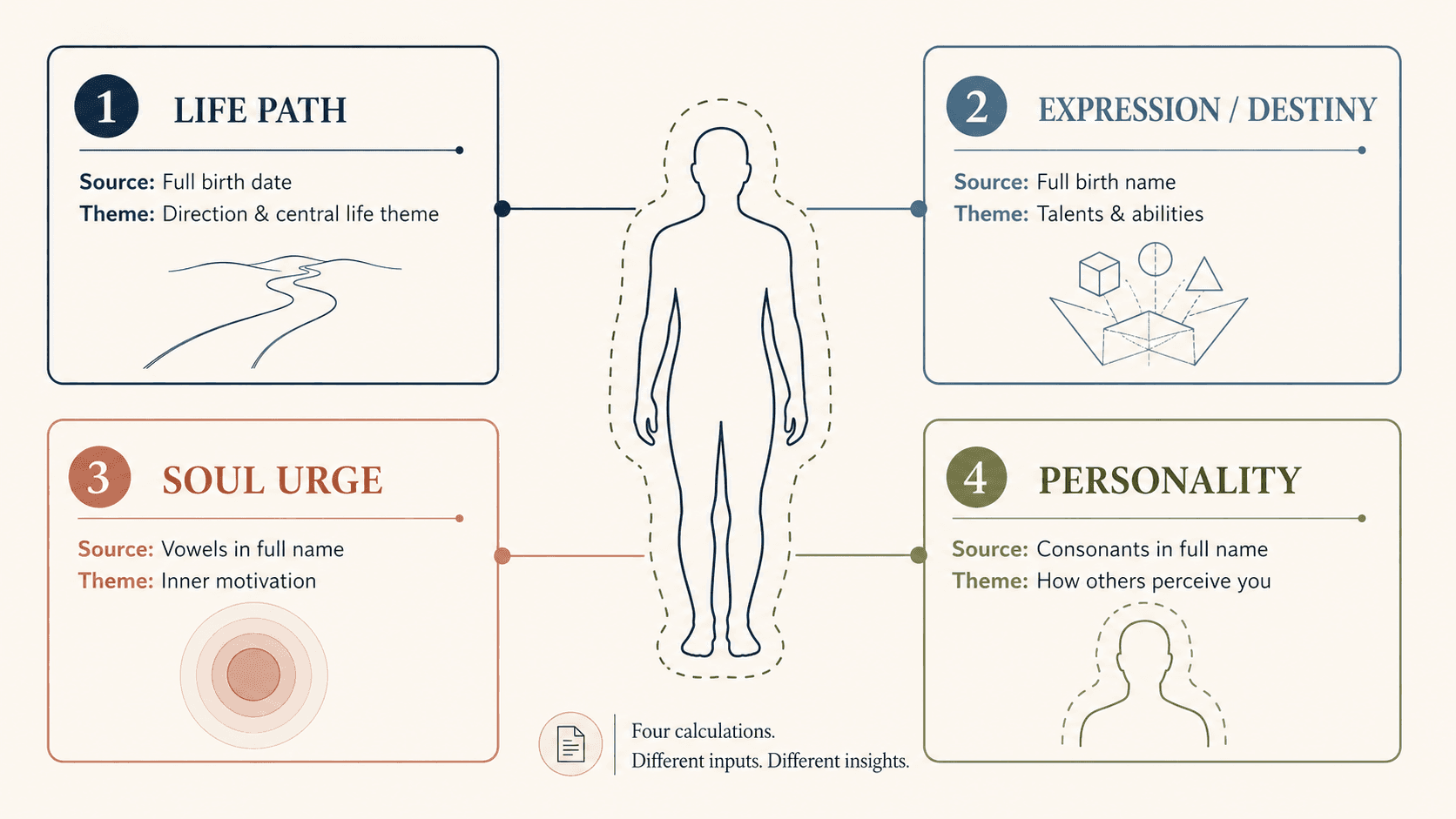
A full numerology profile traditionally involves several distinct numbers, each calculated from a different piece of personal information and traditionally said to describe a different dimension of personality or life direction.
| Number | Calculated from | Traditionally said to represent |
|---|---|---|
| Life Path Number | Full birth date | The overall direction and central theme of a person's life — traditionally considered the most significant number in a reading |
| Expression / Destiny Number | Full name at birth | Natural talents and abilities — what a person is traditionally thought to be well-suited to do |
| Soul Urge / Heart's Desire Number | Vowels in the full name | Inner motivation — what a person traditionally wants at a deep, often unspoken level |
| Personality Number | Consonants in the full name | How a person traditionally comes across to others, as opposed to their inner experience |
The life path number specifically gets the most attention of the four, both in casual conversation and in how numerologists themselves tend to weight a reading — worth its own closer look if you're starting anywhere in this system.
What are master numbers, and why do 11, 22, and 33 get treated differently?
Master numbers are traditionally treated as carrying intensified versions of the qualities associated with their reduced single-digit counterparts — 11 relates to 2, 22 to 4, 33 to 6 — but with added weight, and often added difficulty alongside added potential, in the traditional framing.
The convention of stopping the reduction at 11, 22, or 33 rather than continuing to a single digit is one of the more distinctive features of the system, and it's applied consistently across all the core number calculations, not just the life path number. A closer look at what 11, 22, and 33 are traditionally said to mean covers each one individually, including why they're sometimes described as double-edged rather than simply fortunate.
It's worth distinguishing master numbers, which arise from a specific calculation, from the separate and more casual phenomenon of noticing repeating digits throughout the day — seeing 11:11 on a clock or 222 on a receipt. That pattern, often called angel numbers, works differently and isn't part of a birth-date calculation at all.
Can numerology tell you anything real about yourself?
This article won't settle that question at a metaphysical level, and it's honest to say that sits outside what an article can establish either way. What can be described accurately is how the practice tends to function for the people who use it: as a structured prompt for self-reflection, offering a specific lens to think through personality, motivation, and direction rather than delivering verified facts about a person.
Read that way, a numerology profile works similarly to other reflective frameworks — it gives you a specific angle to consider, and the value comes largely from the thinking it prompts. It's worth being direct about limits, too: numerology isn't a substitute for professional guidance on medical, financial, or legal matters, regardless of what any calculation suggests. For questions in those categories, the right call is a qualified professional, not a number derived from a birth date.
There's also a fair, skeptical observation worth acknowledging directly: personality descriptions written broadly enough tend to feel personally accurate to almost anyone, a well-documented effect in psychology sometimes discussed under the Barnum effect. That's a reasonable thing to hold in mind while reading any numerology description, including the ones covered on this site — the specificity of the calculation doesn't automatically guarantee the specificity of the resulting description.
If you want the fuller picture of what a reading actually walks through — the specific meanings behind each number from 1 through 9 — the numerology number meanings guide covers each digit individually, and this overview of what numerology is is a good companion starting point if you want a shorter, more basic introduction than this article.
Do the arithmetic on your own date before you trust anyone's reading
Ticked: 0 of 5
The first four take a few minutes each and settle what your numbers are made of. The fifth is the one that keeps working afterwards, because a description written broadly enough to fit most people will fit you too, and it will not feel that way while you read it.
Where numerology sits alongside history's actual record
For anyone who wants the fuller historical picture rather than the shorthand version above, a dedicated look at numerology's history traces the path in more detail — from ancient number philosophy through the esoteric revival that actually produced the system practiced today.
What to take from this
Numerology's numbers come from a genuinely learnable arithmetic process, applied to information that's personal in the most literal sense — your own name and birth date. The meanings attached to the results are a tradition with real, if more recent, history than popular framing usually admits, and engaging with it clearly — knowing what's arithmetic and what's interpretation — tends to be more satisfying than either blind acceptance or dismissal.
That distinction is really the whole point of this article. The calculation is verifiable and consistent. The meaning layered on top of it is a tradition, carried forward by real people across a real, if shorter than advertised, span of history — worth engaging with on those honest terms.
Test yourself
Question 1 of 3
A site tells you numerology has been handed down unbroken from Pythagoras. What does the article say the real relationship is?
What is numerology?
Numerology is the practice of deriving numbers from personal information like a birth date and full name, and interpreting those numbers according to traditional meanings.
Is numerology connected to Pythagoras?
Only loosely by philosophical inspiration. While Pythagoras held that numbers were fundamental to reality, the specific calculation methods used today were developed much later, largely in the late 19th and early 20th centuries.
How are numerology numbers calculated?
Through arithmetic digit reduction, repeatedly adding digits together until a single digit remains, with the exception of master numbers 11, 22, and 33.
What are the core numbers in a reading?
The core numbers typically include the Life Path Number (from birth date), Expression/Destiny Number, Soul Urge Number, and Personality Number (from the full name).