
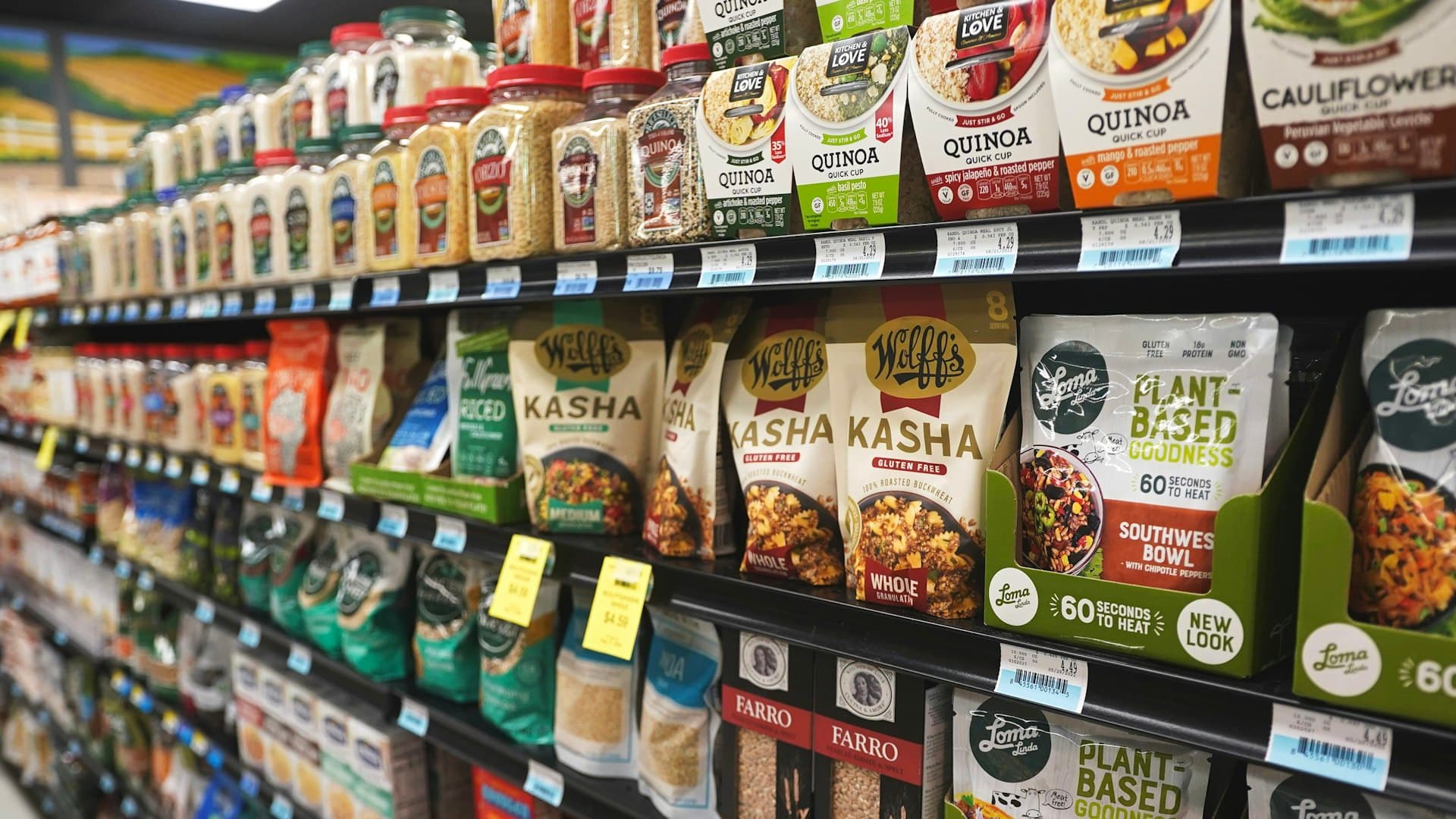
You are standing in front of a wall of bags. Every one of them says something confident: natural, premium, grain-free, real chicken first, ancestral recipe, holistic.
Almost none of that is regulated language, and the parts of the packaging that actually carry information are in small print on the back, which is where nobody looks.
Learning to read that part takes about ten minutes and it makes the whole shelf considerably less confusing.
The front is advertising, the back is regulated
Pet food packaging has two zones with different rules.
The front is designed to sell. Imagery, claims, adjectives. In most markets these are subject only to general advertising rules, which means a wide range of appealing but largely meaningless language is permitted.
The back carries legally required information in a defined format: an ingredient list, a nutritional analysis, feeding guidance, and in many markets a statement about nutritional adequacy. These are constrained, and they are where you find out what you are buying.
Everything designed to catch your eye is unregulated. Everything that is regulated is in small print where you will not look unless you decide to.
One note before the detail: labelling rules differ between countries. The principles below hold broadly, and the specific wording and requirements vary, so check what applies where you live.
The one sentence that matters most
Look for the nutritional adequacy statement. In the United States this is usually an AAFCO statement, and in Europe there is an equivalent declaration of whether the food is complete or complementary.
What you want it to say is that the food is complete and balanced for a specified life stage: growth, adult maintenance, or all life stages.
Why this single line does so much work: it means the food is formulated to supply everything a dog needs at that stage, in the right proportions. A food without that designation is complementary, meaning a topper or treat, and feeding it as a sole diet will produce deficiencies over time.
There is also a distinction worth knowing in the American system. A food can meet the standard either by formulation, meaning the recipe was calculated to meet the profile, or by feeding trials, meaning it was tested on actual dogs. Feeding trials are a somewhat stronger claim, and the statement will usually say which applies.
Check for the right life stage too. A food complete for adult maintenance is not appropriate as a puppy's sole diet, and large-breed puppies have specific requirements around calcium and growth rate that matter a great deal.
Why the ingredient list misleads
The ingredient list is the part everyone reads and the part that misleads most reliably, for one structural reason: ingredients are listed by weight at the point of processing, including their water content.
Fresh chicken is roughly seventy percent water. When the food is processed into dry kibble, most of that water leaves. So a food can list fresh chicken first, entirely truthfully, while chicken contributes considerably less to the finished product than its position suggests.
Meanwhile a dried protein meal, which has already had its water removed, appears lower in the list while contributing more actual protein to the final food.
This is why "real meat first" as a marketing claim is nearly uninformative. It is usually true and it does not tell you what proportion of the finished food is meat.
It is also why meal ingredients have an undeserved reputation. A named meal, such as chicken meal, is simply chicken with the water removed before processing. It is a concentrated protein source rather than a lesser one. Unnamed versions, such as meat meal or animal by-product meal without a species, are a different matter and are worth more scepticism because you cannot tell what is in them.
Ingredient splitting, and how to spot it
A practice worth recognising, because once you see it you cannot unsee it.
Since ingredients are ordered by weight, a manufacturer can move a component down the list by breaking it into several separately listed forms.
Instead of listing peas, which might place them second, a label might list pea protein, pea fibre, pea starch and whole peas as four separate entries, each individually lighter than the meat, and therefore each appearing further down.
The total quantity of pea-derived material is unchanged. Its apparent prominence is much lower.
How to spot it: look for several variants of the same base ingredient scattered through the list. Peas, potatoes, rice and corn are the common ones. Mentally recombine them and reconsider where they would sit.
This is legal and widespread, and it is not evidence that a food is bad. It is evidence that the ingredient list is a weaker signal than it appears.
| What the label says | What it actually tells you |
|---|---|
| "Real chicken is the first ingredient" | Little, because fresh chicken is mostly water at that point |
| "Chicken meal" | Concentrated chicken protein, water already removed |
| "Meat meal" with no species | Source unspecified, worth more scepticism |
| Pea protein, pea fibre, pea starch listed separately | Possible ingredient splitting, recombine mentally |
| Complete and balanced for adult maintenance | The most useful line on the label |
How this is taught inside Astra Trainer
Reading an ingredient label past the marketing claims on the front is one of the three stated aims of the Nutrition & food direction in the Dogs world, alongside deciding what and how much to feed at every life stage and catching what the bowl and the stool tell you.
The direction runs to seven courses, and the vocabulary it drills, protein, fat, fiber and calcium, appears as a set in this world's daily Connections round. That grouping is useful here because those four are exactly what the guaranteed analysis reports, and knowing what each one does is what turns a table of percentages into information. Lessons take about five minutes and a guide walks you through anything strange.
What the guaranteed analysis does and does not tell you
The guaranteed analysis is the small table of percentages: crude protein, crude fat, crude fibre, moisture, sometimes more.
What it tells you: minimum levels of protein and fat, maximum levels of fibre and moisture. These are guarantees rather than exact figures.
Two significant limitations.
It says nothing about quality or digestibility. Crude protein measures nitrogen content, which is a proxy. A food can hit a protein percentage using sources a dog digests poorly, and the number looks identical.
The percentages are not comparable across food types. This catches people constantly. Wet food contains far more water than dry, so its protein percentage looks much lower while the food may be equally or more protein-dense once water is removed.
To compare a wet and a dry food you need to convert to dry matter basis: subtract the moisture percentage from one hundred to get dry matter, then divide the nutrient percentage by that figure. A wet food at ten percent protein and seventy-eight percent moisture is about forty-five percent protein on a dry matter basis, which is considerably higher than most kibble.
Without that conversion, wet food always looks worse and it frequently is not.
A worked example: two labels compared properly
Two dry foods on the same shelf, similar price.
Bag A. Front says premium, natural, grain-free, real deboned chicken first. Attractive packaging, impressive-sounding recipe name.
Back: ingredients begin deboned chicken, then pea protein, then pea starch, then chicken fat, then whole peas, then pea fibre. Guaranteed analysis shows twenty-six percent protein. The adequacy statement says formulated to meet levels for adult maintenance.
Bag B. Front is plainer. Says complete adult dog food, no adjectives beyond that.
Back: ingredients begin chicken meal, then brown rice, then chicken fat, then barley. Guaranteed analysis shows twenty-seven percent protein. The adequacy statement says animal feeding tests substantiate that it provides complete and balanced nutrition for adult maintenance.
Reading them. Bag A leads with fresh chicken, which is mostly water, so its actual protein contribution is lower than the position implies. Four separate pea-derived ingredients suggest splitting: recombined, peas are plausibly the largest component by a good margin.
Bag B leads with chicken meal, which is concentrated, so its protein contribution is higher than a casual read suggests. Grains rather than legumes, which given the unresolved questions around legume-heavy diets is at minimum not a disadvantage.
And the strongest difference is in the line nobody reads. Bag A was formulated to meet a profile. Bag B was tested in feeding trials, which is a stronger form of evidence.
Bag A wins on every word designed to be noticed. Bag B is the better-documented food.
Two honest caveats. This does not mean bag A is bad, and many formulated-to-meet foods are perfectly good. And neither label tells you whether either food suits your particular dog, which is still established by feeding it and watching.
Do not shop by ingredient list alone. The ingredient list is the most visible and least reliable part of the regulated information. A food can have an appealing list and mediocre formulation, or an unglamorous list and excellent nutritional design. The adequacy statement and the manufacturer's credentials tell you more.
Words that legally mean almost nothing
A short list, since these dominate front-of-pack messaging.
Premium, super-premium, ultra. No regulated definition in most markets. Any food can use them.
Holistic. No definition at all in a pet food context.
Human-grade. Has a specific meaning in some jurisdictions and is frequently used loosely. Requires the entire product to be made in a facility approved for human food, which is rare, so treat it with scepticism unless substantiated.
Natural. Loosely defined in some markets, typically meaning derived from plant, animal or mined sources without chemical synthesis. It says nothing about quality or nutritional adequacy.
Ancestral, biologically appropriate, species-appropriate. Marketing language built on claims about dogs' evolutionary diet. Dogs have adapted considerably during domestication, including in starch digestion, so the framing is weaker than it sounds.
Product names are also governed by rules worth knowing. In the US, percentage rules mean "chicken dog food" requires substantially more chicken than "chicken dinner", which requires more than "with chicken", which requires more than "chicken flavour". The name is a clue and the differences between these phrasings are large.
Why this becomes quick with practice
Working through a label the first time takes several minutes. After a few, it becomes a fifteen-second check: adequacy statement, life stage, recombine any split ingredients, glance at the analysis, note the manufacturer.
The Dogs world is structured to build that kind of quick recognition. Quizzes follow each topic and each course ends with a ten-question final exam. The daily Connections round and 10x10 crossword are generated from this world's own lessons, so the nutrition vocabulary comes back as practice rather than as something read once in a shop. Daily quests, points and a streak keep five-minute lessons running, with a streak shield for the day that goes wrong.
A Circle gives you a small group with a shared weekly goal, which on this topic tends to become people photographing labels and asking what a particular line means.
Who made it, and why that matters
A question that gets almost no attention and arguably carries more signal than the ingredient list.
Useful things to know about a manufacturer: whether they employ a qualified veterinary nutritionist or someone with equivalent postgraduate qualifications in animal nutrition; whether they own and control their manufacturing facilities rather than outsourcing; whether they conduct feeding trials; whether they publish nutrient analyses on request; and what their recall history looks like.
Several veterinary organisations publish lists of questions to ask manufacturers along these lines, and most companies will answer them if contacted.
This matters because formulating a complete diet is technical work. A food designed by qualified nutritionists and produced in controlled facilities is a different proposition from one with an appealing recipe and no nutritional expertise behind it, regardless of how the ingredient lists compare.
It is also the area where small artisanal brands frequently fall short, which is uncomfortable because their marketing is often the most appealing on the shelf.
What to take from this
The front is advertising and the back is regulated. Everything designed to catch your attention is the part with the least information in it.
The adequacy statement is the single most useful line: complete and balanced, for a named life stage, ideally substantiated by feeding trials.
The ingredient list misleads because of water weight and ingredient splitting. Named meals are concentrated rather than inferior.
The guaranteed analysis is not comparable between wet and dry without converting to dry matter basis, which is why wet food always looks worse on paper.
And premium, holistic, natural and ancestral are largely unregulated. Who made the food and whether they employ qualified nutritionists tells you more than any adjective on the bag.
None of this is veterinary advice. If your dog has a health condition, the right food is a conversation with your vet rather than a label-reading exercise.
Is chicken meal worse than real chicken?
No. Chicken meal is chicken with the water removed before processing, which makes it a concentrated protein source. Fresh chicken listed first is mostly water at that point, so it contributes less to the finished food than its position suggests. Unnamed meals, without a species, are the ones worth scepticism.
How do I compare wet and dry food?
Convert to dry matter basis. Subtract the moisture percentage from one hundred, then divide each nutrient percentage by that number. Without this, wet food always appears lower in protein because most of what is in the tin is water.
Are by-products bad?
Named by-products such as chicken by-product meal include organ meats, which are nutritionally dense and are eaten by dogs in most parts of the world. The term sounds unappealing in English and the content is frequently good. Unnamed by-products are less transparent.
Does a longer ingredient list mean a better food?
No. Long lists frequently include small quantities of ingredients present mainly for the label. What matters is whether the food is complete and balanced and whether your dog does well on it.
Where can I learn this systematically?
The Nutrition & food direction inside the Dogs world of Astra Trainer runs to seven courses including reading labels past the marketing claims. Lessons take about five minutes and the first needs no card. You can see what is inside the world here.