
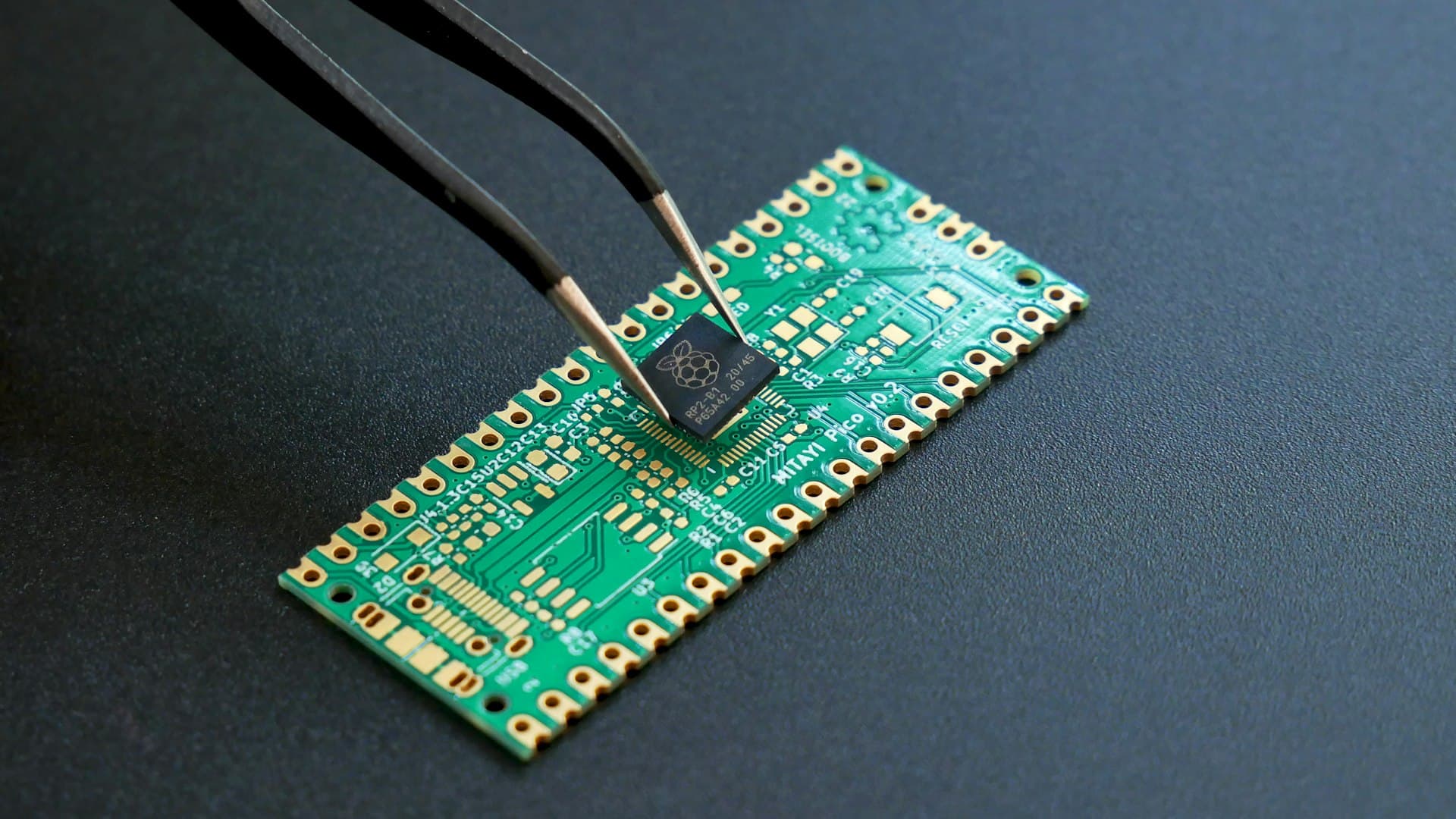
The most misleading moment in electronics development is the first time the board powers up and does what it was meant to do.
One working board proves almost nothing
It proves the concept is sound. It does not prove the design is manufacturable, and the distance between those two things is where most of the engineering lives.
The first article was assembled carefully, often by the designer, from parts drawn from a single reel, tested at room temperature on a bench with a clean supply, with instruments that load the circuit differently from whatever it will eventually connect to.
Production is none of those conditions. The tenth thousand board is built by someone who has never seen the schematic, from parts spanning several date codes and possibly several manufacturers, in a housing with no airflow, powered by a supply that sags, sitting next to a motor.
A prototype answers whether the design can work. Production asks whether it always works, which is a much harder question.
Engineers who have only ever built prototypes are frequently surprised by how much of the profession is the second question.
What the direction covers
The scope: analogue and digital circuit design, printed circuit board design, power electronics, signal integrity, test and measurement, and design for manufacture.
Four areas worth separating.
Circuit design. Analogue, digital and mixed signal, including the part most people mean by electronics.
Layout and signal integrity. Where the physical board stops being a drawing and becomes part of the circuit.
Power. Conversion, regulation, efficiency and thermal management, which is its own discipline and chronically understaffed.
Verification. Test, measurement, compliance and qualification, which is where designs meet reality.
Tolerance, or why the second batch behaves differently
Every component has a tolerance and every tolerance stacks.
A resistor marked five percent may be anywhere in that band. A ceramic capacitor loses a substantial fraction of its nominal capacitance under DC bias, and loses more with temperature, and the datasheet value is measured under conditions your circuit will never see. A transistor's gain varies by a factor of three across a part number. A crystal drifts with temperature and ages.
Three consequences.
Designs that depend on nominal values fail intermittently. They work with the parts you built with and fail with the parts purchasing bought next quarter, which is the hardest class of fault to diagnose because nothing changed in the design.
Worst case analysis is a discipline, not a formality. It asks whether the circuit still meets specification when every component sits at the unhelpful end of its tolerance band simultaneously, at the temperature extremes, at end of life.
The fix is usually topology, not tighter parts. Specifying one percent components where the circuit needs a ratio rather than an absolute value is expensive and does not help. Redesigning so the result depends on a ratio of matched components does.
Heat, which is where most of it ends
Semiconductor lifetime falls sharply with junction temperature. Electrolytic capacitors have a rated life at a rated temperature and lose a large part of it for every ten degrees above that. Most field failures in electronic products have a thermal component somewhere in their history.
The recurring error is treating thermal design as something that happens after the circuit is finished, at which point the options are a heatsink, a fan, or derating the product.
The board is the heatsink in most designs. Copper area, layer count, thermal vias and component placement decide the outcome, and all three are layout decisions.
Efficiency is a thermal specification. A switching converter at 85 percent efficiency in a sealed enclosure is a heater with a useful side effect.
Ambient is not room temperature. Inside a sealed housing, inside a cabinet, in a factory in summer, next to something else that dissipates.
Where this sits in the domain
Electronics engineering is the first of nine directions in Astra Trainer's semiconductors, electronics and quantum domain. It connects directly to embedded systems and computer hardware, since almost every board carries firmware, and to RF, wireless and telecommunications, where the same layout decisions have far larger consequences.
It also connects outward to advanced manufacturing for design for manufacture and test, and to energy for power conversion. Partners usually scope electronics alongside embedded systems, because the two roles argue with each other constantly and understand each other rarely. You can see the nine directions here.
Electromagnetic compatibility, the late and expensive surprise
Products sold in most markets must meet legal limits on the interference they emit and must keep working in the presence of interference from elsewhere. Compliance is demonstrated by test, and the test happens near the end.
This produces a characteristic failure pattern. A design passes every functional test, goes to an accredited laboratory, fails an emissions limit by a few decibels, and the team discovers that the causes are in the layout: a return path that had to detour around a split in the ground plane, a clock routed across that split, a cable acting as an antenna because the connector was placed on the wrong edge of the board, a switching node with more copper than it needed.
None of those is fixable with a component change. All of them are cheap to avoid and expensive to repair, because repairing them means a new board and a new test slot.
The useful framing for anyone learning this: current returns to its source, it returns by the path of least impedance rather than the path on the schematic, and every loop that current makes is an antenna whose efficiency you decided at layout.
The part that goes out of production
Component obsolescence is treated as a supply chain topic and is mostly an engineering one.
A design that specifies a part available from one manufacturer, in one package, with no functional equivalent, has adopted that manufacturer's product roadmap as its own. When the part is discontinued, which for semiconductors happens on timescales much shorter than the life of industrial, medical and aerospace products, the options are a last time buy that ties up cash, a redesign, or a qualification exercise for an alternative.
Three habits that reduce the exposure, all of them decided during design.
Prefer parts with genuine second sources, checked rather than assumed, because pin compatibility is not functional equivalence.
Isolate the parts you cannot second source. Put them on a module or in a clearly bounded section so a replacement is a contained change rather than a full respin.
Design the footprint for more than one part where package variation allows it, which costs nothing at design and saves a respin later.
The roles, named
Analogue design engineers. Persistently scarce, because the skill takes years and is not reducible to a tool.
Digital and mixed signal design engineers.
Printed circuit board layout engineers. Frequently treated as a drafting role and actually determining signal integrity, thermal behaviour and compliance outcomes.
Power electronics engineers. Converters, motor drives, energy conversion.
Signal and power integrity specialists, for high speed designs.
Test engineers. Production test, functional test, in-circuit test and the fixtures that make them possible.
Compliance and qualification engineers. Electromagnetic compatibility, safety, environmental.
Applications engineers at component manufacturers, who see more circuit topologies in a year than most designers see in a career.
Who can be trained into it
Electronics technicians. The strongest conversion in this direction. Someone who has spent years finding faults in hardware has diagnostic instinct that cannot be taught quickly and is usually missing only the analytical layer: tolerance analysis, frequency domain thinking, control loop stability.
Printed circuit board layout designers. Into signal integrity, where their existing spatial understanding of the board is exactly the prerequisite.
Test and repair staff. Into test engineering and design for test, because they already know what is untestable and why.
Field service engineers. Into reliability and applications, holding the failure data nobody in design ever sees.
Electricians and instrumentation technicians. Into power electronics and industrial electronics, with a real base in safety and practical wiring.
Software engineers working close to hardware. Into embedded and mixed signal work, needing the physics rather than the logic.
Safety and compliance obligations. Electrical products placed on the market are subject to legally binding safety, electromagnetic compatibility and environmental requirements that vary by jurisdiction, and high voltage work carries risk of injury and death. Compliance is demonstrated through defined testing and documentation, and formal approvals are issued by accredited bodies. Training builds engineering capability and awareness of where these duties apply. It is not a substitute for a competent person assessment, an accredited test, or the certification and qualification requirements that apply to the work.
What to take from this
A working prototype tells you the concept is sound and almost nothing about whether the product will be.
Tolerance, temperature and time are the three variables that separate the two, and all three are cheap to handle at design and expensive to handle later.
Thermal behaviour and electromagnetic compatibility are decided in layout, not in test. By the time the test fails, the decision was made months earlier.
Component availability is an engineering constraint that most teams meet only when it is already a problem.
And the people most likely to become strong electronics engineers are frequently already in the building, holding a multimeter.
Why does a design that worked stop working in production?
Because production uses parts from across the tolerance band, at temperatures away from the bench, with supplies that vary. A design that depends on nominal component values works with the parts you built with and fails with the next batch.
Why is thermal design a layout problem?
Because in most designs the board is the heatsink. Copper area, layer count, thermal vias and component placement decide junction temperature, and all of them are fixed once the layout is finished.
Why do products fail electromagnetic compatibility testing so late?
Because compliance is demonstrated by test near the end of development, while the causes are layout decisions made months earlier: return path discontinuities, clocks crossing splits, connector placement and switching node geometry.
Is component obsolescence an engineering issue?
Largely yes. Specifying a single sourced part adopts that manufacturer's roadmap. Checking second sources, isolating unavoidable single source parts and designing flexible footprints all happen at design and cost nothing then.
Who converts well into electronics engineering?
Electronics technicians first, because diagnostic instinct takes years and the analytical layer can be taught. Then layout designers into signal integrity, test staff into test engineering, and field service engineers into reliability.