
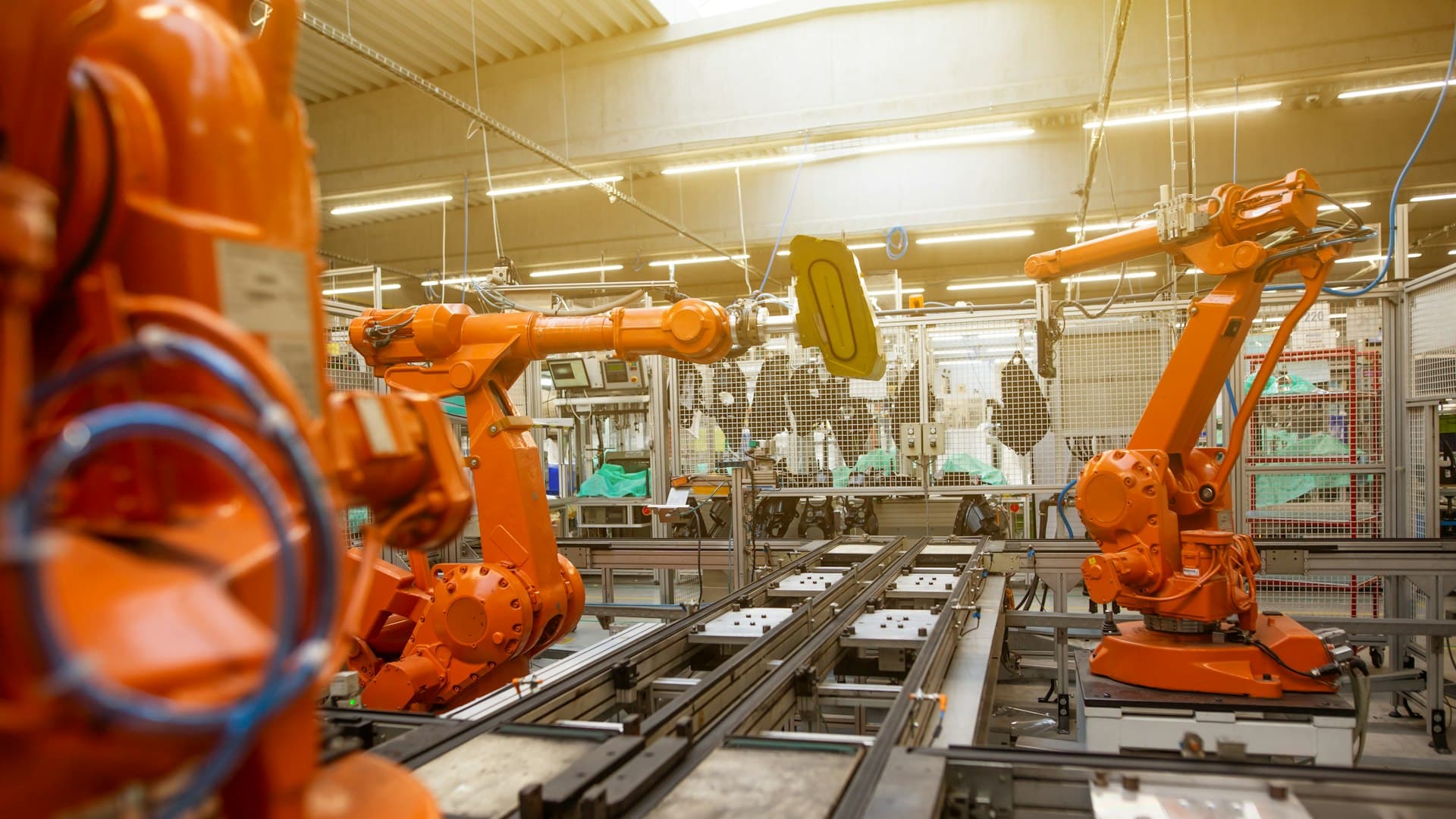
Industry 4.0 has been discussed for over a decade, and the most common outcome in a real plant is a large quantity of stored data and a small number of changed decisions.
Collected, stored, ignored
Modern equipment is instrumented by default. Machines report status, cycle times, alarms, temperatures, energy use and throughput. Historians store it all.
Then someone asks what the data has changed and the answer is frequently a dashboard nobody opens.
A sensor does not improve anything. A sensor connected to a person who owns a decision and has time to act improves something.
The World Economic Forum's Future of Jobs Report 2025 found 58 percent of employers expecting robotics and automation to transform their business by 2030. The equipment is arriving. Whether it changes anything depends on the layer above it.
What the direction covers
The scope: industrial IoT, connected factories, AI, real-time data and cyber-physical systems.
Four areas.
Data acquisition. Sensors, machine connectivity, protocols and getting information off equipment that was not designed to share it.
Data architecture. Where data goes, how it is structured, how it is contextualised and who can reach it.
Analytics and decision support. Turning data into something that changes an action, which is the step that fails.
Integration. Connecting the plant floor to planning, quality and maintenance systems.
The four reasons data does not become a decision
Named specifically, because each has a different fix.
No decision owner. The most common. Data is collected because it was possible, not because someone asked a question. Without a person whose job includes acting on it, and time to do so, it accumulates. The fix is starting from a decision someone needs to make rather than from a sensor.
Missing context. A temperature reading means nothing without knowing which product was running, which shift, which batch of material, what the machine was doing and what happened before. Contextualising data is unglamorous, laborious and the difference between a dataset and an answer.
Data quality. Sensors drift, fail silently, get bypassed during maintenance and report through gaps. Analysis on unvalidated plant data produces confident nonsense, and the people who know which sensor lies are the operators.
No capacity to act. The system identifies an opportunity and the people who would act on it are fully occupied keeping production running. This is the same pattern as predictive maintenance without maintenance capacity, covered in its own article, and it is the one nobody budgets for.
Connectivity is a security decision
The part most often handled badly, because it is treated as an IT question when the risk profile is different.
Connecting operational technology to networks creates exposure that behaves unlike office IT exposure.
Availability outranks confidentiality. In IT, the priority is usually protecting data. In a plant, the priority is that the process keeps running safely. A security measure that stops a line has caused the harm it was preventing.
Legacy equipment cannot be patched. Machines run for decades on control systems that were never designed to be networked and cannot be updated. Segmentation and monitoring substitute for patching.
Safety systems must not be compromised. A compromised control system is a physical safety problem, not only a data one.
Remote access is the common entry point. Vendor support connections, frequently configured for convenience, are a recurring weakness.
The workforce point is that plants need people who understand both the process and security, and organisations usually have IT security staff who do not know the plant and plant staff who do not know security. That combination is the same two-halves problem that appears throughout this section.
Where this sits in the domain
Smart manufacturing and Industry 4.0 is the third of ten directions in Astra Trainer's advanced manufacturing domain, sitting directly alongside industrial IoT and digital twins, which covers the modelling layer, and industrial automation and control, which covers the equipment layer.
The data and security half draws on the AI, data and computing domain, particularly data science and analytics, cloud computing and DevOps, and cybersecurity. Partners implementing Industry 4.0 usually need the plant directions and at least one of those together, because the failure mode is almost always the gap between them. You can see the ten directions here.
The roles, named
Manufacturing data analysts. The role that converts plant data into decisions and barely exists in most organisations.
Industrial data engineers. Collection, contextualisation and pipelines.
OT and control systems engineers extending into connectivity.
MES and systems integration specialists. Connecting plant floor to business systems.
OT cybersecurity specialists. Genuinely scarce and increasingly required.
Digital manufacturing managers. Owning the programme, which is a coordination role more than a technical one.
Process engineers with data capability. The combination that actually produces improvements.
Visualisation and reporting specialists, where the difference between a dashboard used and ignored is usually design.
Who can be trained into it
Process engineers. The strongest conversion. They know which questions matter, what a normal reading looks like and which explanations are plausible. Adding data capability produces someone who can find a real improvement, rather than a correlation.
Machine operators. Know which sensors lie, which alarms are ignored and what actually causes the stops. That knowledge is the difference between usable data and noise, and it is almost never collected.
Controls and automation engineers. Already at the data source, needing the architecture and analytics layers.
IT staff working in manufacturing. Need the process context and the different security priorities of operational technology.
Quality engineers. Already work with statistical data from the process, which transfers directly.
Maintenance planners. Into condition data and asset analytics, which connects to the maintenance direction.
Operational technology security and safety. Connecting industrial control systems to networks introduces risks with physical safety consequences, and safety instrumented systems are governed by functional safety standards that restrict modification. Several jurisdictions apply specific regulation to critical infrastructure operators. Training builds understanding of plant data and security principles. It does not confer authority to modify control or safety systems, nor does it constitute a security assessment for any facility.
What to take from this
Plants collect far more data than they use, and the constraint is decisions rather than sensors.
Start from a decision someone needs to make, not from what can be measured. Data without an owner accumulates.
Context is the hard part, data quality is worse than assumed, and the operators know which sensors lie.
Connecting the plant is a security decision with a different priority order from IT, and legacy equipment cannot be patched.
And process engineers and operators convert better than data scientists, because knowing which question matters is harder to teach than the analysis.
Why does collected plant data go unused?
Usually because no one owns a decision it feeds, context is missing, data quality is unvalidated, or the people who would act are fully occupied keeping production running.
What makes plant data hard to work with?
Context. A reading without the product, shift, batch, machine state and preceding events attached cannot be interpreted, and contextualising is laborious and unglamorous.
Is OT security the same as IT security?
No. Availability outranks confidentiality because the process must keep running safely, legacy equipment cannot be patched, safety systems are a physical risk, and vendor remote access is a recurring weakness.
Who converts into Industry 4.0 roles?
Process engineers, who know which questions matter and what normal looks like, and machine operators, who know which sensors lie and what actually causes stops. Both hold the half that cannot be taught quickly.
Where does this fit in the domain?
Third of ten directions in Astra Trainer's advanced manufacturing domain, usually scoped with digital twins and with the AI, data and computing domain. You can see them here.