
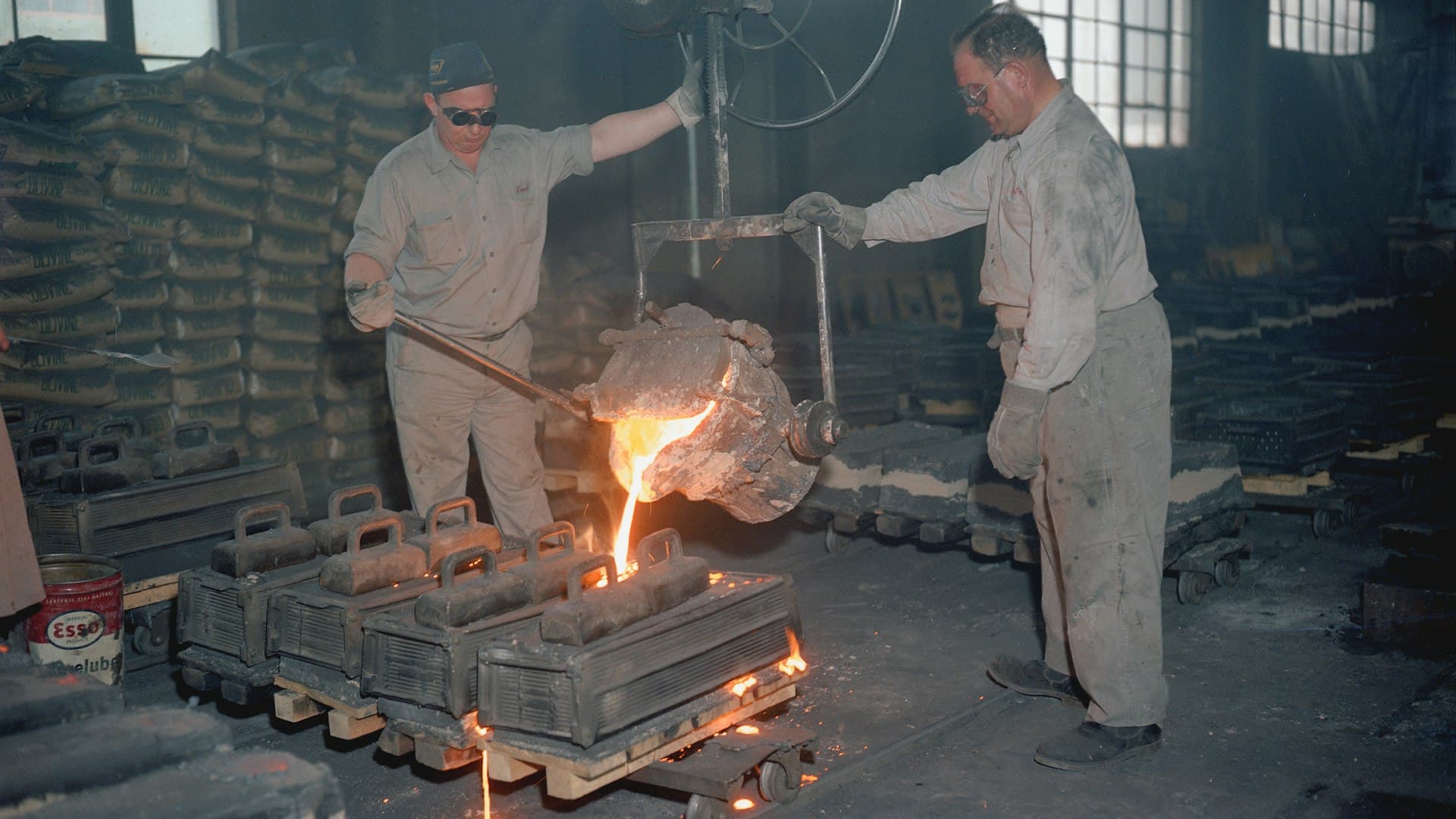
Metals are not a legacy material. Almost everything structural is still metal, and the things replacing metal are mostly being made by machines that are metal.
What did happen is that a lot of organisations stopped employing people who understand them.
A capability that was allowed to lapse
The pattern is familiar across Western manufacturing. Production moved to suppliers, often overseas. With it went the reason to keep a metallurgy function in-house, since the supplier was responsible for the material.
Two things followed.
The internal capability to assess what a supplier delivered went with it, so material acceptance became a paperwork exercise rather than a technical one.
And when production came back, or when supply chains had to be rebuilt quickly, the people who could qualify a new source were no longer there.
A certificate of conformity is a supplier's statement about their own product. Reading it critically requires someone who knows what could be true and still be wrong.
Meanwhile the underlying demand never went away. The US Bureau of Labor Statistics projects materials engineer employment growing about 6 percent between 2024 and 2034, with roughly 1,500 openings a year, and metallurgy sits inside that small number carrying a large share of industrial risk.
What the direction covers
The scope: steel, aluminium and alloys, heat treatment, processing and how metals fail.
Four areas.
Physical metallurgy. Phases, microstructure, why an alloy behaves as it does, and how composition and processing interact.
Processing. Casting, forming, machining, joining and heat treatment, and what each does to the structure.
Mechanical behaviour. Strength, ductility, toughness, fatigue, creep, and behaviour at temperature.
Failure. How metals break, what the fracture surface tells you, and how to work backward from a broken part to a cause.
Heat treatment, where most of the value and most of the mistakes are
The operation that most determines what a steel component will do, and the one most often outsourced and least often understood by the organisation buying it.
The same composition can be soft and formable or hard and brittle depending entirely on thermal history: what temperature, how long, how fast it cooled, what happened after.
Four common and expensive problems.
The specification is incomplete. A drawing that calls out a material and a hardness without specifying the treatment leaves the supplier to choose a route, and different routes give different toughness at the same hardness.
Distortion. Parts move during heat treatment. Designing to avoid it requires understanding why it happens, and machining afterwards to correct it can remove the treated surface layer.
Hydrogen embrittlement. Processes including electroplating can introduce hydrogen that makes high-strength steel fail unexpectedly later. Bake-out timing matters, and this is a known cause of delayed fastener failures.
Furnace variation. Load position, atmosphere and thermocouple placement all affect the result. Two batches from one supplier can differ, and nobody notices until something breaks.
An organisation that buys heat treatment without anyone who can audit it is trusting a process it cannot evaluate.
Where this sits in the domain
Metallurgy and metals engineering is the second of eleven directions in Astra Trainer's advanced materials domain, sitting on materials science and connecting to surface engineering and corrosion, composites for hybrid structures, and electronic and semiconductor materials.
Partners in manufacturing commonly scope it with the advanced manufacturing domain, where quality engineering and reliability, and maintenance and asset management cover the plant side of the same problems. Lessons are five minutes, which suits shift-based foundry and heat treatment staff. You can see the eleven directions here.
Why failure analysis is the scarcest skill in the field
Worth its own section, because it is the capability organisations miss most and understand least.
When a metal part fails, the fracture surface carries evidence of how it failed. Fatigue leaves characteristic markings. Overload looks different. Brittle fracture, corrosion-assisted cracking and creep each leave their own signature.
Reading that requires knowing what each mechanism looks like, which comes from having seen many of them, usually alongside someone who had seen more. It is transmitted by apprenticeship rather than by documentation.
Which makes it exactly the capability most at risk from retirement. When a metallurgist with thirty years of failure investigations leaves, the loss is not a set of facts. It is the pattern recognition that let them look at a surface and know within a minute what family of causes to pursue.
Three implications for a workforce plan.
Overlap has to be deliberate and long. Months of working alongside, on real failures, not a handover document.
Build a case library. Photographs, findings and conclusions from past investigations are the closest thing to written-down judgement, and almost nobody keeps one properly.
Structured learning makes the apprenticeship faster. Someone who already understands the mechanisms extracts far more from time alongside an expert than someone starting from nothing.
The roles, named
Metallurgists and materials engineers in manufacturing, energy, aerospace and transport.
Failure analysts. The scarce specialism described above.
Heat treatment process engineers.
Welding engineers. A regulated specialism with formal certification routes, and persistently short.
Foundry and casting engineers. An ageing population and very limited new entry.
Supplier quality engineers with metallurgical capability. The people who prevent problems rather than investigate them.
Non-destructive testing technicians and Level 3 specialists. Certified roles with defined qualification routes.
Materials laboratory staff. Metallography, mechanical testing, composition analysis.
Who can be trained into it
Foundry, heat treatment and forging operators. The strongest and most overlooked pool. They have watched metal behave for years and hold practical intuition that cannot be taught quickly. What they lack is the theory that makes that intuition transferable to unfamiliar situations, and that is the teachable half.
Organisations routinely recruit graduates into metallurgy roles while the people who best understand the processes are classified as operators and never offered a route.
Welders and welding inspectors. Already understand joining and its defects. A natural progression into welding engineering, which has formal certification routes attached.
Machinists. Understand how different materials behave under cutting, which is a real and underrated form of materials knowledge.
Mechanical engineers. Need the structure-property-processing chain.
Chemists and laboratory technicians. Into characterisation and analysis.
Maintenance engineers. Already see failures regularly and are well placed for failure analysis with the underlying theory added.
Certification and hazard. Welding inspection, non-destructive testing and materials sign-off in pressure equipment, aerospace, nuclear and construction are governed by codes and personnel certification schemes with defined examination and experience requirements. Foundry, furnace and heat treatment work carries serious thermal, chemical and respiratory hazards under occupational health regulation. Training builds understanding and prepares people for certification routes. It does not confer certification or authorisation to approve material for service.
What to take from this
The capability lapsed when production moved and was not rebuilt when it returned, so material acceptance became paperwork in a lot of organisations.
Heat treatment decides most of what a steel part will do and is the step most often bought as a black box.
Failure analysis is the scarcest skill, it transfers by apprenticeship rather than documentation, and it is the thing most at risk from retirement.
Deliberate overlap and a real case library are the only ways to move that knowledge, and structured learning makes the overlap far more productive.
And your foundry, heat treatment and welding staff are the best candidates you have, and almost certainly nobody has offered them a route.
Why is metallurgy capability short?
Many organisations cut it when production moved to suppliers, then needed it again when supply chains had to be rebuilt. Meanwhile the remaining workforce aged, and the capability was not being replaced.
Why does heat treatment matter so much?
Because the same composition can be soft and formable or hard and brittle depending entirely on thermal history. It is also the step most often outsourced without anyone in-house able to audit it.
What is the scarcest skill in metallurgy?
Failure analysis. Reading a fracture surface is pattern recognition built from seeing many failures alongside someone more experienced, and it is transmitted by apprenticeship rather than documentation.
Who should be trained into these roles?
Foundry, heat treatment and forging operators first. They hold practical intuition that cannot be taught quickly and need the theory that makes it transferable. Welders, machinists and maintenance engineers follow closely.
Where does this fit in the domain?
Second of eleven directions in Astra Trainer's advanced materials domain, often scoped with advanced manufacturing for the plant side. You can see them here.