
Ceramics rarely appear in a technology strategy and are frequently the reason a process is possible at all.
Where ceramics are load-bearing for the economy
The dependency is broad and mostly invisible.
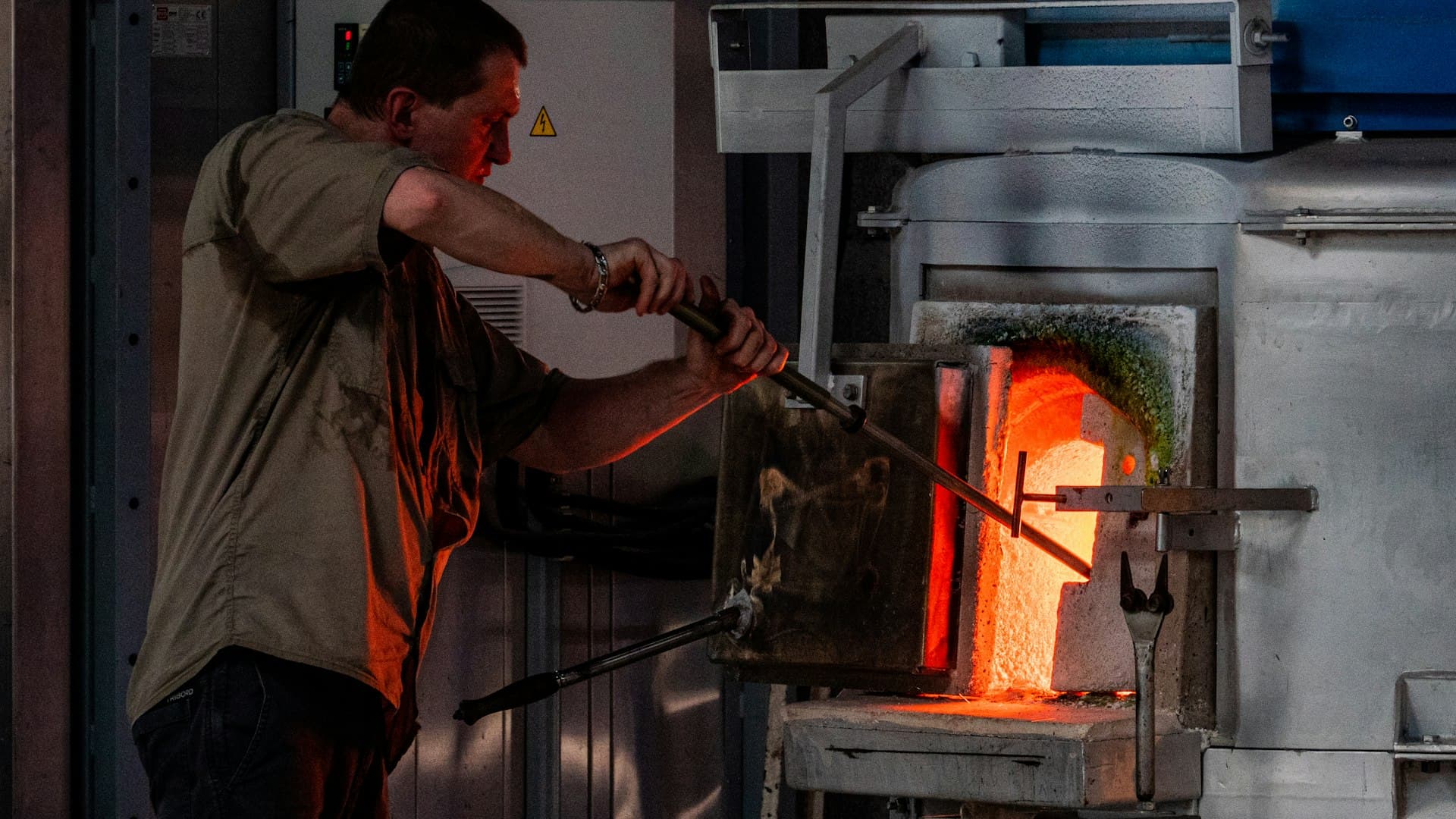
Every furnace has a ceramic lining. Steel, glass, cement, aluminium and chemical processing all run inside refractory materials. Without them there is no high-temperature industry.
Electronics run on ceramics. Substrates, capacitors, piezoelectrics and insulators.
Cutting and wear parts. Tooling, seals, bearings and armour where hardness matters more than toughness.
Energy systems. Solid electrolytes, fuel cell components, thermal barrier coatings on turbine blades. The last of these is what allows gas turbines to run hotter than their metal can survive, which is a direct efficiency gain.
Medical. Implant bearing surfaces and dental materials, which connects to the biomaterials direction.
A ceramic is usually chosen because nothing else survives the conditions. That means when it fails, there is no easy substitution, only a redesign.
What the direction covers
The scope: industrial ceramics, glass and refractories for high-temperature work.
Four areas.
Structure and bonding. Why ceramics are hard, stiff, chemically stable and brittle, all for the same underlying reason.
Processing. Powder preparation, forming, sintering and finishing. Ceramics are usually made from powder, and almost everything about the final part is decided in that route.
Mechanical behaviour and reliability. Brittle fracture, flaw-controlled strength, thermal shock.
Glass and refractories. Glass science, forming, tempering, and refractory selection and installation.
Brittleness, and why it changes the design method
The most important conceptual difference, and the one that catches out engineers trained on metals.
Metals yield. They deform before they break, which gives warning and lets local stress concentrations redistribute. Ceramics do not. They fracture.
Three consequences that change how design and quality work.
Strength is set by the largest flaw. A ceramic part fails from its worst defect, which may be a pore, an inclusion or a surface scratch. So strength is a property of the specific part rather than of the material, and it varies between nominally identical parts.
Design uses statistical distributions. Because strength varies, ceramic design works in probability of failure rather than a single allowable stress. Engineers used to safety factors on a yield value find this genuinely unfamiliar, and applying metal reasoning to a ceramic produces designs that fail at a rate nobody predicted.
Surface finish is structural. A machining scratch is a flaw, and grinding damage can halve strength. Handling matters too, since a chipped edge is a crack initiation site.
The practical workforce point: ceramic components need people who understand that quality control is about flaw population, not about hitting a mean strength.
Where this sits in the domain
Ceramics and glass technology is the fifth of eleven directions in Astra Trainer's advanced materials domain, connecting to electronic and semiconductor materials for substrates and dielectrics, to energy materials for solid electrolytes and thermal barriers, to biomaterials for implant surfaces, and to surface engineering for coatings.
Heavy industry partners typically scope it with the energy, climate and nuclear domain and with advanced manufacturing, since refractory performance is a plant availability question. Lessons are five minutes, which suits furnace and glass plant shift patterns. You can see the eleven directions here.
Refractories, the least visible dependency in heavy industry
Worth its own section, because it is a genuine and under-discussed workforce risk.
Refractories line the furnaces, ladles, kilns and reactors that heavy industry runs on. They wear out, they are replaced on a schedule, and when they fail unexpectedly the plant stops.
Four things make the expertise hard to replace.
Selection is application-specific. The right refractory depends on temperature, atmosphere, slag chemistry, thermal cycling and mechanical wear in that particular vessel. It is judgement built from experience with similar vessels.
Installation quality decides life. Refractory installation is a skilled trade, and a poorly installed lining fails early regardless of material quality.
Failure prediction is pattern recognition. Knowing from a wear profile how much campaign life remains is exactly the sort of knowledge that lives in people rather than documents.
The population is small and ageing. Few people enter the field, and the ones who know it learned by walking through cooled vessels for decades.
For an operator of any high-temperature process, this is a plant availability risk sitting in a handful of individuals, and it almost never appears in a workforce plan under that description.
The roles, named
Ceramic engineers. Materials selection, processing and component design.
Refractory engineers and technologists. Selection, installation supervision, campaign management.
Glass technologists. Composition, melting, forming, annealing and tempering.
Process engineers in ceramic manufacturing. Powder processing, forming and sintering.
Electronic ceramics specialists. Substrates, dielectrics and piezoelectrics, linking to the electronic materials direction.
Thermal spray and coating engineers, for thermal barrier and wear coatings.
Quality and characterisation staff. Flaw detection, microstructure and strength testing.
Kiln and furnace engineers. Where ceramics, combustion and process control meet.
Who can be trained into it
Glass and ceramic plant operators. The most overlooked pool. Years of watching how the material responds to melting, forming and cooling, and usually no formal grounding. Adding the science makes them capable of diagnosis and process improvement.
Refractory installers and bricklayers. Understand installation and wear in practice, and a route into refractory engineering exists that almost nobody offers them.
Metallurgists and materials engineers. Adjacent discipline, need the brittle-fracture and statistical design layer.
Chemists. Into composition, powder processing and glass science.
Furnace and process operators in steel, cement and glass. Already live with the consequences of refractory performance.
Mechanical engineers. Need the reliability-based design approach, which is the conceptual conversion rather than a technical one.
Hazard, and why some knowledge is not transferable by reading. High-temperature work carries severe thermal and molten-material hazards; refractory installation and demolition can involve confined space entry and respirable dust, including crystalline silica and some refractory ceramic fibres that carry specific occupational exposure controls in many jurisdictions. Training builds understanding and hazard awareness. It does not substitute for site-specific safety authorisation, confined space qualification, or the supervised experience that safe high-temperature work requires.
What to take from this
Ceramics are chosen when nothing else survives, so a ceramic failure usually means a redesign rather than a substitution.
They fail from their largest flaw and without yielding, so design works in probability of failure and quality control is about flaw population rather than mean strength.
Surface finish and handling are structural, because a scratch is a crack starter.
Refractories are a plant availability risk concentrated in a small ageing population, and that risk is rarely written down as a workforce issue.
And glass and refractory plant operators, and refractory installers, are the conversions nobody makes.
Why are ceramics designed differently from metals?
Because they do not yield. Strength is controlled by the largest flaw in the specific part, varies between identical parts, and design therefore works in probability of failure rather than a single allowable stress.
Why does surface finish matter so much?
A machining scratch or chipped edge is a crack initiation site. Grinding damage can substantially reduce strength, which makes finishing and handling structural rather than cosmetic.
What is the biggest hidden risk in this area?
Refractory expertise. Selection, installation quality and wear prediction are judgement built over decades in a small ageing population, and a refractory failure stops a plant.
Who can be trained into ceramics roles?
Glass and ceramic plant operators first, then refractory installers, metallurgists needing the brittle-fracture layer, and chemists into composition and powder processing.
Where does this fit in the domain?
Fifth of eleven directions in Astra Trainer's advanced materials domain, connecting to electronic materials, energy materials, biomaterials and surface engineering. You can see them here.