
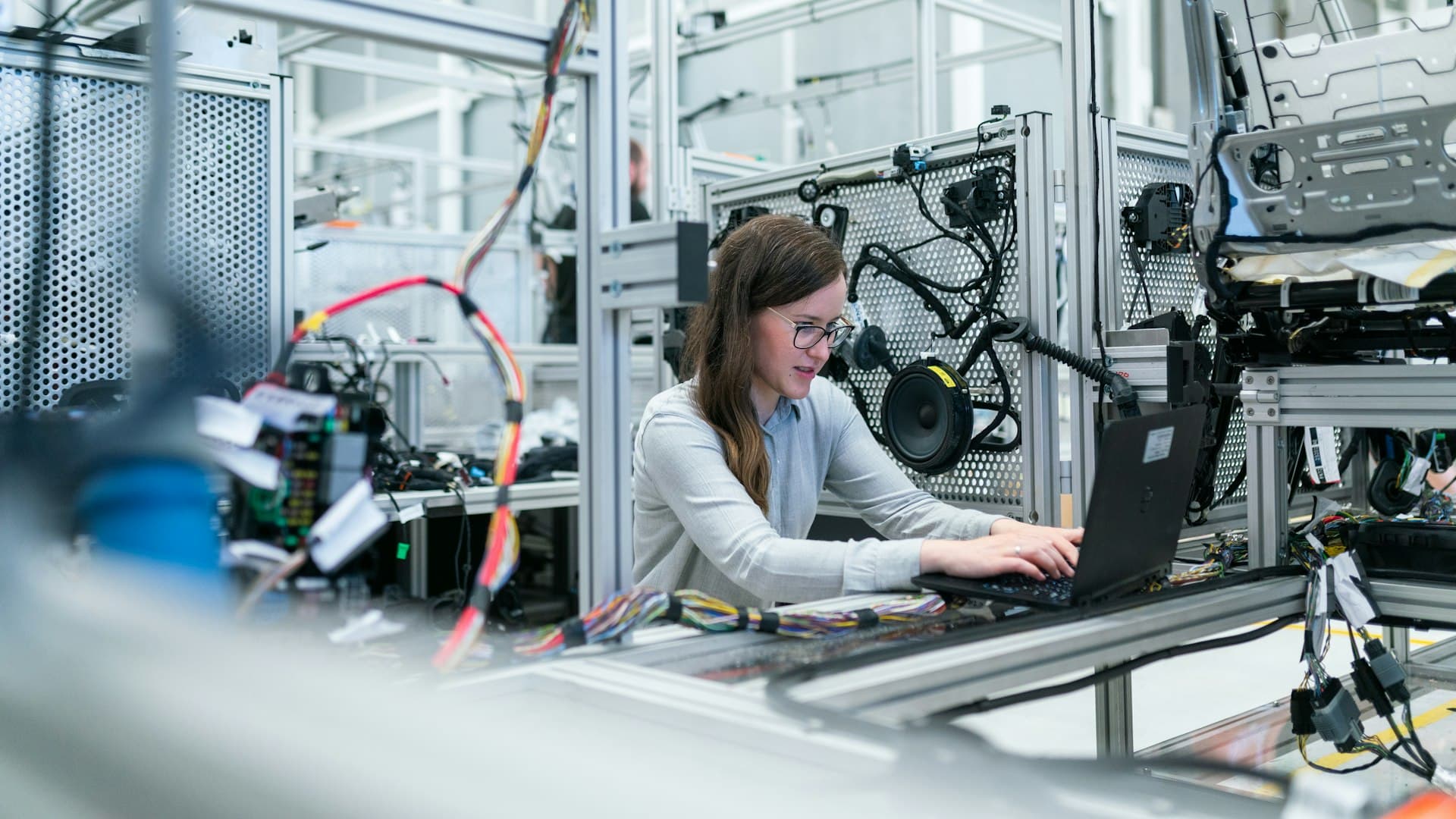
Mechatronics is one of the few engineering disciplines that was invented for an organisational reason rather than a scientific one.
It exists because machines stopped being mechanical with some electronics attached, and organisations kept the departments they had.
The discipline that exists because handoffs fail
A modern machine is mechanical structure, actuation, sensing, power electronics, embedded control and higher-level software, all interacting continuously.
Most organisations are still structured as mechanical engineering, electrical engineering and software, with a handoff between each.
The failure mode is not that any team is wrong. It is that each team is correct about their own part and the machine still does not work.
Three predictable symptoms.
The problem that belongs to nobody. A vibration that the mechanical team traces to a control response, that the controls team traces to a mechanical resonance, that the software team says is not in their code. Each analysis is right. The problem is the interaction.
The design that optimises one layer and breaks another. A lighter structure that is less stiff, making control harder. A cheaper motor that needs more sophisticated control to behave. A software fix for a mechanical problem that works until the mechanics wear.
Requirements that do not survive the handoff. A specification written by one discipline in its own terms, handed to another that interprets it differently. The gap appears at integration, late, when changing anything is expensive.
What the direction covers
The scope: mechanics, electronics and embedded systems integrated under automatic control.
Four areas, and the point is holding them together rather than mastering each.
Actuation and drives. Motors, drives, transmission, sizing, and the relationship between what you ask for and what the machine can deliver.
Sensing and signal handling. What the sensor actually measures, its noise, its bandwidth, and the fact that every measurement is late and imperfect.
Embedded control. Real-time execution, sampling, latency, and the awkward truth that a controller designed in continuous time runs on a computer that samples.
System dynamics. How the whole thing behaves: resonances, backlash, compliance, friction, and why the model differs from the machine.
The problems that live between teams
Four concrete examples, because this is a direction that stays abstract otherwise.
Structural resonance meeting control bandwidth. Push a controller harder for faster response and it excites a mechanical resonance. The fix might be stiffening the structure, filtering in the controller, reducing the demand, or changing the trajectory. Choosing correctly requires understanding both sides, and a team that only has one will pick badly.
Backlash and compliance. The motor moves; the end of the machine does not move quite the same way. Encoders on the motor tell you the motor position, not the tool position. This produces accuracy problems that look like software bugs.
Thermal effects. The machine warms during operation and dimensions change. Precision drifts over a shift. This is invisible in a design review and obvious in production.
Sampling and latency. Sensor delay, computation time and actuator lag all add phase delay, which reduces stable control bandwidth. Nothing is broken and the machine simply cannot be made faster without addressing it.
Each of these needs somebody who can look at a symptom and decide which layer to interrogate. That decision is the skill.
Where this sits in the domain
Mechatronics is the second of nine directions in Astra Trainer's robotics and autonomous systems domain, sitting between robotics engineering and control systems, and feeding into industrial robotics and everything above it.
It is the direction partners most often scope for existing engineers rather than for new hires, because its value is turning specialists into people who can reason across the boundary. It pairs with the advanced manufacturing domain, where industrial automation and control, and maintenance and asset management cover the plant side. Lessons are five minutes, so engineers build it alongside project work. You can see the nine directions here.
Why organisations do not train for this
Worth naming, because the reason is structural rather than accidental.
Career progression rewards depth. An engineer is promoted for being the best mechanical engineer, not for being adequate at three things. Breadth looks like a lack of specialisation on a performance review.
Budgets sit inside functions. Training spend is allocated by department, and cross-domain training benefits a boundary that no department owns.
The value is invisible. A mechatronics-capable engineer prevents integration problems, and prevented problems do not appear anywhere. This is the same attribution difficulty as corrosion prevention and as training measurement generally.
The failures get attributed to individuals. A late project with an integration problem is usually explained as a planning failure or a supplier issue, not as a missing capability.
So the capability is universally wanted and structurally unfunded, which is why it stays short.
The roles, named
Mechatronics engineers. Where the title exists, usually in machine building, robotics and medical devices.
Systems engineers on electromechanical products, owning requirements across disciplines.
Machine design engineers in special purpose machinery, which is mechatronics whether or not it is called that.
Controls engineers with mechanical understanding, which is the combination that makes them effective rather than merely competent.
Commissioning engineers. The people who make a machine work on site, which is mechatronics under time pressure.
Test and validation engineers for electromechanical systems.
Field service engineers on complex equipment, diagnosing across disciplines without support.
Maintenance technicians on modern automated equipment, covered below.
Who can be trained into it
Maintenance technicians on modern equipment. The most important and least recognised group. Diagnosing a fault on an automated machine already requires reasoning across mechanical, electrical and control layers, so they are doing mechatronics daily without the framework. Giving them the theory converts practical pattern recognition into transferable capability, and they are the people on site when something breaks.
Mechanical engineers. Need control and electronics. The most common formal route and a genuinely demanding one, because control theory is not a weekend subject.
Electrical and controls engineers. Need mechanical system dynamics: stiffness, resonance, friction, inertia. Frequently the shorter gap.
Embedded software engineers. Need the physical layer, particularly that sensors lie a little and actuators saturate.
Field service engineers. Already cross boundaries under pressure and rarely get the underlying theory.
Apprentice-trained engineers. Often hold unusually good practical breadth from a hands-on route and are undervalued relative to graduates in these roles.
Where competence is formally required. Work on machinery combining electrical, mechanical and control hazards is governed by machinery safety regulation and site procedure, including energy isolation, authorisation and, for electrical work, defined competence requirements. Functional safety systems carry their own standards and personnel competence expectations. Training builds engineering understanding. It does not confer electrical competence, functional safety certification or site authorisation.
What to take from this
The discipline exists because organisations kept departments that machines stopped respecting.
The characteristic failure is a problem every team can prove is not theirs, and resolving it needs someone who can decide which layer to interrogate.
Organisations under-fund this for structural reasons: progression rewards depth, budgets sit in functions, and prevented problems are invisible.
Maintenance technicians on automated equipment are already doing this work without the theory, and they are the highest-value conversion available.
And a small number of genuinely cross-domain people changes how fast an organisation can diagnose anything, which is worth more than it looks on a training budget line.
What is mechatronics actually for?
Solving the problems that sit between mechanical, electrical and software teams. The characteristic failure is a symptom each discipline can correctly prove is not theirs, while the machine still does not work.
Why is the capability short everywhere?
Structural reasons. Career progression rewards depth in one discipline, training budgets sit inside functions, and the value shows up as integration problems that did not happen.
Who is already doing this without the title?
Maintenance technicians on modern automated equipment. Diagnosing a fault across mechanical, electrical and control layers is mechatronics, and they do it daily without the framework.
Is it easier to train a mechanical or an electrical engineer into it?
Usually the electrical or controls engineer, because acquiring mechanical system dynamics tends to be a shorter gap than acquiring control theory from scratch.
Where does this fit in the domain?
Second of nine directions in Astra Trainer's robotics and autonomous systems domain, most often scoped for existing engineers rather than new hires. You can see them here.