
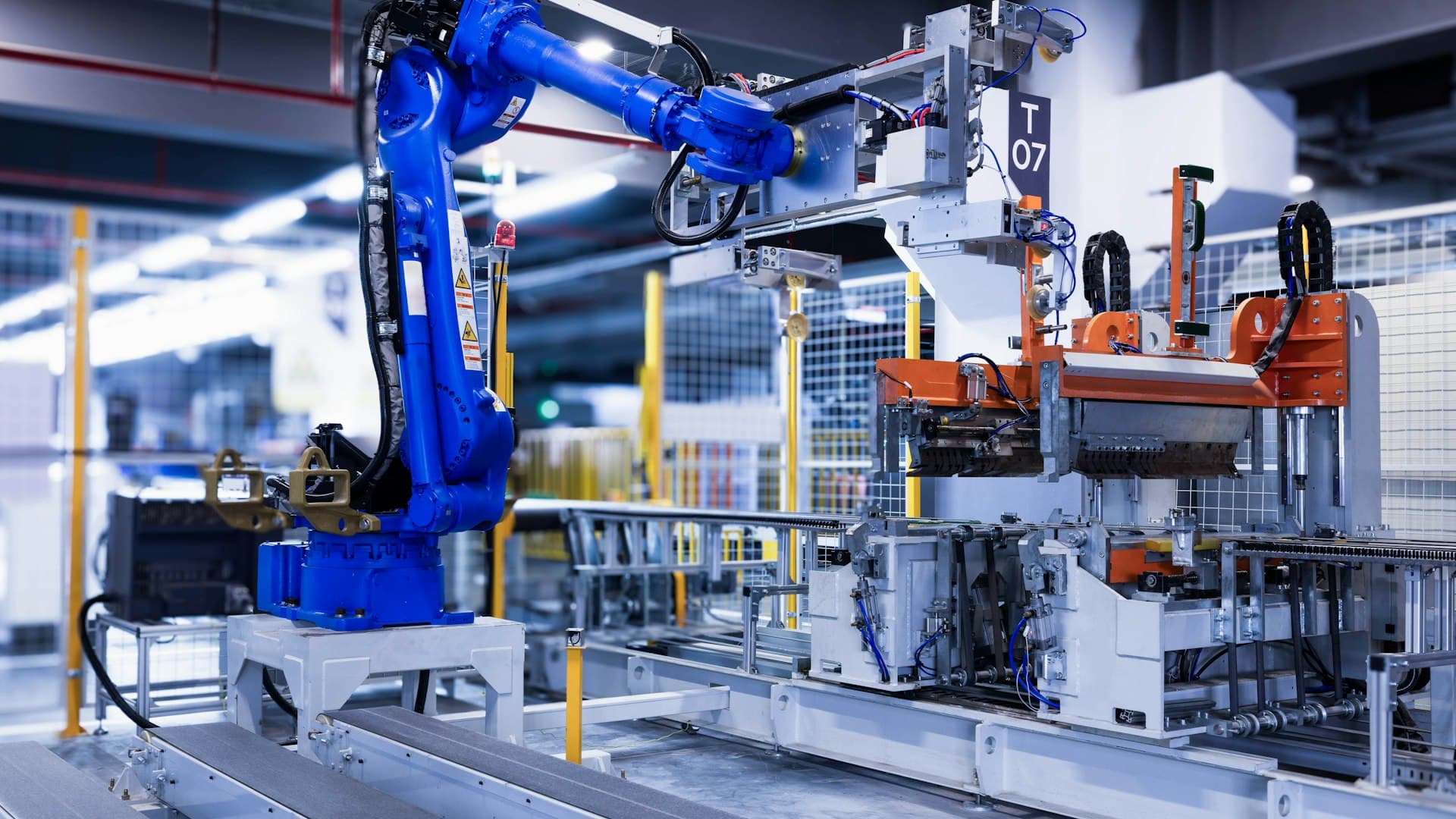
Industrial robotics is the most commercially mature part of this domain and the one where the gap between expectation and outcome is most consistently measurable.
Eighty percent in five countries
The World Economic Forum's Future of Jobs Report 2025 notes that 80 percent of the world's industrial robot installations happen in just five countries.
That figure is usually read as a statement about manufacturing competitiveness. For workforce planning it says something more specific.
Practical integration experience accumulates where the installations are. If you are building capability outside those five countries, you are competing for a skill that mostly exists somewhere else.
Three consequences.
Hiring experienced integrators is hard in low-density markets, because there are fewer people who have commissioned many cells.
Vendor support is thinner, which means more has to be done internally.
Training the existing workforce is not the cheaper option, it is the available one. This is the same structural point as the semiconductor and energy articles: where the work is geographically fixed and the experienced people are elsewhere, the local workforce is the supply.
Alongside that, the WEF reports 58 percent of employers expecting robots and autonomous systems to transform their business by 2030, and the US Bureau of Labor Statistics projects industrial engineer employment growing about 11 percent to 2034.
What the direction covers
The scope: robots on the line, manipulators, robot cells, programming, safety and integration.
Four areas.
Robot types and selection. Articulated arms, SCARA, delta, gantry and collaborative robots, and matching payload, reach, speed and accuracy to an application.
Programming. Teach pendant, offline programming and simulation, and the vendor-specific reality that skills do not transfer cleanly between manufacturers.
Cell design. Layout, fixturing, part presentation, end effectors, guarding and material flow. Where most of the engineering effort goes.
Safety and integration. Risk assessment, protective measures, and connecting the cell to the rest of the plant. Safety has its own direction later in this domain.
The economics that decide whether it works
The part that most determines whether an automation programme succeeds, and the part least often understood by the people approving it.
The robot is a minority of the cost. Fixturing, tooling, end effectors, safety equipment, controls, integration labour and commissioning typically dominate the project. A business case built on the robot price is wrong by a large multiple.
Utilisation decides payback, not cycle time. A cell that runs faster than a person but is only available 60 percent of the time because of faults, changeovers and part supply will not deliver its case. Availability is the variable that matters and it is the one the vendor demonstration does not show.
Changeover cost is usually underestimated. If the cell needs new fixtures and reprogramming for each product variant, and the plant runs many variants, the real capacity is much lower than the calculation.
Maintenance capability determines lifetime cost. A cell that requires an external engineer for every fault has downtime measured in days rather than hours.
Each of these is a workforce question wearing a financial label. Availability comes from people who can diagnose. Changeover cost comes from people who can reprogram and refixture. Maintenance cost comes from whether you have anyone.
Where this sits in the domain
Industrial robotics is the fourth of nine directions in Astra Trainer's robotics and autonomous systems domain, sitting on robotics engineering, mechatronics and control systems, and feeding into human-robot interaction and robot safety.
It is the direction most often scoped alongside the advanced manufacturing domain, where industrial automation and control covers the PLC and line layer, quality engineering and reliability covers the inspection regime, and maintenance and asset management covers keeping the cell running. For a plant automating production, that combination is the realistic program. Lessons are five minutes, which fits a shift change. You can see the nine directions here.
Why small and medium manufacturers struggle
Worth its own section, because the usual explanation is wrong.
The common account is that smaller manufacturers cannot afford robots. Robot hardware costs have fallen and finance is available, so affordability is rarely the binding constraint.
The real constraints are different.
High product mix. Traditional automation economics assume high volume and low variety. A plant running many products in small batches faces changeover costs that destroy the case.
No internal capability. Without someone who can reprogram and refixture, every product change becomes an external engagement. The cell effectively locks the plant into the products it was designed for.
Engineering resource, not capital, is the scarce input. Smaller manufacturers have few engineers and those engineers are busy with production. An automation project competes with keeping the plant running.
Risk concentration. One failed project is a much larger share of budget and credibility than for a large firm, which makes decision-makers cautious in ways that look like conservatism and are actually rational.
The workforce implication is direct: for a smaller manufacturer, the highest-return move is usually building the capability to reprogram and maintain cells internally, before or alongside buying more of them. Capability first changes what the hardware can be used for.
The roles, named
Robot programmers. Vendor-specific, certifiable, the most accessible entry point into the field.
Automation and controls engineers. The PLC, safety and line integration layer.
Cell designers and mechanical engineers for automation. Fixturing, tooling and end effectors. Undervalued and decisive.
Robot maintenance technicians. A growing shortage as installed bases age, and the role that determines availability.
Offline programming and simulation specialists. Proving cells before build, which cuts commissioning time and risk.
Systems integrators and project engineers.
Machine safety specialists. Risk assessment and protective measures, covered in its own direction.
Production engineers who understand what can realistically be automated in their own process.
Who can be trained into it
Production operators on automated lines. The most overlooked pool. They know the product variability, the failure patterns and the workarounds, which is the knowledge that determines whether a cell design will actually work. Adding robot programming produces people who can adjust a cell for a new variant without an external visit.
Maintenance technicians. Into robot maintenance and diagnosis, which is the availability lever.
CNC programmers and setters. Already think in coordinate frames, offsets, tooling and process, which is most of robot programming conceptually.
Toolmakers. Into fixturing and end effector design, where their fixture-making judgement is directly applicable and genuinely rare.
Electricians. Into controls and cell wiring, and onward into automation engineering.
Welders. Into robotic welding programming, where knowing what a good weld requires is the part a programmer without welding experience lacks.
Industrial robots are hazardous machinery and the rules are not advisory. Robot installations require a documented risk assessment and appropriate protective measures under machinery safety regulation. Entering a robot cell requires energy isolation or a safe-state procedure and site authorisation. Teaching and commissioning modes present particular risk because normal guarding may be suspended, and reduced-speed operation is a mitigation rather than a guarantee. Training builds engineering and hazard understanding. It does not authorise cell entry, maintenance work or modification of any safety function.
What to take from this
Eighty percent of installations in five countries means experience concentrates with the hardware, so training the local workforce is the available route rather than merely the cheaper one.
The robot is a minority of project cost. Fixturing, tooling, safety, integration and commissioning dominate, and a business case on hardware price is wrong.
Utilisation decides payback. Availability comes from people who can diagnose, and changeover cost comes from people who can reprogram.
Smaller manufacturers are blocked by product mix and missing internal capability rather than by affordability, so capability first changes what the hardware is worth.
And your line operators know what the cell will actually face. That is the input integration needs most and the one nobody collects.
Why does the five-country concentration matter?
Because practical integration experience accumulates where installations do. Outside those markets, experienced integrators are scarce and vendor support is thinner, which makes building capability internally the realistic route.
What drives automation project payback?
Utilisation rather than cycle time. A fast cell that is available 60 percent of the time misses its case, and availability depends on whether anyone on site can diagnose a fault.
Why do smaller manufacturers struggle to automate?
Product mix and missing internal capability, not affordability. High variety destroys traditional changeover economics, and without someone who can reprogram and refixture, every product change needs an external engagement.
Who converts into industrial robotics?
Production operators, who know the variability that decides whether a cell works; CNC programmers, who already think in coordinate frames and tooling; toolmakers into fixturing; and welders into robotic welding.
Where does this fit in the domain?
Fourth of nine directions in Astra Trainer's robotics and autonomous systems domain, usually scoped with advanced manufacturing. You can see them here.