Most beginner astrology is sign-heavy and planet-light, which is backwards. The signs are adjectives. The planets are what is actually going on.
Planets are the verbs
A chart placement has three components, and confusing their roles is the commonest early mistake.
The planet is what. Which function or drive is involved.
The sign is how. The style or manner in which that function operates.
The house is where. The area of life in which it shows up.
Mars in Libra in the seventh house is one statement: assertion, conducted diplomatically, in partnerships. Take the planet away and there is nothing to describe.
This is why a person's Sun sign alone carries so little in the tradition's own terms. It names one planet's sign and omits nine others, their houses and every relationship between them.
The luminaries
The Sun and Moon are grouped separately in traditional practice. They are not planets in the astronomical sense and the tradition calls them lights.
The Sun. Read as the core identity, vitality, the conscious self and the direction a life is oriented in. It is the reference point the rest of the chart is read against, which is why sign-based popular astrology fixed on it.
The Moon. Read as the emotional nature, instinct, habit, what a person needs rather than what they want, and the response that arrives before thought. In traditional practice it also governs the body and daily rhythm.
The distinction astrologers draw between them is worth knowing, since it is the most useful thing in this section. The Sun is what you are becoming. The Moon is what you already are when nobody is watching.
The personal planets
Mercury, Venus and Mars move quickly enough to differ substantially between people born in the same year, which is why they are read as personal.
Mercury. Thinking, speech, learning, writing, exchange and movement of information. How a person processes and transmits. Never far from the Sun in the sky, which means it is always in the same sign as the Sun or one adjacent to it.
Venus. Attraction, value, taste, pleasure and relating. What a person finds beautiful and what they consider worth having. Also money and possessions in traditional practice, on the logic that value is one idea.
Mars. Assertion, drive, appetite, conflict and the capacity to act on a want. How a person pursues, and how they behave when opposed.
Venus and Mars are often read as a pair, one describing what draws a person and the other how they go after it.
The social planets
Jupiter and Saturn move slowly enough to be shared across a birth year or two, and they sit between the personal and the generational.
Jupiter. Expansion, growth, meaning, belief, opportunity and excess. Where a person reaches, and where they overextend. The tradition calls it the greater benefic, and it is not uncritical: too much of anything is a Jupiter problem.
Saturn. Limitation, structure, time, discipline, responsibility and consequence. Where effort is required and where results are slow. Called the greater malefic in traditional practice, and read in modern practice as the place where mastery is possible precisely because it is not given easily.
The pair is the clearest opposition in the system: expansion against constraint, and a chart is read partly through how they balance.
How this is taught inside Astra Trainer
This is Planets, one of thirteen sub-topics in the Astrology direction of the Spiritual world, which is the largest direction in the world by sub-topic count.
It sits between Zodiac Signs and Houses, and before Aspects, Natal Chart Reading, Planets in Houses, Planets in Zodiac Signs, Strong and Weak Planets and House Rulers in Houses. Planets come early because without them the signs have nothing to modify. Lessons take about five minutes, and there is a discussion thread under every one.
The outer three, and why they are different
Uranus, Neptune and Pluto are not visible to the naked eye and were discovered in 1781, 1846 and 1930 respectively.
That single fact reorganises how they should be understood.
Every traditional technique predates them. Dignity tables, rulerships and the classical methods were all built on the seven visible bodies. The outer planets were fitted in afterwards.
They move very slowly. Pluto takes roughly two and a half centuries to circle the zodiac, Neptune about 165 years, Uranus about 84. Everyone born within a span of years shares their sign, which is why they are read as generational rather than personal.
Their meanings were assigned, not inherited. Astrologers attributed significations to them based on their discovery periods and mythology, which is a defensible method and a different kind of claim from a signification with two millennia behind it.
The significations in general use: Uranus for disruption, sudden change, independence and deviation from norms. Neptune for dissolution, imagination, idealism, spirituality and confusion. Pluto for power, depth, compulsion, destruction and transformation.
Practitioners differ on how much weight to give them. Traditional astrologers often use them lightly or not at all. Modern practice frequently treats them as central. That is a real methodological divide rather than a matter of taste.
Speed explains the structure
The organising principle that makes the whole set make sense.
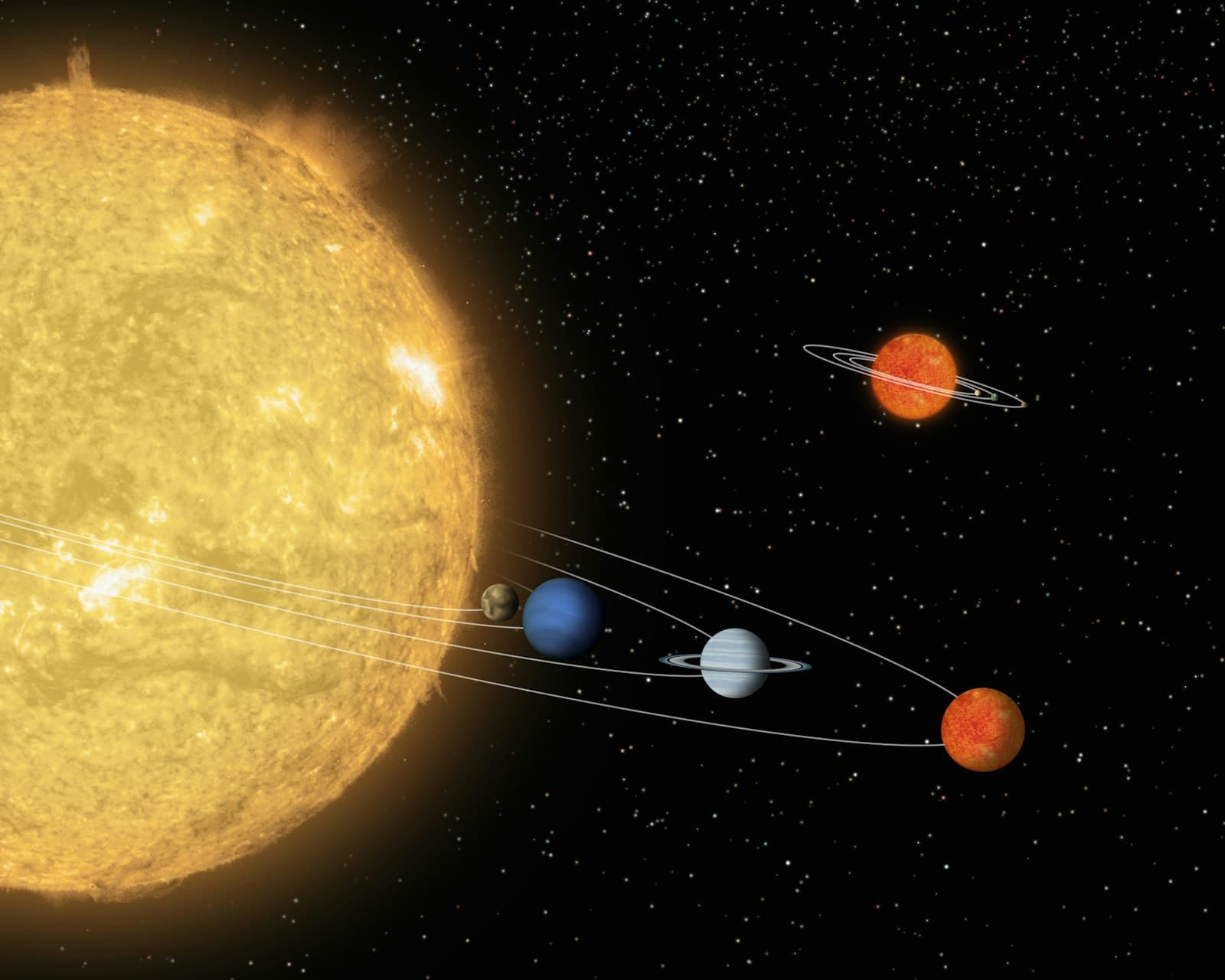
The Moon moves through the whole zodiac in roughly a month. The Sun, Mercury and Venus take about a year. Mars takes around two. Jupiter about twelve, Saturn about twenty-nine. Then the outer three, in decades and centuries.
The interpretive convention follows directly.
Fast bodies are personal, because two people born a week apart can differ on them.
Slow bodies are shared, because everyone born in a stretch of years has them in the same sign, so the sign says something about a cohort rather than an individual.
House placement is what individualises the slow ones. Everyone in a generation may have Pluto in the same sign, and its house depends on birth time and place, so that is where a generational placement becomes personal.
This is the most defensible piece of internal logic in the system, and it follows from orbital mechanics rather than from interpretation.
Rulership, and the disagreement inside it
Each sign is associated with a ruling planet, and there are two schemes in use.
The traditional scheme uses the seven visible bodies. The Sun rules Leo and the Moon Cancer, and the other five each rule two signs: Mercury takes Gemini and Virgo, Venus takes Taurus and Libra, Mars takes Aries and Scorpio, Jupiter takes Sagittarius and Pisces, Saturn takes Capricorn and Aquarius. The arrangement is symmetrical around the Sun and Moon, which is part of why it was built that way.
The modern scheme reassigns three of those. Uranus is given Aquarius, Neptune Pisces, Pluto Scorpio, leaving Saturn, Jupiter and Mars with one sign each.
Two consequences worth stating.
This changes chart readings. Rulership drives the house ruler technique covered in its own article here, so which scheme you use alters which planet answers for which part of the chart.
Both are in active use. The traditional revival has made the older scheme mainstream again, and many practitioners use both, reading the traditional ruler as primary and the modern one as an additional layer.
Not a basis for decisions. This article describes how astrologers read planetary significations within their own tradition. Astrology is not a source of medical, psychological, financial or legal guidance, and nothing here should inform decisions in those areas. For health concerns see a qualified medical professional, and for financial or legal matters a qualified professional in that field.
What to take from this
The planet is the verb, the sign the manner and the house the setting. Sign-only astrology drops nine of the ten.
The Sun and Moon are grouped apart as the lights, and the tradition reads them as what you are becoming against what you already are.
Speed organises everything: fast bodies personal, slow bodies generational, and house placement is what makes a generational body individual.
The outer three were discovered in 1781, 1846 and 1930, so every classical technique predates them and their meanings were assigned rather than inherited.
And rulership has two competing schemes in current use, which changes how a chart reads rather than being a matter of preference.
What do the planets mean in astrology?
They carry the function being described. The Sun is identity and vitality, the Moon instinct and need, Mercury thought and communication, Venus attraction and value, Mars drive and assertion, Jupiter expansion, Saturn limitation and structure.
Why are Uranus, Neptune and Pluto treated differently?
Because they are invisible to the naked eye and were discovered in 1781, 1846 and 1930. Every traditional technique predates them, their significations were assigned rather than inherited, and they move so slowly that a whole generation shares their sign.
What makes a planet personal or generational?
Orbital speed. The Moon circles the zodiac in about a month and Pluto in roughly two and a half centuries, so fast bodies differ between people born days apart while slow ones are shared across years.
Which planet rules which sign?
It depends on the scheme. Traditionally the seven visible bodies cover all twelve signs, with five planets ruling two each. Modern practice reassigns Aquarius to Uranus, Pisces to Neptune and Scorpio to Pluto. Both are in active use.
Why is a Sun sign so limited?
Because it names the sign of one planet and omits the other nine, all of their house placements, and every aspect between them. In the tradition's own terms it is a small fraction of a chart.