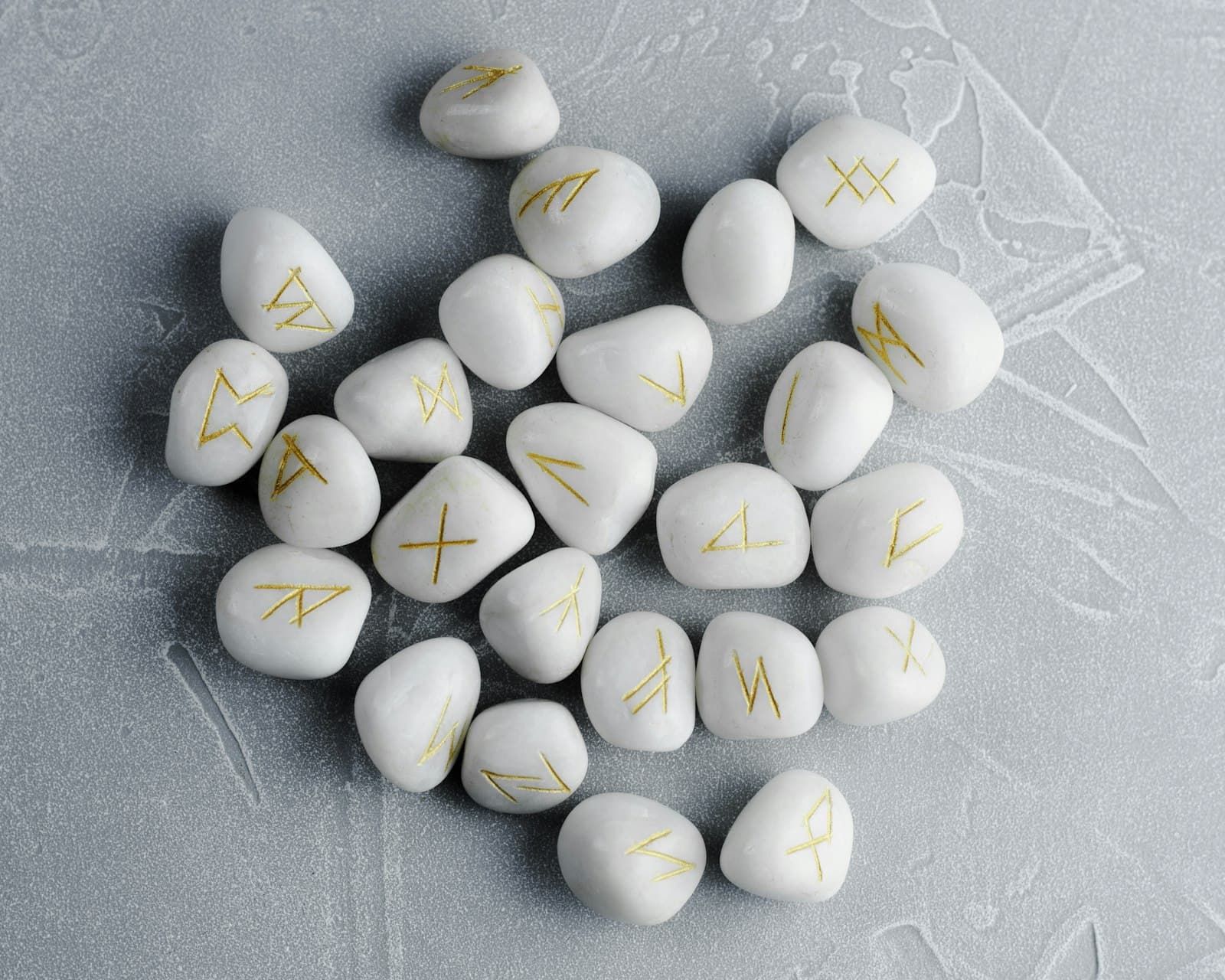
If the first aett sets out the world, the second sets out what the world does to you.
The hard stretch
Read the second aett in order and the tone is unmistakable. Hail, need, ice, then the harvest, then a tree associated with death, then a rune nobody can identify, then protection, then the sun.
Four of the first five name things that threaten survival in a northern agricultural society: a storm that destroys the crop, want, a frozen world, and the yew, which is poisonous and grows in graveyards.
This is a sequence written by people for whom a bad hailstorm in the wrong week meant a hungry winter, and it reads like it.
Modern books tend to render this run as transformation, restriction, stillness and patience, which is a therapeutic vocabulary laid over a survival one. The source material is considerably colder.
Hagalaz
Sound value h, name meaning hail.
The Old English poem calls it the whitest of grains, says it comes whirling from the sky, is tossed by the wind, and turns to water. The Norse poems are blunter, one calling it cold grain and associating it with sickness and ruin.
The image is precise. Hail looks like grain, falls from the sky like a harvest arriving, and destroys the actual harvest. A false grain that ruins the real one.
Modern readings usually give disruption or sudden change, often with a reassurance that it clears the way for something better. The sources do not offer the reassurance.
Nauthiz
Sound value n, name meaning need, in the strong sense of necessity, hardship or want rather than of wanting something.
The Old English poem is one of the few that offers any comfort: need is oppressive to the heart, and can nonetheless become a help and a healing if it is heeded early. That is a verse about attending to hardship before it becomes unmanageable.
The Norse poems give no such opening. One line describes need as leaving little choice, and as a condition that burns the naked in frost.
Modern readings give constraint, necessity and the friction that produces resilience, which keeps the English poem's angle and drops the Norse one.
Isa
Sound value i, name meaning ice.
The poems are consistent here and unusually vivid. Ice is described as very cold and slippery, glittering like glass, beautiful to look at, a floor made of frost.
The Norse material adds the danger explicitly, warning about the breadth of ice and the risk of crossing it.
What comes through is not stillness in the meditative sense. It is a surface that looks solid, is beautiful, and may not hold your weight. Modern readings of stillness, pause and suspension are a considerable softening of an image about treacherous footing.
Jera
Sound value j, name meaning year, and specifically a good year or harvest.
This is the turn in the aett and the poems treat it accordingly. The Old English poem describes it as a joy to all when the earth gives her increase. The Norse material associates it with plenty and with peace.
Placed after hail, need and ice, the harvest reads as relief rather than as prosperity. Something survived. The cycle came round.
That placement is the most defensible bit of structural reading in the whole futhark, and it does not require believing anything about divination to notice it.
How this is taught inside Astra Trainer
This is the 2nd Aett, Hagal's Aett, one of eight sub-topics in the Runes direction of the Spiritual world.
It sits between the first and third aettir, and the direction works through all 24 runes in the historical order with the rune poems given alongside the modern glosses, so that the difference between the two is always visible. Lessons take about five minutes, and there is a discussion thread under every one.
Eihwaz
Sound value close to a long e or a sound now lost, name meaning yew.
The Old English poem describes the yew as rough on the outside, firmly rooted, a keeper of fire and a joy on the estate. That last part is warmer than expected, and reflects the yew's practical value: it is dense, durable, and was the wood for bows.
What the poem does not say, and what any northern European audience knew, is that the yew is poisonous in nearly every part and grows in churchyards, living for centuries. It is a tree associated with both durability and death.
Modern readings lean heavily on the death and rebirth axis. The sources give a hard, long-lived, useful tree, and the darker associations come from the wider culture rather than from the poems themselves.
Perthro, the one nobody can read
The most honest entry in the entire futhark, and the one modern books handle worst.
The name is not securely known. The Old English poem gives a verse about something that is a source of recreation and amusement to those who sit in the hall, where warriors sit together cheerfully. That is the whole of it.
Proposals for the referent include a dice cup or gaming piece, which fits the hall and amusement, a pear tree, and various others. None commands agreement, and the Norse poems do not help because the rune does not survive into the Younger Futhark.
So the position is genuinely open. A rune whose name is uncertain, described in one late poem as something people play with indoors.
Modern books routinely give this rune confident meanings around fate, chance, mystery, hidden things and the womb. Some of that is extrapolated from the dice cup reading, which is reasonable if flagged, and much of it is simply invented.
When a source gives you a definite meaning for perthro without mentioning that its name is unknown, you have learned something useful about that source.
Algiz and Sowilo
The last two of the aett, and the two that require the appropriation note.
Algiz, sound value a terminal z sound. The name is usually taken as elk, though the Old English poem describes a sedge or reed that grows in marshes, wounds severely and draws blood from anyone who grasps it. Elk and a cutting marsh plant are quite different, and the reading is unsettled. Modern practice gives protection, which derives more from the shape and from the elk reading than from the poem.
Sowilo, sound value s, name meaning sun. The poems are consistent and positive. The Old English poem calls it a joy to seafarers when they travel over the fishes' bath until the sea-steed brings them to land. The Norse material associates it with light and with the shield of the clouds.
Both of these runes were taken up in Nazi symbolism. Sowilo doubled forms the SS sig rune, via Guido von List's reinterpretation of the sun rune as a victory sign, and the ADL tracks a number of runic symbols as hate symbols because of continued neo-Nazi use.
The historical runes are not extremist symbols and the appropriation had no warrant in the sources. It remains true that these two in particular will be read by some people as something other than an alphabet, and it is better to know that than to discover it.
On algiz, sowilo and modern use. Both runes appear in Nazi and contemporary far-right symbolism, and sowilo doubled is the SS sig rune. The historical runes are a writing system belonging to a genuine cultural heritage, and Heathen and Norse pagan communities have consistently opposed their misuse. Astra Trainer teaches the historical material and endorses no political use of these symbols. The full history is in the article on rune sources.
What to take from this
The second aett is the harsh stretch: hail, need, ice and the yew are all versions of the same northern threat.
Jera sits in the middle as the turn, and reads as relief that something survived rather than as abundance.
Perthro's name is genuinely unknown, and confident meanings for it are invented. This is the single best test of whether a rune source is being straight with you.
Algiz is unsettled between an elk and a cutting marsh plant, and the protective reading owes more to shape than to the poem.
And sowilo is the sun in every source that describes it, which is what makes its appropriation as a victory symbol a distortion rather than an interpretation.
Which runes are in the second aett?
Hagalaz, nauthiz, isa, jera, eihwaz, perthro, algiz and sowilo, in that order. It is the harshest stretch of the futhark, opening with hail, need and ice.
What does perthro mean?
Nobody knows. The name is not securely identified, the single Old English verse describes something people are amused by in the hall, and proposals include a dice cup and a pear tree. Sources that give it a confident meaning are inventing one.
Is algiz really protection?
That reading comes largely from the elk interpretation and from the rune's shape. The Old English poem describes a marsh sedge that wounds severely and draws blood from anyone who grasps it, which is a different image.
Why is jera positioned where it is?
After hail, need and ice, the harvest reads as relief that the cycle came round and something survived, rather than as prosperity. It is the clearest piece of structure in the futhark.
Are algiz and sowilo far-right symbols?
They were appropriated into Nazi symbolism, and sowilo doubled is the SS sig rune, so both now carry a second public meaning. The historical runes are a writing system from a genuine cultural heritage, and the appropriation had no basis in the sources.