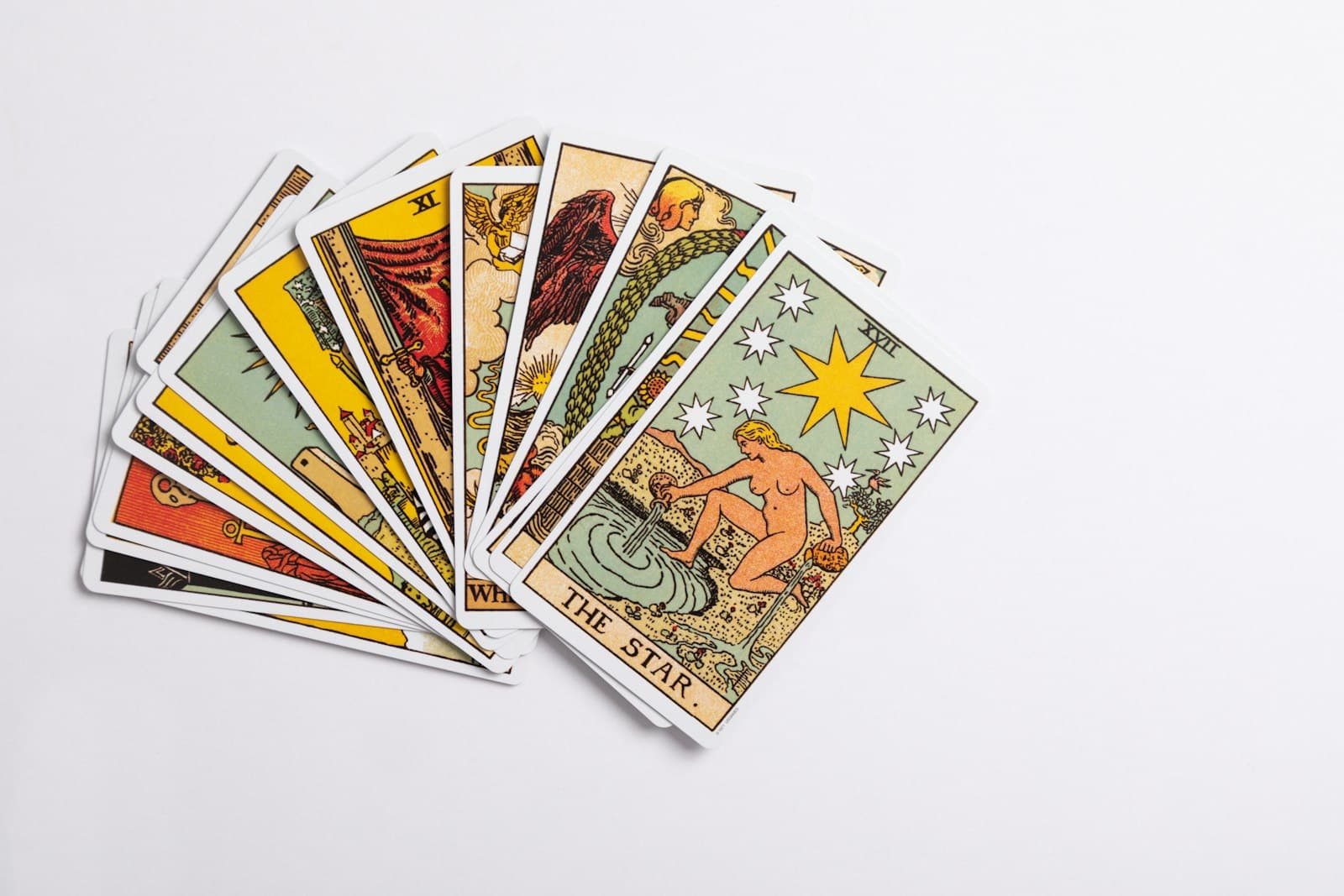
If you own a Rider-Waite-Smith deck and a Marseille deck, two cards have swapped numbers between them. The reason is astrological, and it is from 1909.
A change you can see in the deck
Most claims about tarot history are difficult to check. This one is in your hands.
In the older tradition, including the Tarot de Marseille, Justice is card VIII and Strength is card XI.
The Rider-Waite-Smith deck, published in December 1909, was the first to make Strength 8 and Justice 11. Nearly every deck produced in the English-speaking world since has followed it, which is why most people have never seen the older arrangement.
Two cards in the most widely used tarot deck in the world carry the numbers they do because of a decision made by a Victorian occult society.
This is not a hidden controversy. It is openly discussed among readers, and decks still differ. It is worth knowing because it shows exactly how much of modern tarot practice is a recent layer.
Why they made the swap
The reasoning is specific and it is astrological.
The Hermetic Order of the Golden Dawn assigned each major arcanum a correspondence, including zodiac signs for twelve of them. The aim was a coherent system in which the trumps mapped onto the signs in order.
Strength depicts a lion, which points at Leo. Justice depicts scales, which points at Libra. In the older numbering those two sat in the wrong places for a zodiacal sequence.
Swapping them fixed it. The relevant stretch then runs Cancer, Leo, Virgo, Libra, matching the zodiacal order: the Chariot, Strength, the Hermit, Justice.
Arthur Edward Waite was a member of the Golden Dawn, and when he produced his deck with the artist Pamela Colman Smith he used the order his tradition had adopted. The suggestion itself traces back to the Cipher Manuscripts that underlie the Golden Dawn's teachings.
So the sequence of the most widely used tarot deck was altered to fit an astrological scheme devised in the late nineteenth century.
Where the whole system came from
The wider context, and readers who have followed the Kabbalah articles in this world will recognise it immediately.
The same Golden Dawn synthesis produced three things that are now treated as tarot tradition.
The astrological attributions. Signs, planets and elements assigned to the major arcana, and decan rulerships assigned to the minors.
The placement of tarot on the Tree of Life. The twenty-two majors mapped onto the twenty-two paths of the Kabbalistic Tree. As the article on Jewish and Hermetic Kabbalah sets out, this appears in no Jewish source and is a nineteenth-century construction.
The elemental dignities in minor card reading, covered in the companion article on decans and dignities.
All three came together, from the same order, in the same period, as parts of one system intended to unify tarot, astrology, Kabbalah and ceremonial magic into a single correspondence table.
That system is coherent and genuinely interesting. It is also about a hundred and thirty years old, and tarot itself is considerably older, having begun as a card game in fifteenth-century Italy before acquiring divinatory use in the eighteenth century.
How this is taught inside Astra Trainer
This is Tarot and Astrology, one of four sub-topics in the Tarot direction of the Spiritual world.
It follows Tarot Cards, Tarot Reversed and Tarot Combinations, and it connects across to the Astrology direction, where the same correspondences appear from the other side. The history is given first for the same reason it is in the chakra and rune material: knowing which layer you are holding is part of knowing the subject. Lessons take about five minutes, and there is a discussion thread under every one.
What the correspondences actually are
The system as it is generally used, stated so you can recognise it.
Twelve majors carry zodiac signs. The Emperor with Aries, the Hierophant with Taurus, the Lovers with Gemini, the Chariot with Cancer, Strength with Leo, the Hermit with Virgo, Justice with Libra, Death with Scorpio, Temperance with Sagittarius, the Devil with Capricorn, the Star with Aquarius, the Moon with Pisces.
Seven carry planets. The Magician with Mercury, the High Priestess with the Moon, the Empress with Venus, Wheel of Fortune with Jupiter, the Tower with Mars, the Sun with the Sun, the World with Saturn.
Three carry elements. The Fool with air, the Hanged Man with water, Judgement with fire, in the most common arrangement.
The suits carry elements. Wands fire, Cups water, Swords air, Pentacles earth, though some systems swap Wands and Swords.
The minors carry decans. The thirty-six numbered cards from two through ten across four suits map onto the thirty-six ten-degree divisions of the zodiac, each with a planetary ruler. That is the subject of the next article.
Two observations about this table. It is elegant, with twelve plus seven plus three accounting for all twenty-two majors. And its elegance is evidence of construction rather than of inheritance, since inherited systems are rarely this tidy.
Decks disagree
The practical consequence, and it matters for anyone using these correspondences.
The Strength and Justice numbering differs between Marseille-tradition decks and Rider-Waite-Smith-descended decks, as covered above.
The Thoth deck differs again. Aleister Crowley, also a Golden Dawn member, produced a deck with Lady Frieda Harris that renames several cards and makes its own adjustments to the attributions.
Wands and Swords attributions vary. Some systems assign Wands to fire and Swords to air, others reverse it, and the disagreement is long-running.
Marseille reading does not use these correspondences at all. Readers in that tradition work from number and suit structure, without the astrological layer.
So the correct answer to what a card corresponds to is: in which system. Anyone stating a correspondence as simply true has not encountered the alternatives.
Whether it is worth using
The fair assessment, since the history could be read as debunking and should not be.
It is internally consistent, which is a real virtue. A system where the Emperor is Aries, Aries is ruled by Mars, and the Tower is Mars gives you cross-references that reinforce each other.
It aids memory. Learning seventy-eight cards is easier with a structure attached, and the correspondences give one.
It connects practices. Someone studying both tarot and astrology gains a shared vocabulary, which is efficient.
It is recent, and that is fine. Traditions add layers. The Golden Dawn system is a genuine contribution to tarot practice and it is not what tarot was before 1888.
The position this world takes throughout applies here: use the system if it works for you, and describe it accurately. The problem is never that something is modern. It is claiming that something modern is ancient, which misleads the reader and is checkable.
Not a basis for decisions. This article describes the history of a correspondence system and how practitioners use it. Tarot and astrology are not sources of medical, psychological, financial or legal guidance, and nothing here should inform decisions in those areas. For health concerns see a qualified medical professional, and for financial or legal matters a qualified professional in that field.
What to take from this
Justice was VIII and Strength XI until the Rider-Waite-Smith deck of December 1909 reversed them.
The Golden Dawn made the change so Strength would align with Leo and Justice with Libra, putting the trumps in zodiacal order.
The same order produced the tarot astrology attributions and the placement of tarot on the Kabbalistic Tree, as one unified correspondence system.
Decks disagree, so a correspondence belongs to a system rather than to tarot, and Marseille reading uses none of it.
And the system is worth using and worth describing accurately. Being recent is not a fault; being described as ancient is.
Why is Strength card 8 in some decks and 11 in others?
Older decks including the Marseille have Justice as VIII and Strength as XI. The Rider-Waite-Smith deck, published in December 1909, was the first to reverse them, and most English-language decks since have followed.
Why did they swap the cards?
So the trumps would run in zodiacal order. Strength shows a lion for Leo and Justice shows scales for Libra, and swapping them produced the sequence Cancer, Leo, Virgo, Libra across the Chariot, Strength, the Hermit and Justice.
Where do tarot astrology correspondences come from?
The Hermetic Order of the Golden Dawn, in the late nineteenth century. The same synthesis assigned the majors to the paths of the Kabbalistic Tree of Life and introduced elemental dignities into minor card reading.
Do all decks use the same correspondences?
No. The Thoth deck makes its own adjustments, systems disagree about whether Wands or Swords take fire, and Marseille reading does not use astrological correspondences at all.
Is the Golden Dawn system worth learning?
It is internally consistent, aids memory and connects tarot to astrological study, so many readers find it useful. It is also a nineteenth-century construction rather than ancient tarot tradition, and worth describing as such.