
Fehu Key Facts
What the record shows
- Sound
- /f/
- Ætt
- Freyr's ætt, 1st of 8
- Literal meaning
- Cattle; livestock as movable wealth
- Rune poems
- Wealth in all three poems: a comfort to share (Old English), a cause of strife among kin (Norwegian, Icelandic)
- Other names
- Feoh (Old English), Fé (Old Norse), fe (Gothic letter name)
In modern rune reading
- Associated deity
- Freyr and Freyja — a modern link, not attested
- Element
- Fire in some systems; no agreed element
- Yes or No?
- Yes
- Love
- Generosity and shared resources; possessiveness when blocked
- Career & money
- Earned income, assets to manage and keep moving
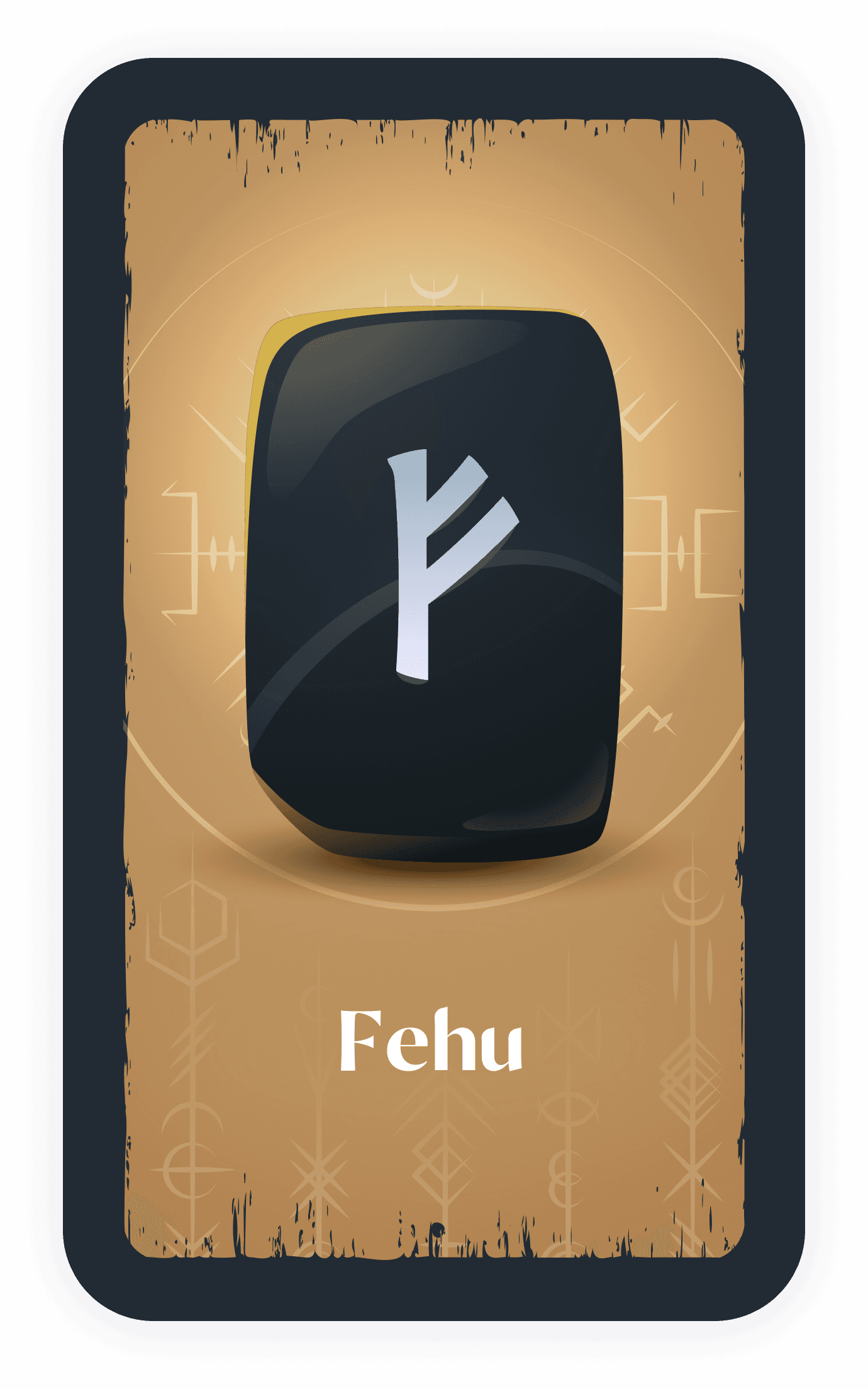
Fehu is the first rune of the Elder Futhark and the first letter of the word "futhark" itself. Its name meant cattle — the wealth that walks — and every later rune poem reads it as wealth. This page keeps two layers apart: what the historical record supports, and what modern rune reading has built on top of it.
What does Fehu mean?
Fehu stood for the sound /f/. Its name is reconstructed from Proto-Germanic *fehu, "cattle, livestock, property" — the same root as Old English feoh, Old Norse fé, German Vieh and, by a long road through Anglo-Norman law, the English word fee. In an economy without much coinage, a herd was the wealth you could move, trade, give as a dowry or lose to raiders, and the word covered both the animals and the money they stood for.
No Iron Age source lists the rune names. They are rebuilt by comparing three much later rune poems with a set of Gothic letter names, then working backwards linguistically. For Fehu that reconstruction is about as secure as it gets: every source agrees on the sound, the word and the idea of wealth. That makes it a good first rune — and a useful benchmark for the ones where the sources disagree.
What do the rune poems say about Fehu?
All three poems open with this rune, and all three read it as wealth — but they do not agree on whether wealth is good news.
- Old English (the Anglo-Saxon futhorc, 8th–9th century): wealth is a comfort to everyone, yet each must share it freely to win honour before the Lord.
- Old Norwegian (c. 13th century, Younger Futhark): wealth causes strife among kinsmen; the wolf lives in the forest.
- Old Icelandic (c. 15th century, Younger Futhark): wealth is the strife of kinsmen, the fire of the sea and the path of the serpent — both kennings for gold — glossed with the Latin aurum.
The poems are late and describe later rune rows. The Old English poem belongs to the Anglo-Saxon futhorc; the Norse poems to the 16-rune Younger Futhark. They are the best evidence for what the Elder Futhark names meant, not a manual for how anyone used Fehu in a reading.
Read together, the stanzas give Fehu a double edge that the modern keywords usually flatten: wealth comforts, and wealth divides families. The Christian Old English poet resolves it with generosity; the Norse poets simply set the quarrel beside the wolf.
Fehu upright meaning
In modern rune reading an upright Fehu is a rune of resources: money, possessions, earned reward, and the energy to get something moving. Most readers carry the poems' tension forward as a condition — the wealth is real, but it stays healthy only while it circulates.
- Material gain — income, a raise, a sale, an asset arriving.
- Earned rather than found — cattle had to be raised and guarded, so readers link Fehu to effort paying off.
- Circulation — spending, investing or sharing wisely, not hoarding.
Fehu reversed (merkstave) meaning
Drawn upside down, Fehu is read as the same resources going wrong: money slipping away, a loss or debt, greed, or a quarrel over an inheritance — the strife among kinsmen of the Norse poems, turned into a warning. Some readers treat it less as a loss than as stagnation: wealth that exists but is not doing anything.
Reversed readings are a modern convention. The rune poems give one stanza per rune and no inverted counterpart; merkstave meanings come from 20th-century rune books. Many practitioners find them useful — just know which layer you are using.
Fehu in love and relationships
In a love reading Fehu is about what two people bring and share. Upright it points to generosity, a relationship that feels abundant, or a practical step such as moving in or pooling money. Reversed, it is read as possessiveness, keeping score, or money becoming the thing the couple argues about.
Fehu in career and money
This is the rune's home ground. Upright Fehu suggests income that reflects the work put in, a good moment to ask for what you are owed, or assets that need active management. Reversed, readers look for a leak — overspending, an unpaid invoice, a project that consumes money without returning any.
Is Fehu a yes or no rune?
In yes-or-no rune reading, an upright Fehu is a yes, especially for questions about money, purchases or effort paying off; reversed, most readers take it as a no or a "not like this". This is purely modern divinatory practice — there is no historical evidence of runes being read this way.
What is attested and what is modern
| Layer | Fehu | How solid |
|---|---|---|
| Sound | /f/ | Solid — read in surviving inscriptions |
| Name and literal meaning | *fehu, cattle and movable wealth | Strong — reconstructed from the poems, Gothic and cognates |
| Wealth as the rune's idea | In all three rune poems | Strong, but the poems are medieval |
| Freyr and Freyja | Modern association | No historical source links them to the rune |
| Upright, merkstave, yes or no | Modern divination | 20th-century practice |
Fehu opens Freyr's ætt, and the next rune, Uruz, turns from tame cattle to the wild aurochs. Readers often pair it with Gebo, the gift, and with Othala, the inherited estate that closes the Futhark. For the whole alphabet and the meanings scholars still dispute, see Elder Futhark rune meanings.
What does the Fehu rune mean?
Fehu literally meant cattle — livestock as movable wealth — and stood for the sound /f/. All three medieval rune poems read it as wealth, and modern rune readers use it for money, resources and earned reward.
What does Fehu mean reversed?
In modern practice a reversed (merkstave) Fehu is read as loss, greed, debt or wealth that has stopped moving. Reversed meanings are a 20th-century convention; the rune poems give no inverted reading.
Is Fehu a good rune to draw?
Most readers see an upright Fehu as positive, especially for money and work. The rune poems add a caution worth keeping: wealth comforts, but it also causes strife among kin when it is not shared.
Is Fehu the rune of Freyr?
Not in any historical source. The link to Freyr and Freyja comes from modern rune books, partly because the first group of eight runes is called Freyr's ætt in later tradition.