
Gebo Key Facts
What the record shows
- Sound
- /g/
- Ætt
- Freyr's ætt, 7th of 8
- Literal meaning
- Gift, giving
- Rune poems
- Generosity brings honour and helps the destitute (Old English); no Norse stanza
- Other names
- Gyfu (Old English), geuua (Gothic letter name); no Old Norse name
In modern rune reading
- Associated deity
- —
- Element
- —
- Yes or No?
- Yes
- Love
- Mutual giving, balance, commitment; one-sided giving in a hard position
- Career & money
- Fair exchange, partnership, a good offer; unequal deals in a hard position
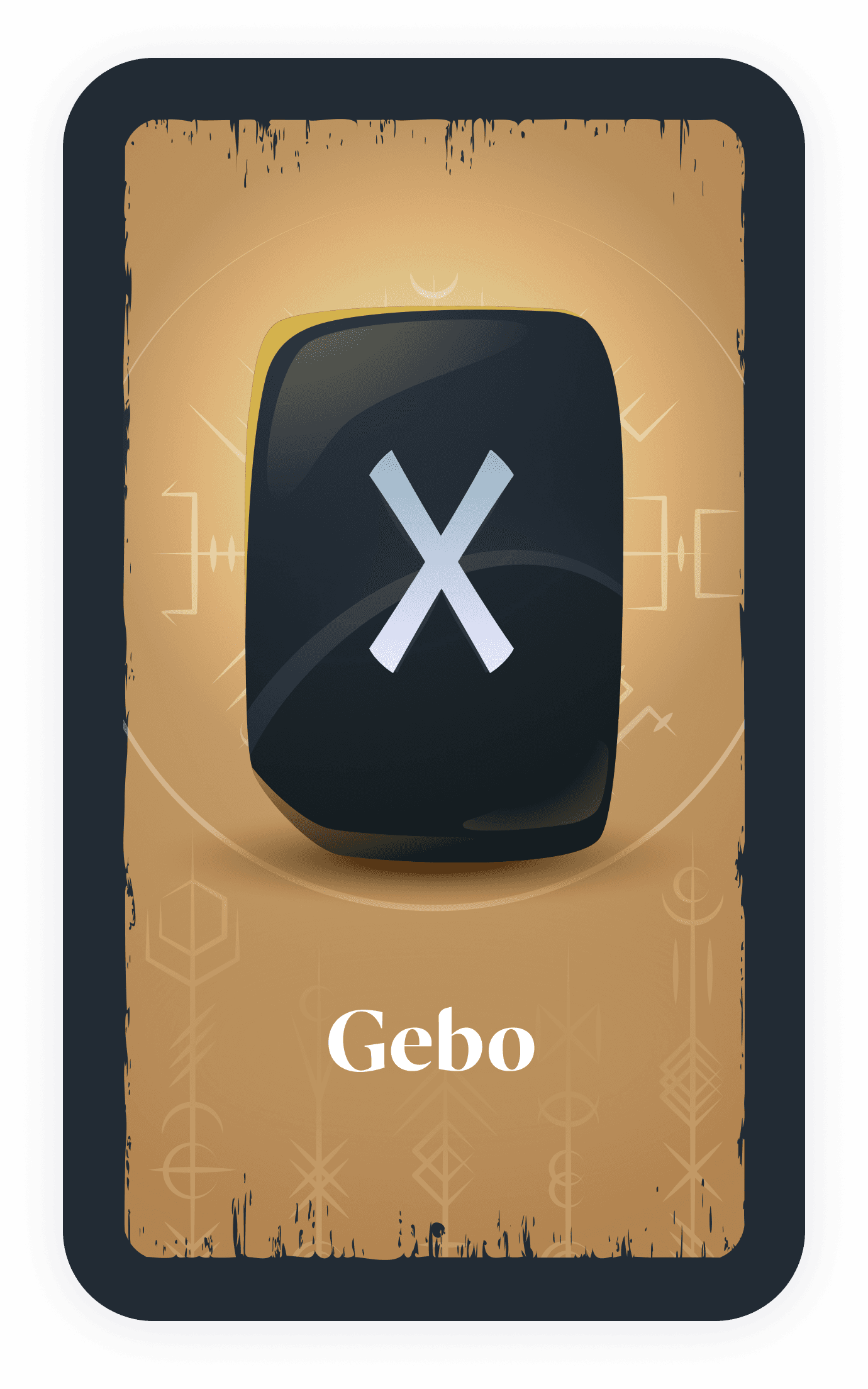
Gebo is the seventh rune of the Elder Futhark, and one of the simplest to name: it means gift. It is also a rune with only one medieval poem behind it, and a shape that looks the same whichever way it lands. This page keeps the attested layer apart from the modern one, and explains why Gebo has no reversed meaning.
What does Gebo mean?
Gebo stood for the sound /g/. The name is reconstructed as Proto-Germanic *gebō, "gift", matching Old English gyfu and Gothic giba; the Gothic letter name was recorded as geuua. It shares its root with English give. The shape is a plain X; one runologist has suggested it was borrowed from a Latin letter of the same form.
In the world that used the Elder Futhark, a gift was not a free extra. Lords rewarded followers with rings and weapons, hosts and guests owed each other, and a gift created ties and obligations between people. Gebo's modern meaning — exchange and reciprocity — grows from that, and it is one of the reasonable extensions of a well-documented word.
What do the rune poems say about Gebo?
Only one of the three poems has a stanza for Gebo.
- Old English (the Anglo-Saxon futhorc, 8th–9th century): generosity brings credit and honour and supports a person's dignity; to the destitute who have nothing else, it is help and sustenance.
- Old Norwegian (c. 13th century): no stanza. The 16-rune Younger Futhark dropped the g-rune and wrote g with the k-rune, so the Norse poems never name it.
- Old Icelandic (c. 15th century): no stanza either, for the same reason.
The one surviving stanza is late and English. The Old English poem belongs to the Anglo-Saxon futhorc and a Christian society. It is the best evidence for what the rune name meant, not a record of how anyone used Gebo in a reading.
Read on its own, the stanza is less about exchange than about generosity: giving is an ornament to the giver and a lifeline to the poor. The modern emphasis on balance between two parties is an extension — a sensible one, given how gift-giving bound people together in the period, but not something the poem says.
Gebo upright meaning
In modern rune reading Gebo is a rune of exchange: gifts given and received, partnership, generosity, and the balance that keeps a relationship between equals. Many readers also read it as a talent — a gift in the other sense.
- Giving and receiving — an offer, a present, help arriving or asked for.
- Partnership — a contract, an alliance, a bond with obligations on both sides.
- Balance — fair exchange, where neither side keeps score because neither needs to.
Gebo reversed: why there is no merkstave
Gebo cannot be drawn reversed. The X looks identical whichever way up it lands, so a tile or stave shows no difference between upright and upside down, and most readers give it no merkstave meaning. Readers who want a shadow side take it from context instead: a Gebo among difficult runes, or drawn for a troubled question, can point to a gift with strings attached, dependence, or giving until nothing is left.
Reversed readings are a modern convention, and Gebo shows their limit. The rune poems give no inverted stanza for any rune, and several runes — Gebo, Isa, Jera, Ingwaz and Sowilo among them — are symmetrical enough that "reversed" is not defined.
Gebo in love and relationships
Gebo is one of the most positive runes for love in modern practice: mutual giving, commitment, a partnership of equals — some readers see a proposal or a marriage. With no reversal, a hard position is read as imbalance: one partner giving far more, or love offered with conditions.
Gebo in career and money
At work Gebo points to fair exchange: a good offer, a partnership, a collaboration, a contract that works for both sides. It can also mean recognition of a talent. In a difficult spread, readers look for an unequal deal, favours that create obligations, or a partner who takes more than they give.
Is Gebo a yes or no rune?
In yes-or-no rune reading Gebo is treated as a yes, especially for questions about partnerships, offers and agreements. Because it has no reversed form, orientation cannot turn it into a no. This is purely modern divinatory practice; there is no historical evidence of runes being read this way.
What is attested and what is modern
| Layer | Gebo | How solid |
|---|---|---|
| Sound | /g/ | Solid — read in surviving inscriptions |
| Name and literal meaning | *gebō, gift | Strong — Old English, Gothic and cognates agree |
| Generosity | Old English poem only; no Norse stanza | Attested, but one medieval source |
| No reversed form | Symmetrical shape | A fact of the glyph |
| Exchange, partnership, yes or no | Modern divination | 20th-century practice |
Gebo is the seventh rune of Freyr's ætt, after Kenaz and before Wunjo, the joy that closes the group. Readers often pair it with Fehu — wealth that stays healthy when it is shared — and with Ehwaz, partnership in motion. For which runes can and cannot be reversed across all 24, see Elder Futhark rune meanings.
What does the Gebo rune mean?
Gebo stood for the sound /g/, and its name is reconstructed as *gebō, gift. The Old English rune poem praises generosity, and modern rune readers use Gebo for gifts, exchange, partnership and balance between people.
Does Gebo have a reversed meaning?
No. Gebo is an X, which looks the same upside down, so it cannot be drawn reversed. Readers who want a negative reading take it from the spread or the question — a gift with strings attached, or one-sided giving.
Is Gebo a love rune?
In modern practice, yes: it is read as mutual giving, commitment and partnership between equals. That is an extension of the gift meaning; no historical source connects the rune with love or marriage.
Why is Gebo missing from the Norse rune poems?
The Norwegian and Icelandic poems describe the 16-rune Younger Futhark, which dropped the g-rune and wrote g with the k-rune. Only the Old English poem, on the Anglo-Saxon futhorc, has a stanza for Gebo.