

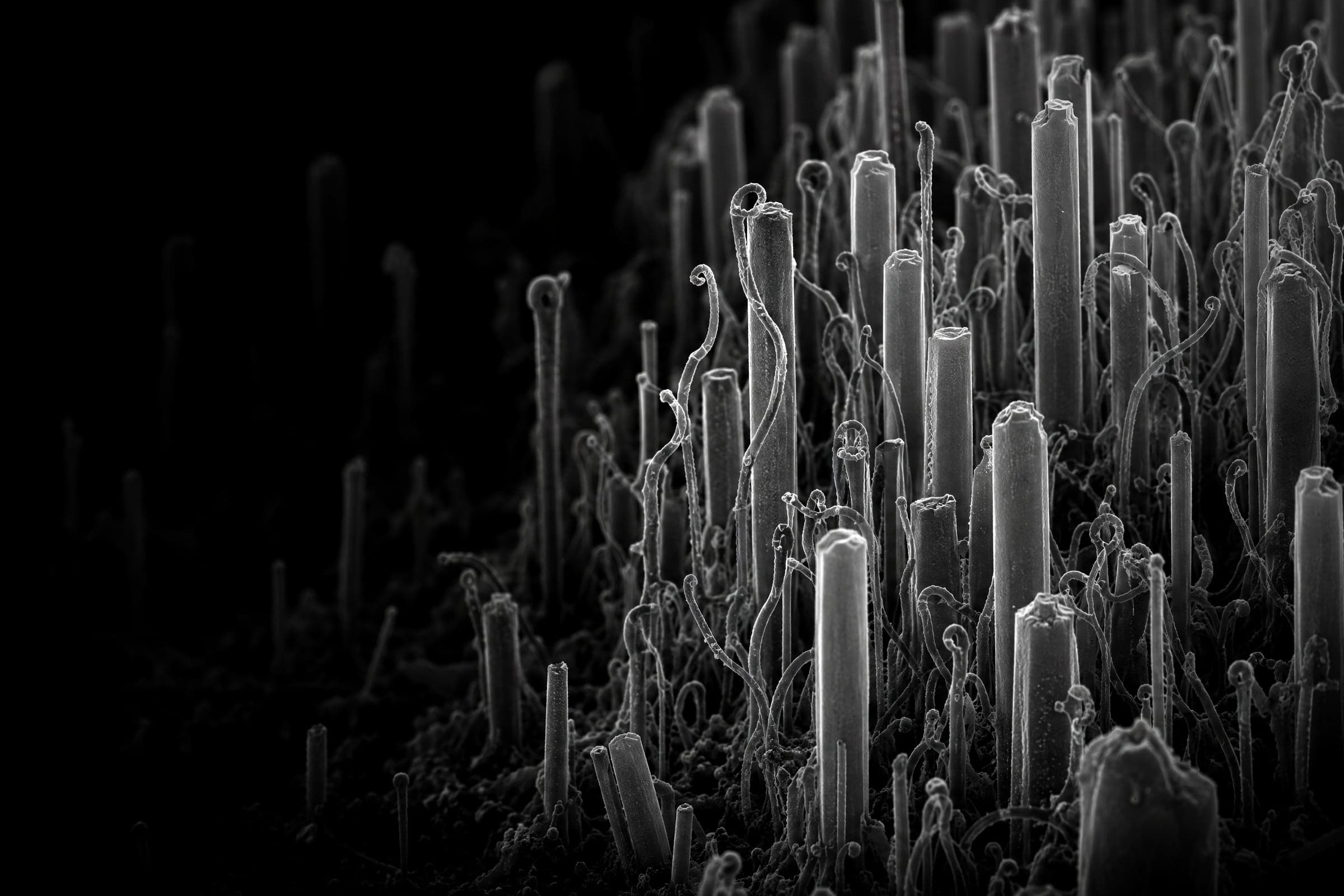
Скоро
Nanotechnology
Работайте там, где размер меняет физику, — и стройте на этом.
Полный курс
- модуля
- 64
- тем
- 714
- минут на урок
- 15
30%
работодателей ожидают, что новые материалы и композиты изменят их бизнес к 2030 году.
Что вы сможете делать.
Предсказывайте, как размер меняет материал
Этап 1 · Nanoscale Physics
Выбирайте частицы, нити, плёнки или поры
Этап 2 · Nanostructures
Синтезируйте и стабилизируйте наночастицы
Этап 3 · Synthesis & Assembly
Формируйте структуры литографией и травлением
Этап 4 · Fabrication & Integration
Интерпретируйте изображения SEM, TEM и AFM
Этап 5 · Characterization & Modeling
Масштабируйте производство и работайте безопасно
Этап 6 · Devices, Manufacturing & Safety
Семь этапов.Один ровный подъём.
Сначала физика — на этом масштабе она меняется. Потом сделайте, измерьте, примените.
в 7 этапах
≈ 11 на модуль
в уроках по 15 минут
до конца всего курса
- 1
Nanoscale Physics
Почему малое ведёт себя иначе
13 модулей · 142 темы · ≈ 36 ч
- 2
Nanostructures
Точки, нити, плёнки и поры
7 модулей · 78 тем · ≈ 20 ч
- 3
Synthesis & Assembly
Выращивание и сборка
9 модулей · 99 тем · ≈ 25 ч
- 4
Fabrication & Integration
Создание рисунков в наномасштабе
4 модуля · 46 тем · ≈ 12 ч
- 5
Characterization & Modeling
Доказательство того, что вы сделали
12 модулей · 138 тем · ≈ 35 ч
- 6
Devices, Manufacturing & Safety
Сенсоры, мембраны, масштабирование, безопасность
15 модулей · 170 тем · ≈ 43 ч
- 7
Practicum & Projects
Конструкция, которая обязана работать
4 модуля · 41 тема · ≈ 10 ч
Месяцы
Часы и месяцы — оценка: один 15-минутный урок на тему, каждый день.
Каждый модуль.Каждая тема.
Названия модулей и тем остаются на английском — на этом языке говорит отрасль.
Этап 1
Nanoscale Physics
Почему малое ведёт себя иначе
13 модулей · 142 темы
1Foundations of Nanotechnology9 тем
- Nanoscience, Nanotechnology, and Nanoengineering
- The Approximate 1-100 Nanometer Range and Its Limits
- Natural, Incidental, and Engineered Nanostructures
- Nano-Objects and Nanostructured Materials
- Top-Down and Bottom-Up Approaches
- Size, Shape, Composition, and Architecture as Design Variables
- Characteristic Length Scales and the Onset of Size Effects
- From Nanoscale Building Blocks to Macroscopic Functions
- Evidence Behind Claims of Nanoscale Performance
2Nanoscale Geometry and Scaling Laws11 тем
- Length, Area, Volume, and Unit Conversions
- Surface-Area-to-Volume Ratios
- Specific Surface Area and Accessible Surface Area
- Characteristic Dimensions of Spheres, Rods, Plates, and Pores
- Aspect Ratio, Curvature, and Geometric Anisotropy
- Scaling of Forces, Energies, and Transport Rates
- Number, Mass, and Volume Concentrations
- Size Distributions and Distribution Moments
- Dimensionless Groups in Nanoscale Problems
- Order-of-Magnitude Estimates and Limiting Cases
- When Continuum Approximations Become Inadequate
3Atomic Structure and Nanoscale Morphology10 тем
- Atomic Bonding and Local Coordination
- Crystalline, Polycrystalline, and Amorphous Nanostructures
- Crystal Facets and Surface Atomic Arrangements
- Shape Anisotropy and Crystallographic Anisotropy
- Defects in Nanocrystals and Atomically Thin Structures
- Grain Boundaries and Internal Interfaces
- Lattice Strain and Structural Relaxation
- Surface Reconstruction and Atomic Termination
- Structural Heterogeneity Within Individual Nano-Objects
- Connecting Atomic Structure to Measured Morphology
4Surface Dominance and Interparticle Forces12 тем
- Surface Energy and Undercoordinated Atoms
- Van der Waals Interactions Between Nano-Objects
- Electrostatic Forces and Charge Screening
- Electrical Double Layers and Debye Length
- Steric Repulsion and Ligand-Mediated Interactions
- Solvation and Hydration Forces
- Hydrophobic Interactions in Nanoscale Assembly
- Capillary Forces and Liquid Bridges
- Adhesion, Contact Geometry, and Surface Roughness
- Depletion Forces in Mixed Dispersions
- Competing Interactions and Effective Pair Potentials
- Distance Dependence of Nanoscale Forces
5Thermodynamics of Small Systems12 тем
- Bulk and Surface Contributions to Free Energy
- Chemical Potential in Curved Nanostructures
- Adsorption Isotherms and Surface Coverage
- Gibbs-Thomson Effects and Size-Dependent Equilibria
- Melting-Point Shifts and Their Material Dependence
- Equilibrium Crystal Shapes and Facet Energies
- Metastable Structures and Kinetic Trapping
- Mixing, Segregation, and Finite-Size Effects
- Capillary Condensation and Confined Phase Behavior
- Entropic Contributions to Nanostructure Organization
- Fluctuations and Statistical Descriptions of Small Systems
- Thermodynamic Stability Versus Practical Shelf Stability
6Brownian Motion, Diffusion, and Fluctuations11 тем
- Thermal Energy and the Meaning of kBT
- Brownian Motion and Random Walks
- Translational and Rotational Diffusion
- Stokes-Einstein Relations and Their Assumptions
- Diffusion Times Across Nanoscale Distances
- Diffusion-Limited Encounters and Capture
- Brownian Motion Versus Sedimentation
- Low-Reynolds-Number Motion
- Peclet Number and Competing Transport Mechanisms
- Thermal Noise in Nanoscale Measurements
- Fluctuation-Dissipation Relations as a Physical Framework
7Colloidal Interactions and Dispersion Stability12 тем
- Dispersed Particles, Aggregates, and Agglomerates
- Electrostatic and Steric Stabilization
- DLVO Theory and Its Assumptions
- Non-DLVO Contributions to Stability
- Zeta Potential and Its Interpretation Limits
- pH, Ionic Strength, and Surface Charge
- Ligand Coverage and Steric Layer Structure
- Diffusion-Limited and Reaction-Limited Aggregation
- Reversible Clustering and Irreversible Association
- Concentration Effects and Crowded Dispersions
- Dispersion Stability in Complex Media
- Sedimentation, Creaming, and Time-Dependent Separation
8Quantum Size Effects and Confinement11 тем
- Wave Behavior and Relevant Quantum Length Scales
- Confinement in One, Two, and Three Spatial Directions
- Quantum Wells, Quantum Wires, and Quantum Dots
- Discrete Energy Levels and Density of States
- Size-Dependent Electronic and Optical Gaps
- Excitons and the Exciton Bohr Radius
- Strong and Weak Confinement Regimes
- Quantum Tunneling and Barrier Thickness
- Charging Energy and Coulomb Blockade
- Thermal Broadening and the Observability of Quantum Effects
- Distinguishing Quantum Confinement from Classical Size Effects
9Nanoscale Charge and Ion Transport12 тем
- Characteristic Transport Lengths and Mean Free Paths
- Diffusive, Ballistic, and Hopping Transport
- Conductance Quantization and Transmission Channels
- Contact Resistance and Interface-Limited Conduction
- Tunneling Across Nanogaps and Ligand Layers
- Charge Transport Through Nanoparticle Networks
- Percolation and Connectivity at Low Material Loading
- Trap States and Disorder-Limited Transport
- Ionic Motion in Confined Geometries
- Surface Charge and Ion Distribution
- Coupled Electronic and Ionic Responses
- Interpreting Conductivity Changes in Nanostructured Systems
10Optical Responses of Nanostructures12 тем
- Absorption, Scattering, and Extinction
- Particle Size Relative to Optical Wavelength
- Rayleigh and Mie Descriptions of Particle Scattering
- Localized Surface Plasmon Resonances
- Shape, Composition, and Dielectric Environment Effects
- Near-Field Enhancement and Hotspots
- Coupled Optical Responses of Neighboring Particles
- Excitonic Absorption and Photoluminescence
- Quantum Yield, Quenching, and Blinking
- Radiative and Nonradiative Relaxation
- Classical Resonances and Quantum-Size Corrections
- Ensemble Spectra and Single-Particle Optical Behavior
11Nanomagnetism10 тем
- Magnetic Domains and Single-Domain Particles
- Magnetic Anisotropy at Small Dimensions
- Superparamagnetism and Thermal Fluctuations
- Blocking Temperature and Measurement Timescale
- Magnetic Hysteresis in Nanoparticle Ensembles
- Neel and Brownian Relaxation
- Dipolar Interactions and Collective Magnetic Behavior
- Surface Spin Disorder and Finite-Size Effects
- Magnetic Response Under Applied Fields
- Connecting Magnetic Measurements to Particle Structure
12Nanomechanics and Nanoscale Friction10 тем
- Mechanical Response of Individual Nano-Objects
- Surface Stress and Size-Dependent Elasticity
- Defect-Limited and Surface-Mediated Deformation
- Bending, Buckling, and Tension in Nanowires
- Mechanics of Atomically Thin Membranes
- Adhesion-Dominated Mechanical Contacts
- Nanoscale Friction and Stick-Slip Motion
- Indentation Depth and Substrate Contributions
- Mechanical Resonance and Size Scaling
- Distinguishing Intrinsic Properties from Measurement Geometry
13Nanoscale Heat Transport10 тем
- Heat Carriers and Thermal Mean Free Paths
- Diffusive and Ballistic Heat Transport
- Boundary Scattering and Size-Dependent Conductivity
- Thermal Boundary Resistance
- Heat Flow Across Nanoparticle Contacts
- Anisotropic Thermal Transport in Low-Dimensional Structures
- Local Heating and Thermal Gradients
- Nonequilibrium Energy Transfer at Small Scales
- Nanoscale Thermometry and Measurement Perturbation
- Heat Dissipation as a Constraint on Nanostructure Performance
Этап 2
Nanostructures
Точки, нити, плёнки и поры
7 модулей · 78 тем
14Nanoparticles and Zero-Dimensional Building Blocks11 тем
- Nanoparticles, Nanocrystals, and Atomic Clusters
- Spherical, Faceted, and Anisotropic Particles
- Solid, Hollow, and Porous Nanoparticles
- Monodisperse and Polydisperse Particle Populations
- Crystalline Core Size and Overall Particle Size
- Metal, Semiconductor, and Dielectric Nanoparticle Families
- Ultrasmall Clusters and Discrete Atomic Structure
- Colloidal Quantum Dots as Confined Building Blocks
- Plasmonic Nanoparticles as Resonant Building Blocks
- Magnetic Nanoparticles as Field-Responsive Building Blocks
- Selecting Particle Architecture for a Target Function
15One-Dimensional Nanostructures10 тем
- Nanowires, Nanorods, Nanotubes, and Nanofibers
- Diameter, Length, and Aspect-Ratio Distributions
- Axial and Radial Structural Variation
- Solid and Hollow One-Dimensional Geometries
- Single-Crystalline and Polycrystalline Nanowires
- Growth Direction and Crystallographic Orientation
- Bending, Alignment, and Entanglement
- Transport Along and Across One-Dimensional Structures
- Junctions and Networks of Elongated Nano-Objects
- Handling and Integration Challenges of High-Aspect-Ratio Structures
16Two-Dimensional Nanosheets and Heterostructures13 тем
- Monolayers, Few-Layer Sheets, and Thickness Definitions
- Layered Crystals and Exfoliated Nanosheets
- Boron Nitride and Transition-Metal Dichalcogenide Nanosheets
- MXenes and Chemically Terminated Two-Dimensional Sheets
- In-Plane and Out-of-Plane Anisotropy
- Edges, Vacancies, and Grain Boundaries
- Wrinkles, Folds, and Substrate-Induced Strain
- Restacking and Loss of Accessible Surface Area
- Van der Waals Stacking and Interlayer Coupling
- Twist Angle and Moire Superstructures
- Lateral and Vertical Heterostructures
- Environmental Sensitivity of Atomically Thin Materials
- Linking Layer Number to Functional Response
17Carbon Nanostructures10 тем
- Fullerenes and Curved Carbon Cages
- Carbon Nanotube Structure and Chirality
- Single-Walled and Multiwalled Nanotubes
- Graphene, Graphene Oxide, and Reduced Graphene Oxide
- Carbon Nanodots and Heterogeneous Emissive Structures
- Nanodiamond and Surface-Terminated Carbon Particles
- Defects, Functional Groups, and Structural Disorder
- Bundling and Aggregation of Carbon Nano-Objects
- Purity, Residual Catalysts, and Attribution of Properties
- Comparing Carbon Nanostructures by Geometry and Function
18Soft and Molecular Nanoassemblies11 тем
- Molecular Building Blocks and Supramolecular Interactions
- Micelles, Vesicles, and Self-Assembled Nanodomains
- Amphiphilicity and Packing Geometry
- Block-Copolymer Nanostructures
- Dendritic and Branched Molecular Architectures
- Soft Nanoparticles and Deformable Interfaces
- Solvent Quality and Assembly Transitions
- Dynamic Exchange of Molecular Components
- Stimulus-Responsive Assembly and Disassembly
- Structural Heterogeneity in Soft Nano-Objects
- Comparing Soft and Rigid Nanostructure Design
19Nanoporous and Hierarchical Architectures12 тем
- Pore Size, Pore Shape, and Pore Connectivity
- Microporous, Mesoporous, and Macroporous Structure
- Accessible and Inaccessible Porosity
- Ordered and Disordered Pore Networks
- Nanoscale Metal-Organic and Covalent Organic Frameworks
- Tortuosity and Transport Path Lengths
- Nanoparticle-Based Gels and Aerogel Architectures
- Nanoscale Features Within Macroscopic Structures
- Hierarchical Organization Across Length Scales
- Internal Surface Area and Adsorption Capacity
- Pore Collapse and Structural Stability
- Matching Pore Architecture to a Functional Requirement
20Hybrid and Multicomponent Nanoarchitectures11 тем
- Core-Shell and Multishell Structures
- Janus Particles and Asymmetric Surface Chemistry
- Alloyed, Segregated, and Gradient Compositions
- Nanoparticle Dimers and Heterostructured Clusters
- Organic-Inorganic Nanoassemblies
- Nanoscale Spacers and Controlled Intercomponent Separation
- Interfacial Strain and Lattice Mismatch
- Coupled Optical, Magnetic, and Chemical Responses
- Component Compatibility and Unintended Interactions
- Spatial Distribution as a Determinant of Function
- Distinguishing Synergy from Simple Additive Performance
Этап 3
Synthesis & Assembly
Выращивание и сборка
9 модулей · 99 тем
21Nucleation and Nanocrystal Growth12 тем
- Supersaturation and the Driving Force for Nucleation
- Homogeneous and Heterogeneous Nucleation
- Critical Nuclei and Nucleation Barriers
- Classical Nucleation Theory and Its Limits
- Burst Nucleation and Continuous Nucleation
- Reaction-Limited and Diffusion-Limited Growth
- Seeded Growth and Secondary Nucleation
- Facet-Selective Growth and Shape Development
- Oriented Attachment and Particle-Mediated Growth
- Ostwald Ripening and Coalescence
- Growth Arrest and Size Distribution Control
- Linking Growth Histories to Final Nanostructures
22Solution-Based Nanomaterial Synthesis12 тем
- Selecting a Solution Route for a Target Nanostructure
- Precursor Reactivity and Monomer Availability
- Reduction, Precipitation, and Decomposition Routes
- Sol-Gel Formation of Nanoscale Networks
- Hydrothermal and Solvothermal Growth Principles
- Seed-Mediated Synthesis of Anisotropic Particles
- Microemulsion and Confined-Reaction Approaches
- Mixing, Heat Transfer, and Reaction Timescales
- Ligands and Solvents as Growth-Control Variables
- Batch and Continuous-Flow Synthesis
- Yield, Selectivity, and Unwanted Byproducts
- Identifying the Variables That Control Reproducibility
23Vapor-Phase and Aerosol Synthesis11 тем
- Vapor Generation and Gas-Phase Nucleation
- Condensation Growth and Particle Coagulation
- Aerosol Reactors and Residence-Time Distributions
- Flame-Based and Plasma-Based Nanoparticle Formation
- Chemical Vapor Routes to Nanostructure Growth
- Vapor-Liquid-Solid and Vapor-Solid Growth Mechanisms
- Catalyst Particles and Nanowire Diameter Control
- Substrate-Mediated Nucleation and Selective Growth
- Gas Transport, Temperature Gradients, and Product Uniformity
- Particle Collection and Preservation of Dispersibility
- Linking Reactor Conditions to Particle Population Dynamics
24Physical Routes to Nanostructure Formation9 тем
- Mechanical Size Reduction and Its Practical Limits
- High-Energy Milling and Defect Generation
- Laser Ablation in Liquids and Gases
- Inert-Gas Condensation and Cluster Formation
- Sputtering-Based Nanoparticle Generation
- Electrical Discharge Routes to Small Particles
- Physical Exfoliation of Layered Solids
- Contamination and Broad Size Distributions
- Comparing Physical and Chemical Production Routes
25Ligands, Passivation, and Surface Functionalization12 тем
- Ligand Binding and Surface Coordination
- Binding Strength, Exchange Kinetics, and Ligand Coverage
- Surface Passivation and Defect Suppression
- Ligand Exchange and Changes in Particle Stability
- Covalent and Noncovalent Functionalization
- Mixed Ligand Layers and Surface Heterogeneity
- Charge, Wettability, and Solvent Compatibility
- Functional Group Accessibility and Orientation
- Linker Length and Interparticle Separation
- Shell Growth as a Passivation Strategy
- Effects of Functionalization on Transport and Optical Response
- Demonstrating Surface Modification with Independent Evidence
26Purification, Separation, and Dispersion Processing12 тем
- Removing Unreacted Precursors and Free Ligands
- Size-Selective Precipitation and Fractionation
- Centrifugation and Sedimentation-Based Separation
- Filtration, Dialysis, and Membrane-Based Cleanup
- Chromatographic and Field-Flow Fractionation Principles
- Redispersion and Solvent Exchange
- Mixing and Deagglomeration Strategies
- Sonication-Induced Heating and Structural Change
- Drying, Redispersion, and Irreversible Aggregation
- Concentrating Dispersions Without Losing Colloidal Stability
- Material Recovery, Losses, and Mass Balance
- Storage Conditions and Dispersion Aging
27Self-Assembly and Supramolecular Organization12 тем
- Self-Assembly as Free-Energy-Driven Organization
- Building Block Shape and Directional Interactions
- Entropy-Driven and Interaction-Driven Ordering
- Nucleation and Growth of Assembled Structures
- Nanoparticle Superlattices and Collective Organization
- Molecular Recognition and Selective Association
- Hierarchical Self-Assembly Across Length Scales
- Equilibrium Structures and Nonequilibrium Assemblies
- Assembly Pathways and Kinetic Traps
- Defects, Grain Boundaries, and Domain Size
- Reversible Assembly and Error Correction
- Connecting Local Interactions to Emergent Structure
28Directed Assembly and Particle Placement10 тем
- External Fields as Tools for Nanoscale Organization
- Electric-Field-Directed Assembly
- Dielectrophoresis and Polarizability-Based Placement
- Magnetic Alignment and Chain Formation
- Flow-Assisted and Shear-Assisted Organization
- Evaporation-Driven and Capillary Assembly
- Patterned Chemical Affinity and Selective Attachment
- Confinement-Guided Ordering
- Registration, Orientation, and Placement Yield
- Field Removal and Retention of Assembled Structure
29Template-Guided Nanostructure Formation9 тем
- Hard and Soft Templates
- Pore Templates for Nanowires and Nanotubes
- Colloidal Templates and Inverse Architectures
- Block-Copolymer Templates for Nanoscale Domains
- Molecular Templates and Structural Specificity
- Template Infiltration and Feature Replication
- Template Removal and Structural Preservation
- Dimensional Fidelity, Shrinkage, and Residues
- Reusable Templates and Replication Limits
Этап 4
Fabrication & Integration
Создание рисунков в наномасштабе
4 модуля · 46 тем
30Nanopatterning and Lithography13 тем
- Pattern Resolution, Feature Pitch, and Placement Accuracy
- Resist-Based Pattern Definition
- Optical Lithography and Nanoscale Resolution Strategies
- Electron-Beam Lithography
- Focused-Ion-Beam Patterning
- Nanoimprint Lithography and Mold Replication
- Soft Lithography and Pattern Transfer Limits
- Scanning-Probe and Dip-Pen Patterning
- Interference Lithography and Periodic Nanostructures
- Directed Self-Assembly as a Patterning Approach
- Proximity Effects and Pattern Distortion
- Line-Edge Roughness and Feature Variability
- Throughput, Area, Cost, and Resolution Tradeoffs
31Thin-Film Deposition and Atomic-Scale Thickness Control12 тем
- Nucleation and Growth of Ultrathin Films
- Island, Layer-by-Layer, and Mixed Growth Modes
- Physical Vapor Deposition of Nanoscale Layers
- Chemical Vapor Deposition and Surface Reaction Control
- Atomic Layer Deposition and Self-Limiting Reactions
- Conformal Coverage of High-Aspect-Ratio Structures
- Epitaxial Growth and Interface Registry
- Solution-Deposited Nanoparticle Films
- Layer-by-Layer Assembly of Functional Films
- Thickness Uniformity, Roughness, and Pinholes
- Interdiffusion and Interface Sharpness
- Selecting Deposition Methods for a Nanoarchitecture
32Etching, Pattern Transfer, and Nanostructure Release11 тем
- Isotropic and Anisotropic Material Removal
- Wet and Dry Etching Principles
- Etch Selectivity and Mask Durability
- Plasma-Surface Interactions and Feature Formation
- Atomic Layer Etching Concepts
- Aspect-Ratio-Dependent Etching and Transport Limits
- Sidewall Profiles and Nanoscale Roughness
- Pattern Transfer Through Multilayer Structures
- Sacrificial Layers and Freestanding Nanostructures
- Capillary Collapse and Stiction During Release
- Surface Damage, Residues, and Post-Process Verification
33Nanostructure Integration and Contact Formation10 тем
- Transferring Nano-Objects Between Substrates
- Dry and Wet Transfer Approaches
- Placement Accuracy and Orientation Control
- Substrate Compatibility and Thermal Budgets
- Adhesion and Interfacial Contamination
- Electrical Contacts to Individual Nanostructures
- Contact Barriers and Contact-Induced Artifacts
- Interconnection of Nanoparticle and Nanowire Networks
- Encapsulation and Environmental Isolation
- Preserving Nanoscale Properties During System Integration
Этап 5
Characterization & Modeling
Доказательство того, что вы сделали
12 модулей · 138 тем
34Nanometrology and Measurement Strategy12 тем
- Defining the Measurand Before Selecting an Instrument
- Resolution, Sensitivity, Accuracy, and Precision
- Calibration and Metrological Traceability
- Reference Materials and Instrument Verification
- Sampling Representativeness and Population Heterogeneity
- Local Measurements and Ensemble Measurements
- Number-Weighted, Volume-Weighted, and Intensity-Weighted Results
- Measurement Uncertainty and Error Propagation
- Detection Limits and Quantification Limits
- Orthogonal Methods and Cross-Validation
- Comparing Results Obtained in Different Physical States
- Designing a Characterization Plan Around a Scientific Question
35Sample Preparation and Measurement Artifacts11 тем
- Representative Sampling from Powders and Dispersions
- Dilution-Induced Changes in Colloidal State
- Drying Artifacts and Coffee-Ring Deposition
- Adsorption to Supports and Selective Particle Loss
- Surface Contamination During Sample Handling
- Oxidation and Environmental Exposure During Preparation
- Sectioning, Thinning, and Preparation-Induced Damage
- Cryogenic Preservation and Its Interpretation Limits
- Beam, Tip, and Laser Effects on the Specimen
- Blank Samples, Substrate Controls, and Background Signals
- Distinguishing Preparation Artifacts from Native Structure
36Electron Microscopy and Electron Microanalysis13 тем
- Electron-Sample Interactions and Contrast Formation
- Scanning Electron Microscopy of Nanostructured Surfaces
- Transmission Electron Microscopy of Individual Nano-Objects
- High-Resolution Imaging and Lattice Information
- Scanning Transmission Electron Microscopy
- Electron Diffraction and Crystal Orientation
- Energy-Dispersive X-Ray Analysis
- Electron Energy-Loss Spectroscopy
- Elemental Maps and Spatial Resolution Limits
- Electron Tomography and Three-Dimensional Reconstruction
- Projection Effects and Hidden Structural Complexity
- Electron Dose and Beam-Induced Transformations
- Interpreting Images Without Overstating Chemical or Structural Evidence
37Scanning Probe Microscopy12 тем
- Probe-Sample Interactions and Image Formation
- Atomic Force Microscopy Operating Modes
- Height, Phase, and Force Signals
- Tip Geometry and Lateral Size Convolution
- Force-Distance Curves and Adhesion Measurements
- Scanning Tunneling Microscopy and Electronic Contrast
- Conductive Atomic Force Microscopy
- Kelvin Probe Force Microscopy
- Magnetic and Electrostatic Force Microscopy
- Calibration of Displacement, Force, and Tip Response
- Drift, Feedback Artifacts, and Scan-Dependent Features
- Measurements in Air, Vacuum, and Liquid Environments
38Scattering, Diffraction, and Structural Inference12 тем
- Reciprocal Space and Length-Scale Information
- X-Ray Diffraction from Nanocrystalline Materials
- Crystallite Size and Particle Size as Different Quantities
- Peak Broadening from Size, Strain, and Instrument Response
- Small-Angle X-Ray Scattering
- Small-Angle Neutron Scattering and Contrast Variation
- Form Factors and Structure Factors
- Grazing-Incidence Measurements of Thin Nanostructured Layers
- Pair Distribution Functions and Local Atomic Order
- Polydispersity and Model-Dependent Structural Fits
- Ordered Assemblies and Correlation Lengths
- Combining Scattering with Direct Imaging
39Particle Sizing and Concentration Measurements12 тем
- Geometric, Hydrodynamic, and Aerodynamic Diameters
- Dynamic Light Scattering and Correlation Functions
- Intensity Weighting and Sensitivity to Large Particles
- Polydispersity Metrics and Multimodal Distributions
- Nanoparticle Tracking Analysis
- Mobility-Based Sizing of Aerosol Particles
- Resistive Pulse Sensing of Individual Particles
- Single-Particle Elemental Detection
- Particle Number Concentration and Counting Efficiency
- Dilution, Coincidence, and Detection Bias
- Converting Between Size Distribution Representations
- Reconciling Differences Between Sizing Methods
40Chemical and Surface Characterization11 тем
- X-Ray Photoelectron Spectroscopy and Surface Composition
- Chemical States and Binding-Energy Interpretation
- Auger and Secondary-Ion Methods for Local Chemical Information
- Infrared Spectroscopy of Bound Surface Groups
- Raman Signatures of Structure, Defects, and Strain
- Magnetic Resonance Evidence for Ligands and Molecular Environments
- Thermogravimetric Analysis of Organic Content
- Elemental Composition and Trace Impurities
- Gas Adsorption and Specific Surface Area
- Pore Size Analysis and Model Assumptions
- Distinguishing Surface Chemistry from Bulk Composition
41Functional and In Situ Characterization12 тем
- Optical Spectroscopy of Nanostructure Ensembles
- Single-Particle Spectroscopy and Heterogeneity
- Time-Resolved Luminescence and Relaxation Dynamics
- Electrical Transport Measurements and Contact Controls
- Magnetic Measurements and Relaxation Behavior
- Mechanical Measurements of Individual Nano-Objects
- Thermal Measurements at Small Length Scales
- Electrokinetic Measurements in Defined Media
- In Situ Observation of Growth and Transformation
- Operando Measurements Under Functional Conditions
- Correlative Measurements on the Same Nanostructure
- Matching Measurement Conditions to Intended Use
42Image Analysis and Quantitative Nanostructure Data10 тем
- Image Calibration and Scale Verification
- Particle Segmentation and Boundary Definitions
- Equivalent Diameter, Feret Diameter, and Shape Descriptors
- Overlapping Particles and Counting Ambiguity
- Sampling Enough Fields and Independent Specimens
- Size Distributions, Outliers, and Confidence Intervals
- Spatial Correlation and Particle Organization
- Quantifying Orientation and Alignment
- Reproducible Image Processing and Parameter Reporting
- Detecting Bias Introduced by Manual and Automated Analysis
43Atomistic and Electronic-Structure Modeling12 тем
- Selecting a Model for a Nanoscale Question
- Electronic-Structure Methods and Total-Energy Calculations
- Density Functional Theory and Its Approximation Limits
- Surface Energies, Adsorption, and Charge Distribution
- Interatomic Potentials and Force-Field Validity
- Molecular Dynamics of Nanostructures
- Finite Simulation Cells and Boundary Conditions
- Equilibration, Sampling, and Accessible Timescales
- Defects, Ligands, and Realistic Surface Environments
- Comparing Calculated Observables with Experimental Measurements
- Sensitivity to Model Parameters and Assumptions
- Distinguishing Computed Trends from Validated Predictions
44Mesoscale and Multiscale Modeling10 тем
- Coarse-Grained Representations of Nanoassemblies
- Brownian Dynamics of Particle Dispersions
- Kinetic Monte Carlo and Activated Processes
- Population Balance Models for Growth and Aggregation
- Continuum Transport Models and Nanoscale Boundary Conditions
- Coupled Electrostatic, Fluidic, and Thermal Models
- Bridging Atomic, Particle, and Device Scales
- Parameter Transfer Between Modeling Levels
- Uncertainty, Identifiability, and Model Calibration
- Choosing the Simplest Model That Resolves the Design Question
45Experimental Design and Structure-Property Evidence11 тем
- Formulating Testable Nanoscale Hypotheses
- Separating Size, Shape, Composition, and Surface Effects
- Matched Controls and Non-Nanoscale Comparators
- Independent Synthesis Batches as Experimental Replicates
- Randomization and Blinded Measurement
- Factorial Designs and Interacting Process Variables
- Normalizing Performance by Mass, Area, or Particle Number
- Identifying Hidden Variables and Confounding Impurities
- Reproducibility Within and Between Laboratories
- Reporting Negative Results and Unsuccessful Replication
- Establishing Mechanistic Support for a Performance Claim
Этап 6
Devices, Manufacturing & Safety
Сенсоры, мембраны, масштабирование, безопасность
15 модулей · 170 тем
46Nanosensors and Molecular Detection12 тем
- Nanoscale Transduction Mechanisms
- Surface Binding and Signal Generation
- Electrical, Optical, Magnetic, and Mechanical Readouts
- Nanoparticle Labels and Signal Amplification
- Functionalization for Selectivity
- Nonspecific Adsorption and Interference
- Signal-to-Noise Ratio and Detection Limits
- Sensitivity, Dynamic Range, and Calibration
- Transport-Limited Response and Recovery Time
- Matrix Effects in Real Samples
- Drift, Fouling, and Reusability
- Comparing Nanosensor Performance with Established Methods
47Nanofluidics and Confined Transport12 тем
- Fluid Confinement and Relevant Length Scales
- Nanofluidic Channels and Nanoslit Geometries
- Surface Charge and Electrical Double-Layer Overlap
- Electroosmotic and Pressure-Driven Flow
- Ion Selectivity and Concentration Polarization
- Ionic Current Rectification
- Slip, Wetting, and Interfacial Friction
- Molecular Confinement and Altered Transport
- Entrance Effects and Access Resistance
- Coupled Transport of Solvent, Ions, and Molecules
- Continuum Predictions and Molecular-Scale Deviations
- Measuring Flow and Transport in Confined Systems
48Nanopores, Membranes, and Selective Separations11 тем
- Single Nanopores and Porous Membrane Ensembles
- Pore Geometry and Molecular Passage
- Steric, Charge-Based, and Affinity-Based Selectivity
- Transport Through Atomically Thin Membranes
- Track-Etched, Templated, and Assembled Pore Structures
- Permeability, Selectivity, and Resistance Tradeoffs
- Defect Pathways and Unintended Leakage
- Fouling, Concentration Polarization, and Surface Changes
- Nanopore Signals and Molecular Translocation Events
- Distinguishing Adsorption from Sustained Separation
- Performance Validation Under Realistic Feed Conditions
49Nanocatalysis and Reactive Nanointerfaces12 тем
- Accessible Active Sites and Catalytic Surface Area
- Particle Size, Facets, and Site Distribution
- Support Effects and Metal-Support Interfaces
- Adsorption Strength and Reaction Selectivity
- Confinement Effects in Nanoporous Catalysts
- Single-Atom Sites and Cluster-Based Catalysis
- Bimetallic Nanostructures and Cooperative Effects
- Mass Transfer and Apparent Catalytic Performance
- Turnover Metrics and Active-Site Normalization
- Sintering, Poisoning, Leaching, and Deactivation
- Operando Evidence of the Active Catalyst State
- Separating Nanoscale Mechanisms from Surface-Area Effects
50Nanoelectromechanical Systems11 тем
- Nanoscale Beams, Cantilevers, and Membranes
- Resonance Frequency and Effective Mass
- Quality Factor and Energy Dissipation
- Electrostatic, Piezoelectric, and Thermal Actuation
- Optical and Electrical Motion Readout
- Mass, Force, and Displacement Sensing
- Thermal Motion and Fundamental Noise
- Pull-In Instability and Nonlinear Response
- Surface Adsorption and Resonance Drift
- Stiction, Wear, and Mechanical Failure
- Connecting Nanoscale Motion to Usable System Outputs
51Molecular Machines, Active Nano-Objects, and Manipulation11 тем
- Molecular Switches, Rotors, and Motors
- Energy Input and Directional Molecular Motion
- Active Particles and Nonequilibrium Behavior
- Propulsion and Transport at Low Reynolds Number
- Brownian Motion Versus Directed Motion
- Chemical Gradients and Phoretic Motion
- Optical and Magnetic Manipulation of Nano-Objects
- Scanning-Probe Manipulation of Atoms and Molecules
- Collective Behavior in Driven Particle Systems
- Tracking Motion Near Spatial and Temporal Resolution Limits
- Evidence Standards for Claims of Autonomous Nanomachines
52Nano-Optical and Photonic Structures11 тем
- Subwavelength Resonators and Optical Antenna Concepts
- Engineered Plasmonic Gaps and Hotspot Geometries
- Dielectric Nanostructures and Resonant Scattering
- Metasurfaces Built from Nanostructured Elements
- Structural Color and Spectral Selectivity
- Surface-Enhanced Raman Scattering
- Photothermal Conversion and Local Heating
- Coupling Emitters to Nanostructured Environments
- Optical Losses and Performance Tradeoffs
- Fabrication Variability and Spectral Reproducibility
- Distinguishing Local Enhancement from System-Level Performance
53Nano-Bio Interfaces and Bioinspired Nanostructures12 тем
- Biological Molecules as Nanoscale Building Blocks
- Biomolecular Recognition and Selective Nanoassembly
- DNA Origami as Programmable Nanoscale Organization
- Protein-Based Templates and Ordered Nanostructures
- Biomimetic Pores and Membrane-Inspired Architectures
- Adsorption of Biomolecules onto Nanoparticles
- Protein Corona Formation and Dynamic Exchange
- Particle Identity in Biological Fluids
- Size, Shape, and Surface Effects on Biological Interactions
- Cellular Association, Uptake, and Localization as Different Observations
- Nanomaterial Interference with Biological Assays
- Limits of Transferring Simplified Interface Results to Living Systems
54Nanomanufacturing and Scale-Up12 тем
- Defining the Product and Required Nanoscale Attributes
- Laboratory Yield and Manufacturing Productivity
- Scale-Up, Numbering-Up, and Continuous Processing
- Mixing and Heat-Transfer Changes with Production Scale
- Residence Time and Particle Population Uniformity
- Precursor Utilization and Material Efficiency
- Purification Bottlenecks and Product Recovery
- Dry Powder, Dispersion, and Supported Product Formats
- Preserving Surface Chemistry During Production
- High-Throughput Patterning and Large-Area Uniformity
- Integrating Characterization into Process Development
- Evaluating Performance, Cost, and Production Consistency Together
55Process Control and Batch Consistency11 тем
- Critical Quality Attributes of Nanomaterial Products
- Critical Process Parameters and Their Interactions
- Size and Shape Distribution Acceptance Criteria
- Surface Coverage, Composition, and Impurity Specifications
- In-Process Measurements and Sampling Plans
- Batch Variation and Within-Batch Heterogeneity
- Process Drift and Early Warning Signals
- Traceability from Precursors to Finished Nanomaterials
- Reference Batches and Retained Samples
- Changes in Suppliers, Equipment, and Scale
- Demonstrating Consistency Beyond a Single Successful Sample
56Stability, Aging, and Nanostructure Failure11 тем
- Aggregation and Loss of Dispersibility During Storage
- Ligand Desorption and Surface Chemical Change
- Oxidation, Sulfidation, and Other Environmental Transformations
- Dissolution and Changes in Particle Size
- Ostwald Ripening and Sintering Under Use Conditions
- Shell Failure and Interfacial Degradation
- Structural Reconstruction During Functional Operation
- Photobleaching and Loss of Optical Response
- Mechanical Damage to Delicate Nanoarchitectures
- Accelerated Aging and Its Extrapolation Limits
- Defining End of Life by Functional Performance
57Nanomaterial Exposure and Risk Fundamentals11 тем
- Hazard, Exposure, Dose, and Risk
- Material-Specific Rather Than Size-Only Risk Assessment
- Inhalation, Ingestion, and Dermal Exposure Pathways
- Mass, Number, and Surface-Area Dose Metrics
- Particle Shape, Persistence, and Dissolution
- Free Nanoparticles and Matrix-Bound Nano-Objects
- Exposure During Production, Transfer, Use, and Disposal
- Background Aerosols and Attribution of Measured Exposure
- Biological Responses and Their Experimental Context
- Uncertainty in Translating Laboratory Hazard Evidence
- Integrating Exposure Information with Material Characterization
58Safe Handling and Exposure Controls11 тем
- Task-Based Assessment of Nanomaterial Handling
- Hierarchy of Controls for Nanomaterial Work
- Substitution and Safer Product Forms
- Enclosed Processes and Local Exhaust Ventilation
- Handling Powders and Dispersions as Different Exposure Scenarios
- Containment During Transfer, Cleaning, and Maintenance
- Selection and Limitations of Protective Equipment
- Exposure Monitoring and Verification of Control Performance
- Labeling, Documentation, and Worker Training
- Spill and Waste Procedures Within Institutional Safety Systems
- Reviewing Controls When Materials or Processes Change
59Environmental Fate and Sustainable Nanotechnology12 тем
- Release Pathways Across the Product Life Cycle
- Aggregation, Sedimentation, and Environmental Transport
- Dissolution and Transformation in Environmental Media
- Interactions with Natural Organic Matter
- Distinguishing Particle Effects from Dissolved Species Effects
- Persistence and Bioavailability in Relevant Environments
- Release from Embedded Nanostructures During Wear
- Measuring Nanomaterials Against Complex Environmental Backgrounds
- Functional Units for Comparing Nano-Enabled Products
- Energy, Solvent, and Resource Demands of Nanoscale Production
- Recovery, Reuse, and End-of-Life Release Considerations
- Safer and More Sustainable Design Under Uncertainty
60Standards, Reporting, and Technology Translation10 тем
- Nanotechnology Terminology and Operational Definitions
- Material Identity and Minimum Characterization Information
- Reference Methods and Interlaboratory Comparisons
- Reporting Measurement Conditions and Data Provenance
- Product Specifications and Independent Performance Verification
- Matching Evidence Requirements to Intended Applications
- Technology Readiness and Scale-Relevant Demonstration
- Cost Drivers and Value Relative to Existing Solutions
- Communicating Benefits, Limitations, and Uncertainty
- Responsible Claims About Nano-Enabled Products
Этап 7
Practicum & Projects
Конструкция, которая обязана работать
4 модуля · 41 тема
61Nanoscale Physics and Design Practicum10 тем
- Estimating Surface Area and Particle Number from Material Quantity
- Comparing Diffusion, Sedimentation, and Flow Timescales
- Assessing the Importance of Thermal Fluctuations
- Selecting Characteristic Length Scales for a Size-Effect Problem
- Predicting Qualitative Trends in Quantum Confinement
- Comparing Colloidal Interaction Scenarios
- Interpreting Nanoparticle Growth and Ripening Curves
- Estimating Ligand Coverage from Independent Measurements
- Relating Nanoarchitecture to a Target Functional Response
- Testing a Scaling Argument Against Experimental Evidence
62Characterization and Evidence Practicum11 тем
- Building a Characterization Plan for an Unknown Nanomaterial
- Reconciling Electron Microscopy and Dynamic Light Scattering Results
- Comparing Number-Weighted and Intensity-Weighted Distributions
- Identifying Drying, Beam, and Tip Artifacts
- Distinguishing Crystallite Size from Particle Size
- Evaluating Evidence for Core-Shell Structure
- Assessing Surface Functionalization from Multiple Measurements
- Interpreting Aggregation in Complex Media
- Quantifying Uncertainty in Image-Based Particle Measurements
- Evaluating a Claimed Structure-Property Relationship
- Writing a Reproducible Nanomaterial Characterization Report
63Process and Scale-Up Case Studies9 тем
- Comparing Candidate Routes to a Target Nanoparticle Geometry
- Diagnosing Batch-to-Batch Changes in Size Distribution
- Identifying Mixing and Heat-Transfer Limitations
- Evaluating Purification Losses and Residual Impurities
- Preserving Dispersion Stability During Concentration and Storage
- Selecting a Patterning Route for a Required Area and Resolution
- Diagnosing Nanostructure Damage During Transfer and Integration
- Comparing Functional Performance Before and After Scale-Up
- Building a Process Improvement Proposal with Measurable Criteria
64Integrated Nanotechnology Design Project11 тем
- Defining a Functional Need and a Measurable Target
- Justifying the Use of a Nanoscale Approach
- Selecting Building Blocks, Geometry, and Surface Chemistry
- Choosing Synthesis, Assembly, or Fabrication Routes
- Estimating Relevant Physical Effects and Design Constraints
- Planning Characterization and Independent Validation
- Specifying Controls, Comparators, and Replication
- Evaluating Stability and Performance Under Use Conditions
- Assessing Scale-Up, Exposure, and Environmental Considerations
- Comparing the Proposed Design with Established Alternatives
- Presenting Evidence, Tradeoffs, Uncertainty, and Next Experiments
Пятнадцать минут.Каждый день.
- 1
Урок влезает в обеденный перерыв
По одной мысли за раз, на коротких слайдах. Весь урок — около пятнадцати минут.
- 2
Практика с мгновенной обратной связью
Вопросы — внутри урока. Отвечаете и сразу видите, получилось ли.
- 3
Стрик, который возвращает вас снова
Урок в день держит стрик. Короткие регулярные занятия доводят до конца курса.

- 1
Урок влезает в обеденный перерыв
По одной мысли за раз, на коротких слайдах. Весь урок — около пятнадцати минут.
- 2
Практика с мгновенной обратной связью
Вопросы — внутри урока. Отвечаете и сразу видите, получилось ли.
- 3
Стрик, который возвращает вас снова
Урок в день держит стрик. Короткие регулярные занятия доводят до конца курса.
Для тех, кто работает в малом масштабе.
Химики, которых тянет к наноматериалам
Где вы вырастете сильнее всего
Синтезируйте и стабилизируйте наночастицы
Этап 3 · Synthesis & AssemblyСтуденты-материаловеды, выбирающие специализацию
Инженеры тонких плёнок и покрытий
Где вы вырастете сильнее всего
Формируйте структуры литографией и травлением
Этап 4 · Fabrication & Integration
Куда ведёт этот курс.
Работа, вокруг которой построен курс, и как в неё попадают.
Nanomaterials Research Technician
Создаёт и измеряет материалы на наноуровне в исследовательской лаборатории.
Все карьеры будущегоВ работе
- Синтезировать наноматериалы по рецептуре
- Исследовать их микроскопией и спектроскопией
- Вести точные записи для исследовательской команды
Как туда попадают
На роли техника обычно ждут диплом по химии, физике или материаловедению.

Будьте первыми в очереди.
Ранний доступ — для частных лиц, пилот — для команд. Расскажите, кто у вас учится.
enterprise@astratrainer.com