Search for obsidian meaning and the same short list comes back everywhere: protection, grounding, shadow work. That list is real in the sense that practitioners use it, and it is also about a hundred years old. The older story is stranger, better documented, and it begins with the fact that obsidian is not a stone at all.
Most stones in the modern crystal literature acquired their meanings by association. Obsidian is one of the few whose reputation can be traced to something it physically did.
Affiliate link: if you buy through it, Astra Trainer may earn a commission. The price is the same for you.
Photographs courtesy of Aven Atelier.
It is glass, and everything follows from that
Obsidian is not a mineral. Minerals have an ordered internal structure, atoms arranged in a repeating lattice. Obsidian has none. It is volcanic glass, formed when lava rich in silica cools so quickly that the atoms never organise themselves.
That single fact explains nearly everything else about it.
Because there is no lattice, there are no planes along which it prefers to break. It fractures conchoidally instead, in smooth curved surfaces like a struck sheet of glass, and those surfaces meet at an edge. And because there is no crystal structure to interrupt the surface, it polishes to a genuine reflection rather than a shine.
A stone that cuts and a stone that reflects. Both properties come from the same absence.
Where the name comes from
Obsidian is named after a person, and probably after a printing mistake.
Pliny the Elder records a dark stone found in Ethiopia by a Roman called Obsius. The Latin is Obsianus lapis, the stone of Obsius. Later manuscripts and early printed editions carry Obsidianus, with an extra letter that appears to have entered as a copying or printing error, and that is the form English inherited toward the end of the fourteenth century.
So the standard name of the stone preserves a slip of the pen about a man we know almost nothing else about. It is a small thing, and it sets the pattern for everything that follows: what gets repeated about this material is not always what was originally written.
The edge
The fracture edge is extraordinarily fine. An obsidian blade edge has been measured at around three nanometres, which is considerably finer than a surgical steel scalpel. Under magnification a steel edge looks serrated, almost like a saw. An obsidian edge stays smooth at the same magnification.
This is worth stating carefully. Obsidian blades have been made and studied for specialist surgical use, and they are not approved by the United States Food and Drug Administration for standard human surgery, largely because glass is brittle and an edge that fine is fragile. The sharpness is real. The clinical use is limited and specific, and nothing about it says anything at all about wearing the stone.
What matters historically is that for most of human history this was the sharpest available material. Obsidian was worked into blades and points across the Americas, the Mediterranean and the Near East, and it was traded over long distances by people who had no metal. A stone that outperformed everything else in the toolkit accumulated status for entirely practical reasons before it accumulated any other kind.
A stone that cuts and a stone that reflects. Both come from the same absence of structure.
The same property, worked small
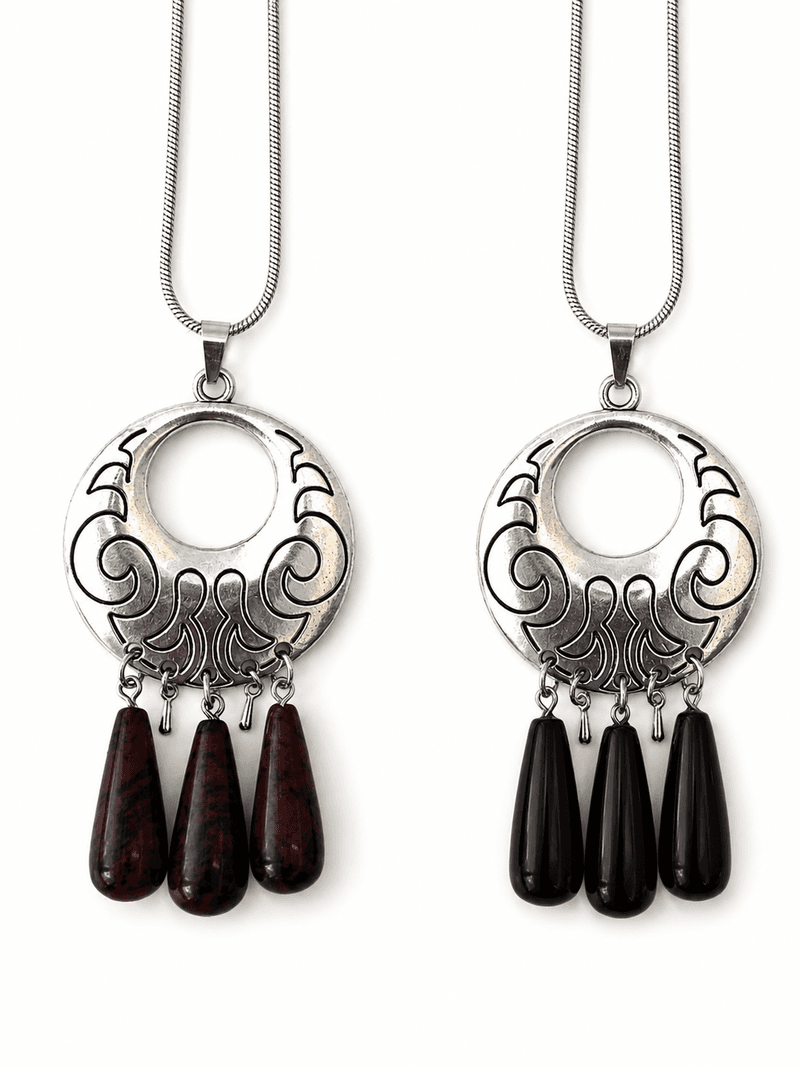
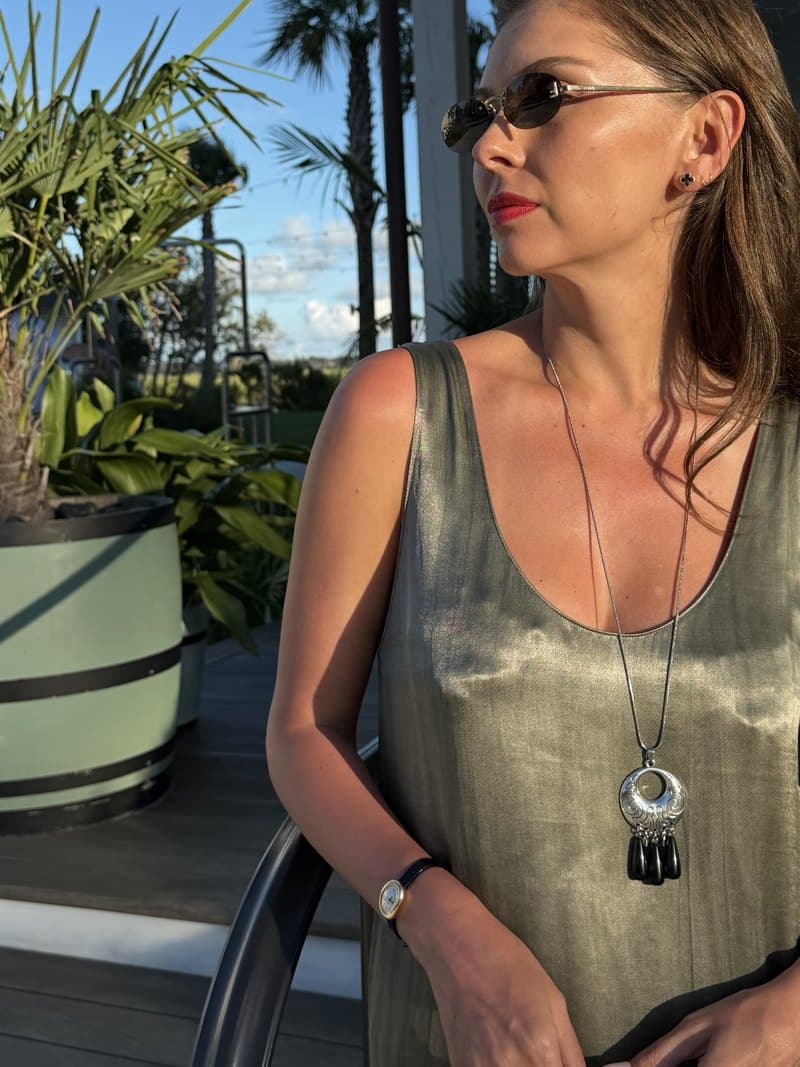
Aven Atelier's Three Teardrops Pendant Necklace hangs three polished obsidian drops from a cast filigree disc on a snake chain. The brand also makes it in a dark red stone called Golden Swan, and photographs the two together, which is a quick way to see what the glass is doing.
Affiliate link: if you buy through it, Astra Trainer may earn a commission. The price is the same for you.
Three obsidian teardrops on a cast disc, 29.5 inch snake chain. $135 at the time of writing.
Photographs courtesy of Aven Atelier.
Mirrors, three thousand years before metal ones
Here is the part that most crystal books omit, and it is the most interesting thing about the stone.
The oldest known mirrors in the world are obsidian. They come from Neolithic Anatolia, in what is now Turkey, and the examples from Çatalhöyük date to roughly 6000 BCE. They are small, around four by six centimetres, slightly convex, and polished well enough to return a sharp image.
Fifty-six of them have been recorded across six Anatolian sites occupied between the eighth and fifth millennia BCE. No comparable mirrors are known from anywhere else in that period, which suggests the technique was a local invention rather than something widely shared.
Two details are worth sitting with. These predate metal mirrors by thousands of years, so for a very long stretch of human experience, obsidian was the only way to see your own face clearly. And at Çatalhöyük a number of them were found in graves, often women's graves, which places them among the objects people chose to be buried with rather than among ordinary tools.
Whatever anyone later decided obsidian means, this is the ground it grew from. Not a symbolic association with reflection. Actual reflection, in the hands of people who had nothing else that did it.
The stone as an object you hold
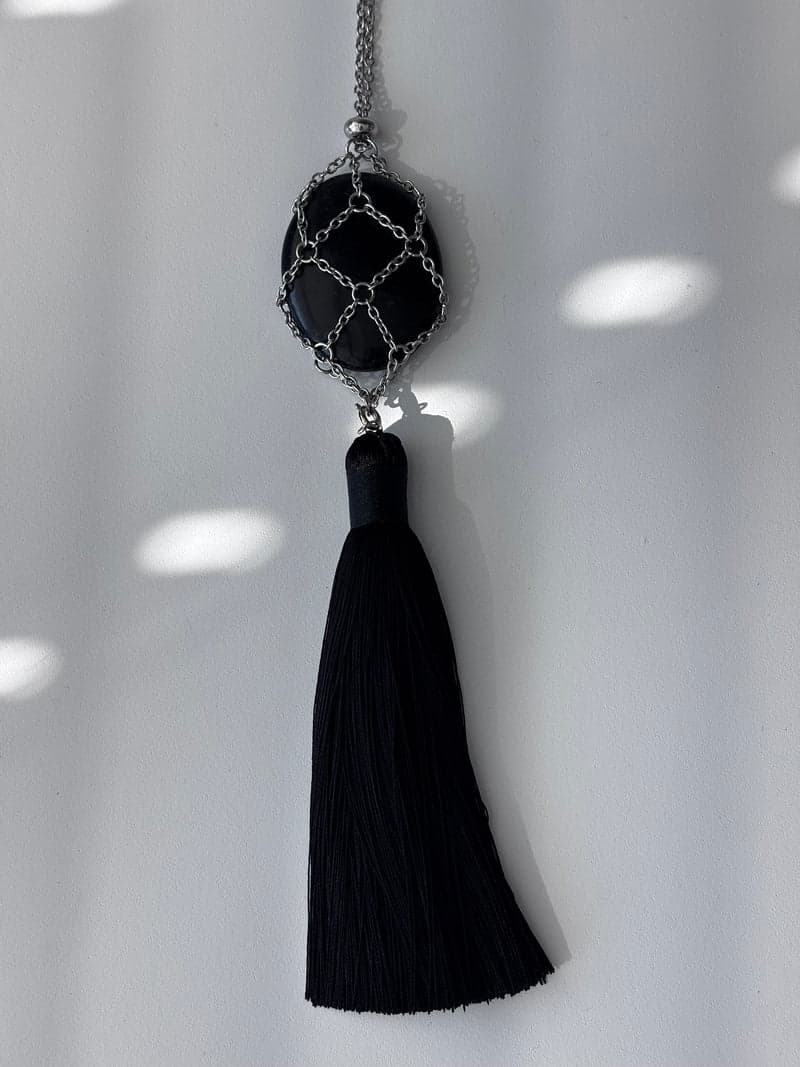
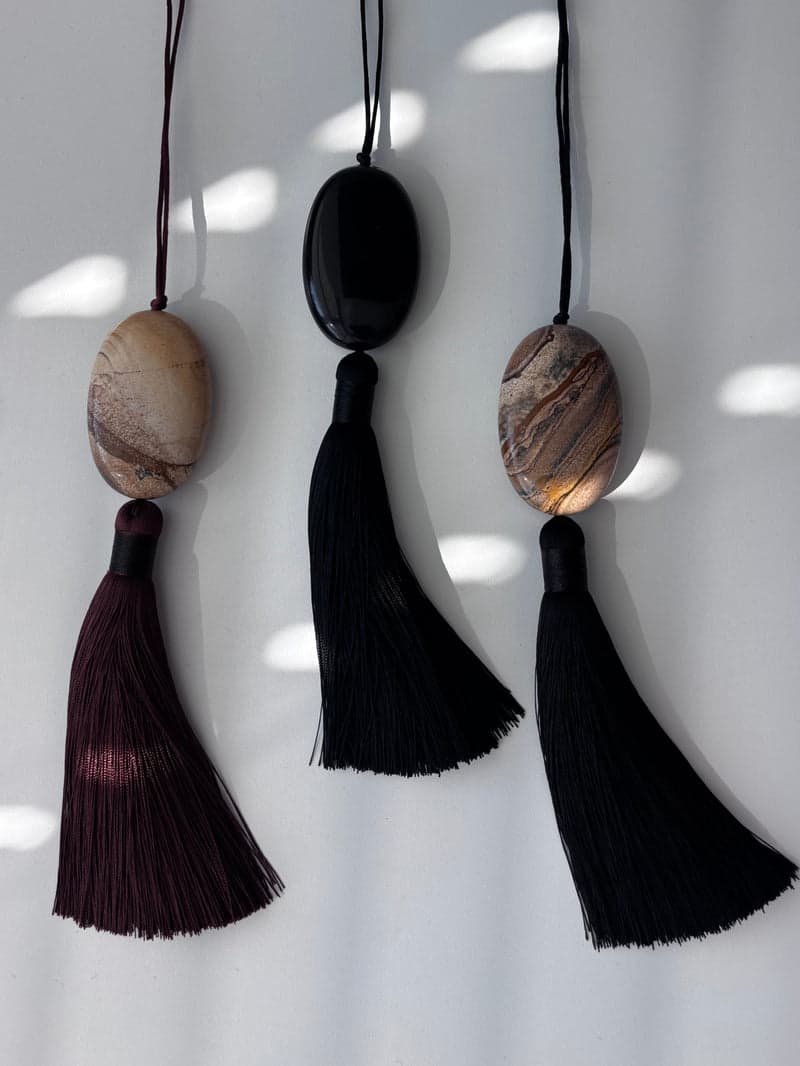
Aven Atelier's Mesh Net Long Tassel Necklace suspends a single obsidian oval in a chain-mesh cage above a tassel. The stone, the mesh and the tassel all detach, so the piece is designed to be worn three ways, which is why the obsidian reads as something set rather than something mounted.

Affiliate link: if you buy through it, Astra Trainer may earn a commission. The price is the same for you.
Ornament about 7.5 inches including mesh and tassel, on a 26 or 31.5 inch chain. Offered in obsidian and six other stones. $200 at the time of writing.
Photographs courtesy of Aven Atelier.
The smoking mirror
In Mesoamerica the same physical property produced a different and much more elaborate tradition.
Obsidian was central to Aztec material culture, as blades, as sacrificial implements, and as polished mirrors. The god Tezcatlipoca, whose name is usually translated as Smoking Mirror, is associated with obsidian mirrors, and depictions show a mirror in place of one foot or at the temple.
Mirrors in this context were not decorative. They were instruments, associated with rulership, with divination and with seeing what is otherwise hidden. The dark surface returns an image that is present but dimmed, which is a genuinely different visual experience from a bright reflection, and it is easy to see how a surface that shows you yourself darkly attracted the meanings it attracted.
Much of the obsidian involved came from specific and well-known sources. The deposits near Pachuca, north of modern Mexico City, were exploited heavily, and Pachuca obsidian has a distinctive green-gold tint that makes it traceable.
Check yourselfBefore you read on: John Dee, Elizabeth I's astrologer, scried with a black obsidian mirror whose origin was assumed rather than known for centuries. Beyond its colour, what could researchers measure today to say where a piece of obsidian was formed?Show the answerHide the answer
Its chemistry. Each obsidian flow has a distinct geochemical fingerprint, which is why sourcing obsidian is a standard archaeological method. In 2021 researchers measured Dee's mirror and three other museum objects with X-ray fluorescence and compared the results against known sources. All four were Mexican, and Dee's mirror matched Pachuca. That settled where the glass came from. How the mirror reached England is still unknown.
How an Aztec mirror reached an Elizabethan magician
John Dee was Elizabeth I's astrologer and one of the most documented occult figures in English history. Among his instruments was a black obsidian mirror, now in the British Museum, which he used for scrying.
For centuries its origin was assumed rather than known. In 2021 a study published in Antiquity settled it. Researchers used X-ray fluorescence to measure the geochemical composition of four obsidian objects in the museum's collection, including Dee's mirror, and compared the results against known obsidian sources. All four were Mexican. Dee's mirror, and another of similar design, matched the Pachuca source.
So the object an Elizabethan magician used to contact spirits was made by Aztec craftsmen from Mexican volcanic glass, and had crossed the Atlantic in the wake of the Spanish conquest before ending up in the hands of a man in England who had no idea what he was holding.
How it actually reached him is still unknown. That gap is not a flaw in the story. It is the story: an object carrying one tradition's meaning was picked up and given another, and the second owner was entirely unaware of the first.
Not a health or safety instrument. No stone treats any illness, and there is no evidence that obsidian or any other mineral has therapeutic effects on physical or mental health conditions. Nothing here is medical or psychological advice, and no stone should be used in place of medical care. Practically: obsidian is glass, it chips, and a fresh chip is genuinely sharp. Handle broken pieces as you would broken glass, and keep them away from small children.

Affiliate link: if you buy through it, Astra Trainer may earn a commission. The price is the same for you.
Photographs courtesy of Aven Atelier.
What the tradition says, and what the lists say
The obsidian meaning given in modern crystal books is generally protection, grounding and what is often called shadow work, meaning attention to the parts of yourself you avoid looking at.
Those associations are not arbitrary, and they are also not ancient in the form they are usually given. The standardised meaning lists were assembled in the twentieth century, and they present as settled tradition a set of correspondences that no historical source states in those terms.
What the historical record does support is narrower and stronger. Obsidian was used for seeing, in at least two unconnected parts of the world, because it was the material that could be made to return an image. The link between this stone and looking at yourself is not a symbolic invention. It is a description of what people did with it for eight thousand years.
That is a better foundation than most stones have, and it does not require adding anything to be interesting.
Buying it, and what gets sold as it
Several named varieties exist and the differences are physical rather than symbolic. Snowflake obsidian carries pale radial clusters of cristobalite. Rainbow and sheen obsidian show iridescence from microscopic inclusions aligned in layers. Mahogany obsidian is streaked with iron oxide. Apache tears are small rounded nodules that transmit light at the edges.
Two things to be aware of when buying.
Manufactured glass is sold as obsidian, and since obsidian is itself glass, telling them apart by eye is genuinely hard. Deliberately produced glass tends to be too uniform, too free of inclusions and too saturated in colour. Anything marketed with a colour that does not occur naturally is a strong signal.
Ask where it came from. Obsidian is traceable. Geochemical sourcing of obsidian is a standard archaeological method precisely because each flow has a distinct fingerprint, which is how Dee's mirror was identified. A seller who knows the source is telling you something checkable.
The stone in wear
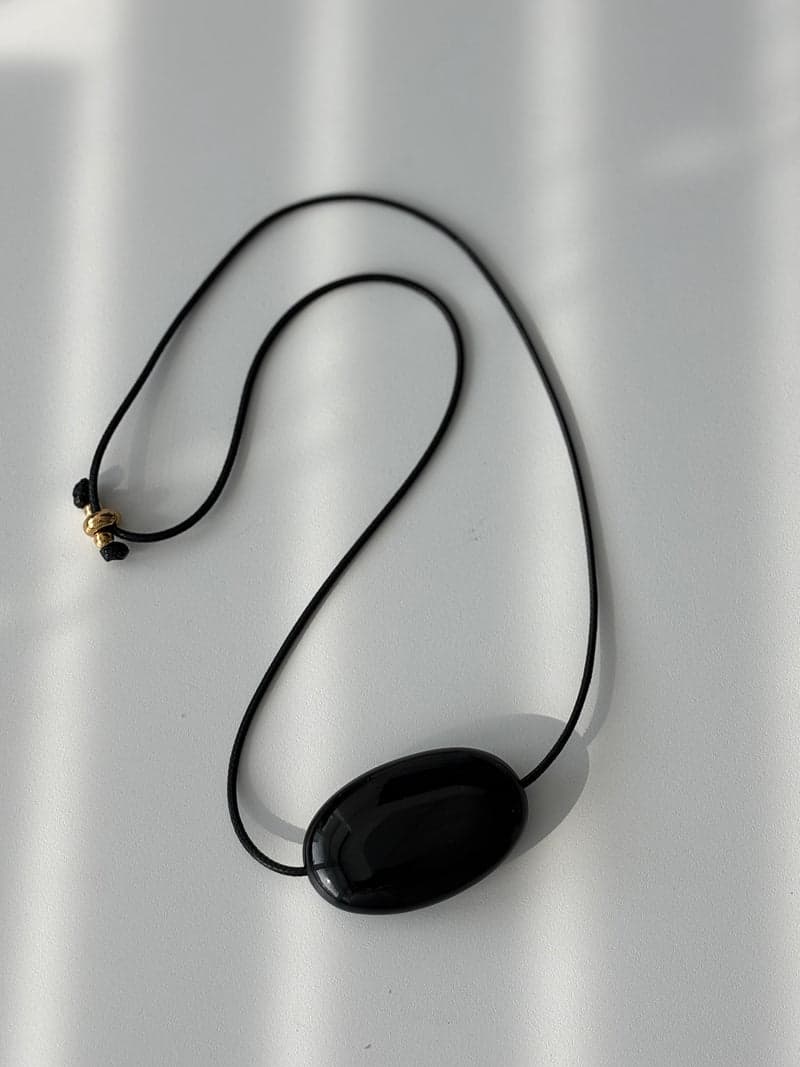
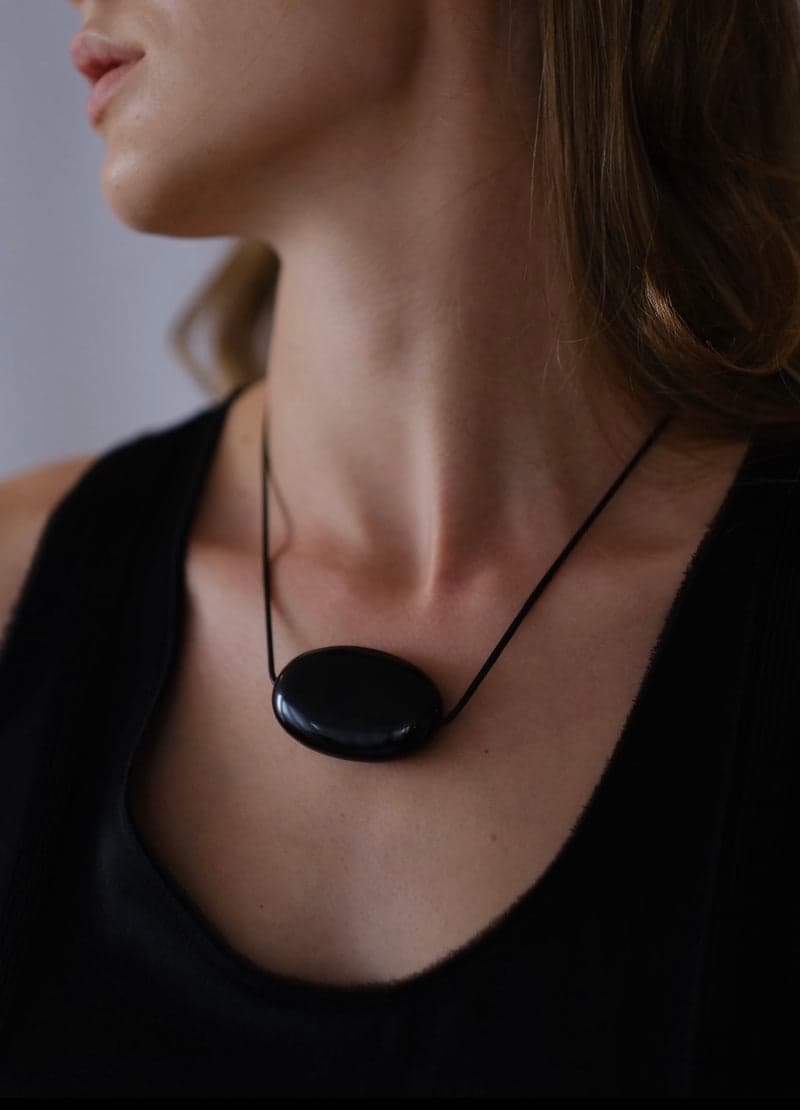
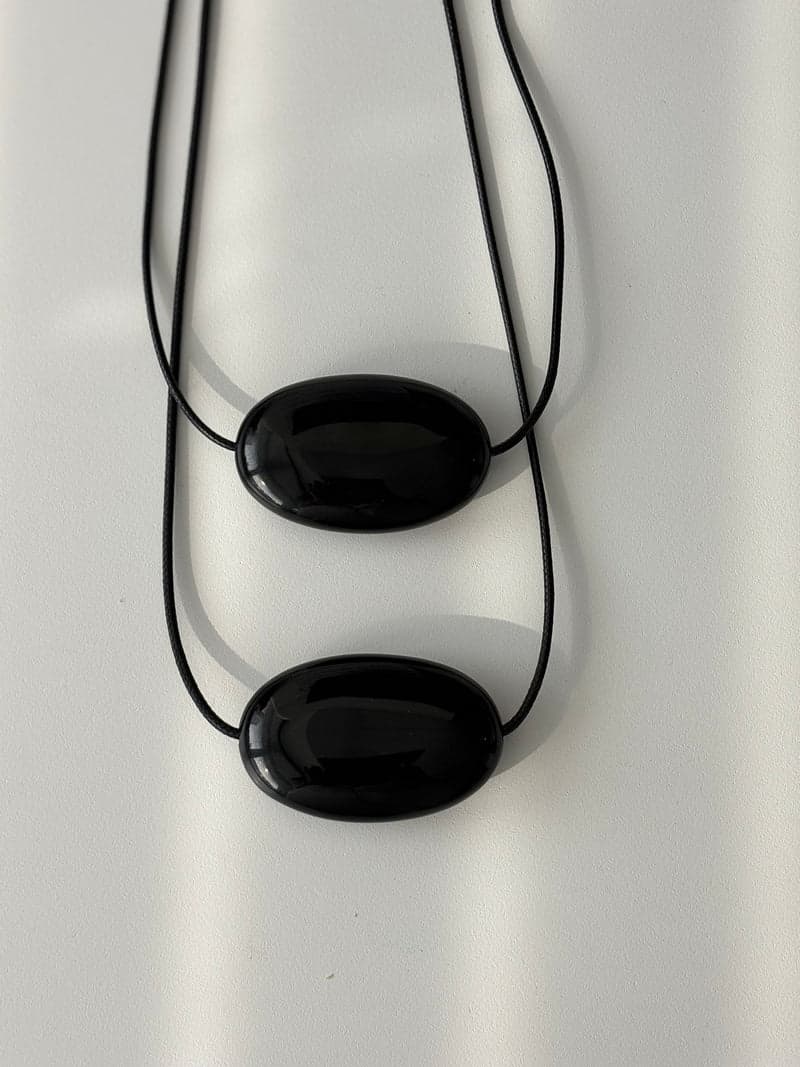
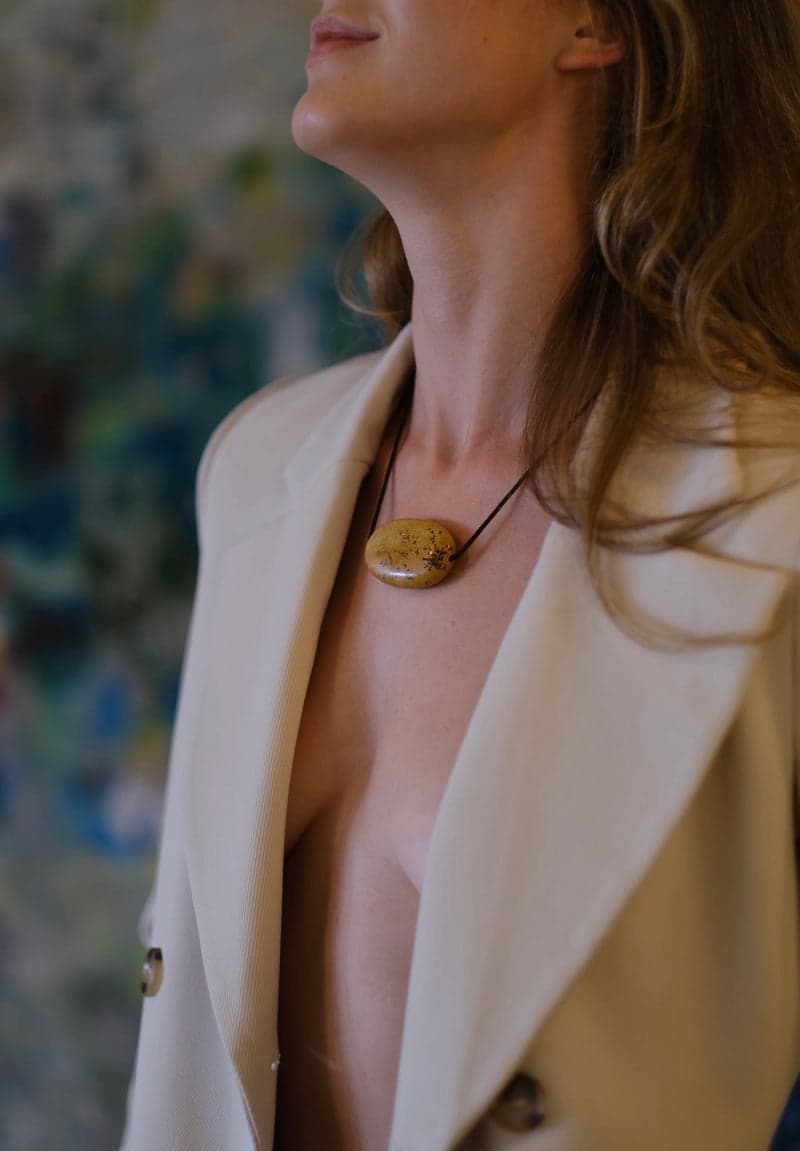
As an example of how the material is used now rather than a recommendation: Aven Atelier's Large Bean Design Pendant Necklace, a single polished bean-shaped stone on an adjustable cord, offered in black obsidian or dendritic jasper.
Affiliate link: if you buy through it, Astra Trainer may earn a commission. The price is the same for you.
Stone roughly 1.4 by 2.2 inches. Cord adjustable to a maximum of 27 inches, with a stopper closure. $120 at the time of writing.
Photographs courtesy of Aven Atelier.
It is worth saying why this piece is here and not another. The brand sells it as jewelry, describing the shape and the polish, and makes no claim about what the stone does. That is the right way to sell obsidian and it is rarer than it should be.
What to take from this
Obsidian is glass, and the absence of a crystal structure is what gives it both the edge and the mirror.
The edge reaches around three nanometres, finer than surgical steel, which made it the best cutting material available for most of human history.
The oldest mirrors known anywhere are obsidian, from Anatolia around 6000 BCE, and a number were buried with their owners.
Independently, in Mesoamerica, the same material became the instrument of a god named for a smoking mirror.
And Dee's scrying mirror turned out to be Aztec, from Pachuca, confirmed by geochemistry in 2021. The stone associated with seeing is associated with it because people spent eight thousand years seeing with it.
Test yourself
Question 1 of 3
What single fact does the article say explains both obsidian's cutting edge and its mirror polish?
What is obsidian?
Volcanic glass, not a mineral. It forms when silica-rich lava cools too fast for a crystal structure to develop, which is why it fractures into curved surfaces and polishes to a true reflection.
What does obsidian mean?
Modern crystal books generally assign it protection, grounding and shadow work. Those specific lists are twentieth-century. What the historical record supports is narrower: obsidian was the material people used to see with, as mirrors, in several unconnected cultures.
Is obsidian really sharper than a scalpel?
An obsidian edge has been measured at around three nanometres, finer than surgical steel. Obsidian blades are not approved by the FDA for standard human surgery, since glass that fine is brittle.
What were the first mirrors made of?
Obsidian. The oldest known examples come from Neolithic Anatolia around 6000 BCE, including Çatalhöyük, thousands of years before metal mirrors, and a number were found in graves.
Was John Dee's magic mirror really Aztec?
Yes. A 2021 study in Antiquity used X-ray fluorescence to match it to Mexican obsidian from near Pachuca. How it reached England remains unknown.
Where this leads. Crystal Meanings and Their Origins, Traced does for the whole list what this article does for one stone: it traces where the modern meanings were written down, and by whom.