
Perthro Key Facts
What the record shows
- Sound
- /p/
- Ætt
- Hagal's ætt, 6th of 8
- Literal meaning
- Unknown; a game, lot-cup or fruit tree proposed
- Rune poems
- Old English only: play and laughter in the beer-hall; no Norse stanza (no p-rune)
- Other names
- Peorð (Old English), pertra (Gothic letter name), Perth, Pertho
In modern rune reading
- Associated deity
- The Norns in some modern books — not attested
- Element
- —
- Yes or No?
- Maybe
- Love
- The unknown factor, chemistry, a secret; unwelcome surprises when blocked
- Career & money
- A gamble, luck and timing; hidden costs when reversed
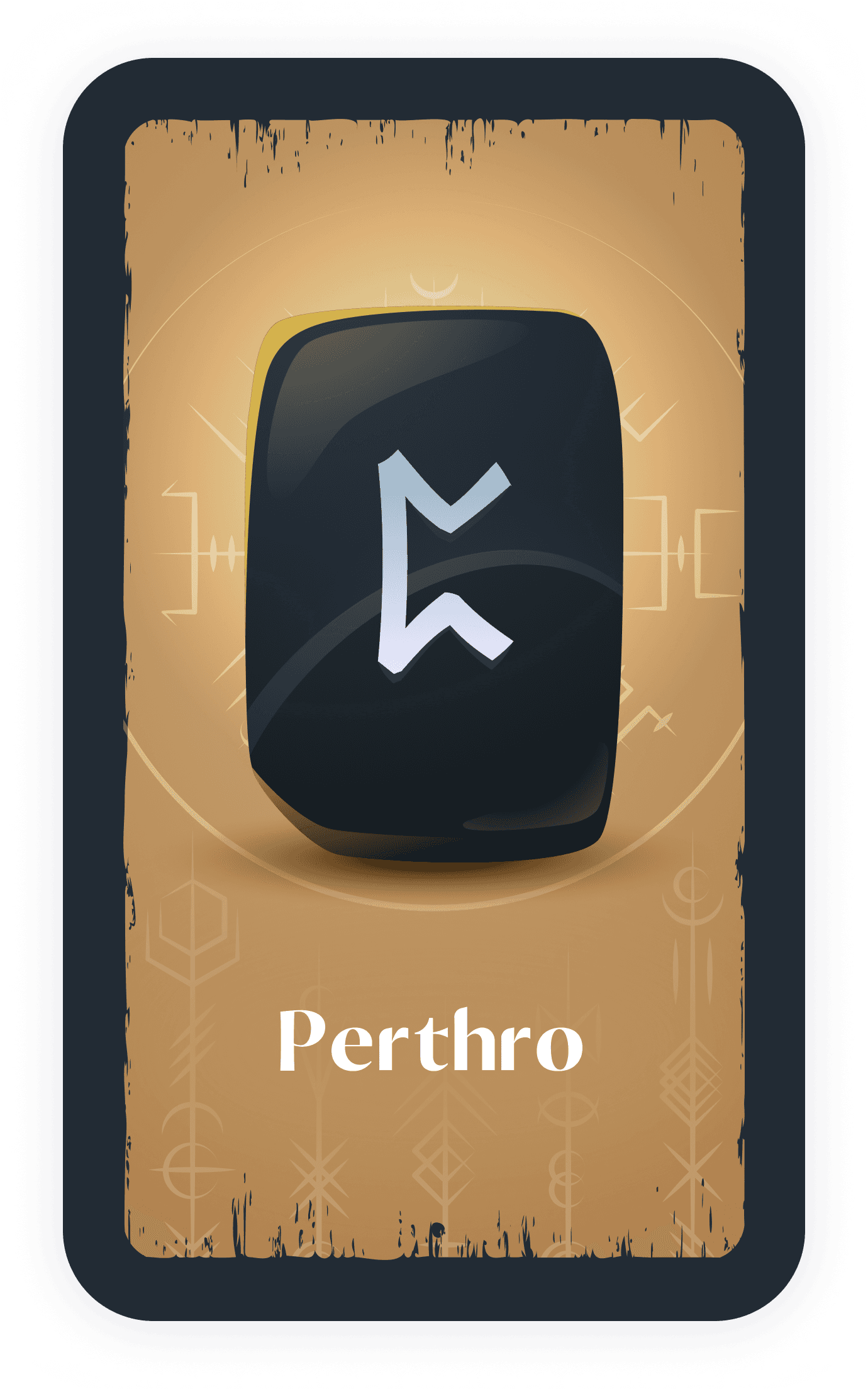
Perthro is the fourteenth rune of the Elder Futhark and the most honest test of any rune guide: nobody knows what its name meant. It stood for /p/, it had a name, and one medieval stanza about it survives. This page keeps what the record supports apart from what modern rune reading has built in the gap.
What does Perthro mean?
The sound is not in doubt: ᛈ spelled /p/, a rare sound in early Germanic, which is one reason the rune is rare in inscriptions. The name is reconstructed as *perþ(r)ō, partly from an alleged Gothic letter name, pertra, and partly from the Old English rune name peorð. Neither helps much. The word is not traceable anywhere else in Old English, and it does not survive in Old Norse at all, because the Younger Futhark dropped the p-rune and wrote /p/ with the b-rune.
Scholars have proposed a board game, dice or lots, and a pear or some other fruit tree; none of these is proven. Even the rune's place wobbles: the Kylver Stone puts it before Eihwaz, the Vadstena bracteate after. When a rune list gives Perthro a confident one-word meaning with no caveat, it is repeating a guess.
What do the rune poems say about Perthro?
Only one poem mentions this rune, and its stanza is the entire period evidence for what Perthro meant.
- Old English (the Anglo-Saxon futhorc, 8th–9th century): peorð is always play and laughter among the proud, where warriors sit in the beer-hall, cheerful together.
- Old Norwegian (c. 13th century, Younger Futhark): no stanza. The 16-rune Younger Futhark has no p-rune.
- Old Icelandic (c. 15th century, Younger Futhark): no stanza, for the same reason.
One late stanza is all there is. The Old English poem describes the Anglo-Saxon futhorc, centuries after the Elder Futhark took shape, and its manuscript burned in 1731, so even this text survives through an 18th-century printing. Nothing in it mentions fate, wombs or divination.
Read plainly, the stanza describes something enjoyed in company in a hall, which is why most scholars lean toward a game played with dice, lots or pieces. The modern reading of Perthro as fate and chance extends that gambling guess. It is an extension, not a translation.
Perthro upright meaning
In modern rune reading an upright Perthro is the rune of the unknown: chance, fate, hidden factors and whatever has not yet been revealed. Many readers picture the shape as a dice cup tipped on its side. That image comes from the gambling guess, and the readings built on it are 20th-century practice.
- Chance — luck, odds, a situation whose outcome is genuinely open.
- Hidden things — information not yet on the table, something working out of sight.
- Play — enjoying the game rather than forcing the result, the one idea the stanza itself supports.
Perthro reversed (merkstave) meaning
Drawn upside down, Perthro is read as chance turning against you: bad luck, an unwelcome surprise, a secret coming out at the wrong moment, or a bet that should not have been placed. Some readers treat it as stagnation instead — nothing is being revealed, and the cup stays closed.
Reversed readings are a modern convention. The rune poems give one stanza per rune and no inverted counterpart; merkstave meanings come from 20th-century rune books. With Perthro they stack on a guess: the upright meaning already extends an uncertain name, so a merkstave meaning is modern practice built on modern practice.
Perthro in love and relationships
In a love reading Perthro stands for what is not yet known: attraction that is hard to explain, a relationship whose direction is still open, or something a partner has not said. Reversed, readers see secrets doing damage, a gamble on the wrong person, or an old pattern repeating because nobody looks at it.
Perthro in career and money
Upright Perthro suggests luck at work: a speculative project, a career move whose outcome you cannot predict, or an opportunity that depends on timing. Reversed, it warns of hidden costs, bad odds, or a financial risk being taken without enough information.
Is Perthro a yes or no rune?
In yes-or-no rune reading, Perthro is usually a maybe: the answer is not yet knowable, or depends on factors outside the question. Reversed, many readers lean toward no. This is purely modern divinatory practice — there is no historical evidence of runes being read this way.
What is attested and what is modern
| Layer | Perthro | How solid |
|---|---|---|
| Sound | /p/ | Solid — read in surviving inscriptions |
| Name | *perþ(r)ō; peorð, pertra | Reconstructed from thin evidence |
| Literal meaning | Unknown — game, lots or fruit tree proposed | Unresolved; no guess is proven |
| Play and laughter in the beer-hall | Old English poem only | The only period evidence |
| Fate, chance, upright and merkstave | Modern divination | 20th-century extension of a guess |
Perthro sits in Hagal's ætt between Eihwaz, the yew, and Algiz, another rune whose meaning is disputed. Modern readers sometimes contrast it with Naudhiz, need: what you are forced into against what falls to chance. For the full evidence on the disputed runes, see Elder Futhark rune meanings.
What does the Perthro rune mean?
Nobody knows for certain. Perthro stood for /p/, but its name is not traceable in Old English or Old Norse. The only period evidence is an Old English stanza about play and laughter in a beer-hall, which suggests a game. Modern readers use it for chance and fate.
Why is Perthro called the rune of fate?
Because modern rune books extend the most common scholarly guess — a game of dice or lots — into chance, fate and hidden knowledge. That reading is 20th-century practice; no historical source connects Perthro with fate.
What does Perthro mean reversed?
In modern practice a reversed Perthro is read as bad luck, unwelcome surprises, secrets or a poor gamble. Reversed meanings are a modern convention, and the single surviving stanza for this rune gives no inverted reading.
Why is Perthro missing from the Norse rune poems?
The Norwegian and Icelandic poems describe the 16-rune Younger Futhark, which had no p-rune; /p/ was written with the b-rune. Only the Old English poem, written for the Anglo-Saxon futhorc, has a stanza for it.