
Naudhiz Key Facts
What the record shows
- Sound
- /n/
- Ætt
- Hagal's ætt, 2nd of 8
- Literal meaning
- Need, distress, constraint
- Rune poems
- Hardship in all three: need that helps if heeded (Old English), scant choice (Norwegian), a bondmaid's grief (Icelandic)
- Other names
- Nȳd (Old English), Nauðr (Old Norse), noicz (Gothic letter name); Nauthiz
In modern rune reading
- Associated deity
- —
- Element
- Fire in some systems; no agreed element
- Yes or No?
- No
- Love
- Unmet needs named honestly; scarcity or dependence in a hard position
- Career & money
- Constraint that forces a decision; hardship or burnout in a hard position
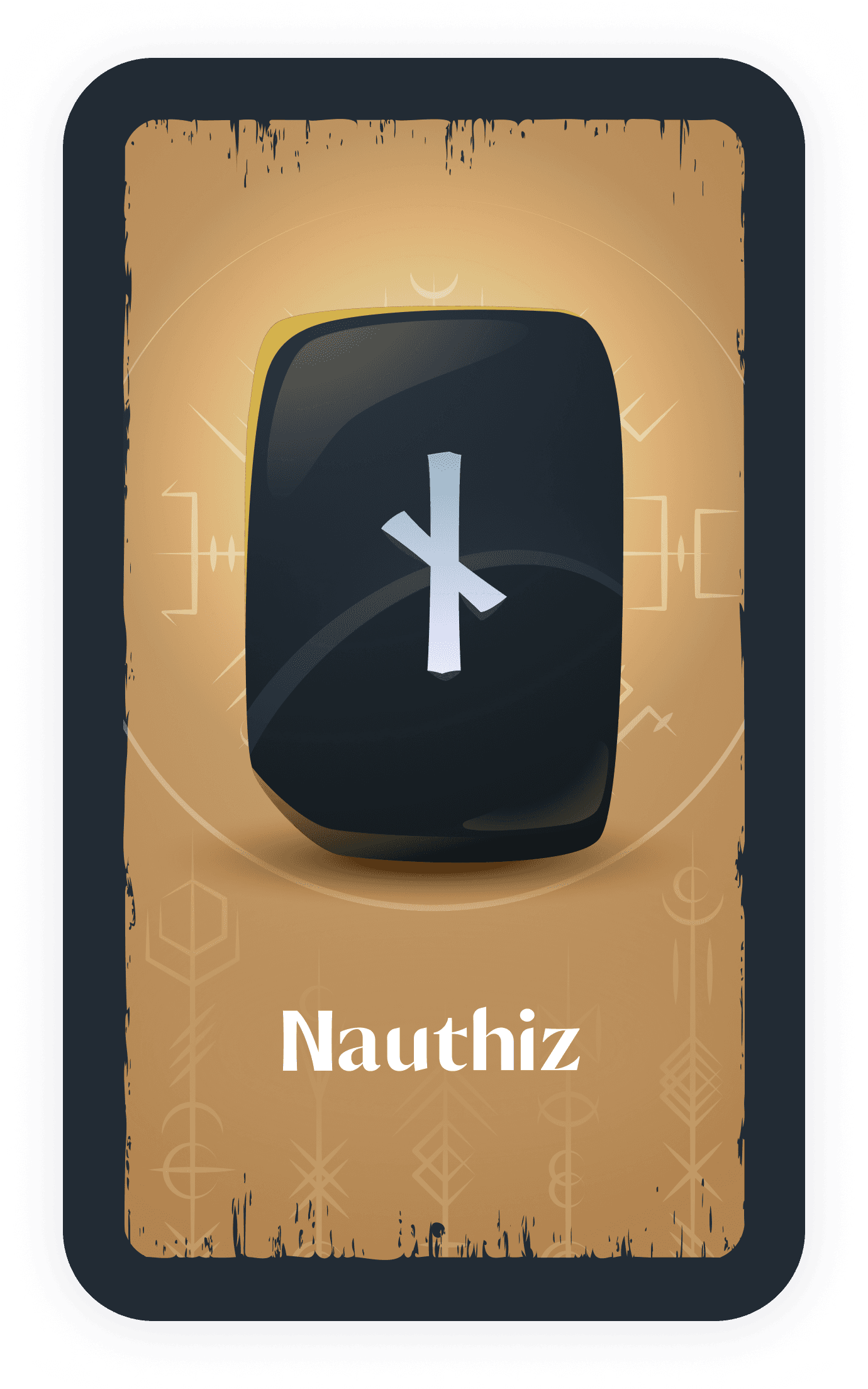
Naudhiz is the tenth rune of the Elder Futhark, the second of Hagal's ætt. Its name means need — want, distress, the pressure of necessity — and all three rune poems treat it as hardship. Modern readers make it the limit that forces a decision. This page keeps the historical layer apart from the modern one, and explains why a reversed Naudhiz is not what it seems.
What does Naudhiz mean?
Naudhiz stood for the sound /n/. The name is reconstructed as Proto-Germanic *naudiz, "need, distress, constraint" — the ancestor of Old English nȳd, Old Norse nauðr, Gothic nauþs and English need. The Gothic letter name was recorded as noicz. Spellings vary between books — Naudhiz, Naudiz, Nauthiz — but the meaning does not.
Naudhiz is also one of the few runes named in Old Norse poetry. In the Eddic poem Sigrdrífumál, the valkyrie tells Sigurd to carve protective runes on a drinking horn and on the back of his hand, and to mark Nauð on the nail. That poem survives in a 13th-century Icelandic manuscript, centuries after the Elder Futhark, so it shows medieval ideas about rune magic rather than Iron Age practice.
What do the rune poems say about Naudhiz?
All three poems include the rune, and none of them makes need pleasant.
- Old English (the Anglo-Saxon futhorc, 8th–9th century): need is oppressive to the heart, yet it often becomes help and salvation to those who heed it in time.
- Old Norwegian (c. 13th century, Younger Futhark): constraint gives scant choice; a naked man is chilled by the frost.
- Old Icelandic (c. 15th century, Younger Futhark): need is the grief of the bondmaid, a state of oppression and toilsome work, glossed with the Latin opera. The oldest manuscript is damaged here, so part of the stanza is reconstructed.
The poems are late and describe later rune rows. The Old English poem belongs to the Anglo-Saxon futhorc; the Norse poems to the 16-rune Younger Futhark. They are the best evidence for what the Elder Futhark names meant, not a manual for how anyone used Naudhiz in a reading.
Read together, the Norse stanzas are bleak: no choice, bitter cold, forced labour. The Old English poet adds the turn that modern readers built on — hardship understood early can become the thing that saves you. Naudhiz as a hard teacher comes almost directly from that one stanza.
Naudhiz upright meaning
In modern rune reading Naudhiz is a rune of necessity: a shortage, a limit, a situation that leaves few options. Readers follow the Old English poem and treat it as instructive rather than purely negative — the constraint shows what you actually need, and pushes a decision you have been avoiding.
- Hardship — a shortage of money, time, energy or support.
- Necessity — the choice forced by circumstances, and the resourcefulness it demands.
- Heed it early — the problem that helps if faced now and harms if ignored.
Naudhiz reversed: why there is no true merkstave
The rune is a single stave crossed by a slanted stroke, and turned upside down it looks exactly the same. A drawn tile therefore cannot show a reversed Naudhiz, even though some modern lists still give one — usually deeper deprivation, desperation, or ignoring a real need. Readers who take symmetry seriously draw that harder shade from context instead: the question, the position, the runes beside it.
Reversed readings are a modern convention, and symmetrical runes expose it. The rune poems give no inverted stanza for any rune, and several runes look identical upside down — Naudhiz, Gebo, Hagalaz, Isa and Jera among them — so for them "reversed" is not defined.
Naudhiz in love and relationships
In a love reading Naudhiz asks what is missing. Upright it can mean an unmet need finally named, a relationship tested by hardship, or patience through a lean period. In a hard position readers see scarcity — of time, affection or trust — or a bond held together by need rather than choice.
Naudhiz in career and money
At work Naudhiz points to constraint: a tight budget, a heavy workload, a deadline that removes options. The modern advice is to put first what truly matters and act before the pressure decides for you. In a difficult spread readers look for burnout, debt, or staying somewhere only out of necessity.
Is Naudhiz a yes or no rune?
In yes-or-no rune reading Naudhiz is usually a no, or a "not yet — first deal with what is missing". Some readers give it a reluctant yes when the question is whether you must do something. This is purely modern divinatory practice; there is no historical evidence of runes being read this way.
What is attested and what is modern
| Layer | Naudhiz | How solid |
|---|---|---|
| Sound | /n/ | Solid — read in surviving inscriptions |
| Name and literal meaning | *naudiz, need, distress | Strong — every source agrees |
| Hardship that helps if heeded | Old English rune poem | Attested, but medieval |
| Nauð marked on the nail | Sigrdrífumál, Poetic Edda | Attested in a 13th-century manuscript |
| Upright, reversed, yes or no | Modern divination | 20th-century practice |
Naudhiz is the second rune of Hagal's ætt, between Hagalaz, hail, and Isa, ice — the coldest stretch of the Futhark. Readers often set it against Jera, the harvest that follows a lean season, and beside Eihwaz, endurance. For the full row, see Elder Futhark rune meanings.
What does the Naudhiz rune mean?
Naudhiz stood for the sound /n/, and its name is reconstructed as *naudiz, need or distress. All three rune poems treat it as hardship; modern readers use it for constraint, necessity and the limit that forces a decision.
What does Naudhiz mean reversed?
Naudhiz looks the same upside down, so it cannot really be drawn reversed. Some modern lists still give a reversed meaning — desperation or ignoring a real need — but many readers take any harder shade from context instead.
Is Naudhiz the same as Nauthiz?
Yes. Naudhiz, Naudiz and Nauthiz are spellings of the same reconstructed Proto-Germanic name. Old English called the rune nȳd and Old Norse nauðr; the meaning, need, is the same in all of them.
Is Naudhiz a bad rune?
It is a hard rune, not a hopeless one. The Old English rune poem says need oppresses the heart but can become help and salvation to those who heed it early, and modern readers treat Naudhiz the same way.