
Eihwaz Key Facts
What the record shows
- Sound
- Uncertain: /æ/ or /ï/ proposed
- Ætt
- Hagal's ætt, 5th of 8
- Literal meaning
- Yew tree
- Rune poems
- Old English only: a rough-barked, deep-rooted yew, guardian of flame; no Norse stanza for this rune
- Other names
- Eoh, Ih (Old English), Eiwaz, Ihwaz, Eihaz
In modern rune reading
- Associated deity
- —
- Element
- —
- Yes or No?
- Maybe
- Love
- Commitment that lasts through hard seasons; rigidity in a hard spread
- Career & money
- Long-term projects, endurance, steady work over years
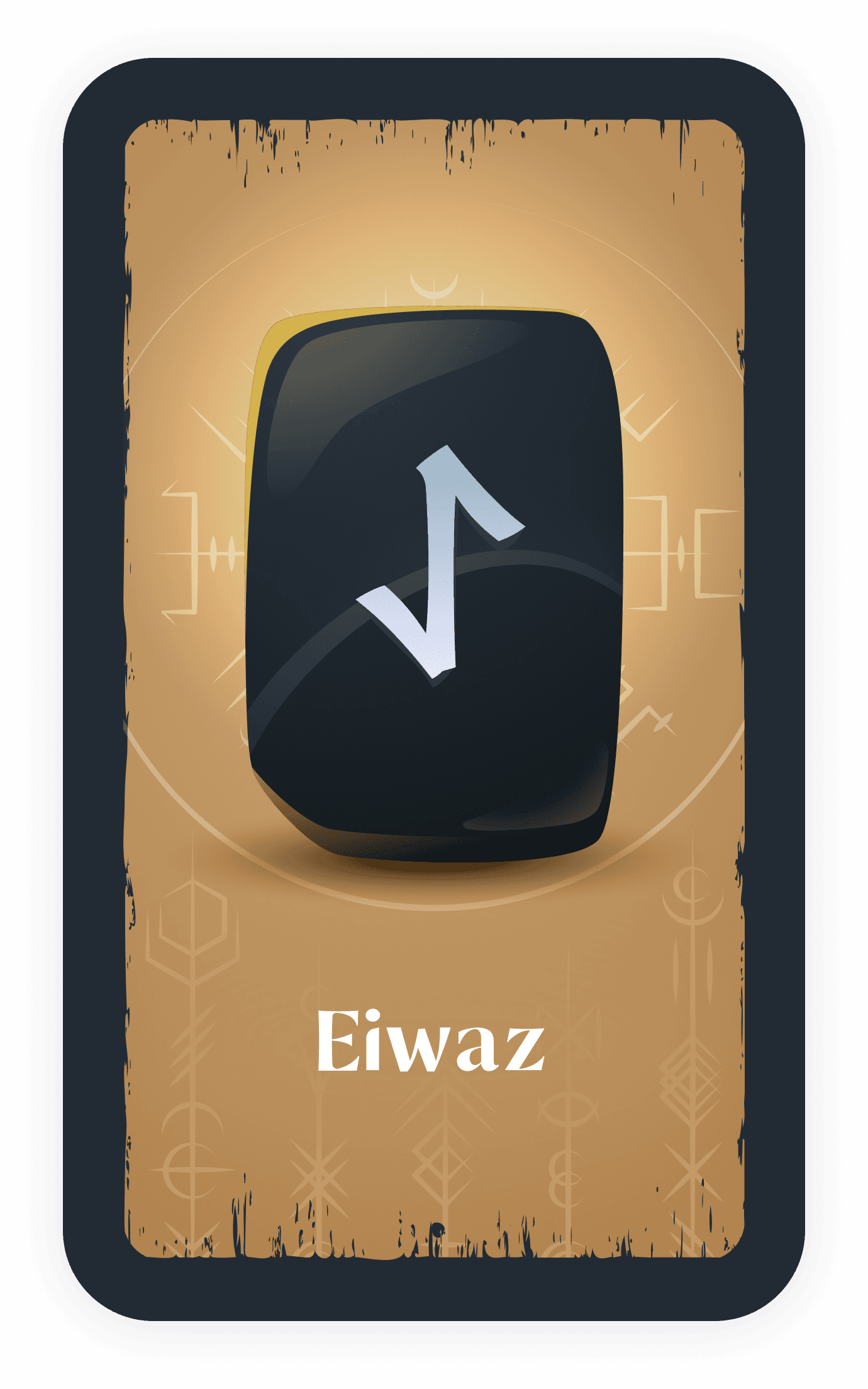
Eihwaz is the thirteenth rune of the Elder Futhark, and its name meant the yew — an evergreen, long-lived and poisonous tree. It is also one of the least understood runes at the level of the alphabet itself: nobody is sure what sound it spelled. This page keeps two layers apart: what the historical record supports, and what modern rune reading has built on top of it.
What does Eihwaz mean?
The yew part is secure. The name is reconstructed from Proto-Germanic *īwaz or *īhaz, "yew" — two variant forms that the usual spelling Eihwaz blends together. Old English kept both: īw, the ancestor of the word yew, and ēoh, the name the Anglo-Saxon rune row gives this rune. Yew wood is dense and springy, the classic material for bows, and the tree lives for centuries and stays green through winter.
The sound is the problem. ᛇ turns up rarely in inscriptions, and scholars still argue whether it stood for /æ/, a vowel between /i/ and /e/, or something else; the standard transliteration ï is a convention, not a solution. On the two earliest complete rune rows it even changes place: the Kylver Stone puts it after Perthro, the Vadstena bracteate before, which is the order modern lists follow. Eihwaz is a rune whose meaning is clear and whose letter is not.
What do the rune poems say about Eihwaz?
Only one of the three rune poems has a stanza for this rune, and it is a plain portrait of the tree.
- Old English (the Anglo-Saxon futhorc, 8th–9th century): the yew is a tree with rough bark, hard and fast in the earth, held up by its roots, a guardian of flame and a joy on an estate.
- Old Norwegian (c. 13th century, Younger Futhark): no stanza for this rune. The poem does praise the yew as the greenest tree in winter, but that stanza belongs to ýr, a different rune that inherited the sound of Algiz and only borrowed the yew's name.
- Old Icelandic (c. 15th century, Younger Futhark): likewise no stanza for Eihwaz. Its ýr stanza — a bent bow, brittle iron — describes the same tree under the same borrowed name.
The poems are late and describe later rune rows. The Old English poem belongs to the Anglo-Saxon futhorc; the Norse poems to the 16-rune Younger Futhark. The Younger Futhark dropped Eihwaz altogether, so reading the Norse yew stanzas as if they described ᛇ is a common slip in rune books.
On its own evidence, the Old English stanza gives Eihwaz three concrete ideas: rootedness, toughness, and a tree that guards fire — a phrase commentators explain in different ways. The Norse yew stanzas point the same direction, bow wood and winter green, but they are testimony about the tree, not about this rune.
Eihwaz upright meaning
In modern rune reading an upright Eihwaz is the rune of endurance. Readers take the evergreen tree as a picture of what survives a hard season, and many connect it with Yggdrasil, the World Tree of Norse myth — a modern association, since the Eddic poems call Yggdrasil an ash.
- Endurance — staying power; a situation that tests you and that you can outlast.
- Protection through strength — bow wood and deep roots: defence that comes from being hard to move.
- Death and continuity — the poisonous tree that keeps growing, read as change that ends one phase without ending the story.
Eihwaz reversed: why there is no merkstave
Turn ᛇ upside down and you get the same shape, so a drawn Eihwaz cannot land reversed, and most rune books give it no merkstave reading at all. Readers who want its shadow side look at the runes around it instead: next to hard runes such as Hagalaz or Isa, its endurance can read as rigidity, stubbornness, or clinging to a situation that should end.
Reversed readings are a modern convention anyway. The rune poems give one stanza per rune and no inverted counterpart, and symmetrical runes like Eihwaz, Sowilo, Ingwaz and Dagaz show the limit of the idea: for them "reversed" is not even defined. More on this in how to read runes for beginners.
Eihwaz in love and relationships
In a love reading Eihwaz is about a bond built to last. It points to commitment that has already survived something, loyalty through a difficult stretch, or a relationship that grows slowly and deeply. In a hard spread readers see the same strength turned rigid: staying out of habit, or refusing to let a relationship change.
Eihwaz in career and money
Eihwaz favours the long game: a multi-year project, a skill that takes a decade to master, savings built patiently rather than a quick win. It rarely promises speed. In a difficult spread it warns of burnout from simply enduring, or of holding a position long after it stopped serving you.
Is Eihwaz a yes or no rune?
In yes-or-no rune reading, most readers treat Eihwaz as a maybe or a slow yes: the answer can be positive, but only with patience and effort. Because it has no reversed form, the neighbouring runes set the tone. This is purely modern divinatory practice — there is no historical evidence of runes being read this way.
What is attested and what is modern
| Layer | Eihwaz | How solid |
|---|---|---|
| Sound | /æ/, /ï/ or another vowel | Uncertain — rare in inscriptions |
| Name and literal meaning | *īwaz / *īhaz, yew | Strong — Old English ēoh and īw, cognates |
| Yew as the rune's idea | Old English poem only | Strong, but the poem is medieval |
| World Tree, death and rebirth | Modern association | Built on the yew; in no rune source |
| Upright meaning, yes or no | Modern divination | 20th-century practice |
Eihwaz sits in the middle of Hagal's ætt, after Jera, the harvest year, and before Perthro, the rune nobody can translate. Its yew name passed, in the Norse rune row, to the successor of Algiz. It makes a natural contrast with Berkano: the evergreen against the spring birch. For the runes whose sound or meaning is still disputed, see Elder Futhark rune meanings.
What does the Eihwaz rune mean?
Eihwaz literally meant the yew tree. The Old English rune poem describes a rough-barked, deep-rooted yew that guards flame. Modern rune readers use Eihwaz for endurance, resilience, protection and continuity through change.
Does Eihwaz have a reversed meaning?
No. ᛇ looks the same upside down, so it cannot be drawn reversed, and most rune books give it no merkstave reading. Some readers take a harsher sense, such as rigidity or stubbornness, from the runes drawn beside it.
Is Eihwaz the rune of Yggdrasil?
Only in modern books. The link rests on the yew being evergreen and long-lived, but the Eddic poems call Yggdrasil an ash, and no historical source ties the Eihwaz rune to the World Tree.
What sound does the Eihwaz rune make?
Nobody is sure. It is transliterated ï by convention, and proposals include /æ/ and a vowel between /i/ and /e/. The rune is rare in inscriptions, which is why its sound value is still debated.