
This astrology quiz has 12 questions and answers, two for each of six topics: the signs, the planets, the houses, aspects, dignities and reading a chart. The questions are written for this page and go a step past definitions. Several ask why something is true, and one has both a traditional and a modern answer.
Cover each answer, say yours out loud, then read on. Keep count as you go: after the twelfth question you will find what your score means and how to test yourself more rigorously.
The sky under the symbols
Several questions here are about astronomy as much as astrology. Signs, aspects and angles are all measured on a real sky, for one place and one moment.
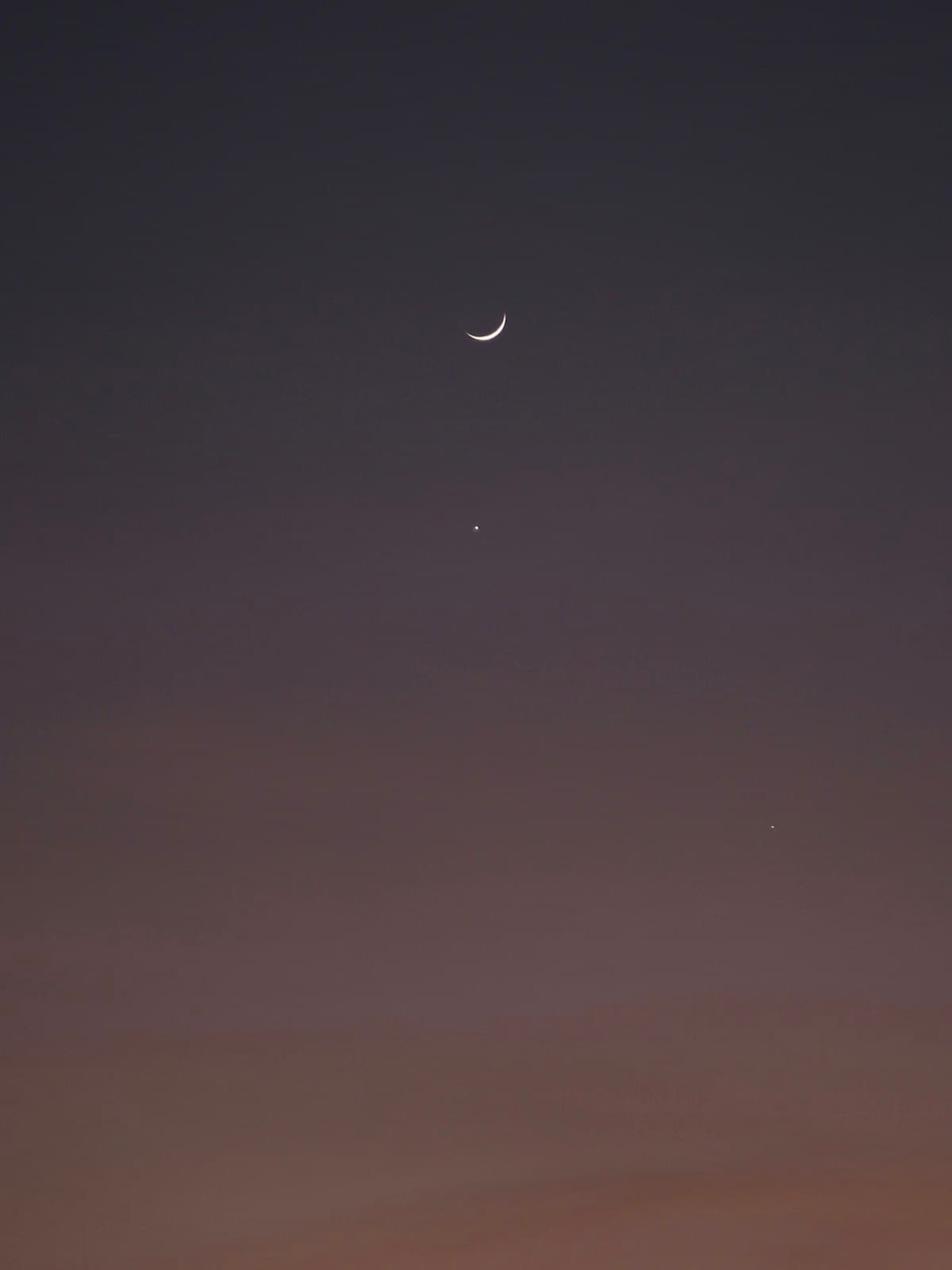

Photos: Angel Reyes and Kouji Tsuru on Unsplash.
The signs
1. Which element and which modality does Scorpio belong to?
Answer: water and fixed. The twelve signs are the four elements crossed with the three modalities, so each sign is one combination and none repeats. Water has three signs: Cancer is cardinal, Scorpio fixed and Pisces mutable. The fixed signs fall in the middle month of each season in the northern hemisphere, when the season is settled, which is where the name comes from.
2. Your Sun is at 10° Aries in a tropical chart. Is the Sun in front of the constellation Aries?
Answer: no, it is in front of the constellation Pisces. The tropical zodiac is measured from the March equinox, and that point drifts slowly backwards against the stars through the precession of the equinoxes. It has moved about 24 degrees since the signs and the constellations roughly lined up, which is most of a sign. Sidereal astrology, used in Jyotish, measures from the stars instead. Your Sign Does Not Match the Constellation Any More explains both zodiacs.
The planets
3. Can Mercury ever be in opposition to the Sun in a birth chart?
Answer: no. Mercury and Venus orbit inside the Earth's orbit, so from here they never appear far from the Sun: Mercury no more than about 28 degrees away, Venus no more than about 47. Mercury is therefore always in the Sun's sign or a neighbouring one, and the only major aspect it can make to the Sun is the conjunction.
4. Which planets rule Aquarius and Pisces in the traditional scheme, and which in the modern one?
Answer: traditionally Saturn rules Aquarius and Jupiter rules Pisces. The modern scheme gives Aquarius to Uranus and Pisces to Neptune, just as it gives Scorpio to Pluto instead of Mars. The traditional scheme was built on the seven planets visible to the naked eye, long before the outer planets were discovered in 1781, 1846 and 1930. Both schemes are in use, some astrologers read the modern ruler as a co-ruler beside the traditional one, and a well-set exam says which scheme it expects.
The houses
5. Which houses are angular, and why are planets in them read as prominent?
Answer: the 1st, 4th, 7th and 10th. In quadrant systems such as Placidus they begin at the four angles, the Ascendant, the Imum Coeli, the Descendant and the Midheaven, where the horizon and the meridian cross the ecliptic. A planet in an angular house is close to rising, culminating, setting or reaching its lowest point, and the tradition reads those positions as the most forceful in the chart, a form of accidental dignity. The 2nd, 5th, 8th and 11th houses are succedent, and the 3rd, 6th, 9th and 12th are cadent and traditionally the weakest.
6. Two websites put your Venus in different houses from the same birth data. What is the most likely reason?
Answer: they use different house systems. Placidus, the default in most Western software, divides the sky by time; Whole Sign makes each sign one house; Equal House counts 30 degrees at a time from the Ascendant. The same planet can land in different houses under each, and neither site has made a mistake. The next suspect is how each site handled the time zone or daylight saving time: the Ascendant moves about a degree every four minutes, so an hour's error shifts every house cusp. Astrologers Cannot Agree Which House System Is Right compares the systems.
Aspects
The five major aspects divide the circle: the conjunction at 0 degrees, the sextile at 60, the square at 90, the trine at 120 and the opposition at 180.
7. Why are squares usually formed between signs of the same modality?
Answer: because a square spans 90 degrees, three signs, and signs three apart share a modality. Aries, Cancer, Libra and Capricorn are all cardinal, yet no two of them share an element. The same mode of action with clashing elements is why the tradition reads the square as friction that demands effort. The word usually matters: near the edge of a sign, the orb can stretch a square into a sign of a different modality.
8. Mars is at 10° Leo and Saturn at 16° Scorpio, both moving direct. What is the aspect, and is it applying or separating?
Answer: a square with a 6-degree orb, applying. Leo and Scorpio are three signs apart, and the 6 degrees between 10 and 16 is the orb. Mars moves faster than Saturn and is still short of the exact square, which falls at about 16° Leo, so the aspect is still tightening. Whether a 6-degree square counts at all depends on your orbs: many astrologers would use it, and those who keep orbs tight would not.
Dignities
9. Mars is in Libra. What is its essential condition, and why?
Answer: detriment. Detriment is the sign opposite a planet's domicile, and Libra is opposite Aries, which Mars rules. Mars also rules Scorpio in the traditional scheme, so it is in detriment in Taurus too. Detriment is not a verdict on the person: it describes Mars working through qualities contrary to its nature, here balance and accommodation, which the tradition reads as awkward for the planet.
10. In the traditional scheme, which planet is exalted in a sign it already rules, and what follows for the opposite sign?
Answer: Mercury, which rules Virgo and is also exalted there. Because detriment and fall are simply the signs opposite domicile and exaltation, Pisces is both Mercury's detriment and its fall, a double debility that makes Mercury in Pisces a favourite teaching example. The exaltations are inherited from ancient sources rather than derived from a rule, so they have to be learned.
Reading a chart
11. What is the chart ruler, and how do you find it?
Answer: the planet that rules the sign on the Ascendant. With Sagittarius rising, the chart ruler is Jupiter; with Gemini rising, it is Mercury. Note its sign, its house, the aspects it makes and its condition. Traditional practice treats it as one of the most significant planets in the chart, which is why a reading establishes it early.
12. A chart has seven planets in fire signs and none in earth. Do you start the reading with that, or with the Sun sign?
Answer: with that. A working method goes from general to specific: the overall shape first, including the balance of elements and modalities, then the angles and the chart ruler, then the Sun and Moon, then the other planets, the aspects and the house rulers. An imbalance this strong colours everything read after it, so it belongs at the start. Reading a Chart in the Right Order sets out the full sequence.
What your score means
Give yourself a point for every answer you got right in substance, even if your wording was different.
- 10 to 12. A solid foundation. Any gaps are specific, so look at which topic your misses came from.
- 7 to 9. A good base with one or two weak areas. The misses often cluster in one topic, which tells you where to start.
- 6 or fewer. Go back to the building blocks: signs, planets and houses first, then aspects and dignity. Astrology for Beginners: How to Read a Birth Chart is a good place to begin.
For comparison, the pass mark on Astra's level-1 astrology exam is 70 percent, which on this page would be nine out of twelve. Treat that as a rough guide only: the exam is timed and forty questions long, so it is a different test.
Check yourselfBefore you read on: suppose you take this quiz again next week and score 12 out of 12. Would you expect the same result on 40 questions you have never seen, with up to 90 seconds for each? Why, or why not?Show the answerHide the answer
Probably not the same. A second pass over the same questions mostly tests whether you remember these answers, and recognising an answer you have already read is far easier than producing one from what you know. New questions test whether the knowledge carries over to a different phrasing, and a time limit tests whether recall is quick. That is why a fresh set of questions against the clock is the better check.
How to check yourself properly
A quiz on a page is a good start and a weak test. You can see the answers, take as long as you like, and repeat it until the answers feel familiar. Three changes make self-testing honest.
- Use questions you have not seen. Write your own from your notes, swap with a study partner, or use a question bank you have not opened before.
- Answer before you check. Commit to an answer, out loud or on paper, and only then look. Pulling an answer from memory is what strengthens it, which is one of the most reliable findings in learning research.
- Add a clock. In a timed exam there is little time to look anything up, so recall has to be quick. Ninety seconds a question is a useful benchmark.
Astra's free astrology practice test does the first two for you: 10 questions with answers and explanations, and no sign-up.
If you want the result on record, the level-1 astrology exam is the next step: 40 questions in 45 minutes, up to 90 seconds for each, with a pass mark of 70 percent and With distinction printed from 90 percent. It is unsupervised, with no webcam and no proctor. Two attempts are included, the second opening 24 hours after the first, and subscribers get level 1 included.
Pass it and you get a certificate with your name, the direction, Level 1 · Foundation, a number, a QR code and a public verification page, valid for two years and then renewed with a short test. It is not a licence, an accreditation, an official qualification or a right to practise. It is a checkable record that you passed a foundations exam, taken without supervision.
Not a basis for decisions. This quiz tests knowledge of astrology as a tradition. Astrology is not a source of medical, psychological, financial or legal guidance, and nothing here should inform decisions in those areas.
Test yourself
Question 1 of 3
How many other signs share both an element and a modality with Scorpio?
What are good astrology quiz questions for beginners?
Questions about structure rather than trivia: the element and modality of each sign, the ruler of each sign, the angular houses, the angle of each major aspect, and the four major conditions of essential dignity. Questions that ask why, such as why Mercury can never oppose the Sun, test understanding better than lists do.
How many zodiac signs are there, and what about Ophiuchus?
Twelve. The signs are equal 30-degree divisions of the ecliptic, not the constellations that gave them their names. Ophiuchus is a constellation the Sun passes in front of, but it is not one of the twelve signs of either the tropical or the sidereal zodiac.
Which planet rules each zodiac sign?
In the traditional scheme, Mars rules Aries and Scorpio, Venus rules Taurus and Libra, Mercury rules Gemini and Virgo, the Moon rules Cancer, the Sun rules Leo, Jupiter rules Sagittarius and Pisces, and Saturn rules Capricorn and Aquarius. The modern scheme gives Scorpio to Pluto, Aquarius to Uranus and Pisces to Neptune.
What topics does an astrology exam cover?
A foundations exam usually covers the signs, the planets, the houses, the major aspects, essential dignity and the basics of reading a chart. Higher levels add forecasting techniques and sometimes a practical reading. Check the exam's own topic list, and which conventions it uses.
Is there a free astrology test with answers?
Yes. Astra's free astrology practice test has 10 questions with answers and explanations and needs no sign-up. This page is another: 12 questions, each with the reason behind the answer.
What is the hardest part of learning astrology?
For many students it is synthesis: turning separate placements into one coherent reading. Knowing what each part means is the easier half. Reading a whole chart in order, out loud, is where most of the practice goes.