This tarot quiz has twelve questions in five topics: the Major Arcana, the Minor Arcana and suits, reversals, combinations and spreads. They were written for this article, and each answer explains the reasoning, because the reasoning is what carries over to the cards and spreads that are not in any quiz.
To get an honest score, answer each question out loud or on paper before you read the answer below it. Give yourself a point when your answer matches in substance; the exact wording does not matter. The scoring guide and a better way to test yourself come at the end.
The Major Arcana
1. How is a 78-card tarot deck divided, and where does The Fool sit?
Answer: 22 Major Arcana and 56 Minor Arcana. The Major Arcana run from The Fool, numbered 0, to The World, numbered XXI, and the Minor Arcana are four suits of fourteen cards each. The Fool's zero, or its lack of any number in older decks, lets readers place it at the start of the sequence or outside it.
2. Why is Strength VIII and Justice XI in the Rider-Waite-Smith deck, when older decks have them the other way round?
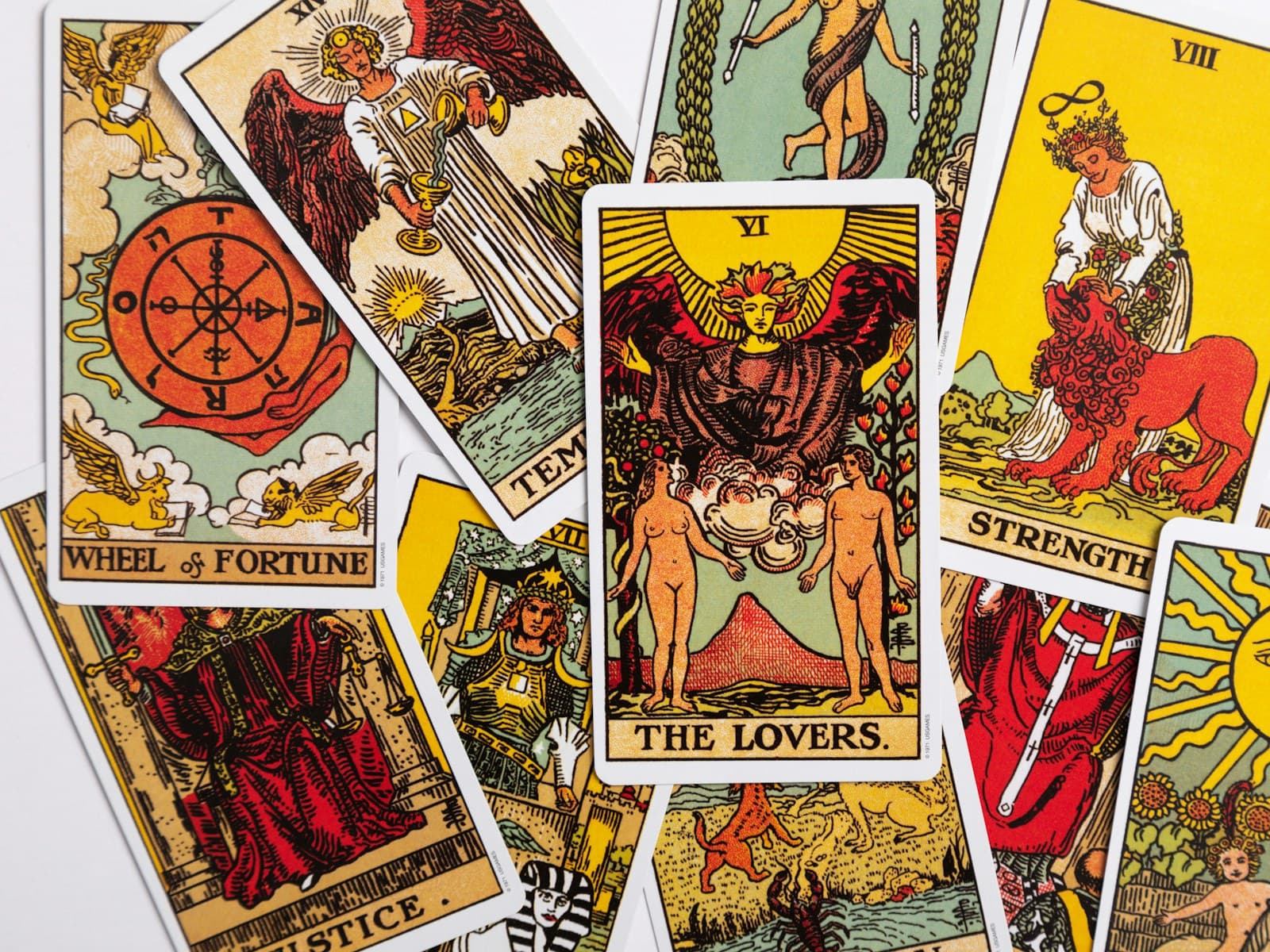
Answer: Because of the Golden Dawn, the occult order Waite belonged to. In Marseille-style decks Justice is VIII and Strength XI. The Golden Dawn gave twelve of the majors a zodiac sign each and wanted the signs to run in zodiacal order. With Strength on Leo and Justice on Libra, that only works if the two cards change places, and the Rider-Waite-Smith deck of 1909 was the first published deck to follow. Most decks based on it keep that order, so check yours before a numbered question catches you out. Tarot and Astrology tells the full story.
3. Death turns up in a reading about a job. What is the conventional reading?
Answer: An ending that makes room for something else: a role, a team or a way of working coming to a close. Modern readers almost never read Death literally, and a responsible reader never predicts anyone's death, whatever card appears.
The Minor Arcana and the suits
4. Which element and area of life goes with each suit?
Answer: In the Rider-Waite-Smith tradition, Cups are water (feelings and relationships), Wands fire (action, drive and creativity), Swords air (thought, conflict and communication) and Pentacles earth (money, work and the body). Some decks and teachers swap Wands and Swords, so a guidebook that calls Wands air is following another system, not making a mistake.
5. What do the four Fives have in common?
Answer: Disruption. Five sits in the middle of the sequence, where the stability of the Four gives way: loss in the Five of Cups, conflict in the Five of Wands, a hollow win in the Five of Swords and hardship in the Five of Pentacles. Once you know what a number does across the suits, you can make a sound first reading of a card you have never looked up.
6. What are two common ways of reading a court card?
Answer: As a person involved in the situation, or as a way of acting that someone is taking or needs to take. The rank gives the manner, from the Page's curiosity and the Knight's headlong action to the settled mastery of the Queen and King, and the suit gives the territory.
Test yourself the way an exam will
Turn a card, answer, then check. That order, recall first and reading second, is what makes a quiz worth doing.
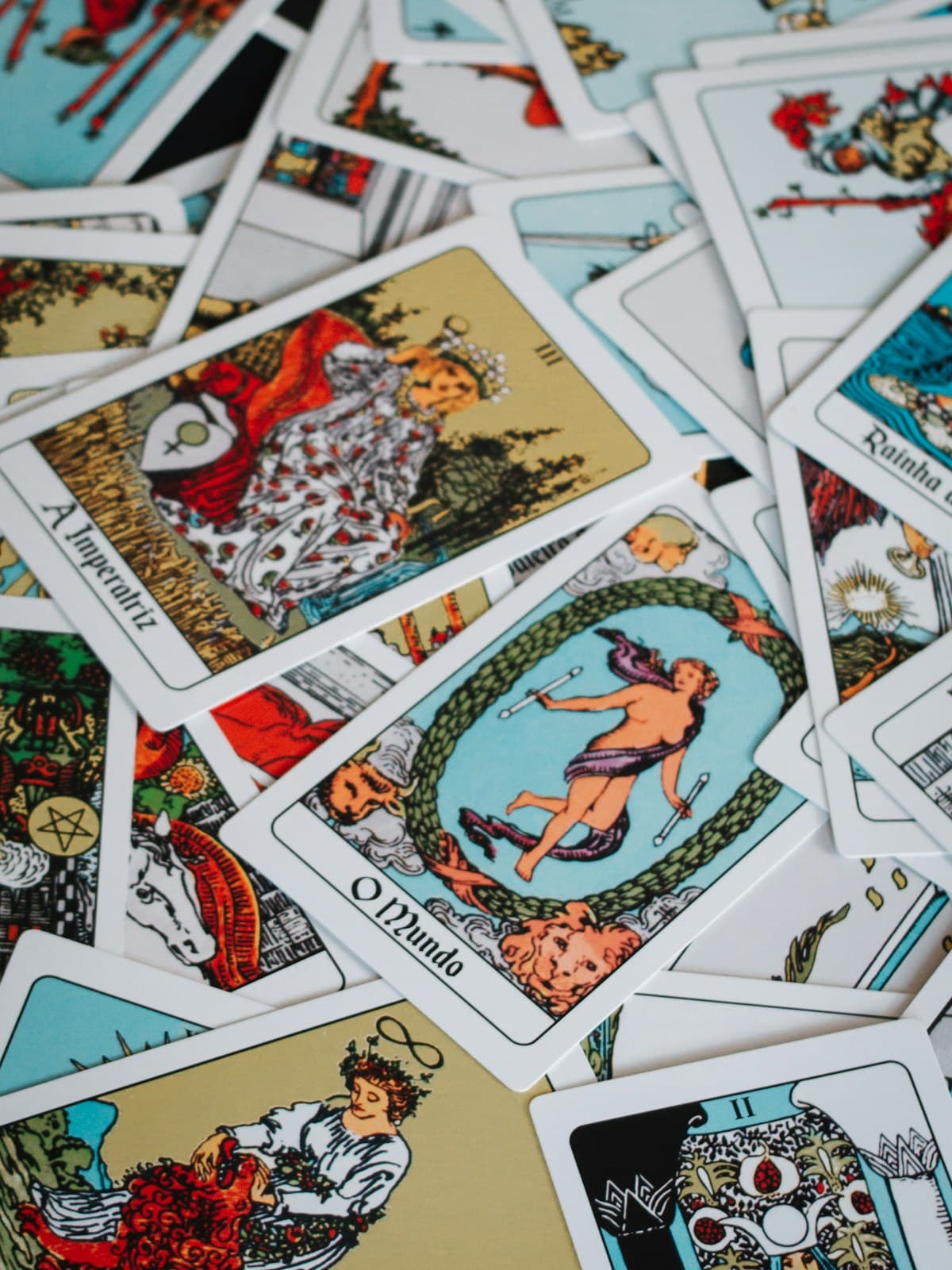
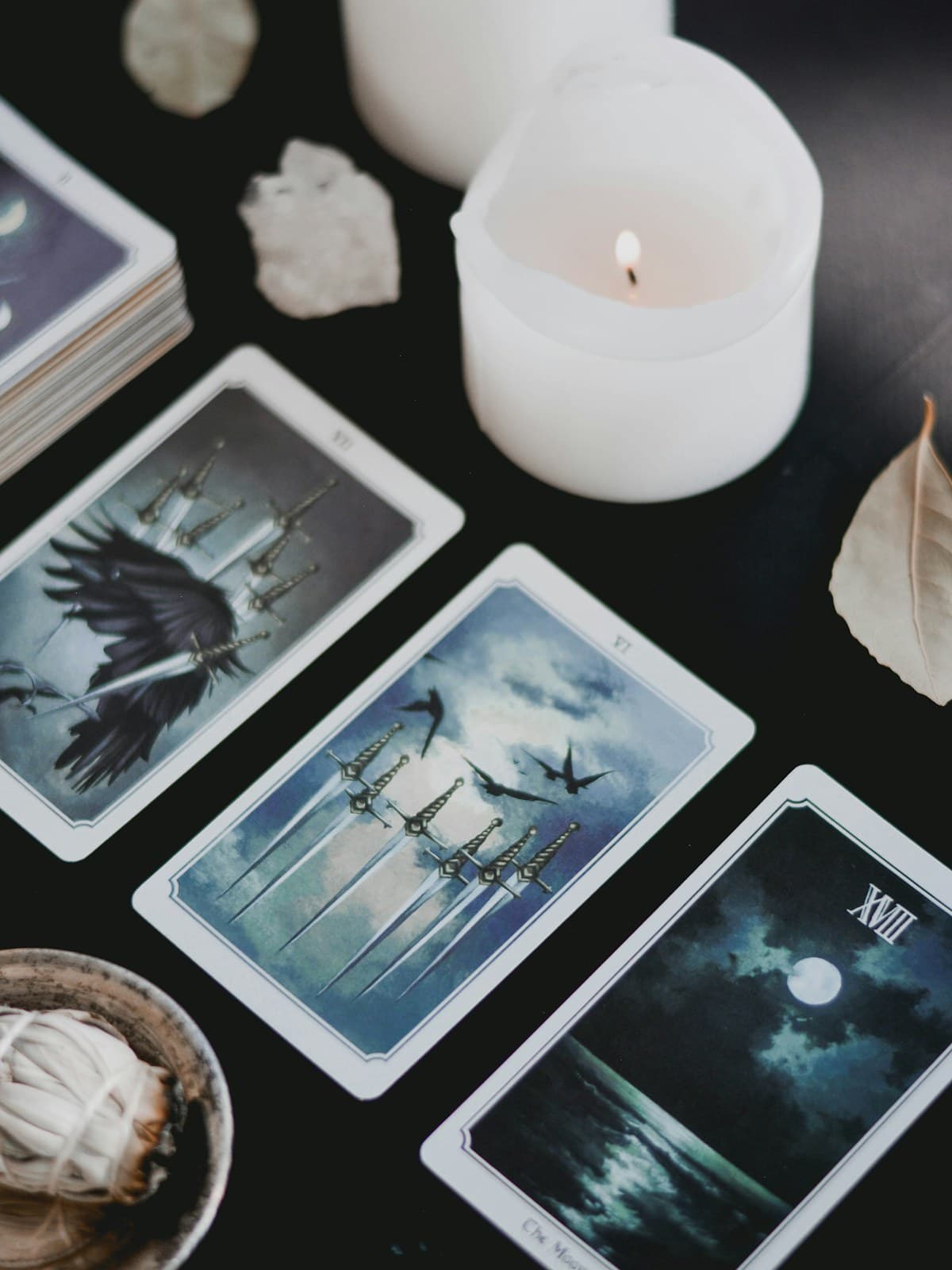
Photos: Ivett M and Content Pixie on Unsplash.
Reversals
7. Is there one agreed way to read a reversed card?
Answer: No. Readers use several conventions: the upright meaning blocked or turned inward, the meaning in excess or delayed, or its opposite, and some leave reversals out altogether. The conventions give different readings of the same card, so settle how you read reversals before you shuffle, keep to it and say which approach you use when you read for someone else. What goes wrong is changing the rule after you see the card, to reach the reading you hoped for.
8. In a yes-or-no method, upright counts as yes and reversed as no. Does that make every reversed card a bad sign?
Answer: No. That rule belongs to that method only. In an ordinary reading a reversal usually changes how the upright meaning is expressed, and some reversals are hopeful: the Four of Cups reversed can mean re-engaging after a period of withdrawal. Orientation does not sort the deck into good cards and bad ones. Tarot Card Reversals and Yes-or-No Readings Explained goes further.
Combinations
9. The Chariot falls beside the Four of Pentacles, and the spread gives neither a position. Which card is the subject?
Answer: The Chariot. With no positions to go on, a Major Arcana card beside a minor is usually read as the larger condition, and the minor as the way it shows up. That gives one statement rather than two verdicts, for example momentum that is being slowed by holding on too tightly to what is already secure.
10. In elemental dignities, which suits strengthen each other and which weaken each other?
Answer: With the usual attributions, fire and air strengthen each other (Wands with Swords), and so do water and earth (Cups with Pentacles). Fire and water weaken each other (Wands with Cups), and so do air and earth (Swords with Pentacles). Two cards of one suit are the strongest pairing of all, and many modern books read the two remaining pairs, fire with earth and air with water, as neutral. The technique comes from the Golden Dawn in the late nineteenth century, not from the earliest decks. Tarot Card Combinations shows it at work.
Spreads
11. The Four of Swords lands in “what helps” in one spread and in “what hinders” in another. Why do the readings differ?
Answer: The position gives the card its job. In “what helps”, the Four of Swords is rest and recovery doing you good; in “what hinders”, the same pause reads as withdrawal or stalling. The card did not change, the question it answers did, which is why the positions are fixed before the draw and never after.
12. How many cards does the Celtic Cross use, and what do the first two show?
Answer: Ten. The first card is the heart of the situation and the second, laid across it, is what crosses it: the challenge or complication. Experienced readers tend to work through the Celtic Cross in small groups of two or three cards rather than as ten separate readings, which is why three-card practice prepares you for it. Three Card Tarot Spread is the place to start.
How did you score?
| Score | What it suggests | What to do next |
|---|---|---|
| 11 or 12 | Solid foundations across all five topics | Take a timed test on the same ground |
| 8 to 10 | Good knowledge with one or two weak topics | Go back to the topics where you dropped points |
| 7 or fewer | The structure is not yet automatic | Start again with the suits, the numbers and the majors |
Look at where you dropped points as much as at the total. Two misses in one topic tell you more than two scattered ones, and they tell you exactly where to spend the next week.
Check yourselfSuppose you scored 10 out of 12 on this page. Before you read on: why might a timed exam next week give you a lower score, even with questions just as hard?Show the answerHide the answer
Three things flattered the score here. Each answer sat just below its question, so part of the work was recognising the idea rather than producing it. The questions came in topic blocks, so each heading told you which rules to reach for. And there was no clock. A mixed, timed test that shows no answer until you commit removes all three supports, and sitting it a few days after you last studied also tests what has stayed with you.
How to test yourself properly
A self-test is only as good as its conditions. Four of them make the difference:
- Recall before you check. Say or write the answer before you look, every time.
- Mix the topics. A question should not tell you which suit or rule it is about.
- Put a clock on it. At a minute or so per question, there is no time to look things up.
- Leave a gap. Test yourself days after you studied, not minutes after.
For a check on the same ground as Astra's level-1 exam, start with the free practice test, and give yourself about a minute a question.
If you want a certificate at the end of it, the level-1 Tarot certification exam has 40 questions in 45 minutes, up to 90 seconds each, and a 70% pass mark. From 90% the certificate says With distinction, though the percentage is never printed. It is unsupervised, with no webcam and no proctor, so it shows that your account passed a timed exam rather than that anyone watched you take it. Two attempts are included, the second 24 hours after the first, and subscribers get level 1 included.
A pass brings a certificate with your name, the direction, Level 1 · Foundation, a number in the form AST-XXX-XXXXXX, a QR code and a public verification page. It is valid for two years, then renewed with a short test, and it comes in eight languages as a PDF and an image, with an Add to LinkedIn button. It is not a licence, an accreditation, an official qualification or a right to practise. None of the twelve questions above come from the exam's question bank.
What to take from this
Twelve questions cannot cover a 78-card deck, but they can show whether you have its structure: what the numbers do across the suits, how a reversal changes a meaning, which of two cards leads and what a position asks of a card. That structure is what lets you read cards you have never looked up.
If you scored well, test yourself again under harder conditions: mixed, timed and a few days later. If you did not, the answers above show which part of the deck to go back to.
Test yourself
Question 1 of 3
Why does the quiz say to settle how you read reversals before you shuffle?
How can I test my tarot knowledge?
Answer questions from memory before checking, mix the topics, time yourself and leave a few days between studying and testing. A quiz with answers, like this one, is a good start; a timed test on mixed topics is the stronger check.
Is there a free tarot test with answers?
Yes. Astra's free Tarot practice test has 10 questions with answers and explanations and needs no sign-up. The twelve questions on this page are free too.
How many cards are in a tarot deck?
78: 22 Major Arcana, from The Fool to The World, and 56 Minor Arcana in four suits of fourteen, Ace to Ten plus Page, Knight, Queen and King.
Do I need to memorise all 78 tarot cards?
Not as 78 separate facts. Four suits and fourteen ranks generate the 56 minor cards, so the real load is the structure plus the 22 majors. Learning the structure first is faster than going card by card.
What is the hardest part of tarot to learn?
For many learners, combinations: reading several cards as one statement. Reversals come close, because different books use different conventions. Both are skills of reasoning rather than memory.
Are these questions from the Astra certification exam?
No. They were written for this article and are not taken from the exam's question bank. The free practice test shows the kind of question the exam asks.
What score do I need to pass the tarot certification exam?
For Astra's level-1 Tarot exam, 70%. From 90%, the certificate says With distinction. The exam has 40 questions in 45 minutes, and two attempts are included.
Where this leads. How to Memorize Tarot Cards: What Actually Works explains why testing yourself beats rereading, and how the deck's structure turns 78 cards into a much smaller load.