
Berkano Key Facts
What the record shows
- Sound
- /b/
- Ætt
- Tyr's ætt, 2nd of 8
- Literal meaning
- Birch, or a birch twig
- Rune poems
- A young tree in all three: fruitless but shooting (OE), greenest-leaved (Norw.), leafy twig (Icel.)
- Other names
- Beorc (Old English), Bjarkan (Old Norse), bercna (Gothic letter name), Berkana
In modern rune reading
- Associated deity
- —
- Element
- —
- Yes or No?
- Yes
- Love
- Nurture, family, a gentle new start; neglect or stalled growth when blocked
- Career & money
- A new venture growing steadily; stalled plans when reversed
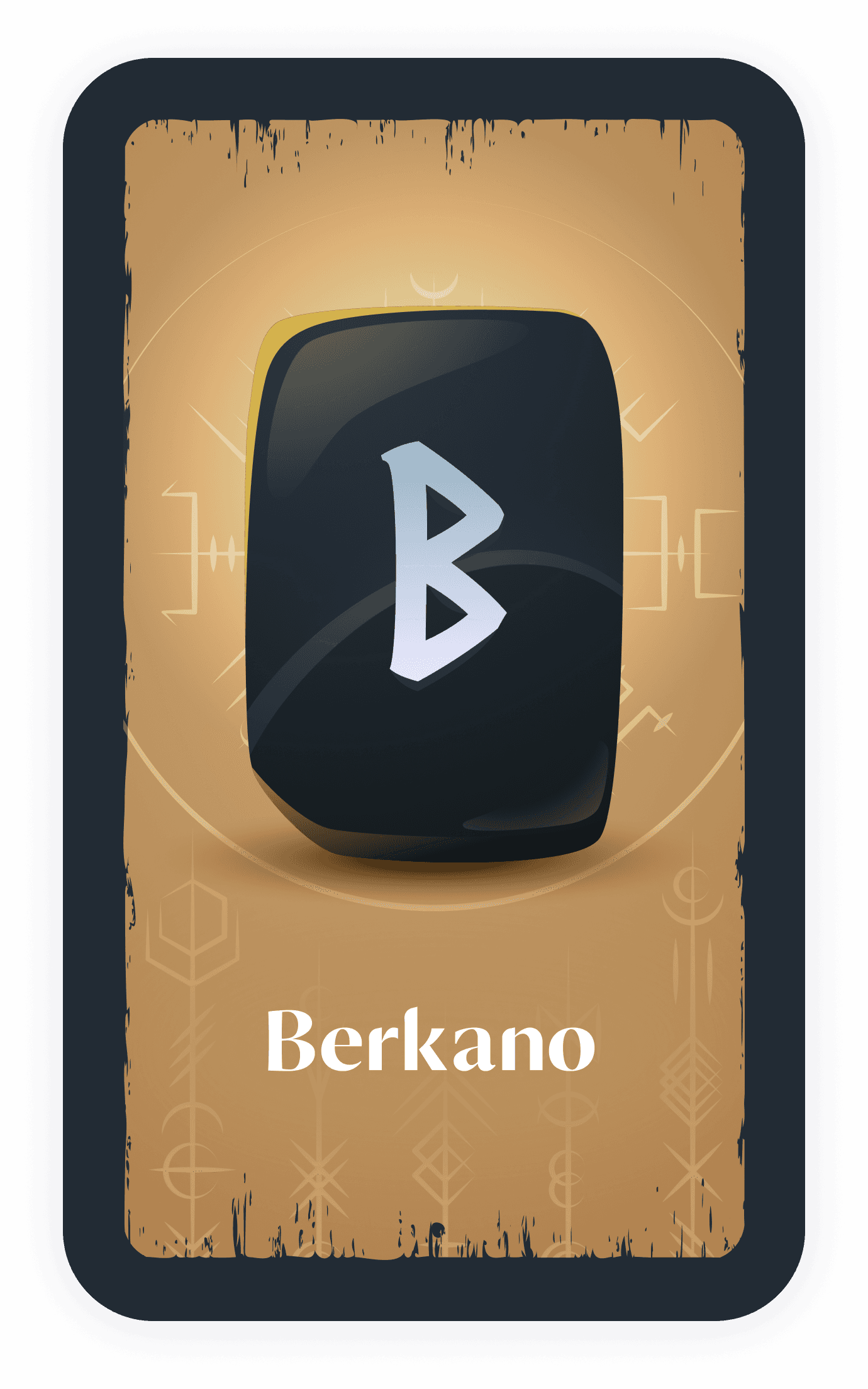
Berkano is the eighteenth rune of the Elder Futhark, the birch — one of the first trees to leaf in a northern spring and to colonise cleared ground. This page keeps two layers apart: what the historical record supports about the rune, and what modern rune reading has built on top of it.
What does Berkano mean?
Berkano stood for the sound /b/. Its name is reconstructed from Proto-Germanic *berkanan, "birch" or "birch twig", related to Old English beorc, Old Norse bjǫrk and English birch; the Gothic letter name bercna is close to the same form. It is one of the runes that survived into the Younger Futhark, where ᛒ also took on /p/ once the p-rune had gone.
The birch is a pioneer tree: among the first to spring up on cleared or burned land, among the first to green in spring, its pale bark bright in winter woods. Those plain facts about the tree carry most of the rune's modern meaning of beginnings and growth. The medieval sources, as the poems show, are less tidy.
What do the rune poems say about Berkano?
All three poems give this rune a stanza about a tree, but not all of them are clearly describing a birch.
- Old English (the Anglo-Saxon futhorc, 8th–9th century): beorc bears no fruit, yet sends up shoots without seed; it is beautiful in its branches, its high crown reaching toward the sky. The description fits a poplar at least as well as a birch, and translators differ.
- Old Norwegian (c. 13th century, Younger Futhark): birch has the greenest leaves of any branch; the second line, as often in this poem, turns elsewhere, to Loki and his deceit.
- Old Icelandic (c. 15th century, Younger Futhark): birch is a leafy twig, a little tree and young wood, glossed with the Latin abies, fir.
The poems are late and describe later rune rows. The Old English poem belongs to the Anglo-Saxon futhorc; the Norse poems to the 16-rune Younger Futhark. Even the tree is unstable: the Old English stanza may describe a poplar, and the Icelandic Latin gloss names a fir.
What the stanzas share is youth and new growth: shoots without seed, the greenest leaves, a little tree. That thread is genuinely in the sources, and the modern reading of Berkano as birth and renewal follows it more closely than many modern meanings follow their runes.
Berkano upright meaning
In modern rune reading an upright Berkano is a rune of beginnings that need care: growth, birth, nurture, something new starting in a protected place. Many readers also treat it as a feminine or mother rune — a modern emphasis, not a historical one.
- Growth — a project, relationship or skill in its early, promising stage.
- Nurture — care, family and home; the conditions that let something develop.
- Renewal — a fresh start after something ends, like birch on cleared ground.
Berkano reversed (merkstave) meaning
Drawn upside down, Berkano is read as growth that stalls: plans that do not take root, neglect of something that needed tending, family tension, or anxiety about a new start. Some readers see overprotection instead — nurture that smothers rather than helps.
Reversed readings are a modern convention. The rune poems give one stanza per rune and no inverted counterpart; merkstave meanings come from 20th-century rune books. Many practitioners find them useful — just know which layer you are using.
Berkano in love and relationships
In a love reading Berkano is about tending: a new relationship in its gentle early phase, a partnership that feels like home, or a wish to build a family. Some readers use it for pregnancy questions — purely modern practice. Reversed, it points to neglect, smothering, or a relationship that has stopped growing.
Berkano in career and money
Upright Berkano suggests a new venture growing steadily: a business in its first year, a role you are growing into, or a team that needs care more than pressure. Reversed, readers look for stalled projects, missing support, or something launched before it was ready.
Is Berkano a yes or no rune?
In yes-or-no rune reading an upright Berkano is a yes, usually a gentle one — yes, if you give it time and care; reversed, most readers read it as not yet, or no. This is purely modern divinatory practice — there is no historical evidence of runes being read this way.
What is attested and what is modern
| Layer | Berkano | How solid |
|---|---|---|
| Sound | /b/ | Solid — read in surviving inscriptions |
| Name and literal meaning | *berkanan, birch | Strong — cognates, Gothic bercna, the poems |
| A young, growing tree | In all three rune poems | Strong, though the OE tree may be a poplar |
| Mother and fertility rune | Modern emphasis | No historical source |
| Upright, merkstave, yes or no | Modern divination | 20th-century practice |
Berkano is the second rune of Tyr's ætt, after Tiwaz, the god, and before Ehwaz, the horse. Readers often pair it with Ingwaz, the seed before it shows, and it makes a natural contrast with Eihwaz, the long-lived yew. For the whole alphabet, see Elder Futhark rune meanings.
What does the Berkano rune mean?
Berkano literally meant birch, or a birch twig, and stood for the sound /b/. All three medieval rune poems describe a young or growing tree. Modern rune readers use Berkano for growth, birth, nurture and new beginnings.
What does Berkano mean reversed?
In modern practice a reversed Berkano is read as stalled growth, neglect, family tension or anxiety about a new start. Reversed meanings are a 20th-century convention; the rune poems give no inverted reading.
Is Berkano a fertility or pregnancy rune?
Many modern readers treat it that way, extending the poems' images of new shoots and young trees. No historical source calls Berkano a fertility or mother rune; that association belongs to modern practice.
Why does the Old English rune poem seem to describe a poplar?
Its tree bears no fruit and spreads by shoots, which fits a poplar at least as well as a birch, so some translators render beorc as poplar. The name still corresponds to birch, and the Norse poems clearly mean birch.