
Tiwaz Key Facts
What the record shows
- Sound
- /t/
- Ætt
- Tyr's ætt, 1st of 8
- Literal meaning
- The god Tyr; possibly also a generic "god"
- Rune poems
- OE: a faithful sign that never fails in the night; Norse: Tyr, the one-handed god
- Other names
- Tir (Old English), Týr (Old Norse), tyz (Gothic letter name), Teiwaz
In modern rune reading
- Associated deity
- Týr — the rune is named for him
- Element
- —
- Yes or No?
- Yes
- Love
- Loyalty, a promise kept, fairness; imbalance or conflict when reversed
- Career & money
- Justice, a fair contest won, principled leadership
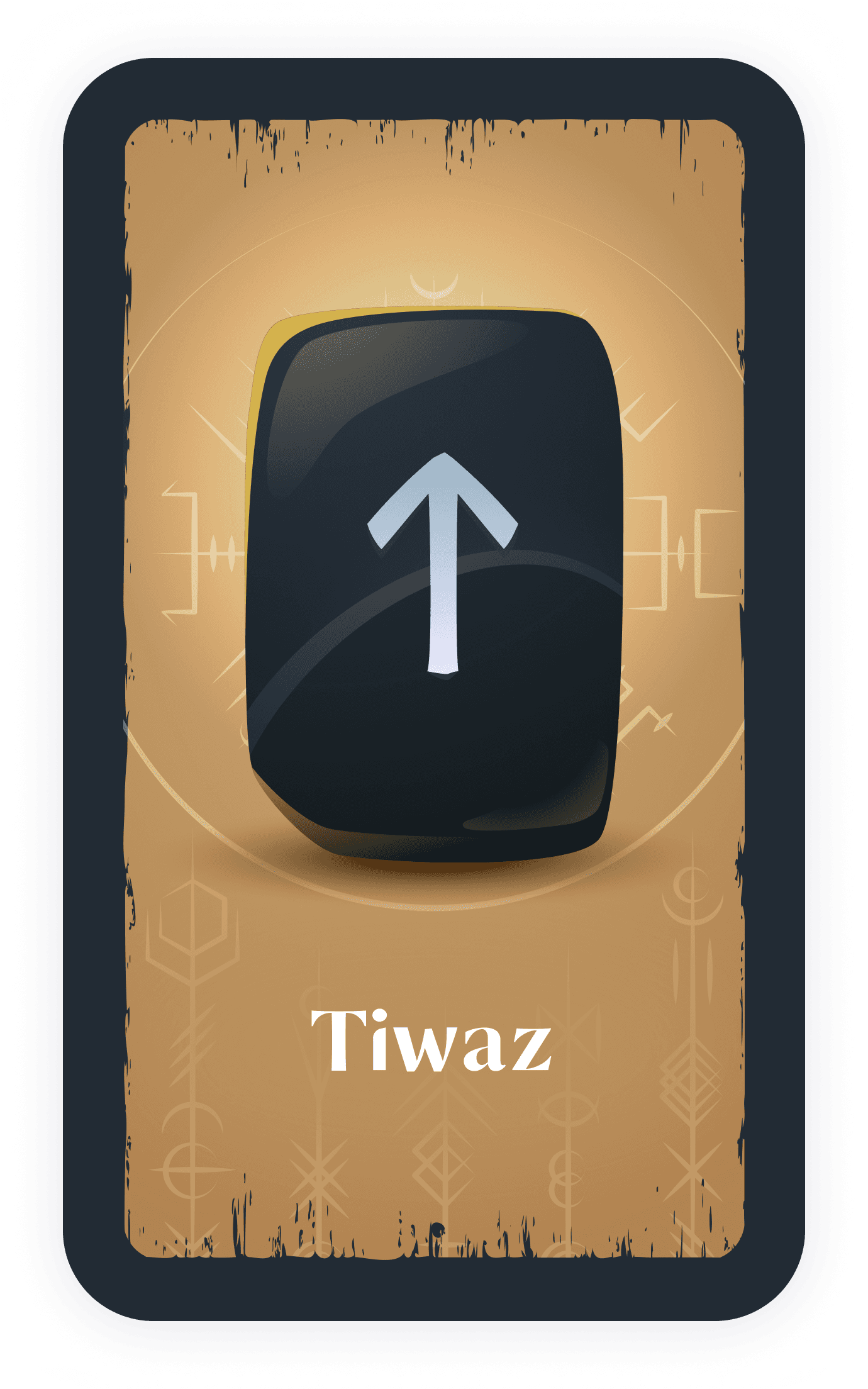
Tiwaz opens the third group of eight in the Elder Futhark, and it is one of only two runes named directly for a god: Tyr, the one-handed god of Norse myth. Its shape is a simple upward arrow. This page keeps two layers apart: what the historical record supports, and what modern rune reading has built on top of it.
What does Tiwaz mean?
Tiwaz stood for the sound /t/. Its name is reconstructed from Proto-Germanic *Tīwaz, the god called Týr in Old Norse and Tīw in Old English — the god behind the English word Tuesday. The same word may also have meant simply "a god", and the Gothic letter name tyz fits the reconstruction. Tyr is well attested across Germanic sources, so this rune name is among the most secure in the row.
In Norse myth Tyr is the god who put his hand in the wolf Fenrir's mouth as a pledge while the gods bound the wolf, and lost it when the trick was discovered. That story of courage, a false promise and a price paid shapes nearly every modern reading of the rune. One medieval poem also ties the name to war: the Eddic Sigrdrífumál tells a warrior to carve victory runes on his sword and name Tyr twice.
What do the rune poems say about Tiwaz?
All three poems include this rune, but the Old English stanza has drifted away from the god.
- Old English (the Anglo-Saxon futhorc, 8th–9th century): tir is a sign that keeps faith well with princes, always on its course through the mists of night, and never fails — usually read as a guiding star or planet.
- Old Norwegian (c. 13th century, Younger Futhark): Tyr is the one-handed god; the second line adds that the smith often has to blow, a half-line with no obvious link, as often in this poem.
- Old Icelandic (c. 15th century, Younger Futhark): Tyr is the one-handed god, the leavings of the wolf and the prince of temples, glossed with the Latin Mars.
The poems are late and describe later rune rows. The Old English poem belongs to the Anglo-Saxon futhorc; the Norse poems to the 16-rune Younger Futhark. The Old English poet may not have had the god in mind at all: tīr also meant glory in Old English.
Side by side, the stanzas give two Tiwaz traditions. The Norse poets keep the god and his missing hand, the cost of the pledge. The Old English poet keeps a fixed point that holds its course in the dark. Modern readings of justice and faithfulness draw on both.
Tiwaz upright meaning
In modern rune reading an upright Tiwaz is the warrior's rune in a principled sense: justice, honour, courage and victory in a cause worth fighting for. Readers lean on the Fenrir story, so the victory usually comes with a sacrifice attached.
- Justice — a fair outcome, a dispute settled, rules applied evenly.
- Courage and sacrifice — doing the right thing when it costs you something.
- Direction — the arrow and the star: a clear goal and the discipline to hold course.
Tiwaz reversed (merkstave) meaning
Drawn upside down, the arrow points at the ground, and readers take Tiwaz as the same virtues failing: injustice, a lost battle, cowardice, or a conflict that drains everyone involved. Some read it as imbalance instead — too much fight, or a sacrifice made for the wrong cause.
Reversed readings are a modern convention. The rune poems give one stanza per rune and no inverted counterpart; merkstave meanings come from 20th-century rune books. Many practitioners find them useful — just know which layer you are using.
Tiwaz in love and relationships
In a love reading Tiwaz is about loyalty and fairness: a partner who keeps their word, a relationship with clear commitment, or the courage to say what needs saying. Reversed, readers look for imbalance — one person sacrificing too much, recurring conflict, or a promise that is not being kept.
Tiwaz in career and money
Upright Tiwaz suggests a fair fight you can win: a negotiation, a legal matter, a competitive application, or leadership that people follow because it is principled. Reversed, it warns of a contest you are not ready for, unfair treatment, or a win that costs more than it is worth.
Is Tiwaz a yes or no rune?
In yes-or-no rune reading an upright Tiwaz is a yes, especially for questions about justice, competition or standing up for something; reversed, most readers take it as a no. This is purely modern divinatory practice — there is no historical evidence of runes being read this way.
What is attested and what is modern
| Layer | Tiwaz | How solid |
|---|---|---|
| Sound | /t/ | Solid — read in surviving inscriptions |
| Name | *Tīwaz, the god Tyr / Tīw | Strong — the god is widely attested |
| Tyr and his lost hand | Norse rune poems, Norse myth | Attested, but in medieval Icelandic texts |
| A faithful guiding sign | Old English poem | Attested; its link to the god is unclear |
| Justice, merkstave, yes or no | Modern divination | 20th-century practice |
Tiwaz opens Tyr's ætt; before it comes Sowilo, the sun, and after it Berkano, the birch. It pairs naturally with Ingwaz, the other rune named for a god, and with Raidho, movement with a direction. For the whole alphabet and the runes still disputed, see Elder Futhark rune meanings.
What does the Tiwaz rune mean?
Tiwaz is named for Tyr, the one-handed Germanic god, and stood for the sound /t/. The Norse rune poems describe the god; the Old English poem describes a faithful guiding sign. Modern readers use Tiwaz for justice, honour, courage and victory.
What does Tiwaz mean reversed?
In modern practice a reversed Tiwaz is read as injustice, defeat, cowardice or draining conflict. Reversed meanings are a 20th-century convention; the rune poems give one stanza per rune and no inverted reading.
Why is the third ætt called Tyr's ætt?
Because Tiwaz, the rune named for Tyr, stands at its head. The division of the Futhark into three groups of eight is old, visible around 500 CE; the names Freyr's, Hagal's and Tyr's ætt come from much later material.
Is the Tiwaz rune a hate symbol?
Not by origin. Nazi organisations used the Tyr rune in insignia, and some white-supremacist groups still use it, so context matters. Its historical meaning is unrelated, and most people who use Tiwaz today have no such association.