
Ehwaz Key Facts
What the record shows
- Sound
- /e/
- Ætt
- Tyr's ætt, 3rd of 8
- Literal meaning
- Horse
- Rune poems
- Old English only: the horse, a joy to nobles and a comfort to the restless; no Norse stanza
- Other names
- Eh (Old English), eyz (Gothic letter name)
In modern rune reading
- Associated deity
- —
- Element
- —
- Yes or No?
- Yes
- Love
- Partnership, trust, moving forward together; mismatch when reversed
- Career & money
- Teamwork, steady progress, a good move; friction when reversed
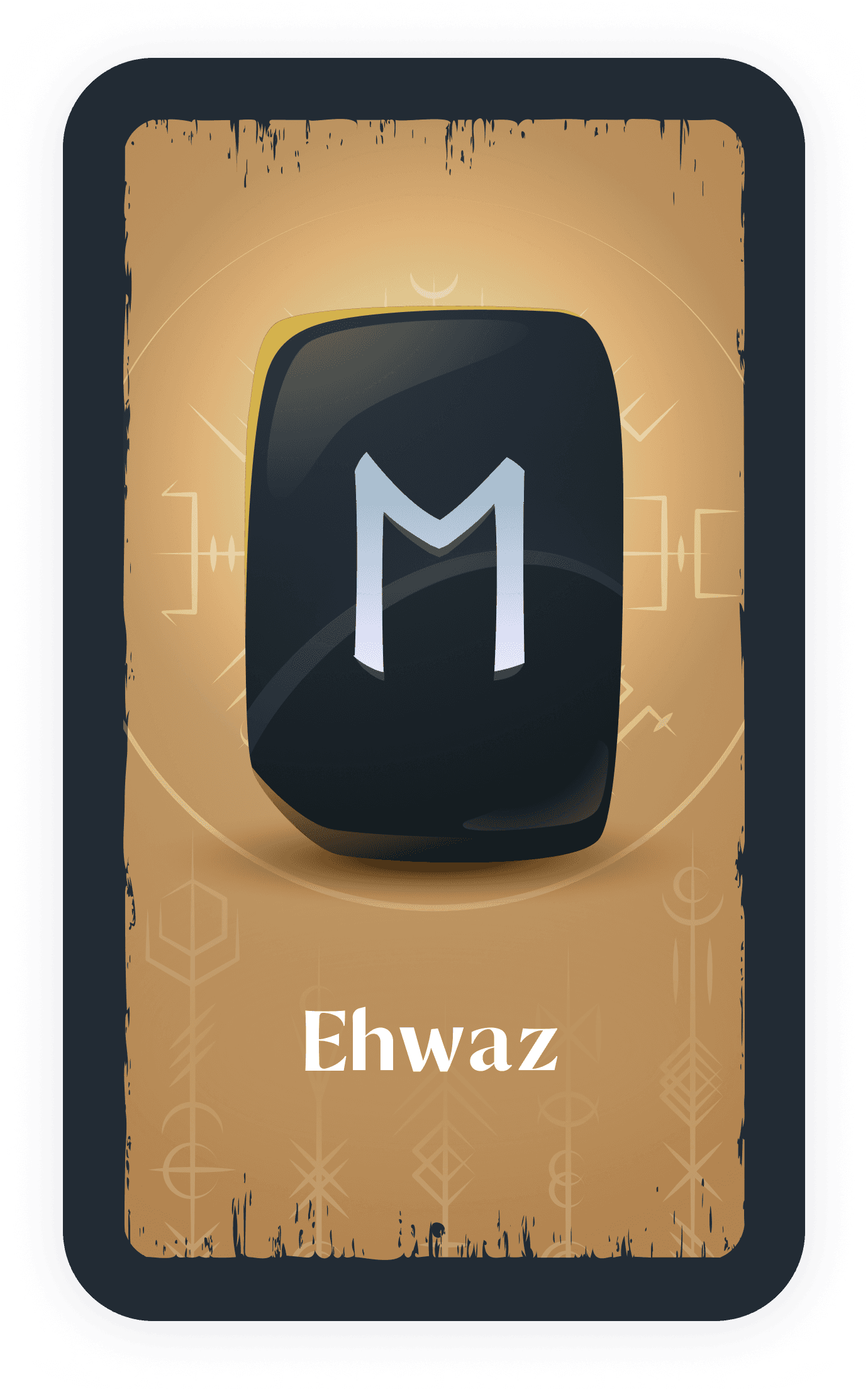
Ehwaz is the nineteenth rune of the Elder Futhark, and its name meant horse. Modern readers take it as the rune of rider and animal working together, which is where its meaning of partnership comes from. This page keeps two layers apart: what the historical record supports, and what modern rune reading has built on top of it.
What does Ehwaz mean?
Ehwaz stood for the sound /e/. Its name is reconstructed from Proto-Germanic *ehwaz, "horse", from the same Indo-European root as Latin equus and Sanskrit aśva. The Old English rune name is eh, and the Gothic letter name eyz is usually read as the Gothic word for horse. Every source points to the same animal, so the name is secure.
The shape looks like two uprights joined in the middle, which many modern readers see as two horses, or a horse and its rider. Some scholars think the form was adapted from a Latin E; the evidence is uncertain. In the Germanic world the horse meant wealth, transport, war and status at once, and Norse myth gives the gods famous horses, above all Odin's eight-legged Sleipnir — though no source connects any of them to the rune.
What do the rune poems say about Ehwaz?
Only the Old English poem has a stanza for this rune.
- Old English (the Anglo-Saxon futhorc, 8th–9th century): the horse is a joy to princes among warriors, a steed proud in its hooves when wealthy riders trade words about it, and always a comfort to the restless.
- Old Norwegian (c. 13th century, Younger Futhark): no stanza. The Younger Futhark dropped Ehwaz and had no separate rune for /e/ at all.
- Old Icelandic (c. 15th century, Younger Futhark): no stanza, for the same reason.
The poems are late and describe later rune rows. The Old English poem belongs to the Anglo-Saxon futhorc; the Norse poems to the 16-rune Younger Futhark. For Ehwaz only the Old English stanza survives, so the rune's medieval gloss comes from one poet in one tradition.
The single stanza is about status and companionship more than travel: the horse as a noble's pride, a talking point among riders, and a comfort to someone who cannot settle. The modern emphasis on trust and partnership is a fair extension of that; the idea of the journey itself belongs more to Raidho.
Ehwaz upright meaning
In modern rune reading an upright Ehwaz is the rune of partnership in motion: trust between two parties, cooperation, and steady progress made together. Readers picture horse and rider, each relying on the other, and extend that to any relationship where both sides have to move as one.
- Partnership — a trusted collaborator, a good match, loyalty that holds under pressure.
- Progress — steady forward movement; a change of place or situation that goes smoothly.
- Trust — handing part of the load to someone else and letting them carry it.
Ehwaz reversed (merkstave) meaning
Drawn upside down, Ehwaz is read as a partnership falling out of step: mistrust, a mismatch between people who want different things, restlessness, or progress stalling because nobody pulls in the same direction. Some readers take it as a move or journey best postponed.
Reversed readings are a modern convention. The rune poems give one stanza per rune and no inverted counterpart; merkstave meanings come from 20th-century rune books. Many practitioners find them useful — just know which layer you are using.
Ehwaz in love and relationships
Ehwaz is one of the most relationship-friendly runes in modern reading. Upright it suggests a partner you can rely on, a couple that works as a team, or a relationship taking a step forward, such as moving in together. Reversed, readers look for a mismatch of pace, trust issues, or one partner doing all the carrying.
Ehwaz in career and money
Upright Ehwaz favours collaboration: a good business partner, a team that trusts each other, or a transfer or relocation that goes well. Reversed, it warns of friction with a colleague, a partnership built on the wrong terms, or change made for its own sake.
Is Ehwaz a yes or no rune?
In yes-or-no rune reading an upright Ehwaz is a yes, especially when the question involves another person or a move; reversed, most readers take it as a no, or "not with this partner". This is purely modern divinatory practice — there is no historical evidence of runes being read this way.
What is attested and what is modern
| Layer | Ehwaz | How solid |
|---|---|---|
| Sound | /e/ | Solid — read in surviving inscriptions |
| Name and literal meaning | *ehwaz, horse | Strong — Latin equus, Gothic eyz, Old English eh |
| The horse as noble joy and comfort | Old English poem only | Attested, but medieval |
| Horse and rider as partnership | Modern interpretation | A fair extension; in no source |
| Upright, merkstave, yes or no | Modern divination | 20th-century practice |
Ehwaz is the third rune of Tyr's ætt, between Berkano, the birch, and Mannaz, the human being — the horse beside its rider. Readers often pair it with Raidho, the journey, and with Gebo, the exchange that binds two parties. For the whole alphabet, see Elder Futhark rune meanings.
What does the Ehwaz rune mean?
Ehwaz literally meant horse and stood for the sound /e/. The Old English rune poem calls the horse a joy to nobles and a comfort to the restless. Modern rune readers use Ehwaz for partnership, trust, teamwork and steady progress.
What does Ehwaz mean reversed?
In modern practice a reversed Ehwaz is read as mistrust, a mismatched partnership, restlessness or stalled progress. Reversed meanings are a 20th-century convention; the one surviving rune-poem stanza gives no inverted reading.
Is Ehwaz a good rune for love?
In modern practice, yes: an upright Ehwaz is read as a reliable partner and a couple moving forward together. That reading is built on the horse-and-rider image, not on anything the historical sources say about the rune.
Why is Ehwaz missing from the Norse rune poems?
The Norwegian and Icelandic poems describe the 16-rune Younger Futhark, which dropped Ehwaz and had no separate rune for /e/. Only the Old English poem, written for the Anglo-Saxon futhorc, keeps a stanza for the horse.