
Ingwaz Key Facts
What the record shows
- Sound
- /ŋ/, the "ng" in sing
- Ætt
- Tyr's ætt, 6th of 8
- Literal meaning
- The god Ing (Yngvi)
- Rune poems
- Old English only: Ing, seen among the East-Danes, left eastward over the waves; no Norse stanza
- Other names
- Ing (Old English), enguz (Gothic letter name), Inguz
In modern rune reading
- Associated deity
- Ing (Yngvi), usually identified with Freyr
- Element
- —
- Yes or No?
- Yes
- Love
- Commitment, a relationship ready to grow; feelings withheld in a hard spread
- Career & money
- A project prepared and ready to launch; rest before a new start
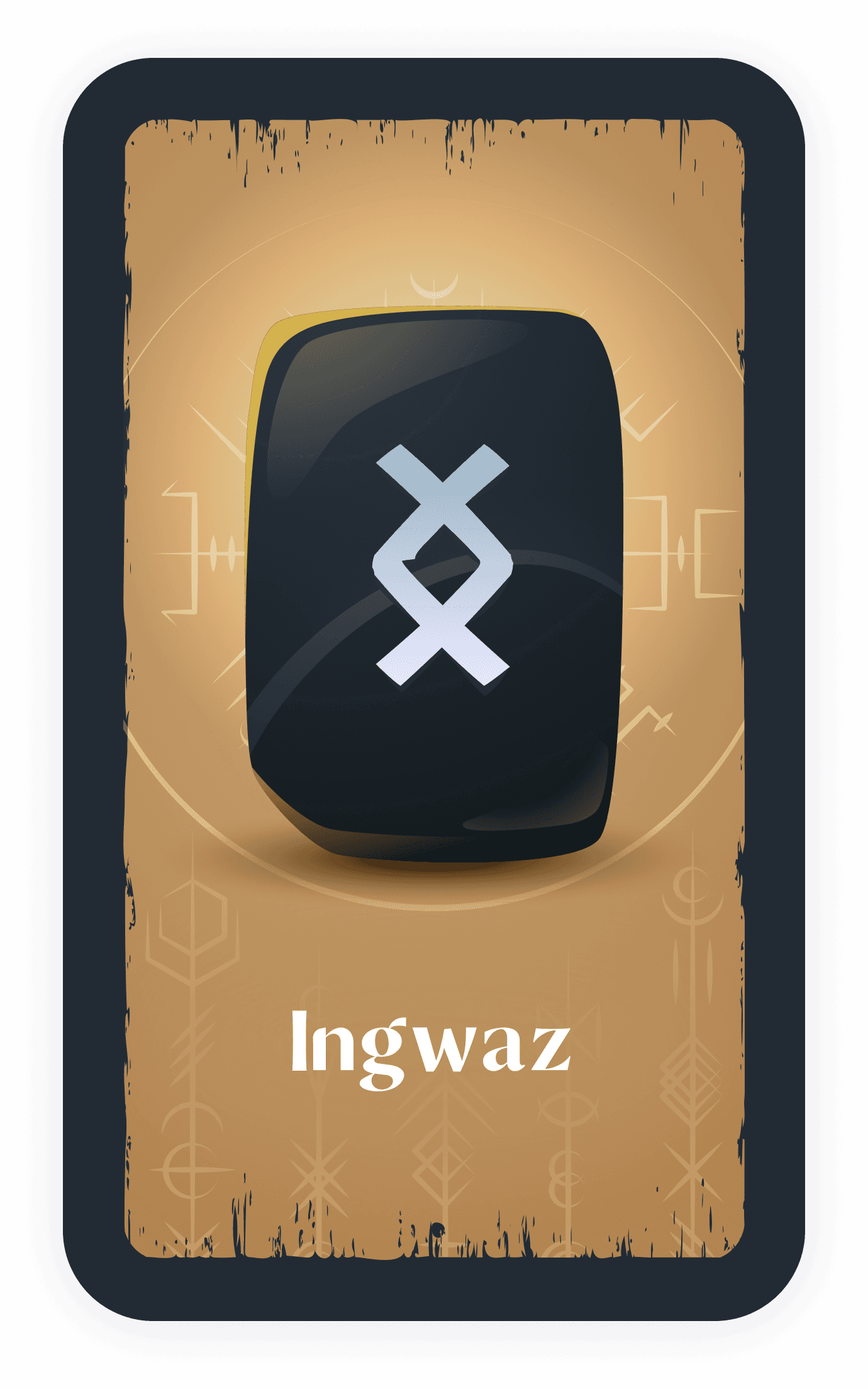
Ingwaz is the twenty-second rune of the Elder Futhark and the second of only two runes named for a god — Ing, a figure far less documented than Tyr. It spelled the sound at the end of sing. This page keeps two layers apart: what the historical record supports, and what modern rune reading has built on top of it.
What does Ingwaz mean?
Ingwaz stood for /ŋ/, the "ng" sound, which never began a word in early Germanic. The name is reconstructed from Proto-Germanic *Ingwaz, the god or ancestor-figure the Old English poem calls Ing. The Gothic letter name enguz fits, and the Roman historian Tacitus names a group of Germanic peoples, the Ingaevones, whose name seems to contain the same element.
In Norse tradition Yngvi is a name of the god Freyr, and the Swedish royal line of the Ynglings claimed descent from him; that is why modern books identify Ing with Freyr. The identification is widely accepted, but the figure of Ing himself is thinly documented. The rune's shape varies as well: most often a small diamond or square, and in the Anglo-Saxon row a larger crossed form, ᛝ.
What do the rune poems say about Ingwaz?
Only the Old English poem includes this rune, and its stanza is a fragment of myth rather than a definition.
- Old English (the Anglo-Saxon futhorc, 8th–9th century): Ing was first seen by men among the East-Danes, until he went back eastward over the waves, his wagon running after; so the Heardings named that hero.
- Old Norwegian (c. 13th century, Younger Futhark): no stanza. The Younger Futhark dropped Ingwaz.
- Old Icelandic (c. 15th century, Younger Futhark): no stanza, for the same reason.
The poems are late and describe later rune rows. The Old English poem belongs to the Anglo-Saxon futhorc; the Norse poems to the 16-rune Younger Futhark. Ing's stanza is nearly the only rune-poem evidence for the figure, and nobody knows for certain who the Heardings were.
The stanza gives Ing an arrival and a departure: a being seen for a while among the Danes, then gone over the sea with a wagon following. The wagon has been compared with the cart processions of Germanic fertility deities, such as the goddess Nerthus described by Tacitus — one reason modern readers call Ingwaz a fertility rune. That is interpretation layered on a single obscure verse.
Ingwaz upright meaning
In modern rune reading Ingwaz is the rune of potential held in: a seed before it shows, a pregnancy, a project gestating out of sight, energy stored until it is ready. Many readers also read it as completion — one phase closing so that the next can begin.
- Gestation — something developing quietly, not yet ready to be seen.
- Fertility — growth, family, creative potential; a modern reading built on Ing and Freyr.
- Completion — a cycle closing, and rest before a new start.
Ingwaz reversed: why there is no merkstave
The diamond-shaped Ingwaz looks the same upside down, so it cannot be drawn reversed, and rune books generally give it no merkstave meaning. Readers who want a shadow side read it through its neighbours: next to Isa or Naudhiz, stored potential can read as frustration, impatience, or energy that stays locked up.
Reversed readings are a modern convention anyway. The rune poems give one stanza per rune and no inverted counterpart, and symmetrical runes such as Ingwaz, Gebo, Isa and Dagaz show the limit of the idea: for them "reversed" is not even defined.
Ingwaz in love and relationships
In a love reading Ingwaz suggests a relationship ready for its next stage: commitment, moving in, starting a family, or feelings that have grown quietly and are ready to be said. In a hard spread readers see something withheld instead — feelings kept in, or a relationship waiting too long for the right moment.
Ingwaz in career and money
Ingwaz favours work that has been prepared carefully: a project finished and ready to launch, a skill that has matured, or a deliberate pause before a new role. In a difficult spread it warns of launching too early, or of holding back something that is already ready.
Is Ingwaz a yes or no rune?
In yes-or-no rune reading Ingwaz is a yes, often a "yes, when it is ready", and because it cannot be reversed it stays a yes. This is purely modern divinatory practice — there is no historical evidence of runes being read this way.
What is attested and what is modern
| Layer | Ingwaz | How solid |
|---|---|---|
| Sound | /ŋ/ | Solid — read in surviving inscriptions |
| Name | *Ingwaz, the god Ing | Strong name; the figure thinly documented |
| Ing departing over the waves | Old English poem only | Attested, but obscure and medieval |
| Ing as Yngvi-Freyr | Norse tradition | Widely accepted identification |
| Fertility, gestation, yes or no | Modern divination | 20th-century practice |
Ingwaz is the sixth rune of Tyr's ætt, after Laguz, water, and before Dagaz, the day. It pairs with Tiwaz, the other rune named for a god, and readers often set it beside Berkano and Jera as runes of growth that comes in its own time. For the two god-named runes in context, see Elder Futhark rune meanings.
What does the Ingwaz rune mean?
Ingwaz is named for Ing, a Germanic god or ancestor usually identified with Freyr, and stood for the sound /ŋ/. The Old English poem tells of Ing departing over the waves. Modern readers use it for potential, gestation, fertility and completion.
Does Ingwaz have a reversed meaning?
No. The diamond-shaped Ingwaz looks the same upside down, so it cannot be drawn reversed, and most rune books give it no merkstave reading. Reversed meanings are a modern convention in any case.
Is Ingwaz the rune of Freyr?
Indirectly. The rune is named for Ing, and in Norse tradition Yngvi is a name of Freyr, so the identification is widely accepted. The figure of Ing himself is thinly documented, and almost nothing is known of his worship.
Why is Ingwaz called a fertility rune?
Because modern readers extend its link to Freyr, a god of fertility and plenty, and to the wagon in the Old English stanza. No historical source defines the rune as a fertility sign; that reading is modern.