
Mannaz Key Facts
What the record shows
- Sound
- /m/
- Ætt
- Tyr's ætt, 4th of 8
- Literal meaning
- Man, in the sense of human being
- Rune poems
- Dear to kin yet mortal (OE); increase of the dust (Norw.); delight of man (Icel.)
- Other names
- Man (Old English), Maðr (Old Norse), manna (Gothic letter name)
In modern rune reading
- Associated deity
- —
- Element
- —
- Yes or No?
- Maybe
- Love
- Equals who see each other clearly; projection or isolation when reversed
- Career & money
- Cooperation, networks, people skills; office politics when reversed
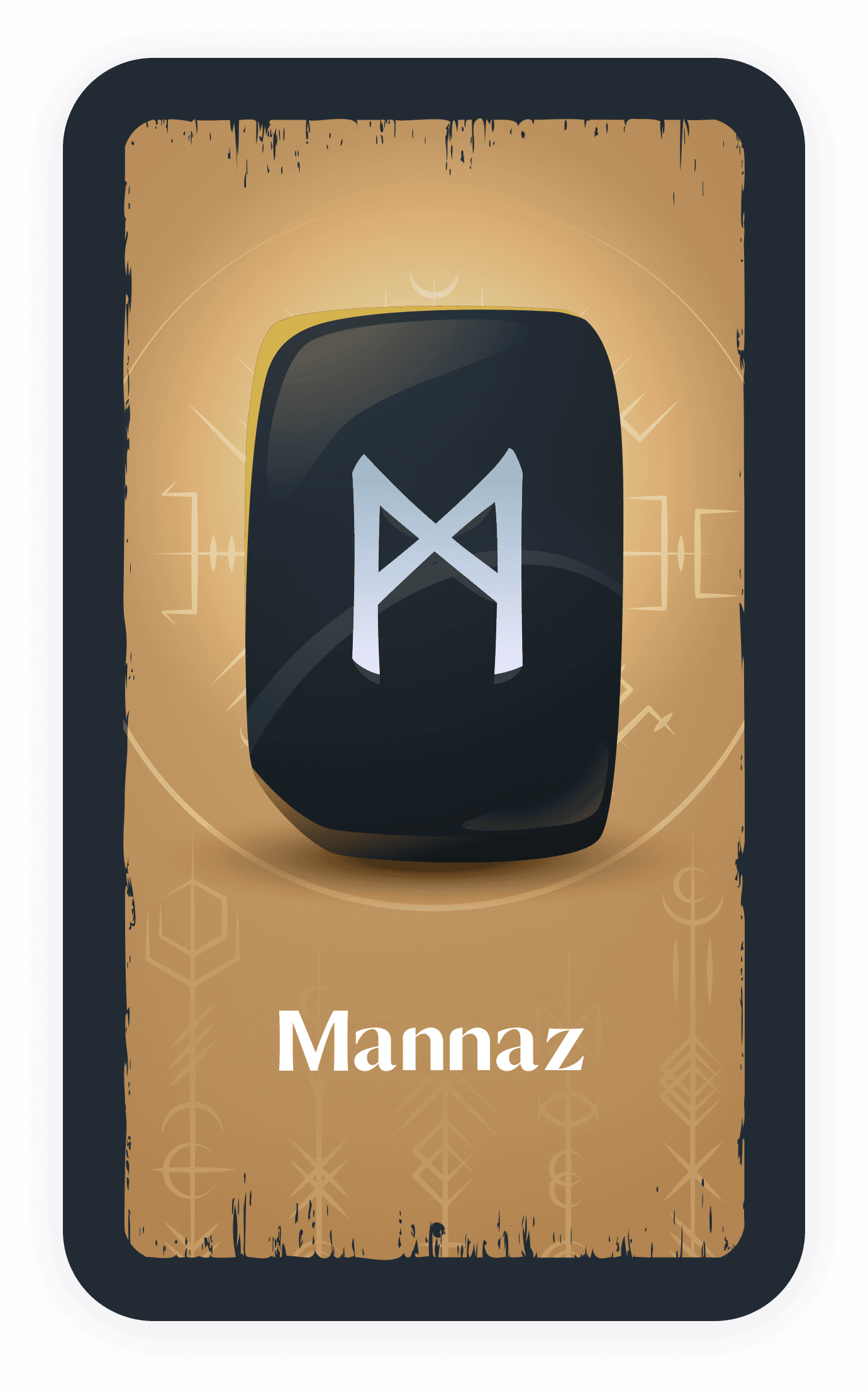
Mannaz is the twentieth rune of the Elder Futhark, and its name meant a human being — not specifically a male one. It is the rune of the person among other people. This page keeps two layers apart: what the historical record supports, and what modern rune reading has built on top of it.
What does Mannaz mean?
Mannaz stood for the sound /m/. Its name is reconstructed from Proto-Germanic *mannaz, "person, human being", the ancestor of English man in its old sense of anyone, as in mankind. Old English named the rune man, Old Norse maðr, and the Gothic letter name manna matches. Few names in the row are so secure.
The rune also shows how rune rows changed. The Younger Futhark kept the name and the sound but not the shape: its m-rune took the form ᛘ, which in the older row had belonged to Algiz. Separately, the Roman historian Tacitus names Mannus, son of the earth-born god Tuisto, as an ancestor of the Germanic peoples; modern writers often connect him with this rune, a link no early source makes.
What do the rune poems say about Mannaz?
All three poems have a stanza for this rune, and each one sets people against the earth they come from or return to.
- Old English (the Anglo-Saxon futhorc, 8th–9th century): the joyful man is dear to his kinsmen, yet each must fail the other, because the Lord will commit the wretched flesh to the earth.
- Old Norwegian (c. 13th century, Younger Futhark): man is the increase of the dust; the second line, with no clear link, praises the great grip of the hawk's claw.
- Old Icelandic (c. 15th century, Younger Futhark): man is the delight of man, the increase of the earth and the adorner of ships, glossed with the Latin homo.
The poems are late and describe later rune rows. The Old English poem belongs to the Anglo-Saxon futhorc; the Norse poems to the 16-rune Younger Futhark. They are the best evidence for what the Elder Futhark name meant, not a manual for how anyone used Mannaz in a reading.
Read together, the stanzas hold two thoughts at once: people are a joy to one another, and every one of them returns to the earth. The Christian Old English poet turns that into a lesson in mortality; the Icelandic poet stays with the pleasure of company. Modern readings keep the social half and mostly drop the grave.
Mannaz upright meaning
In modern rune reading an upright Mannaz is the rune of the self among others: humanity, identity, community, and the mind that reflects on all three. Readers use it for questions about how you relate to people, and how clearly you see yourself.
- Self-awareness — seeing your own strengths and limits honestly.
- Community — family, friends, colleagues; help given and received.
- Shared humanity — cooperation, fairness, remembering the other person is human too.
Mannaz reversed (merkstave) meaning
Drawn upside down, Mannaz is read as the social fabric fraying: isolation, self-deception, manipulation, or seeing other people only as obstacles. Some readers connect it with the Old English stanza's harder line — that people fail one another, and that nobody is permanent.
Reversed readings are a modern convention. The rune poems give one stanza per rune and no inverted counterpart; merkstave meanings come from 20th-century rune books. Many practitioners find them useful — just know which layer you are using.
Mannaz in love and relationships
In a love reading Mannaz is about seeing and being seen: a relationship between equals, honest communication, partners who are also friends. Reversed, readers look for projection — loving an idea of someone rather than the person — or a couple cut off from the people around them.
Mannaz in career and money
Upright Mannaz favours people skills: networking, teamwork, mentoring, or a role where judgement about people matters more than raw output. Reversed, it warns of office politics, being used by others, or a working life that has become lonely.
Is Mannaz a yes or no rune?
In yes-or-no rune reading Mannaz is usually a maybe that depends on other people: the answer turns on cooperation, or on how honestly you are assessing yourself. Reversed, many readers take it as a no. This is purely modern divinatory practice — there is no historical evidence of runes being read this way.
What is attested and what is modern
| Layer | Mannaz | How solid |
|---|---|---|
| Sound | /m/ | Solid — read in surviving inscriptions |
| Name and literal meaning | *mannaz, human being | Strong — cognates, Gothic manna, all three poems |
| Joy of kin, mortality, the earth | In all three rune poems | Strong, but the poems are medieval |
| Mannus of Tacitus | Modern connection | Related word; no source ties him to the rune |
| Self, community, merkstave, yes or no | Modern divination | 20th-century practice |
Mannaz is the fourth rune of Tyr's ætt, after Ehwaz, the horse, and before Laguz, water. Readers often pair it with Gebo, the gift that creates obligations between people, and with Othala, the inherited home. For the whole alphabet, see Elder Futhark rune meanings.
What does the Mannaz rune mean?
Mannaz literally meant a human being and stood for the sound /m/. The rune poems describe people as a joy to their kin and as mortal, returning to the earth. Modern readers use Mannaz for humanity, the self, community and cooperation.
What does Mannaz mean reversed?
In modern practice a reversed Mannaz is read as isolation, self-deception, manipulation or conflict with others. Reversed meanings are a 20th-century convention; the rune poems give one stanza per rune and no inverted reading.
Does Mannaz mean man or human?
Human. Proto-Germanic *mannaz meant a person of any sex, the older sense that survives in English words such as mankind. Modern rune readers accordingly use Mannaz for humanity and the self, not for men in particular.
What does Mannaz mean in a love reading?
In modern practice an upright Mannaz points to a relationship between equals, honest communication and partners who are also friends; reversed, to projection or isolation. These are modern readings, not part of the historical record.