
Raidho Key Facts
What the record shows
- Sound
- /r/
- Ætt
- Freyr's ætt, 5th of 8
- Literal meaning
- Ride, riding, journey; also a wagon
- Rune poems
- Riding in all three: easy indoors, hard on the road (Old English); worst for horses (Norwegian); joy and toil (Icelandic)
- Other names
- Rād (Old English), Reið (Old Norse), reda (Gothic letter name); Raido
In modern rune reading
- Associated deity
- —
- Element
- Air in some systems; no agreed element
- Yes or No?
- Yes
- Love
- A relationship moving forward together; drifting apart when blocked
- Career & money
- Travel, relocation, a well-planned route; delays when blocked
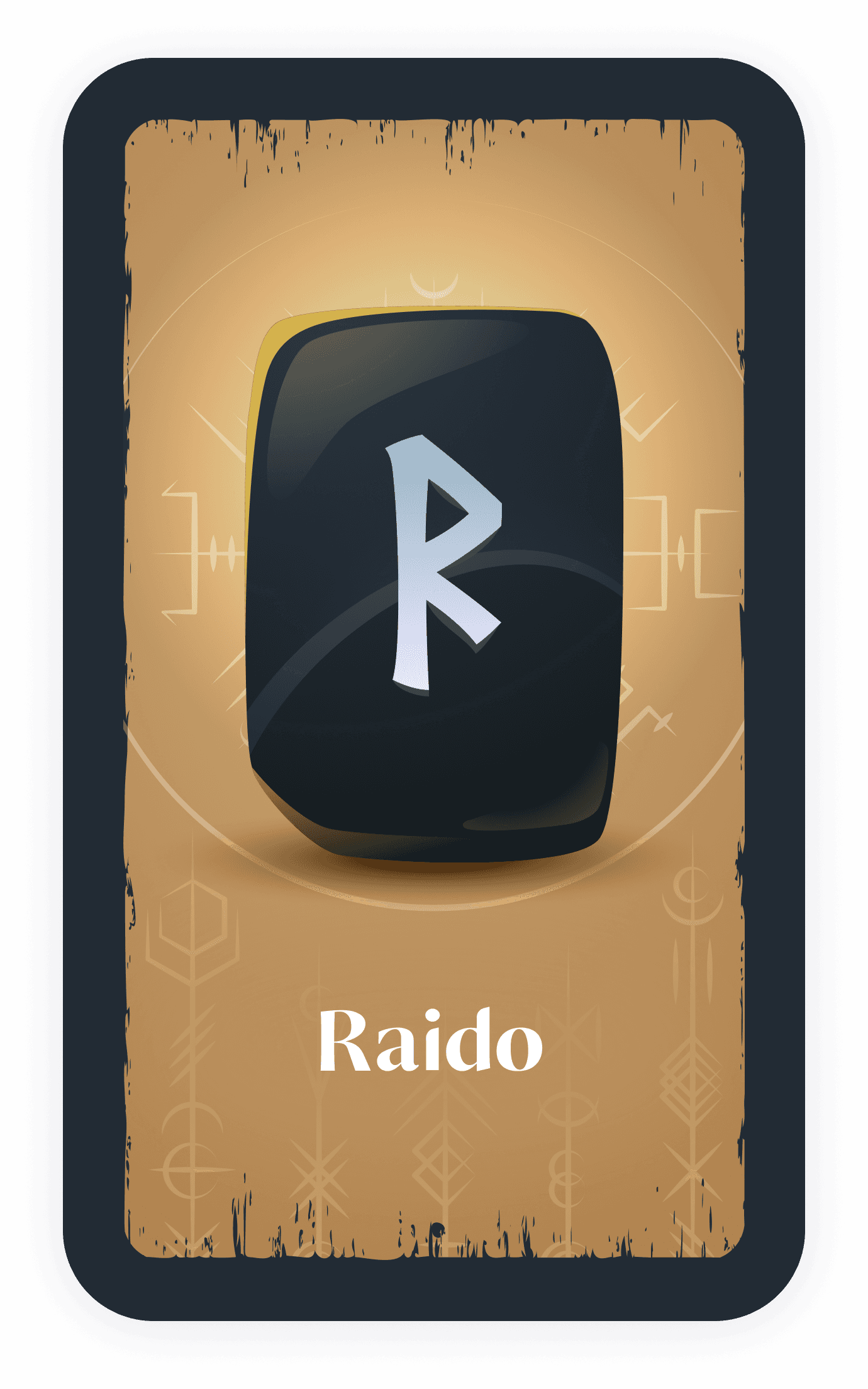
Raidho is the fifth rune of the Elder Futhark, the r in "futhark". Its name means riding, and all three rune poems agree on that, which makes it one of the more secure runes in the row. Modern readers make it the rune of journeys, direction and movement. This page keeps what is attested apart from what is modern.
What does Raidho mean?
Raidho stood for the sound /r/. The name is reconstructed as Proto-Germanic *raidō, "riding", with the extended senses of journey and wagon — the same family of words as English ride and road. The Old English rune name is rād, the Old Norse reið, and the Gothic letter name reda has been connected with a Gothic word for a wagon.
This is a rune where the sources line up. Every poem names it riding, and the concrete world is easy to picture: a horse, a road, perhaps a cart, and the distance between two places in a landscape where travel was slow, tiring and sometimes dangerous. The rune's shape may come from Latin R. The app spells the name Raido; both spellings are common.
What do the rune poems say about Raidho?
All three poems describe riding, and all three are honest about what it costs.
- Old English (the Anglo-Saxon futhorc, 8th–9th century): riding seems easy to every warrior while he is indoors — and a far harder matter for the one astride a strong horse on the long roads.
- Old Norwegian (c. 13th century, Younger Futhark): riding is said to be the worst thing for horses; Reginn forged the finest sword.
- Old Icelandic (c. 15th century, Younger Futhark): riding is the joy of the horseman, a speedy journey and the toil of the steed, glossed with the Latin iter, journey.
The poems are late and describe later rune rows. The Old English poem belongs to the Anglo-Saxon futhorc; the Norse poems to the 16-rune Younger Futhark. They are the best evidence for what the Elder Futhark names meant, not a manual for how anyone used Raidho in a reading.
Read together, the stanzas have a dry humour the modern keywords miss. The English poem teases the man who talks bravely about riding by the fire; the Norse poems remember the horse doing the work. The Norwegian second line turns to Reginn, the smith of the Sigurd legend — its stanzas often pair the rune with an unrelated saying. The shared idea is that a journey is effort, not just motion.
Raidho upright meaning
In modern rune reading an upright Raidho is a rune of movement with a direction: travel, a move, a plan put into motion, or life settling into a workable rhythm. Many readers stress the journey over the destination — the rune is about how you travel, not only where you arrive.
- Travel — a trip, a relocation, a route that matters.
- Direction — the right road chosen, a decision with a clear next step.
- Rhythm and order — things moving in sequence, at a pace you can keep.
Raidho reversed (merkstave) meaning
Drawn upside down, Raidho is read as a journey going wrong: delays, cancelled plans, a detour, trouble on the road, or a sense of moving without direction. Some readers read it as stagnation — the horse still in the stable while you talk about the road.
Reversed readings are a modern convention. The rune poems give one stanza per rune and no inverted counterpart; merkstave meanings come from 20th-century rune books. Many practitioners find them useful — just know which layer you are using.
Raidho in love and relationships
In a love reading Raidho is about moving together. Upright it can mean a relationship progressing, travelling as a couple, or a long-distance bond closing the gap. Reversed, readers look for partners heading in different directions, a stalled commitment, or one person setting the whole pace.
Raidho in career and money
At work Raidho favours travel, relocation, logistics and any plan that depends on doing things in order. Upright it suggests the route is sound — keep moving. Reversed it points to delays, a project off course, or a change of direction made for its own sake.
Is Raidho a yes or no rune?
In yes-or-no rune reading, an upright Raidho is a yes, especially for questions about travel, moving house or getting started. Reversed, most readers take it as a no or a not yet. This is purely modern divinatory practice; there is no historical evidence of runes being read this way.
What is attested and what is modern
| Layer | Raidho | How solid |
|---|---|---|
| Sound | /r/ | Solid — read in surviving inscriptions |
| Name and literal meaning | *raidō, riding, journey | Strong — the same idea in every source |
| Wagon | Extended sense, via the Gothic letter name | Plausible, less certain |
| Journey as effort | In all three rune poems | Strong, but the poems are medieval |
| Upright, merkstave, yes or no | Modern divination | 20th-century practice |
Raidho is the fifth rune of Freyr's ætt, after Ansuz and before Kenaz, the torch. Readers often pair it with Ehwaz, the horse itself, and contrast it with Isa, the ice that stops all movement. For the whole alphabet and the names still disputed, see Elder Futhark rune meanings.
What does the Raidho rune mean?
Raidho stood for the sound /r/, and its name is reconstructed as *raidō, riding or journey. All three medieval rune poems describe riding, and modern rune readers use it for travel, direction, progress and a steady rhythm.
What does Raidho mean reversed?
In modern practice a reversed (merkstave) Raidho is read as delays, disrupted travel, a detour or movement without direction. Reversed meanings are a 20th-century convention; the medieval rune poems give one stanza per rune and no inverted reading.
Is it Raidho or Raido?
Both. Raidho, Raido and Raidō are spellings of the same reconstructed Proto-Germanic name. Old English called the rune rād and Old Norse reið; the spelling differs between books, the meaning does not.
Does Raidho mean a journey or a wagon?
Mainly riding and journey — that is what all three rune poems describe. The wagon sense rests chiefly on the Gothic letter name, so it is an extension. Modern readers use both images for movement with a direction.