
Kenaz Key Facts
What the record shows
- Sound
- /k/
- Ætt
- Freyr's ætt, 6th of 8
- Literal meaning
- Disputed: torch (Old English) or ulcer, sore (Norse)
- Rune poems
- A bright torch in the hall (Old English); an ulcer fatal to children (Norwegian, Icelandic)
- Other names
- Cēn (Old English), Kaun (Old Norse), chozma (Gothic letter name); Kaunan
In modern rune reading
- Associated deity
- —
- Element
- Fire in most modern systems; not historical
- Yes or No?
- Yes
- Love
- Warmth, desire, clarity about feelings; a flame going out when blocked
- Career & money
- Skill, craft, learning, creative work; a block or lost vision when blocked
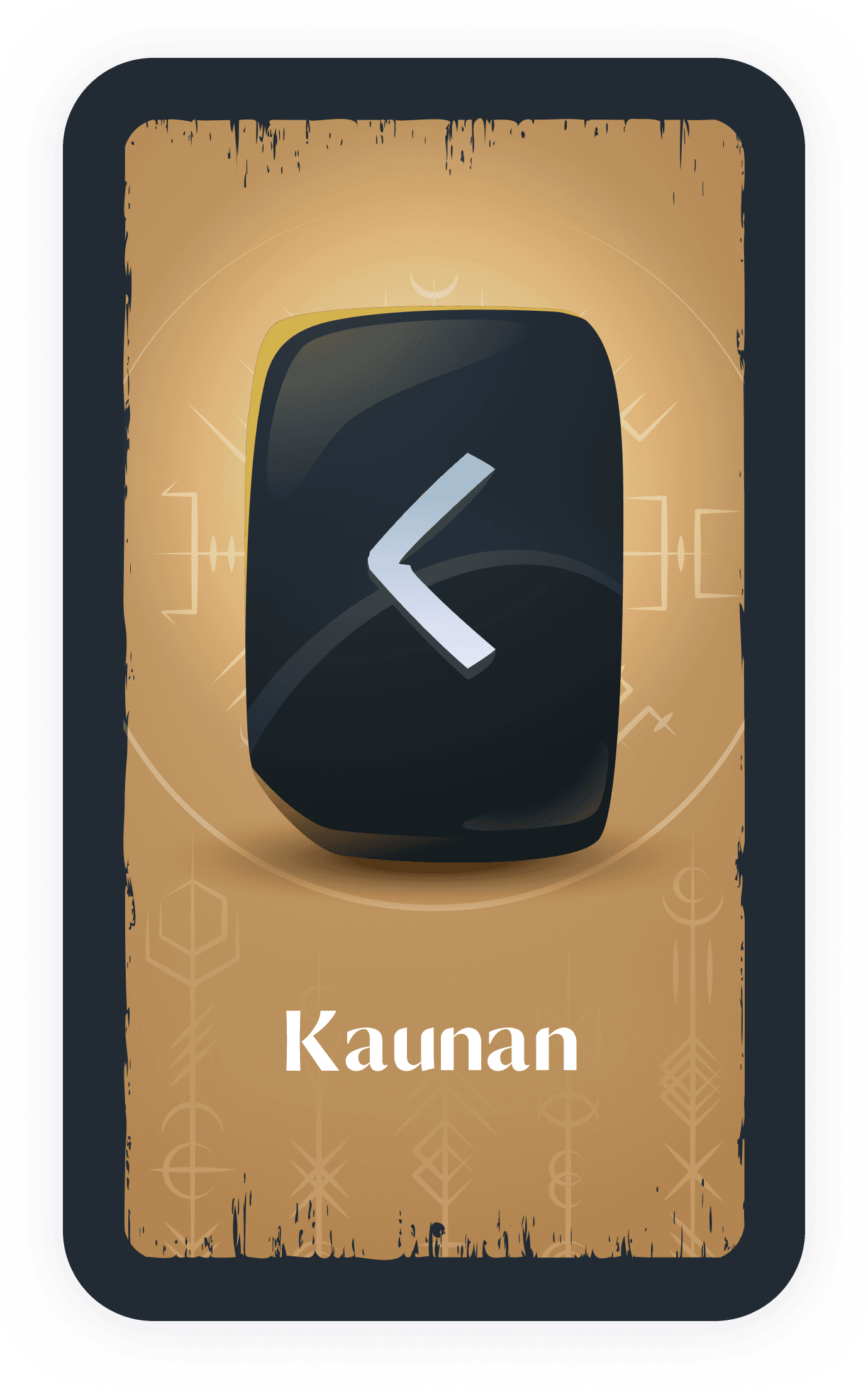
Kenaz is the sixth rune of the Elder Futhark, the k in "futhark". Its name is one of the openly disputed ones: the Old English rune poem calls it a torch, the Norse poems an ulcer. Modern practice almost always takes the torch. This page shows both, and keeps the historical layer apart from the modern one.
What does Kenaz mean?
Kenaz stood for the sound /k/. Two names compete. Kenaz, "torch", is built from the Old English rune name cēn, and it is the name most rune books and this site use. Kaunan, "sore, ulcer", is built from Old Norse kaun, the name both Norse poems agree on, and several scholarly reconstructions prefer it. The app uses Kaunan. They are the same rune.
Nobody can say for certain which sense is older, and the Gothic letter name, chozma, does not settle it. Either way, the concrete world behind the rune is burning — a pale flame in a dark hall, or an inflamed sore. The shape itself is less mysterious: it most likely comes from an Old Italic or Latin letter C.
What do the rune poems say about Kenaz?
All three poems include the rune, and this is where the split between the English and Norse traditions shows most clearly.
- Old English (the Anglo-Saxon futhorc, 8th–9th century): the torch is known to every living person by its pale, bright flame; it burns most often where nobles rest indoors.
- Old Norwegian (c. 13th century, Younger Futhark): ulcer is fatal to children; death makes a corpse pale.
- Old Icelandic (c. 15th century, Younger Futhark): the ulcer is a disease fatal to children, a painful spot and the house of rotting flesh, glossed with the Latin flagella.
The poems are late and describe later rune rows. The Old English poem belongs to the Anglo-Saxon futhorc; the Norse poems to the 16-rune Younger Futhark. They are the best evidence for what the Elder Futhark names meant — and here they disagree outright, with no earlier source to break the tie.
Read together, the stanzas share more than they seem to. Both are about burning, and both use the word pale: the English torch's pale flame, the Norwegian corpse turned pale. Modern readers take the torch because a light in the hall is easier to work with than a dying child, but the darker reading is just as much part of the record.
Kenaz upright meaning
In modern rune reading an upright Kenaz is a rune of controlled fire: knowledge, skill, creativity and the moment something becomes clear. Readers picture the torch carried into a dark hall — light you made and can direct, rather than the wildfire of chance.
- Illumination — understanding, an insight, seeing a situation plainly.
- Craft — skill learned and applied, the smith's fire or the artist's.
- Warmth — passion, energy and the hearth that draws people in.
Kenaz reversed (merkstave) meaning
Drawn upside down, Kenaz is read as the light going out: confusion, a creative block, lost motivation, or something coming to an end. Readers who remember the Norse poems also read it as illness, or a painful situation that needs attention before it spreads.
Reversed readings are a modern convention. The rune poems give one stanza per rune and no inverted counterpart; merkstave meanings come from 20th-century rune books. Many practitioners find them useful — just know which layer you are using.
Kenaz in love and relationships
In a love reading Kenaz is warmth and desire. Upright it can mean a new attraction, rekindled passion, or finally seeing a relationship clearly. Reversed, readers look for a cooling flame, a truth someone is avoiding, or an old hurt still festering.
Kenaz in career and money
At work Kenaz favours skill and craft: learning, teaching, design, any job where expertise shows. Upright it suggests your knowledge is the asset and a problem is about to make sense. Reversed it warns of burnout, a stalled creative project, or working in the dark without the information you need.
Is Kenaz a yes or no rune?
In yes-or-no rune reading, an upright Kenaz is a yes, particularly for questions about learning, creative work or understanding. Reversed, most readers take it as a no, or a sign that you cannot see the situation well enough yet. This is purely modern divinatory practice; there is no historical evidence of runes being read this way.
What is attested and what is modern
| Layer | Kenaz | How solid |
|---|---|---|
| Sound | /k/ | Solid — read in surviving inscriptions |
| Name | Kenaz (torch) or Kaunan (ulcer) | Disputed — English and Norse sources disagree |
| Torch | Old English poem only | Attested, but medieval |
| Ulcer | Norwegian and Icelandic poems | Attested, but medieval |
| Fire, upright, merkstave, yes or no | Modern divination | 20th-century practice |
Kenaz is the sixth rune of Freyr's ætt, after Raidho and before Gebo, the gift. Readers often pair its torch with Sowilo, the sun — light made and light given — and set it against Isa, fire beside ice. For the other disputed names in the row, see Elder Futhark rune meanings.
What does the Kenaz rune mean?
Kenaz stood for the sound /k/. Its name is disputed: the Old English rune poem calls it a torch, the Norwegian and Icelandic poems an ulcer. Modern rune readers almost always use the torch — knowledge, skill, creativity and clarity.
What does Kenaz mean reversed?
In modern practice a reversed (merkstave) Kenaz is read as confusion, a creative block, lost motivation or illness. Reversed meanings are a 20th-century convention; the medieval rune poems give one stanza per rune and no inverted reading.
Is Kenaz the same rune as Kaunan?
Yes. Kenaz is reconstructed from the Old English name cēn, torch; Kaunan from Old Norse kaun, ulcer. Both name the same k-rune, ᚲ. Books choose one depending on which tradition they treat as older.
Why do the Norse rune poems call Kenaz an ulcer?
The Norwegian and Icelandic poems use the Old Norse word kaun, a sore or ulcer, and describe it as fatal to children. Why the English tradition has a torch instead is unknown; both readings are medieval evidence.