
Wunjo Key Facts
What the record shows
- Sound
- /w/
- Ætt
- Freyr's ætt, 8th of 8
- Literal meaning
- Joy, bliss
- Rune poems
- Bliss for one who knows little sorrow and has a good home (Old English); no Norse stanza
- Other names
- Wynn (Old English), uuinne (Gothic letter name); no Old Norse name
In modern rune reading
- Associated deity
- —
- Element
- —
- Yes or No?
- Yes
- Love
- Contentment, harmony, feeling at home together; discontent when blocked
- Career & money
- Satisfying work, team harmony, goals met; dissatisfaction when blocked
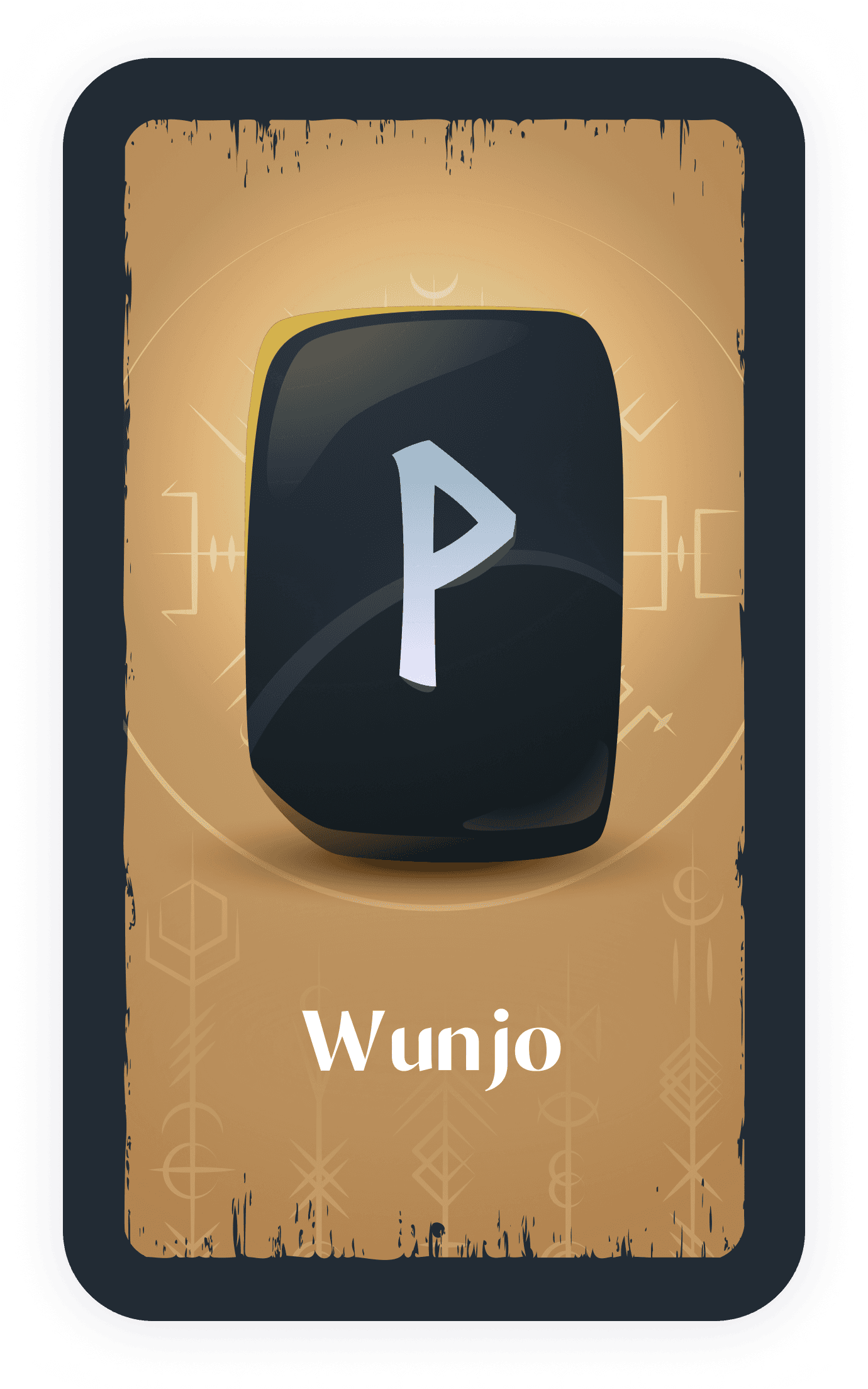
Wunjo is the eighth rune of the Elder Futhark and the last of the first ætt. Its name means joy — not excitement, but the quiet contentment of someone with little to worry about. This page separates what the historical record supports from what modern rune reading has added.
What does Wunjo mean?
Wunjo stood for the sound /w/. The name is reconstructed as Proto-Germanic *wunjō, "joy", from the Old English rune name wynn, "bliss", a relative of German Wonne. The Gothic letter name, recorded as uuinne, is less clear — it has been connected both with a Gothic word for pasture and with one for pain — so the joy reading rests mainly on the English evidence.
Wunjo had an unusually long afterlife. English scribes writing in the Latin alphabet had no good letter for /w/, so they borrowed the rune: the letter wynn, ƿ, runs through Old English manuscripts, including Beowulf, and fell out of use only around 1300, when w replaced it. For centuries a rune sat inside ordinary English spelling.
What do the rune poems say about Wunjo?
Only the Old English poem has a stanza for this rune.
- Old English (the Anglo-Saxon futhorc, 8th–9th century): bliss belongs to the one who knows little of suffering, sorrow or anxiety, and has prosperity, happiness and a good enough house.
- Old Norwegian (c. 13th century): no stanza. The 16-rune Younger Futhark dropped the w-rune, so the Norse poems never name it.
- Old Icelandic (c. 15th century): no stanza either, for the same reason.
The one surviving stanza is late and English. It belongs to the Anglo-Saxon futhorc and a Christian society, and it is the only period comment on this rune's name — evidence for what the word meant, not for how anyone read Wunjo.
Read on its own, the stanza defines joy mostly by absence: little pain, little sorrow, enough to live on and a roof that will do. It is a modest, grounded idea of happiness, and the modern readings that make Wunjo about contentment and belonging rather than ecstasy stay closer to the poem than most.
Wunjo upright meaning
In modern rune reading an upright Wunjo is a rune of wellbeing: contentment, harmony, belonging, and things falling into right relation. Many readers see it as the settled state at the end of the first ætt, after the wealth, strength, struggle, journeys and gifts that come before it.
- Contentment — enough, and knowing that it is enough.
- Harmony — a family, group or team working well together.
- Success felt — a goal reached and actually enjoyed.
Wunjo reversed (merkstave) meaning
Drawn upside down, Wunjo is read as joy withheld: sadness, discontent, not belonging, or harmony breaking into conflict. Some readers take it as a warning against looking for happiness in the wrong place — the poem's good enough house turned into never enough.
Reversed readings are a modern convention. The rune poems give one stanza per rune and no inverted counterpart; merkstave meanings come from 20th-century rune books. Many practitioners find them useful — just know which layer you are using.
Wunjo in love and relationships
In a love reading Wunjo is one of the gentlest runes to see. Upright it points to happiness together, feeling at home with someone, or a relationship settling after a hard stretch. Reversed, readers look for discontent, loneliness inside a relationship, or joy that depends too much on the other person.
Wunjo in career and money
At work Wunjo means satisfaction: a job that fits, a team that works, recognition for a finished project. Upright it suggests effort paying off in more than money. Reversed it points to low morale, a poor fit, or success on paper that does not feel like success.
Is Wunjo a yes or no rune?
In yes-or-no rune reading, an upright Wunjo is a clear yes. Reversed, most readers take it as a no, or a yes that will not make you as happy as you expect. This is purely modern divinatory practice; there is no historical evidence of runes being read this way.
What is attested and what is modern
| Layer | Wunjo | How solid |
|---|---|---|
| Sound | /w/ | Solid — in inscriptions, and kept as the letter ƿ |
| Name and literal meaning | *wunjō, joy | Strong in English; the Gothic name is unclear |
| Joy as the rune's idea | Old English poem only; no Norse stanza | Attested, but one medieval source |
| Harmony and belonging | Modern extension | Close to the poem, but not in it |
| Upright, merkstave, yes or no | Modern divination | 20th-century practice |
Wunjo closes Freyr's ætt, after Gebo, the gift; the next rune, Hagalaz, opens the second ætt with a hailstorm. Readers often pair Wunjo with Jera, the good harvest, and with Sowilo, the sun. For the whole row, see Elder Futhark rune meanings.
What does the Wunjo rune mean?
Wunjo stood for the sound /w/, and its name is reconstructed as *wunjō, joy. The Old English rune poem describes the bliss of someone with little sorrow and a good home; modern readers use it for contentment, harmony and belonging.
What does Wunjo mean reversed?
In modern practice a reversed (merkstave) Wunjo is read as sadness, discontent, alienation or conflict. Reversed meanings are a 20th-century convention; the medieval rune poems give one stanza per rune and no inverted reading.
Is Wunjo related to the letter wynn?
Yes. Old English scribes borrowed the rune into the Latin alphabet as the letter wynn, ƿ, to write the /w/ sound. It appears in Beowulf and many other manuscripts, and fell out of use around 1300.
Why is there no Norse rune poem stanza for Wunjo?
The Norwegian and Icelandic poems describe the 16-rune Younger Futhark, which had dropped the w-rune. Only the Old English poem, written for the Anglo-Saxon futhorc, gives Wunjo a stanza.