
Hagalaz Key Facts
What the record shows
- Sound
- /h/
- Ætt
- Hagal's ætt, 1st of 8
- Literal meaning
- Hail
- Rune poems
- Hail in all three: white grain that melts to water (Old English), coldest grain (Norwegian, Icelandic)
- Other names
- Hægl (Old English), Hagall (Old Norse), haal (Gothic letter name)
In modern rune reading
- Associated deity
- —
- Element
- Ice or water in some systems; no agreed element
- Yes or No?
- No
- Love
- A sudden storm that clears the air; lasting damage in a hard position
- Career & money
- Unexpected disruption, a forced reset; a long crisis in a hard position
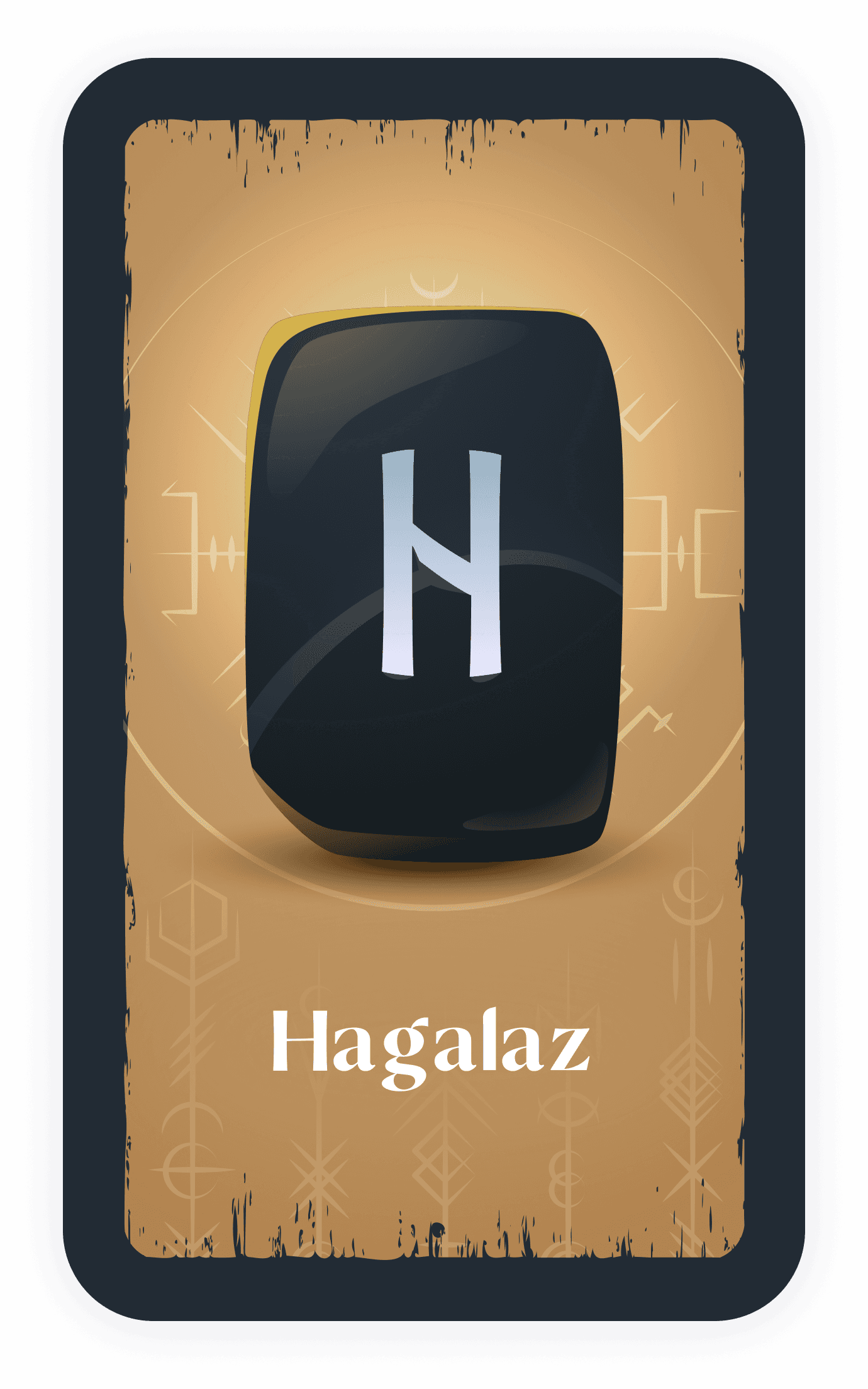
Hagalaz is the ninth rune of the Elder Futhark and the first of the second ætt, which later tradition named after it. Its name means hail, and every rune poem agrees. Modern readers make it the rune of sudden disruption from outside — destructive, but brief. This page keeps the two layers apart and explains why Hagalaz has no reversed form.
What does Hagalaz mean?
Hagalaz stood for the sound /h/. The name is reconstructed as Proto-Germanic *hagalaz or *haglaz, "hail" — the source of Old English hægl, Old Norse hagall and English hail itself. The Gothic letter name was recorded as haal. Of all the names in the row, this is one of the least controversial.
The shape varied more than the name. Scandinavian inscriptions use the single-barred form, ᚺ; continental ones a double-barred form, ᚻ, which the Anglo-Saxon futhorc later adopted; the Younger Futhark uses a star-like ᚼ. For farming communities hail was no metaphor — a few minutes of it could flatten a crop. The name Hagal's ætt comes from much later tradition, borrowed from this rune.
What do the rune poems say about Hagalaz?
All three poems have a stanza for hail, and all three begin by calling it a kind of grain.
- Old English (the Anglo-Saxon futhorc, 8th–9th century): hail is the whitest of grain; it whirls from the vault of heaven, is tossed about by gusts of wind, and then turns to water.
- Old Norwegian (c. 13th century, Younger Futhark): hail is the coldest of grain; Christ created the world of old.
- Old Icelandic (c. 15th century, Younger Futhark): hail is cold grain, a shower of sleet and the sickness of serpents, glossed with the Latin grando, hail.
The poems are late and describe later rune rows. The Old English poem belongs to the Anglo-Saxon futhorc; the Norse poems to the 16-rune Younger Futhark. They are the best evidence for what the Elder Futhark names meant, not a manual for how anyone used Hagalaz in a reading.
Read together, the stanzas treat hail as a grain that falls from the sky and feeds no one. The Old English poem adds the detail modern readers lean on hardest: the storm ends, and the hail becomes water. That is where the idea of Hagalaz as disruption that passes comes from — and it is a fair reading of the stanza.
Hagalaz upright meaning
In modern rune reading Hagalaz is a rune of disruption you did not choose: a sudden event, a crisis, weather in the life sense. Most readers do not treat it as purely bad. Like hail that melts, it is read as destructive but temporary, and sometimes as the shock that clears the way for something new.
- Sudden change — events outside your control arriving all at once.
- Crisis as a test — damage that shows what was weak and what holds.
- Clearing — the storm passes, the ground is reset, work can start again.
Hagalaz reversed: why there is no merkstave
The Elder Futhark Hagalaz, ᚺ, looks the same upside down: two uprights joined by a slanted bar that keeps its angle after a half-turn. A drawn tile cannot show a reversed position, so a merkstave Hagalaz is not a distinct reading, even where a list prints one. Readers who want a harder shade take it from context — among difficult runes, Hagalaz is read as disruption without the clearing: loss, stalled recovery, damage that lingers.
Reversed readings are a modern convention, and symmetrical runes expose it. The rune poems give no inverted stanza for any rune, and several runes look identical upside down — Hagalaz, Gebo, Isa and Jera among them — so for them "reversed" is not defined.
Hagalaz in love and relationships
In a love reading Hagalaz signals a storm: an argument, an unwelcome revelation, outside pressure on the relationship. Readers usually add that storms pass, and a couple may come through it clearer about what they want. In a hard position it is read as damage that will take real time to repair.
Hagalaz in career and money
At work Hagalaz points to disruption beyond your control: a restructuring, a lost client, a market shift, a plan broken by events. The modern advice is to shelter rather than fight the weather, and rebuild when it clears. In a difficult spread readers see a crisis with a longer tail.
Is Hagalaz a yes or no rune?
In yes-or-no rune reading Hagalaz is generally a no, or a "not now — conditions are against you". Because it has no reversed form, orientation does not change the answer. This is purely modern divinatory practice; there is no historical evidence of runes being read this way.
What is attested and what is modern
| Layer | Hagalaz | How solid |
|---|---|---|
| Sound | /h/ | Solid — read in surviving inscriptions |
| Name and literal meaning | *hagalaz, hail | Strong — every source agrees |
| Hail as grain that turns to water | In the rune poems | Attested, but medieval |
| No reversed form | Symmetrical shape | A fact of the glyph |
| Disruption that passes, yes or no | Modern divination | 20th-century practice |
Hagalaz opens Hagal's ætt, following Wunjo, the joy that closed the first; next comes Naudhiz, need. With Naudhiz and Isa it begins a run of hard-weather runes, and readers compare it with Thurisaz, the other rune of disruptive force. For the whole row, see Elder Futhark rune meanings.
What does the Hagalaz rune mean?
Hagalaz stood for the sound /h/, and its name is reconstructed as *hagalaz, hail. All three rune poems describe hail, and modern rune readers use it for sudden disruption from outside — destructive, but usually temporary.
Does Hagalaz have a reversed meaning?
Not a distinct one. The Elder Futhark Hagalaz, ᚺ, looks the same upside down, so it cannot be drawn reversed. Readers take a harder reading from context instead — disruption that lingers rather than clears.
Is Hagalaz a bad rune?
Most readers treat it as challenging rather than bad. The Old English rune poem ends with the hail melting into water, and modern practice reads Hagalaz as a storm that passes and sometimes clears the way for change.
Why is the second ætt called Hagal's ætt?
Because it begins with Hagalaz, hail. The division of the Futhark into three groups of eight is old — it appears on the Vadstena bracteate around 500 CE — but naming the groups comes from much later tradition.